Connect with us

Accounting

Bush & Associates, KMPG take top spots for new SEC audit clients in 2024

Published

on

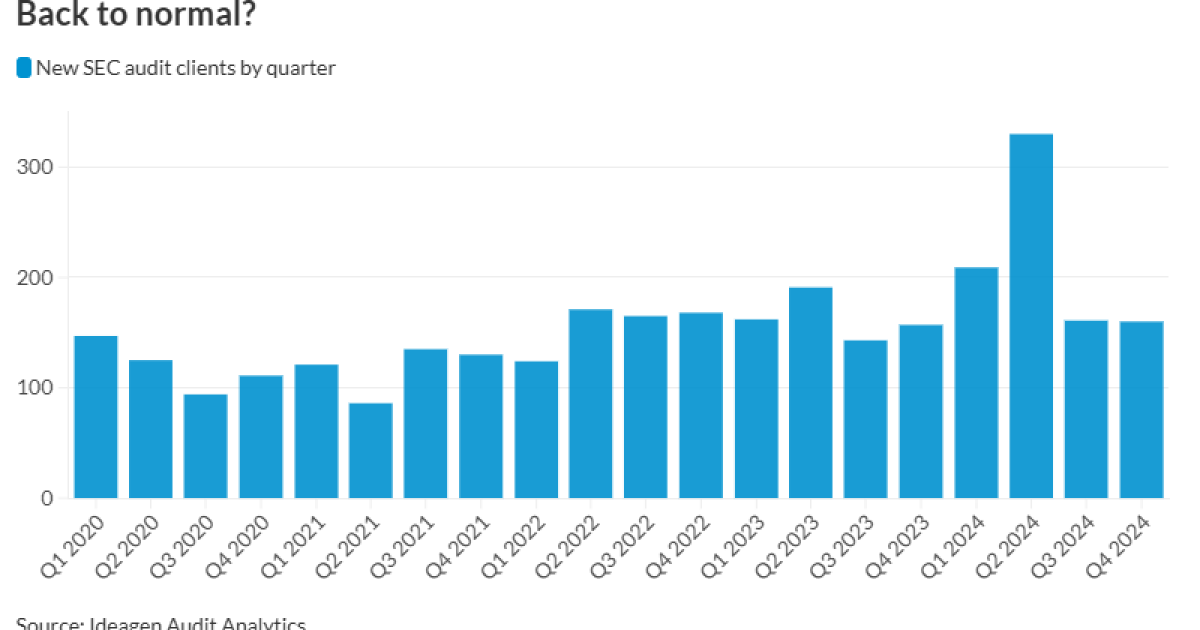
A small firm in Henderson, Nevada, Bush & Associates, topped the list of those with the most new Securities and Exchange Commission audit clients in 2024, followed by Big Four firm KPMG — but the audit firm that had what was likely the biggest impact on the market isn’t on the list at all.

Bush & Associates added 32 new SEC clients and netted 30 over the course of last year, while KPMG added 39 and netted 23. (See “Net engagement leaders.”)

Almost half of Bush’s new clients — 14 out of 32 — came from one-time star BF Borgers, which was permanently suspended from practice by the commission in May, and whose demise amid a welter of accusations of improper practice sent a huge number of clients out into the market seeking new auditors.

A significant number of firms picked up clients that had been with Borgers, including:

  • Michael Gillespie & Associates, with 15 Borgers clients;
  • Boladale Lawal & Co., with 12;
  • Fruci & Associates, with 10;
  • Olayinka Oyebola & Co., with 9;
  • Astra Audit, BCRG Group, and M&K CPAs, with six each; and,
  • BartonCPA and Beckles & Co., with five each.

BF Borgers wasn’t the only firm whose clients were looking for new homes: Astra Audit picked up 13 new engagements in 2024 from Accell Audit & Compliance, which closed down its SEC practice, and the exit of Morison Cogen from the SEC market helped Stephano Slack pick up 11.

Most of these firm departures didn’t have much of an impact on the largest auditors (see “2024 total gains & losses), but the combination of Top 10 Firms Marcum and CBIZ did shake out a large number of clients who were picked up by a wide range of firms.

chart visualization

Clients by filing status, and more

In terms of clients by filing status, KPMG led among new large accelerated filers, while Bush & Associates took the lead among non-accelerated filers and small reporting companies. (See “Audit leaders.“) Deloitte took on the most accelerated filers in 2024.

As you might expect, KPMG topped the league tables for new market capitalization audited, with the biggest contribution coming from Grayscale Bitcoin Trust’s $25.5 billion, as well as for new assets audited, with insurance underwriter Everest Group accounting for $49.3 billion and Grayscale Bitcoin Trust for $26.4 billion. It came in second for new audit fees, energy distribution and services company UGI Corp. the biggest slice, at $9 million, and all the rest of its clients scattered below that. (See “New client leaders.)

Deloitte was No. 1 for new audit fees, with dental instrument and supply provider Dentsply Sirona Inc. coming in at $11.8 million and 3D printing company 3D Systems Corp. at $10 million, and all its other clients below that. The firm came in second for new assets audited, with insurance holding company American National Group’s $79.9 billion and cruise line Carnival’s $49 billion standing out.

Finally, PwC took second in new market cap audited, with a big boost from semiconductor manufacturer Global Foundries Inc.’s $32.1 billion.

Data for the quarterly rankings are provided by Ideagen Audit Analytics, a premium online intelligence service delivering audit, regulatory and disclosure analysis. Reach them at (508) 476-7007, [email protected] or www.auditanalytics.com

Continue Reading

Accounting

AI-Driven Automation and Continuous Accounting Frameworks

Published

on

The accounting profession is undergoing a fundamental structural transition as enterprise finance departments shift from periodic month-end closes toward automated continuous accounting models. By integrating specialized machine learning algorithms directly into enterprise resource planning (ERP) platforms, chief accounting officers are transforming financial reporting from a retrospective exercise into a real-time operational asset.

The Shift from Periodic Close to Continuous Financial Reporting
Traditional accounting workflows heavily relied on manual data reconciliation, spreadsheet calculations, and multi-week closing cycles at the end of each fiscal period. In contrast, continuous accounting frameworks utilize automated software agents to process, validate, and post transactional data in real time as business activities occur.

Automated bank reconciliation tools cross-reference incoming bank feeds, invoice records, and purchase orders automatically. By resolving transactional variances instantly throughout the month, corporate accounting teams eliminate the traditional workload spikes associated with quarterly and annual closes.

Machine Learning in Audit Trails and Anomaly Detection
Advanced natural language processing (NLP) and machine learning tools are redefining internal audit and financial control environments. Automated systems analyze 100% of general ledger entries, identifying anomalous transactions, duplicate payments, and unauthorized journal entries in real time.

Rather than relying on random statistical sampling, corporate internal auditors can focus their attention on high-risk flags automatically surfaced by algorithmic monitoring platforms. This continuous risk assessment strengthens internal controls over financial reporting (ICFR) and significantly reduces fraud risk.

Evolving Roles for Accounting Professionals
As routine data entry and manual reconciliation tasks become fully automated, the skill set required for accounting professionals is shifting toward data analysis, system design, and strategic business advisory.
– Systems Governance: Accountants are increasingly responsible for monitoring algorithmic accuracy and managing data integration pipelines.
– Business Partnership: Finance professionals leverage real-time financial dashboards to advise operational leaders on margin management and working capital allocation.
– Regulatory Compliance Management: Accounting teams utilize automated platforms to ensure compliance with dynamic tax codes and international accounting standards.

Core Implementation Recommendations
1. Deploy Automated Reconciliation Tools: Integrate continuous transaction processing modules into existing enterprise ERP architectures.
2. Establish Algorithmic Governance Controls: Implement strict internal testing protocols to ensure automated accounting rules comply with GAAP/IFRS standards.
3. Reskill Accounting Teams: Invest in training finance staff on data analytics, workflow automation, and predictive financial modeling.

Continue Reading

Accounting

Global ESG Reporting Standards and Double Materiality Compliance

Published

on

Corporate accounting departments face expanding reporting expectations as international sustainability disclosure standards achieve regulatory enforcement across major global jurisdictions. Chief Accounting Officers (CAOs) and corporate controllers are establishing rigorous internal accounting controls to treat Environmental, Social, and Governance (ESG) metrics with the same data precision, auditability, and governance as traditional financial statements.

Regulatory Harmonization Under Global Sustainability Frameworks
The implementation of standardized sustainability reporting frameworks—notably rules established by international sustainability accounting boards—has created unified expectations for public and large private enterprises. Corporations must report standardized metrics covering greenhouse gas emissions (Scope 1, 2, and material Scope 3), energy utilization, workforce demographics, and supply chain governance.

In Europe and other participating international jurisdictions, double materiality principles are mandatory. Under double materiality, organizations must report both how external sustainability risks impact corporate financial performance, and how internal corporate operations affect surrounding environmental and social structures.

Integrating Sustainability Metrics into Core ERP Systems
To provide auditable non-financial data, enterprise organizations are integrating specialized carbon accounting and ESG management platforms directly into core ERP systems. Automated data collectors capture energy utility invoices, logistics fuel consumption metrics, and vendor compliance records in real time.

Establishing automated, traceable data pipelines ensures that non-financial reporting is supported by clear audit trails. This structured approach allows external financial auditors to provide reasonable assurance on sustainability disclosures during annual corporate reporting cycles.

Financial Impacts and Capital Market Disclosure
Accurate ESG reporting directly influences corporate cost of capital and institutional credit ratings. Commercial lenders and institutional asset managers systematically incorporate sustainability metrics into risk pricing models. Companies that demonstrate transparent, verifiable progress in operational energy efficiency and climate risk mitigation benefit from expanded access to green bond markets and lower debt pricing.

Action Steps for Accounting Leadership
1. Implement Double Materiality Frameworks: Conduct comprehensive assessments to identify material financial and operational sustainability metrics.
2. Build Auditable Non-Financial Data Pipelines: Automate ESG data collection within core accounting software to ensure data integrity.
3. Align Sustainability with Annual Financial Filings: Prepare non-financial disclosures concurrently with financial statements to satisfy regulatory audit expectations.

Continue Reading

Accounting

Modernizing Internal Controls: Machine Learning and Continuous Monitoring in Auditing

Published

on

Internal audit departments and corporate risk managers are modernizing internal control frameworks by shifting from periodic sampling techniques to continuous monitoring and machine learning analytics. As operational data volumes increase across enterprise organizations, automated control testing ensures financial integrity, prevents corporate fraud, and streamlines annual audit engagements.

The Limitation of Periodic Audit Sampling
Historically, internal and external auditors evaluated internal controls by reviewing random samples of financial transactions—often analyzing less than five percent of total ledger entries. In complex enterprise environments, periodic sampling methods carry inherent risks of overlooking localized financial misstatements, unauthorized disbursements, or operational control breakdowns.

In 2026, progressive internal audit functions are utilizing automated continuous monitoring platforms that evaluate one hundred percent of financial transactions in real time. Continuous control auditing systems continuously monitor general ledger entries, procurement approvals, and expense reimbursements across all operating subsidiaries.

AI-Powered Fraud Detection and Anomaly Identification
Machine learning models trained on historical corporate financial data excel at identifying subtle transactional anomalies that indicate potential fraud or operational error. Automated systems instantly flag duplicate invoice payments, unapproved vendor creation, unusual journal entry timing, and unauthorized override of authority thresholds.

When an anomaly is detected, the automated auditing platform generates an instant risk alert, allowing internal audit teams to investigate root causes immediately. Early detection prevents minor operational errors from escalating into material weaknesses in financial reporting.

Streamlining External Audit Preparation
Continuous internal control monitoring delivers significant benefits during annual external financial audits. External audit firms can review continuous audit logs and automated control testing documentation, reducing the time required for manual field testing.

This integrated approach lowers overall audit compliance fees, reduces administrative burdens on corporate accounting staff, and provides senior management and audit committees with real-time visibility into the organization’s overall risk profile.

Core Implementation Guidelines
1. Transition to 100% Data Testing: Replace legacy sampling methods with automated continuous audit monitoring systems.
2. Deploy Anomaly Detection Algorithms: Implement machine learning models to identify unauthorized transactions and operational control overrides.
3. Align Internal and External Audit Workflows: Coordinate continuous control testing protocols with external auditors to optimize annual compliance cycles.

Continue Reading

Trending