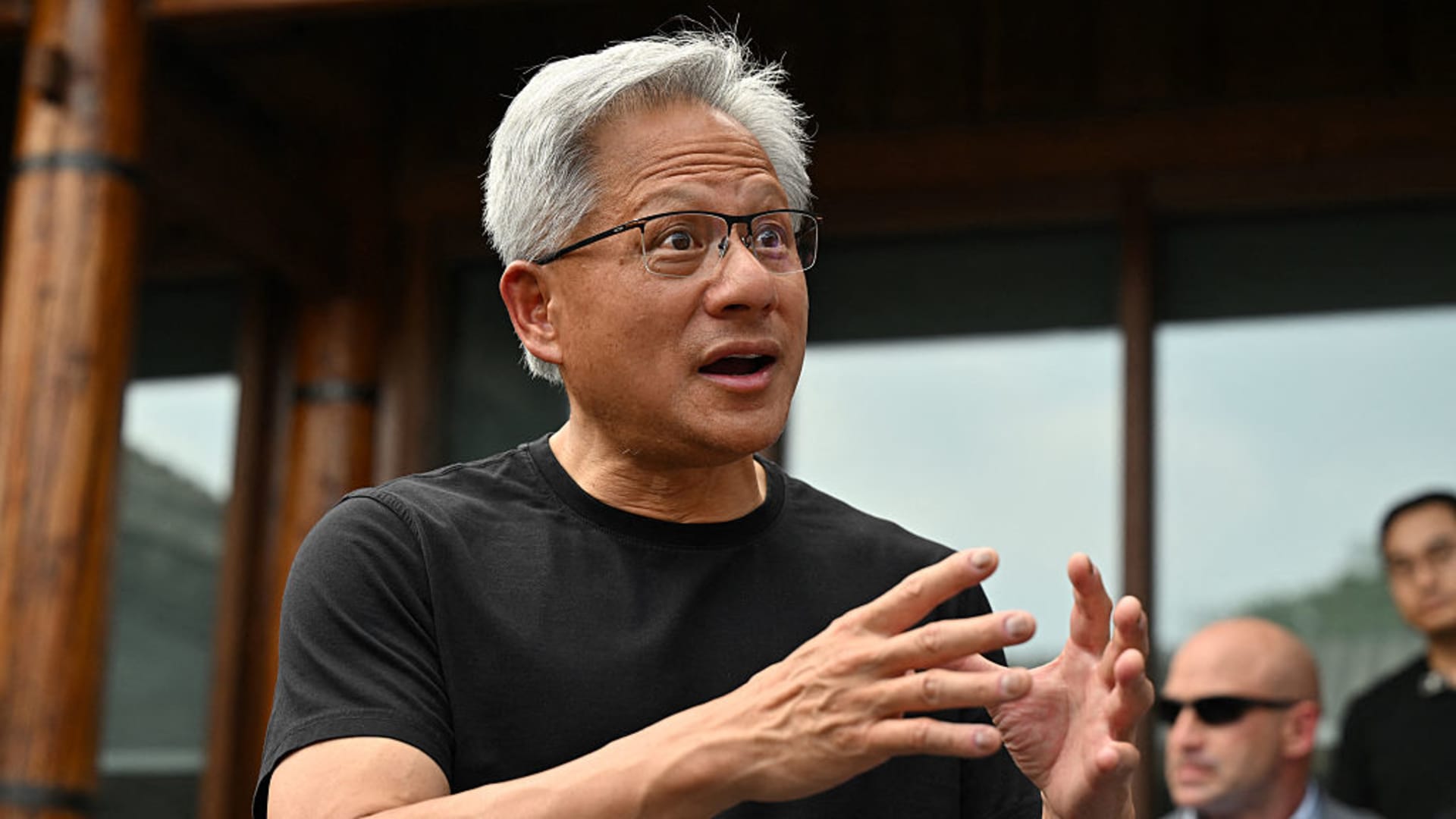
Nvidia CEO Jensen Huang speaks to journalists as he arrives for a press conference at a hotel in Beijing on July 16, 2025.
Adek Berry | Afp | Getty Images
BEIJING — Nvidia CEO Jensen Huang was all smiles and compliments as he made his third trip to China in just about half a year.
As the leader and co-founder of the world’s first, newly-minted $4 trillion market cap company, Huang had particular reasons to be happy when he met the press on Wednesday: Nvidia expected it would be able to resume sales of its less advanced H20 artificial intelligence chips to China after a three-month pause.
“Many of my competitors are my friends,” he noted.
Huang said his understanding was that allowing Nvidia chips into China was part of an exchange with the U.S. for Beijing to release critically needed rare earths. CNBC has reached out to the White House for comment.
Wearing his iconic black leather jacket, Huang walked into the sunny courtyard of the Mandarin Oriental hotel about 15 minutes earlier than scheduled and took multiple questions in the nearly 90-degree Fahrenheit weather.
“Only in China can we do this out in the sun!” he said.
Then he realized the press conference was supposed to be held inside an air-conditioned room.
“What are we doing out here? Why didn’t somebody say so?” he said.
He was swarmed by local reporters asking for signatures of books and T-shirts. “Who needs an autograph? I’ll do it while I’m listening.”
Here are the highlights of what he said over 90 minutes:
Whom he met
Huang said he had a “wonderful meeting” with Chinese Vice Premier He Lifeng, and clarified that the discussions did not include China’s restrictions on battery technology or rare earths.
Earlier in the week, he met with Xiaomi founder and CEO Lei Jun, whom he labelled as “a brilliant business person.” He said the two discussed artificial intelligence for large language models, autonomous driving and robotics.
Xiaomi uses Nvidia’s automotive chips in its electric cars.
Huang said he told U.S. President Donald Trump about his planned voyage to China during a meeting with the White House leader last week to celebrate Nvidia’s $4 trillion market cap.
“[Trump] said, ‘Have a great trip,'” Huang said.
Export controls
Nvidia on Tuesday said it expected to resume its H20 chip shipments to China soon following assurances from the U.S. government. The company was forced to halt such sales in April due to new U.S. requirements at the time.
“In terms of the H20 ban and the lifting of the ban, it was completely in control of the U.S. government and China government. The discussion has nothing to do with me,” Huang said, rejecting the idea that he had played a part in changing Trump’s mind.
“It’s my job to inform the president about what I know very well, which is the technology industry, artificial Intelligence, the developments of AI around the world,” he said.
Huang emphasized Nvidia complies with the final policy decision and that tariffs are just something the company has to “adapt to.”
What’s next for Nvidia in China
U.S. chip restrictions nearly halved Nvidia’s market share in China, Huang said in May. Due to the U.S. export controls on China, the company said it missed out on $2.5 billion in sales during the April quarter and will likely take another $8 billion hit in the July quarter, pegging its sales at $45 billion over the period.
The U.S. effectively banned Nvidia from selling its most advanced chips to China back in 2022.
“I hope to get more advanced chips into China than the H20,” Huang said in response to a CNBC question, “and the reason for that is because technology is always moving on. It’s not like wood.”
He stressed that, years from now, there will be better and better technology available, adding, “I think it’s sensible that whatever we’re allowed to sell in China will continue to get better and better over time as well.”
But Huang would not give a definitive answer about how many orders Nvidia had received, or when the company would restart local sales of its chips — which he acknowledged were not the company’s best, but which could still train AI models.
He said the U.S. government was still processing the licenses for Nvidia to sell the chips to China, and that the company would need to restart its supply chain — a process he indicated could possibly take nine months.
Huawei
Huang also discussed the outlook for competing Chinese tech giant Huawei, which has been impacted by U.S. sanctions that precede the export controls on Nvidia.
“Anyone who discounts Huawei and anyone who discounts China’s manufacturing capability is deeply naïve,” Huang said, pointing also to how Huawei has “excellent chip design” and their own connected cloud system.
“They can go to market all by themselves.”
Underpinning Huawei’s AI model capabilities is an entire tech system that doesn’t rely on any of Nvidia’s chips or tools. Instead, Huawei has developed its own Ascend chips, which works with the company’s “CANN” system that acts as an alternative to Nvidia’s CUDA. It has also built an AI-specific cloud computing system called CloudMatrix that launched last year.
Asked about indications that Huawei’s AI chip systems are still challenging for many developers to switch over to, Huang said, “That’s just a matter of time.”
He said “the important thing to realize I’ve been doing this for 30 years, they’ve been doing it for a few, and so the fact they’re already on the dance floor tells you something about how formidable they are.”
China’s AI
Huang rained down praise on Chinese AI models, as he had during a speech Wednesday morning at the opening ceremony of the high-profile supply chain expo in Beijing.
“The Chinese models, DeepSeek, Qwen, Kimi, are excellent,” he said, referring to the breakthrough from a Chinese startup, Alibaba’s model and another one from an Alibaba-backed startup Moonshot.
“I think over time it will be increasingly less important which one of the models are the smartest,” he said. “It’s going to be which one of the models are the most useful.”
China-developed DeepSeek shocked global investors in January with the release of an AI model that undercut OpenAI on development and operating costs. It’s not clear how DeepSeek managed to develop the model under broad U.S. chip restrictions on China, but the startup’s parent, High-Flyer, reportedly stockpiled Nvidia chips.
One aspect that Huang said he particularly appreciated about Chinese AI models was that they are open source, making them available for people to download for free and use on their own computers.
He said many companies in many countries downloaded DeepSeek R1 — “99%” of people — to use it locally for healthcare, robotics, imaging and other applications.
As Huang was about to end the press conference, a reporter asked whether he would come back to China again this year.
A turbulent week in the U.S. Treasury market prompted the Treasury Department to sharply increase the size of its long-term debt buyback program, as bond prices fell even while equity markets pushed toward record highs. The divergence has drawn attention from fixed-income strategists who see it as a signal of underlying investor unease about federal borrowing levels.
What Happened This Week
U.S. Treasury Secretary Scott Bessent told CNBC on Thursday, August 20, 2026, that the Treasury had doubled the size of its long-term debt buyback operations, moving from roughly $2 billion to at least $4 billion per operation. Bessent indicated the figure could climb further, saying “we’re going to increase the size of the buyback,” and noted the accelerated pace could exceed the announced $4 billion threshold per issue.
Buybacks allow the Treasury to repurchase outstanding government bonds directly from the market, which can help support prices and dampen yield volatility during periods of stress. The expanded program came as stocks staged a late-week recovery: the S&P 500 and Russell 2000 both advanced on Friday, August 21, even as Treasuries logged mild losses, according to Bloomberg market data.
Why Bond and Equity Markets Are Diverging
Capital.com senior market analyst Daniela Hathorn described the week’s dynamic as markets “ending the week on a softer tone after the relative calm of early August was disrupted by renewed pressure in global bond markets, another rise in oil prices, and growing uncertainty around the Federal Reserve’s next move.” She noted that higher long-term borrowing costs are increasingly challenging elevated equity valuations, even as U.S. equities pull back modestly from record highs.
This divergence — equities near record levels while bonds sell off is unusual and reflects two different sets of investor concerns. Equity investors have remained focused on corporate earnings strength, particularly from large technology companies ahead of Nvidia’s closely watched August 26 earnings report. Bond investors, by contrast, are more directly exposed to concerns about the scale of federal borrowing, highlighted this week by the national debt crossing the $40 trillion threshold for the first time.
The Fed and Treasury “Working in Opposite Directions”
Wilmington Trust senior bond portfolio manager Wil Stith told Yahoo Finance that current conditions reflect “the Fed and the Treasury basically working in sort of opposite directions,” adding that the imbalance will likely require the Federal Reserve which he described as having “the larger sandbox” to adjust the federal funds rate rather than relying on Treasury market interventions alone to manage yields.
Notably, the bond market’s reaction to the Treasury’s buyback expansion was relatively muted; strategists described the move as being largely absorbed without a major rally, suggesting the underlying pressure on yields stems from factors, such as inflation persistence and debt sustainability concerns, that a buyback program alone cannot resolve.
What Comes Next
Markets are now looking to two major events in the days ahead: Nvidia’s earnings report on Wednesday, August 26, and the Federal Reserve’s Jackson Hole Economic Symposium, running August 27-29. This will be the first Jackson Hole gathering under new Fed Chair Kevin Warsh, whose public communication style and policy signals remain less established than his predecessors’, according to market commentary from Regards of Wall Street.
For investors, the key metrics to watch are the size and frequency of future Treasury buyback operations, movements in the 10-year Treasury yield, and any policy signals from Warsh’s keynote address. Continued yield volatility alongside record equity valuations would suggest the market imbalance identified this week has not yet been resolved.
The global banking system is undergoing a comprehensive modernization of cross-border payment infrastructure. Driven by real-time settlement networks, open banking APIs, and interoperable messaging standards, financial institutions and multinational corporations are eliminating multi-day delays and reducing transaction costs associated with legacy international wire transfers.
Transition to Real-Time Gross Settlement Networks
Historically, international business-to-business (B2B) payments relied on complex correspondent banking relationships involving intermediary fees and processing delays. In 2026, the widespread adoption of ISO 20022 messaging protocols alongside interconnected Real-Time Gross Settlement (RTGS) systems allows direct, end-to-end processing of cross-border transfers.
Commercial banks are providing corporate clients with continuous, 24/7 payment clearing capabilities. Real-time transaction confirmation and automated FX rate locking allow international businesses to settle cross-border trade obligations within minutes, significantly reducing counterparty risk.
Central Bank Digital Currency (CBDC) Interoperability
Wholesale Central Bank Digital Currency (CBDC) pilot initiatives are reaching operational maturity across several key financial centers. Collaborative multi-CBDC platforms enable participating central banks and commercial institutions to settle foreign exchange and international trade transactions directly on shared distributed ledgers.
These wholesale digital currency networks eliminate traditional clearinghouse delays and minimize foreign exchange slippage. Enterprise treasury departments benefit from enhanced liquidity management, as cross-border cash balances can be deployed and repatriated instantaneously.
Corporate Treasury Transformation
For enterprise treasurers, instant cross-border settlement transforms cash management strategies:
– Working Capital Optimization: Reduced transaction float allows companies to lower precautionary cash reserves and optimize short-term liquidity investments.
– Automated Reconciliation: Enriched data formats embedded in ISO 20022 payment messages streamline automated general ledger posting and invoice matching.
– Reduced Processing Overhead: Account-to-account (A2A) real-time clearing bypasses costly intermediary correspondent banking fees.
Strategic Financial Priorities
1. Upgrade Treasury Systems: Ensure internal core enterprise software supports real-time ISO 20022 payment messaging standards.
2. Leverage Instant Clearing Rails: Utilize direct payment networks to lower cross-border transaction fees and eliminate settlement delays.
3. Evaluate Multi-Currency Liquidity: Modernize liquidity management frameworks to capitalize on 24/7 real-time settlement capabilities.
The global private credit market has solidified its role as a fundamental pillar of enterprise finance, expanding rapidly across middle-market lending, asset-backed finance, and infrastructure financing. As non-bank financial institutions capture a larger share of corporate debt origination, global regulatory bodies are increasing oversight to evaluate market transparency and systemic risk interconnections.
Growth Drivers in Direct Lending
Direct lending platforms have continued to attract substantial institutional allocations from pension funds, sovereign wealth entities, and insurance companies seeking attractive risk-adjusted yields. Private debt funds offer corporate borrowers customized financing structures, faster execution timelines, and confidentiality compared to syndicated loan markets.
In 2026, private credit managers are increasingly financing larger corporate transactions, providing multi-billion-dollar credit facilities for buyout deals and corporate restructurings. The flexibility of private debt contracts—featuring unitranche pricing and tailored covenant packages—has made direct lending the preferred capital source for middle-market enterprise sponsors.
Regulatory Scrutiny and Systemic Risk Assessment
The rapid growth of non-bank intermediation has drawn heightened scrutiny from financial regulators in North America and Europe. Because private debt agreements are negotiated privately without public exchange disclosures, central banks are evaluating potential vulnerabilities related to asset valuation consistency and fund liquidity profiles.
Regulatory agencies are introducing guidelines aimed at improving reporting standards for private investment vehicles managing institutional assets. Key focus areas include monitoring leverage ratios within private credit funds and evaluating indirect credit exposures between commercial banking institutions and private debt funds.
Navigating Elevated Refinancing Costs
With benchmark interest rates remaining elevated, private debt borrowers face higher debt service obligations on floating-rate credit facilities. Financial advisory firms report an increase in proactive liability management strategies, including payment-in-kind (PIK) interest options, equity infusions from sponsors, and covenant modifications.
Private credit managers with deep operational capabilities are actively working alongside portfolio companies to optimize working capital and maintain cash flow coverage ratios during periods of higher borrowing costs.
Key Financial Takeaways
1. Mainstream Asset Class: Private credit has expanded beyond niche alternative asset status into a core corporate finance solution.
2. Enhanced Transparency Standards: Regulatory frameworks are evolving toward greater disclosure requirements for private debt managers.
3. Proactive Risk Management: Lenders and sponsors must prioritize debt sustainability and active portfolio monitoring amid high benchmark rates.









 Economics1 week ago
 Economics1 week ago
 Economics4 days ago
 Stock News4 days ago
 Technology1 week ago
 Economics4 days ago
 Leaders3 days ago
 Economics3 days ago