Connect with us

Finance

Sen. Warren says Fed nominee Kevin Warsh would be Trump rubber stamp

Published

on

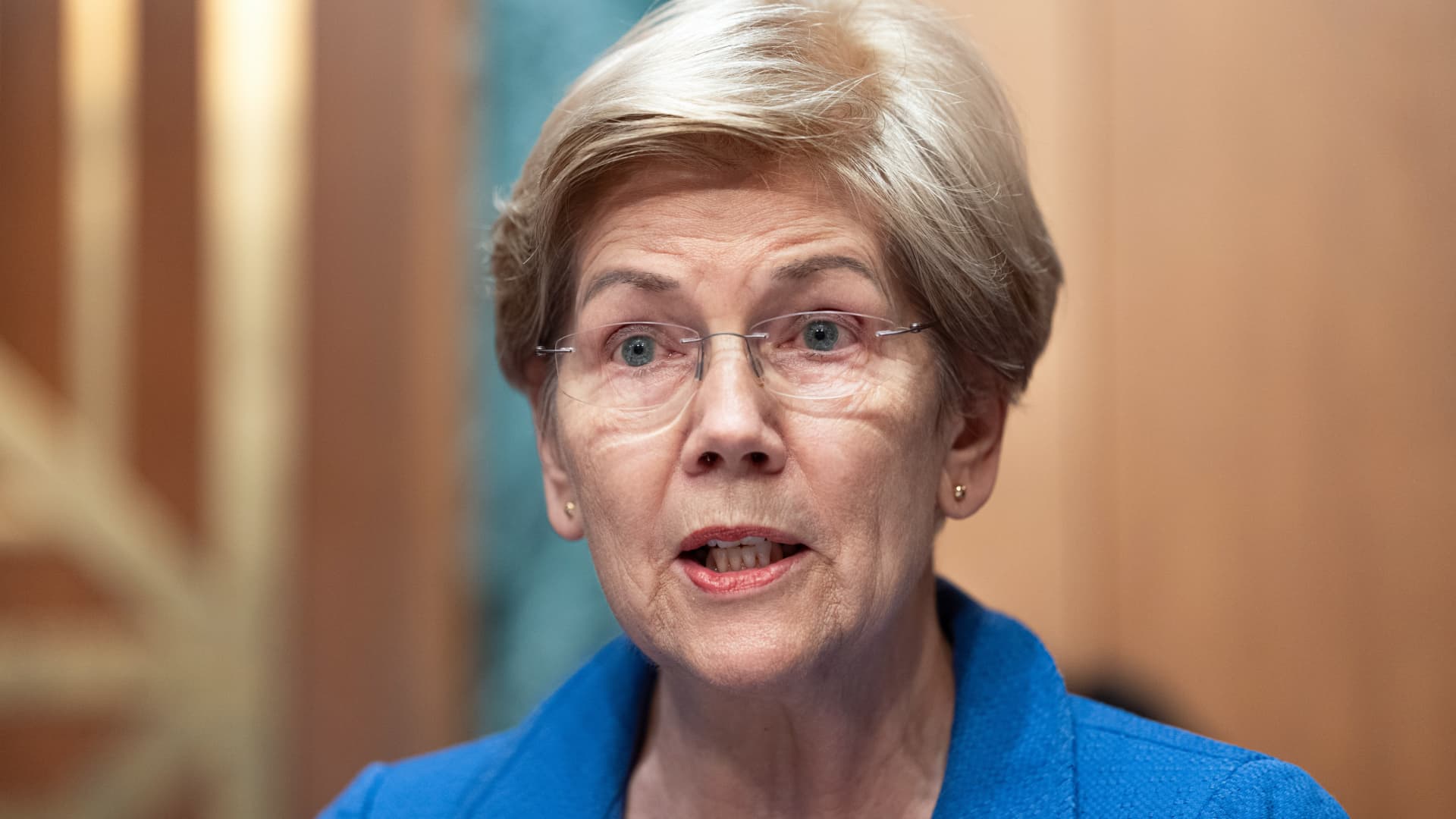
Senator Elizabeth Warren, a Democrat from Massachusetts and ranking member of the Senate Banking, Housing, and Urban Affairs Committee, during a hearing in Washington, DC, US, on Thursday, March 26, 2026.

Aaron Schwartz | Bloomberg | Getty Images

Sen. Elizabeth Warren sent a blistering letter to Federal Reserve chair nominee Kevin Warsh on Thursday, predicting he would serve as a “rubber stamp for President Trump’s Wall Street First Agenda,” and accusing him of having learned “nothing from your failures” during a prior stint at the central bank.

Warren, D-Mass, in the letter reported first by CNBC, told Warsh that his record as a member of the Fed’s Board of Governors from 2006 until 2011 — which included the 2008-09 financial crisis and Great Recession — “should disqualify you from a promotion.”

“But President Donald Trump has vowed that ‘anybody that disagrees with’ him ‘will never be the Fed Chairman,’ ” Warren noted.

“And you, apparently, have passed his test,” she added.

“As Fed Chair, you will be responsible for directing economy-altering policies that have serious
consequences for American workers and communities,” Warren wrote. “However, your track record leading up to, during, and after the 2008 financial crisis raises significant concerns about your ability to do so.”

The letter, which CNBC obtained before it was publicly released, asked Warsh pointed, detailed questions about 10 different subject areas to be answered for his confirmation hearing at the Senate Banking Committee, where Warren is the ranking Democrat.

But those queries were buried at the bottom of what reads as a scathing, eight-page indictment of his tenure at the Fed, and what she called his advocacy “against tougher safeguards intended to prevent big bank failures and taxpayer bailouts” after he left the central bank.

“I write to better understand what, if anything, you’ve learned from your failure to prioritize American families over Wall Street before, during, and after the 2008 financial crisis while serving as a member of the Board of Governors of the Federal Reserve System,” Warren said in the letter’s first sentence.

“Rather than implementing policies to improve the lives of the American public, you ignored the obviously excessive risk-taking on Wall Street; worked tirelessly to bail out large financial institutions after their bets blew up the economy; and advocated for policies that would have further harmed the millions of Americans who lost their jobs, were thrown out their homes, and saw their life savings evaporate,” she continued.

Warsh declined to comment on the letter.

Read more CNBC politics coverage

Warsh’s nomination is in limbo as Warren’s fellow Banking Committee member, Sen. Thom Tillis, R-N.C., has said he would effectively block the nomination from being considered by the full Senate until a criminal investigation of Fed Chair Jerome Powell is resolved.

Jeanine Pirro, the U.S. attorney for the District of Columbia, has indicated she has no intention of dropping that probe.

Pirro’s office is seeking to reverse a ruling on March 11 by a federal judge in Washington, blocking subpoenas issued to the Fed as part of its investigation of Powell, which is purportedly focused on cost overruns of the pricey renovation of the Fed’s headquarters and testimony about that project to the Banking Committee.

District Court Judge James Boasberg, in his order quashing those subpoenas, wrote, “There is abundant evidence that the subpoenas’ dominant (if not sole) purpose is to harass and pressure Powell either to yield to the President or to resign and make way for a Fed Chair who will.”

Trump has repeatedly, and unsuccessfully, pressured Powell and the entire Board of Governors to cut interest rates more quickly and deeply than they have since Trump reentered the White House in January 2025.

Powell earlier in March said he would remain as chair pro tem if Warsh is not confirmed by May, when Powell’s term as chair expires.

In her letter to Warsh on Thursday, Warren said that when he began his service on the Board of Governors, there were “warning signs of the coming crisis” in the subprime home-lending market.

“Yet rather than using the Fed’s powerful supervisory and regulatory authorities to address the severe consumer and financial stability risks posed by subprime mortgages, you defended and even implicitly promoted these products,” Warren wrote.

“Astonishingly, in December 2007, you agreed that “subprime mortgages have gotten a bad name
in this environment,” she wrote. “You also promoted derivatives and other forms of ‘financial innovation’ as vehicles to disperse risk and make the financial system safer.”

“Again, you were wrong.”

Warren said that during the resultant financial crisis, “you appear to have prioritized the interests of large financial institutions ahead of the American public.”

“Your eagerness to bail out Wall Street, including through taxpayer-assisted megamergers, was not surprising, given the seven years you spent as a Morgan Stanley mergers and acquisitions executive prior to joining the George W. Bush Administration,” Warren wrote.

“It has been well-documented that you played a central role helping to arrange numerous [multibillion-dollar] bailouts and even obtained an ethics waiver to deal directly with Morgan Stanley, which received the special regulatory approvals from the Fed on an expedited basis necessary to access additional emergency support.”

The senator said Warsh also advocated for higher interest rates at the time, “further imperiling an ailing economy” that was hemorrhaging jobs.

“Your monetary policy record shows a repeated failure to accurately assess the impact of inflation on the American economy,” Warren wrote.

“It appears you have learned nothing from your failures,” she wrote.

“Since leaving the Fed, you have advocated against tougher safeguards intended to prevent big bank failures and taxpayer bailouts.”

— CNBC’s Matt Peterson contributed to this article.

Choose CNBC as your preferred source on Google and never miss a moment from the most trusted name in business news.

Continue Reading

Finance

Why software stocks, 2026’s market dogs, have joined the rally

Published

on

ETF shelters from the Middle East War

Cybersecurity and enterprise software stocks have been market dogs in 2026, with fears that AI will wipe out a wide range of companies in the enterprise space dominating the narrative. But they snapped a brutal losing streak this past week, joining in the broader market rally that saw all losses from the U.S.-Iran war regained by the Dow Jones Industrial Average and S&P 500.

Cybersecurity has been “a victim of some of the AI-related headlines,” Christian Magoon, Amplify ETFs CEO, said on this week’s “ETF Edge.”

It wasn’t just niche cybersecurity names. Take Microsoft, for example, which was recently down close to 20% for the year. Its shares surged last week by 13%.

A big driver of the pummeling in software stocks was a rotation within tech by investors to AI infrastructure and semiconductors and some other names in large-cap tech, Magoon said, and since cybersecurity stocks and ETFs are heavily weighted towards software companies, they were left behind even as those businesses continue to grow on a fundamental basis.

But Wall Street now has become more bullish with the stocks at lower levels. Brent Thill, Jefferies tech analyst, said last week that the worst may be over for software stocks. “I think that this concept that software is dead, and then Anthropic and OpenAI are going to kill the entire industry, is just over-exaggerated,” he said on CNBC’s “Money Movers” on Wednesday.

Big Short” investor Michael Burry wrote in a Substack post on Wednesday that he is becoming bullish about software stocks after the recent selloff. “Software stocks remain interesting because of accelerated extreme declines last week arising from a reflexive positive feedback loop between falling software stocks and changes in the market for their bank debt,” he wrote.

The Global X Cybersecurity ETF (BUG), is down about 12% since the beginning of the year, with top holdings including Palo Alto Networks, Fortinet, Akamai Technologies and CrowdStrike. But BUG was up 12% last week. The First Trust NASDAQ Cybersecurity ETF (CIBR) is down 6% for the year, but up 9% in the past week.

Piper Sandler analyst Rob Owens reiterated an “overweight” rating on Palo Alto Networks which helped the stock pop 7% — it is now down roughly 6% on the year. Its peers saw similar moves, including CrowdStrike.

Stock Chart IconStock chart icon

hide content

Performance of Global X cybersecurity ETF versus S&P 500 over past one-year period.

Magoon said expectations may have become too high in cybersecurity, and with a crowding effect among investors, solid results were not enough to to push stocks higher. But the down-and-then-back-up 2026 for the sector is also a reminder that when stocks fall sharply in a short period of time, opportunity may knock.

“Once you’re down over 10% in some of these subsectors, you start to see the contrarians start to say, ‘well, maybe I’ll take a look at this,'” Magoon said.

He said AI does add both opportunity and uncertainty to the cybersecurity equation, increasing demand but also introducing new competition. But he added, “I think the dip is good to buy in an AI-driven world,” specifically because the risks to companies may lead to more M&A in cyber names that benefits the stocks.

For now, investors may look for opportunity on the margins rather than rush back into beaten-up tech names. “I think investors are still going to remain underweight software,” Thill said.

But Magoon advises investors to at least take the reminder to keep an eye on niches in the market during pronounced downturns. “The best-performing are often the least bought and do the best over the next 12 months versus late-in-the-game piling on,” he said.

While that may have been a mindset that worked against the last investors into cybersecurity and enterprise software in mid-2025 when the negative sentiment started building, at least for now, it’s started working for the stocks in the sector again.

Meanwhile, this year’s biggest winner is also a good example of what can be an extended trade in either a bullish or bearish direction. Last year, institutional ownership of energy was at multi-year lows, Magoon said, referencing Bank of America data. “Reverse sentiment can be a great indicator,” he said. 

But he cautioned that any selective buying of stocks that have dipped does have to contend with the risk that there is a potentially bigger drawdown in the market yet to come in 2026. That is because midterm election years historically have been marked by large drawdowns. “If you think it is bad right now, it could get a lot worse,” Magoon said. But he added that there’s a silver-lining in that data, too, for the patient investor. The market has posted very strong 12-month returns after midterm election drawdowns end. So, for investors with a longer-term time horizon and no need for short-term liquidity, Magoon said, “stick in there.” 

Sign up for our weekly newsletter that goes beyond the livestream, offering a closer look at the trends and figures shaping the ETF market.

Disclaimer

Choose CNBC as your preferred source on Google and never miss a moment from the most trusted name in business news.

Continue Reading

Finance

Violent downturns could test new ETF strategies, warns MFS Investment

Published

on

ETF Stress Tests: How funds are showing resilience in the face of uncertainty

New innovation in the exchange-traded fund industry could come at a cost to investors during extreme conditions.

According to MFS Investment Management’s Jamie Harrison, ETFs involved in increasingly complex derivatives and less transparent markets may be in uncharted territory when it comes to violent downturns.

“Those would be something that you’d want to keep an eye on as volatility ramps up,” the firm’s head of ETF capital markets told CNBC’s “ETF Edge” this week. “As innovation continues to increase at a rapid pace within the ETF wrapper, [it’s] definitely something that we advise our clients to be really front-footed about… Lack of transparency could absolutely be an issue if we’re going to start seeing some deep sell-offs.”

His firm has been around since 1924 and is known for inventing the open-end mutual fund. Last year, ETF.com named MFS Investment Management as the best new ETF issuer.

“It’s important to do due diligence on the portfolio,” he said. “Having a firm that has deep partnerships, deep bench of subject matter experts that plays with the A-team in terms of the Street and liquidity providers available [are] super important.”

Liquidity as the real issue?

Harrison suggested the real issue is liquidity, particularly during a steep sell-off.

“We’ve all seen the news and the headlines around potential private credit ETFs. That picture becomes much more murky,” he added. “It’s up to advisors, to investors [and] to clients to really dig in and look under the hood and engage with their issuers.”

He noted investors will have to ask some tough questions.

“What does this look like in a 20% drawdown? How does this liquidity facility work? Am I going to be able to get in? Am I going to be able to get out? And if I’m able to get out, am I able to get out at a price that’s tight to NAV [net asset value], and what’s the infrastructure at your shop in terms of managing that consideration for me,” said Harrison.

Amplify ETFs’ Christian Magoon is also concerned about these newer ETF strategies could weather a monster drawdown. He listed private credit as a red flag.

“If your ETF owns private credit, I think it’s worth taking a look at, kind of what the standards are around liquidity and how that ETF is trading, because that should be a bit of a mismatch between the trading pace of ETFs and the underlying asset,” the firm’s CEO said in the same interview.

Magoon also highlighted potential issues surrounding equity-linked notes. The notes provide fixed income security while offering potentially higher returns linked to stocks or equity indexes.

“Those could potentially be in stress due to redemptions and the underlying credit risk. That’s another kind of unique derivative,” Magoon said. “I would very closely look at any ETF that has equity-linked notes should we get into a major drawdown or there be a contagion in private credit or something related to the banking system.”

Choose CNBC as your preferred source on Google and never miss a moment from the most trusted name in business news.

Continue Reading

Finance

Anthropic Mythos reveals ‘more vulnerabilities’ for cyberattacks

Published

on

Jamie Dimon, chief executive officer of JPMorgan Chase & Co., right, departs the US Capitol in Washington, DC, US, on Wednesday, Feb. 25, 2026.

Graeme Sloan | Bloomberg | Getty Images

JPMorgan Chase CEO Jamie Dimon said Tuesday that while artificial intelligence tools could eventually help companies defend themselves from cyberattacks, they are first making them more vulnerable.

Dimon said that JPMorgan was testing Anthropic’s latest model — the Mythos preview announced by the AI firm last week — as part of its broader effort to reap the benefits of AI while protecting against bad actors wielding the same technology.

“AI’s made it worse, it’s made it harder,” Dimon told analysts on the bank’s earnings call Tuesday morning. “It does create additional vulnerabilities, and maybe down the road, better ways to strengthen yourself too.”

When asked by a reporter about Mythos, Dimon seemed to refer to Anthropic’s warning that the model had already found thousands of vulnerabilities in corporate software.

“I think you read exactly what is it,” Dimon said. “It shows a lot more vulnerabilities need to be fixed.”

The remarks reveal how artificial intelligence, a technology welcomed by corporations as a productivity boon, has also morphed into a serious threat by giving bad actors new ways to hack into technology systems. Last week, Treasury Secretary Scott Bessent summoned bank CEOs to a meeting to discuss the risks posed by Mythos.

JPMorgan, the world’s largest bank by market cap, has for years invested heavily to stay ahead of threats, with dedicated teams and constant coordination with government agencies, Dimon said.

“We spend a lot of money. We’ve got top experts. We’re in constant contact with the government,” he said. “It’s a full-time job, and we’re doing it all the time.”

‘Attack mode’

Choose CNBC as your preferred source on Google and never miss a moment from the most trusted name in business news.

Continue Reading

Trending