Connect with us

Stock News

SpaceX Stock Falls Below IPO Price as Investors Reassess Valuation

Published

on

SpaceX Stock Falls Below IPO Price as Investors Reassess Valuation
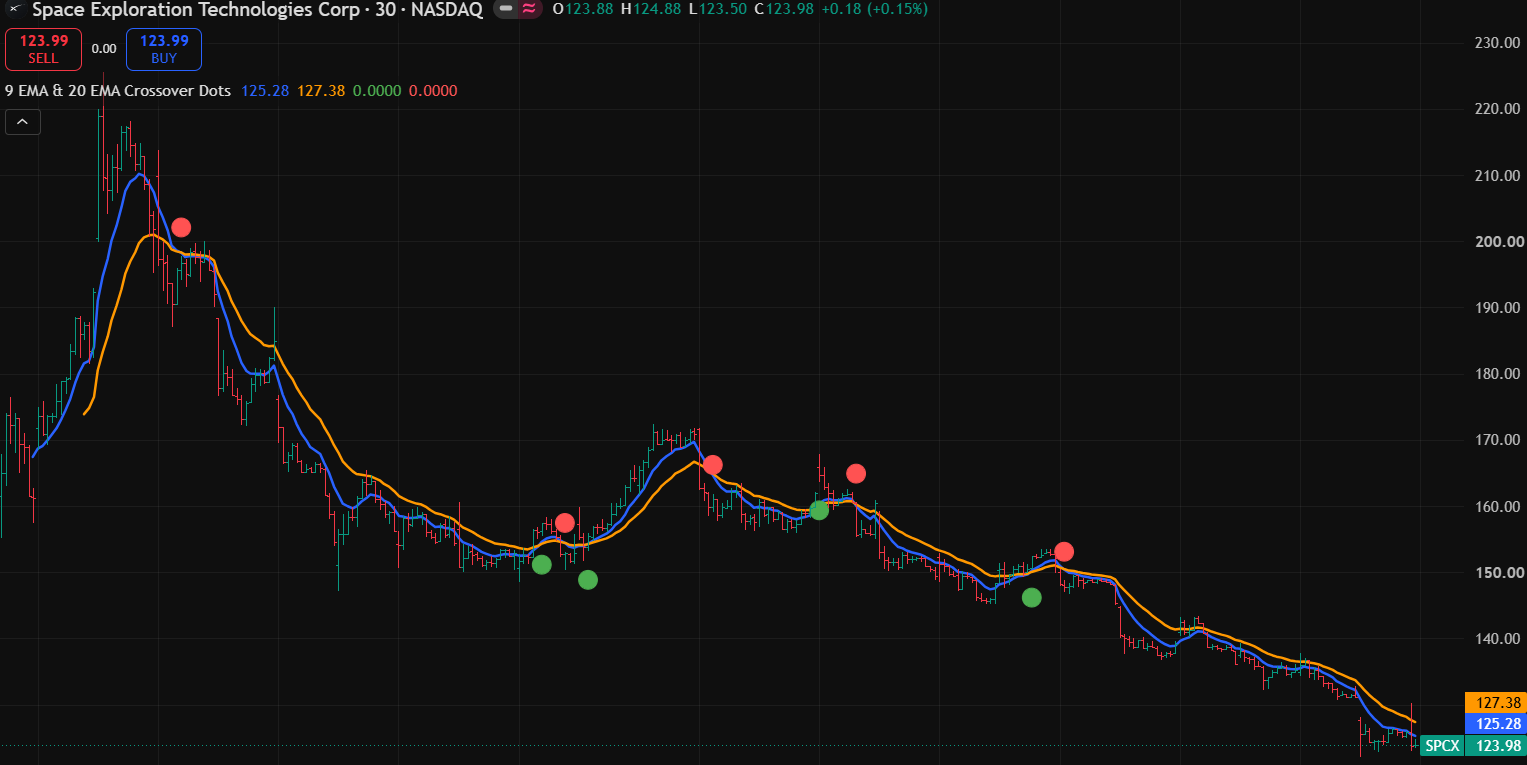
SpaceX Shares Slip Below Their Initial Public Offering Price

SpaceX shares briefly traded below their initial public offering price for the first time since the company’s record-breaking stock market debut. After surging in the weeks following its IPO, the stock declined as investors reassessed the company’s valuation, growth expectations, and near-term financial outlook.

The shares fell below the $135 IPO price during trading before recovering slightly by the market’s close. Even with the recent decline, SpaceX remains one of the world’s most valuable publicly traded companies, although its market capitalization has dropped significantly from its post-IPO peak.

Why Investors Are Selling

Several factors have contributed to the sell-off. Analysts point to profit-taking after the stock’s rapid post-IPO rally, concerns about its premium valuation, and uncertainty surrounding upcoming earnings. Investors are also monitoring the expiration of lock-up restrictions, which could allow more shares to enter the market and increase selling pressure.

In addition, broader market volatility and expectations for higher interest rates have weighed on many high-growth technology companies. SpaceX has also attracted attention for its significant investments in artificial intelligence infrastructure and ambitious long-term expansion plans, prompting questions about how quickly those investments will translate into profits.

Long-Term Growth Story Remains Intact

Despite the recent weakness, many analysts continue to view SpaceX as a company with strong long-term potential. Its leadership in commercial space launches, Starlink satellite internet services, and future space exploration projects continues to support optimism about its growth prospects.

Investors are now looking ahead to the company’s first quarterly earnings report as a publicly traded company. Financial results, future guidance, and progress on Starship development could play a major role in determining the stock’s next direction.

What Investors Should Watch

The recent decline highlights how quickly market sentiment can change after a major IPO. While short-term volatility is expected, many investors believe SpaceX’s long-term value will depend on its ability to execute its ambitious business strategy and deliver consistent financial performance.

As trading continues, Wall Street will closely monitor earnings, new contracts, and upcoming milestones that could influence investor confidence and the company’s share price.

Stock News

Hardware vs. Software Divergence: Navigating Midyear 2026 Tech Sector Earnings

Published

on

Hardware vs. Software Divergence: Navigating Midyear 2026 Tech Sector Earnings

As the midyear 2026 earnings season accelerates through the week of July 20, the technology sector is displaying a notable operational split between hardware infrastructure providers and enterprise software-as-a-service (SaaS) platforms. Market indices reflect strong institutional demand for companies supplying core computing hardware, advanced power management systems, and specialized optical networking components. Conversely, software providers are facing intense margin scrutiny as Wall Street demands concrete, high-margin revenue growth to justify elevated software valuations.

The sustained outperformance of hardware equities is anchored in ongoing, multi-billion-dollar global capital investments into data center infrastructure, grid capacity expansion, and high-performance chip architecture. Semiconductor foundries and specialized component suppliers have consistently reported robust order backlogs, driven by enterprise commitments to build out secure, localized computing clusters. Investors have rewarded these companies due to their tangible, order-backed revenue visibility and strong pricing power in a constrained supply environment.

On the other hand, the software sector is navigating a transition phase. While enterprise software vendors have heavily invested in integrating automated AI capabilities across their product suites, corporate clients are scrutinizing software licencing costs and requiring clear return-on-investment metrics before expanding enterprise seat licenses. Consequently, software vendors that rely on generic feature upgrades without demonstrable productivity improvements are seeing extended sales cycles and valuation compression during quarterly earnings calls.

For equity investors, navigating the tech market for the remainder of 2026 requires rigorous fundamental analysis focused on capital efficiency and cash flow generation. Strategic focus should be directed toward hardware leaders with unassailable technological moats and enterprise software companies possessing deep workflow integration and proven monetization models. Maintaining a balanced, selective exposure ensures participation in technological growth while hedging against localized valuation corrections.

Continue Reading

Stock News

Utilities Re-Valuation: How Industrial Power Demand Driven by AI Upgrades Sector Equities

Published

on

How Industrial Power Demand Driven by AI Upgrades Sector Equities

Traditionally viewed as defensive, low-growth dividend plays, utility equities are undergoing a remarkable structural re-valuation across major stock exchanges in July 2026. Driven by an unprecedented surge in industrial power requirements—stemming from high-density data centers, advanced domestic manufacturing plants, and widespread electrification initiatives—utility providers are presenting revenue growth profiles historically reserved for growth sectors. This transition has repositioned power and energy infrastructure equities into prime targets for institutional capital.

The driver of this market shift is the long-term contractual nature of commercial energy demand. Tech giants and industrial manufacturers are entering into multi-decade power purchase agreements (PPAs) with utility operators to secure guaranteed baseload power. To meet this demand, utility companies are undertaking massive capital expenditure programs to modernize electrical transmission networks, integrate next-generation nuclear and renewable power facilities, and enhance regional grid resilience. Regulated utility models allow these companies to earn predictable returns on these substantial capital investments.

Furthermore, equity analysts highlight that the sector offers an attractive blend of growth potential and downside protection in a sustained high-interest-rate environment. While elevated capital costs increase borrowing expenses for grid infrastructure upgrades, the sheer volume of new industrial power demand provides strong top-line revenue expansion that offsets debt-servicing expenses. Investors seeking reliable yield combined with structural capital appreciation are increasingly allocating capital to regulated electric utilities and independent power producers.

Moving through the second half of 2026, portfolio managers recommend evaluating utility equities based on regional regulatory environments and capital execution track records. Companies operating in regions with streamlined permitting processes, supportive state regulatory commissions, and direct proximity to expanding industrial corridors are best positioned to deliver superior long-term shareholder value.

Continue Reading

Economics

Global Stock Market Weekly Recap: Tech Sell-Off Sparks International Rout

Published

on

Global Stock Market Weekly Recap: Tech Sell-Off Sparks International Rout

The week ending July 17, 2026, will be remembered as a turbulent period for global equities, as a sharp correction in the artificial intelligence (AI) and semiconductor sectors sent ripples through international bourses. Compounded by escalating geopolitical tensions in the Middle East and shifting expectations around central bank monetary policies, major indexes across New York, Tokyo, and Europe experienced pronounced volatility.

If you are tracking your portfolio’s performance, here is exactly how the world’s most important stock markets fared this week.

1. New York Stock Market: Rotation Out of Mega-Cap Growth

Wall Street endured a challenging week as investors rapidly rotated out of high-flying technology names.

  • The Benchmarks: The S&P 500 fell 1.55%, while the tech-heavy Nasdaq Composite dropped 2.9%. The ICE Semiconductor Index plummeted 10%.
  • Sector Performance: Large-cap growth stocks bore the brunt of the damage, falling 4.12%. Conversely, value-oriented and rate-resilient sectors like Healthcare, Financials, and Consumer Staples offered shelter. Energy stocks also outperformed as crude oil prices jumped due to rising Iran hostilities.
  • Macro Drivers: Economic data brought a “Goldilocks” scenario, with U.S. consumer prices (CPI) and producer prices (PPI) coming in cooler than expected. While easing inflation theoretically paves the way for future interest rate cuts, hawkish rhetoric from Federal Reserve officials kept the 10-year Treasury yield sticky near 4.55%.

2. Japan Stock Market: Nikkei Tumbles Into Correction

The Tokyo stock market faced the steepest liquidations of the week, driven heavily by a severe global pullback in chipmakers.

  • The Benchmarks: Japan’s benchmark Nikkei 225 tumbled by an astonishing 4.03% on Friday alone, closing at 64,141.12. At its lowest point during the session, it was down over 6%.
  • Correction Territory: The index is officially down 11.3% from its all-time high close achieved on June 25, firmly entering a technical market correction. The broader Topix also slipped 2.72% to finish at 3,919.21.
  • Individual Losers: Memory and AI-adjacent stocks led the descent. Chip giant Kioxia Holdings plummeted 16.1%—its worst single day in years—while Sumco lost 15.17%. Market analysts noted that while long-term AI demand remains intact, investors are pausing to question the sustainability of soaring semiconductor prices.

3. European Stock Market: A Milder Move Sheltered by Value

Compared to the dramatic tech rout seen in the U.S. and Japan, European stock indexes experienced much milder moves, largely because European benchmarks have less concentration in AI and mega-cap technology firms.

  • The Benchmarks: On Friday, July 17, Germany’s DAX edged down by 0.34% to close at 24,830.98 points. France’s CAC 40 slid 0.47% to wrap up at 8,338.81 points.
  • The Outlier: The British FTSE 100 bucked the negative global trend, gaining 0.27% to close at 10,600.37 points. The FTSE benefited directly from its heavy weightings in commodity producers and traditional financial institutions, which were lifted by higher oil prices and banking resilience.

Looking Ahead to Next Week

As the initial wave of corporate earnings Broadens out from financials to other major industrial sectors, market volatility will likely hinge on Q2 guidance. Investors will remain highly sensitive to whether companies can deliver the massive revenue growth required to justify their current valuations.

Continue Reading

Trending