Connect with us

Personal Finance

Biden administration will roll out new student loan forgiveness plan

Published

on

U.S. President Joe Biden delivers remarks on canceling student debt at Culver City Julian Dixon Library on February 21, 2024 in Culver City, California. 

Mario Tama | Getty Images

A narrower aid package Biden hopes will survive

The president’s Plan B for student loan forgiveness will likely target several groups of borrowers, including those who’ve been in repayment for decades and people who are experiencing financial hardship.

Immediately after the Supreme Court struck down Biden’s $400 billion student loan forgiveness plan last June, his administration began working on a revised assistance package.

The Biden administration believes its updated plan will survive legal challenges this time for several reasons. One, it’s far narrower than its first attempt, which would have impacted as many as 40 million Americans.

“I think it would be easier to justify in front of a court that is skeptical of broad authority,” said Luke Herrine, an assistant professor of law at the University of Alabama, in an earlier interview with CNBC.

Student debt relief activist rally in front of the U.S. Supreme Court on June 30, 2023 in Washington, DC. The Supreme Court stuck down the Biden administration’s student debt forgiveness program in Biden v. Nebraska.

Kevin Dietsch | Getty Images

It is also using a different law — the Higher Education Act rather than the Heroes Act of 2003 — as its legal justification.

The HEA was signed into law by President Lyndon B. Johnson in 1965, and allows the education secretary some authority to waive or release borrowers’ education debt.

The Heroes Act was passed in the aftermath of the 9/11 terrorist attacks, and grants the president broad power to revise student loan programs during national emergencies.

The conservative justices didn’t buy that argument.

″’Can the Secretary use his powers to abolish $430 billion in student loans, completely canceling loan balances for 20 million borrowers, as a pandemic winds down to its end?'” Chief Justice John Roberts wrote in the majority opinion for Biden v. Nebraska. “We can’t believe the answer would be yes.”

Lastly, the Biden administration has now turned to the rulemaking process to deliver its relief. The president previously attempted to cancel the debt through executive action.
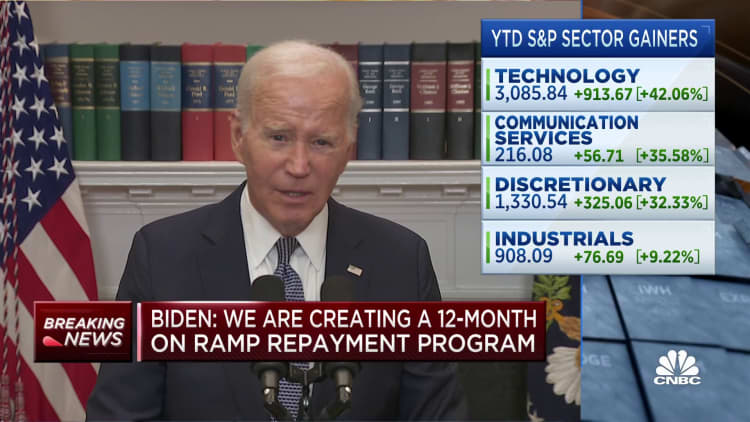
Pres Biden: Today's decision closed one path, now we are going to push through another

As part of the rulemaking process, a team of negotiators met four times to try to establish the new parameters of the updated policy. The final session concluded in February.

Based on the timeline of regulatory changes, the proposal will likely become public within weeks, Kantrowitz said.

“Typically at the end of the negotiated rulemaking, a month or so later you have publication of the proposal,” he said.

There will then be a public comment period, which is likely to last for at least 30 days.

Don’t miss these stories from CNBC PRO:

Continue Reading

Personal Finance

Maximizing Returns in High Rate Climate and market uncertainty

Published

on

Maximizing Returns in High-Rate Climate

In the macroeconomic environment of late July 2026, personal cash management requires an active, structured approach to wealth preservation. With central bank benchmark rates remaining elevated to ensure long-term disinflation, conservative yield-bearing vehicles—such as short-term U.S. Treasury bills, money market funds, and high-yield savings accounts (HYSAs)—continue to offer reliable nominal returns between 4% and 5%. For individual investors, maximizing net returns requires moving beyond passive checking accounts and executing a disciplined cash laddering strategy.

Leaving substantial liquid capital in traditional bank deposits creates an invisible drag on personal net worth due to ongoing inflation. By implementing a tiered liquidity framework, individuals can split emergency cash reserves and short-term capital allocations across rolling maturities. Allocating cash into 4-week, 8-week, and 13-week Treasury bills creates a continuous cycle of maturing liquidity, allowing investors to continuously reinvest capital at prevailing market yields while maintaining immediate access to emergency funds.

Tax efficiency represents a critical dimension of high-yield cash optimization. For high-earning individuals residing in states with substantial local income taxes, direct holdings in short-term U.S. Treasury instruments often deliver superior net post-tax yields compared to standard commercial bank HYSAs. Because interest earned on federal Treasury bills is strictly exempt from state and local taxation, investors can retain a larger portion of their compounding interest gains without taking on additional credit or market risk.

Ultimately, personal wealth accumulation in mid-2026 relies on intentional capital deployment. Cash should be managed as a productive asset class that generates consistent, risk-free returns. Regularly auditing account yield terms, automating recurring transfers, and leveraging tax-advantaged fixed-income instruments ensures that personal liquidity remains fully optimized against macroeconomic fluctuations.

Continue Reading

Personal Finance

Algorithmic Wealth Management: Balancing Automated Financial Planning with Human Oversight

Published

on

Balancing Automated Financial Planning with Human Oversight

The personal finance industry in July 2026 is experiencing a technological evolution, driven by the wide deployment of next-generation algorithmic wealth management tools. Modern digital financial platforms have expanded far beyond basic automated index investing; today’s robo-advisors utilize real-time tax-loss harvesting, dynamic portfolio rebalancing, and hyper-personalized spending analysis to optimize retail investor outcomes. However, as these digital solutions become ubiquitous, investors face the crucial challenge of balancing automated execution with human strategic judgment.

The core advantage of automated financial planning platforms lies in their ability to remove emotional bias from investment execution. During periods of market volatility or localized sector realignments, automated algorithms systematically rebalance portfolios back to target asset allocations without falling victim to panic selling or speculative enthusiasm. Furthermore, integrated cash-flow monitoring algorithms analyze individual spending patterns in real time, automatically sweeping surplus income into designated retirement or debt-liquidation accounts to accelerate net worth accumulation.

Despite these operational advantages, algorithmic tools have inherent structural limitations when addressing complex, highly personalized financial life events. Decisions involving multi-generational estate planning, highly complex tax strategies, small business exits, or nuanced real estate transactions require contextual human judgment that software models cannot replicate. Relying solely on automated models without periodic human professional review can result in misaligned risk profiles or overlooked tax liabilities during major life transitions.

The optimal approach for personal financial planning in late 2026 is a hybrid advisory model. Individuals should utilize automated platforms for routine asset allocation, continuous tax optimization, and low-cost passive index tracking, while engaging qualified human financial advisors for periodic strategic planning, estate structuring, and qualitative risk evaluations. This dual approach ensures maximum cost efficiency and disciplined execution while retaining essential strategic guidance.

Continue Reading

Personal Finance

High-Yield Optimization: Structuring Personal Cash Reserves in a Sustained Rate Environment

Published

on

Structuring Personal Cash Reserves in a Sustained Rate Environment

In the financial environment of mid-2026, personal cash management has re-emerged as a vital component of holistic wealth building. With central bank policy rates holding firm to maintain long-term price stability, yield-bearing instruments such as money market funds, high-yield savings accounts (HYSAs), and short-term Treasury bills continue to offer compounding returns around 4% to 5%. For individual investors, effectively structuring cash reserves requires shifting away from passive bank deposits toward active yield optimization.

A frequent pitfall in personal asset management is leaving substantial liquid capital in traditional checking or low-yield savings accounts, where real returns are continuously eroded by baseline inflation. By implementing a disciplined ‘cash ladder’ strategy—allocating liquid funds across tiered maturities using ultra-short Treasury instruments and FDIC-insured high-yield accounts—individuals can secure maximal yields while retaining immediate liquidity for emergency expenses or tactical investment opportunities.

Simultaneously, investors must evaluate the tax efficiency of their cash holdings based on their tax bracket and geographic location. For high earners situated in states with high local income taxes, direct holdings in short-term U.S. Treasury bills often yield a higher net post-tax return than standard high-yield savings accounts, as Treasury interest is strictly exempt from state and local taxation. Understanding these nuanced tax distinctions allows individuals to capture significant incremental gains without taking on additional market risk.

Ultimately, personal financial health in late 2026 hinges on intentional liquidity management. Cash reserves should not be viewed merely as static emergency funds, but as a dynamic asset class that contributes positively to net worth growth. Regularly auditing yield terms, automating cash transfers, and optimizing for post-tax efficiency ensures that personal capital remains fully productive across all economic conditions.

Continue Reading

Trending