
Personal Finance
The strong U.S. job market is in a ‘sweet spot,’ economists say

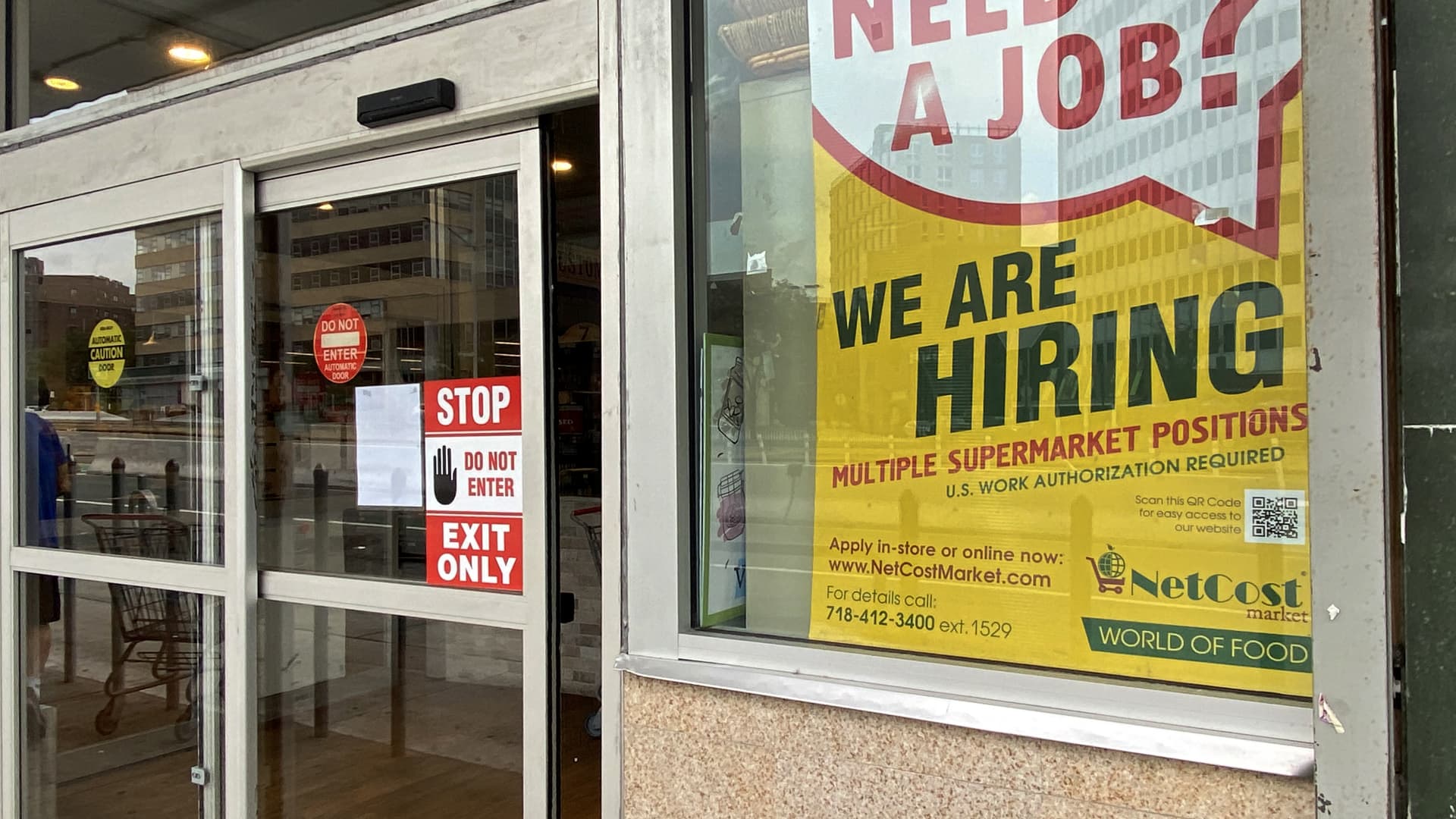
Now Hiring sign in a supermarket window in Queens, New York.
Lindsey Nicholson/UCG/Universal Images Group via Getty Images
The U.S. job market continues to chug ahead without signs of overheating — a good sign for workers and the U.S. economy, according to economists.
While the market has cooled from its breakneck pace of the “great resignation” era, employers are adding ample jobs to their payrolls, unemployment hovers near historical lows, and worker buying power (so-called “real” wage growth) is steadily rising, economists said.
The labor market has been resilient despite economic headwinds like higher interest rates.
“This is still a labor market that’s very attractive, especially historically speaking, for workers,” said Julia Pollak, chief economist at ZipRecruiter.
“There’s still strong, broad-based job growth and real wage growth has been restored,” Pollak said. “I think that’s very, very good news.”
The labor market is in a ‘sweet spot’
Employers added 303,000 jobs to payrolls in March, the U.S. Bureau of Labor Statistics reported Friday. That’s the largest monthly gain since January 2023.
Job growth in the first three months of 2024 — 274,000, on average — beats the 2019 pre-pandemic average by more than 100,000.
The U.S. unemployment rate declined to 3.8% in March, from 3.9% in February. Unemployment has been below 4% — a historically low mark — for more than two years.
“That’s an exceptionally long period of such tight labor markets,” Pollak said.
Those conditions are pushing employers to make “very attractive” offers to new hires and proactively recruit prospective candidates, she said.

The layoff rate has also been near a historic low for more than two years, as employers hang on to their current workforce.
Additionally, more workers joined the labor force in March, boosting the labor force participation rate at a time when job openings remain historically high. That dynamic suggests a healthy, sustainable equilibrium between the supply and demand of labor, economists said.
“The labor market is settling into a sweet spot,” said Nick Bunker, economic research director for North America at job site Indeed.
It’s powering ahead and “there’s open road ahead of it as well,” he said.
The job market is cooler — but perhaps more desirable
Of course, the job market isn’t as a hot as it was in 2021 and 2022, after the U.S. economy awoke from a Covid-induced slumber.
At that time, workers were quitting their jobs at the fastest rate in history — a trend dubbed the great resignation — amid ample job opportunity and the relative ease of finding a higher-paying gig.
Workers saw the “red carpet rolled out for them,” Pollak said.
More from Personal Finance:
Immigration is ‘taking pressure off’ job market and economy
How to spot and overcome ‘ghost’ jobs
Workers are sour on the job market — but it may not be warranted
But those conditions helped stoke high inflation, which touched a four-decade high in 2022. Fast-rising prices for consumer goods meant workers’ rapidly growing wages couldn’t keep pace with price tags at the store.
The average worker’s buying power fell for two years as a result.
Wage growth has declined, to an annual 4.1% pace in March from a pandemic-era peak of 5.9% in March 2022, on average. But inflation has fallen more than that, which translates to an increase in household buying power since May 2023.
Real hourly earnings — wages after accounting for inflation — grew by 1.1% in February 2024 versus a year earlier.
The current labor market is in many ways more desirable than the red-hot one a few years ago, which wasn’t sustainable, economists said.
While workers have lost some leverage, it’s still “relatively easy” to find a job and workers are now getting those inflation-adjusted raises, Bunker said.
“There are aspects of the 2021 and 2022 labor market people want back, but aspects of the 2024 labor market people prefer more,” Bunker said.
Plus, the Federal Reserve raised borrowing costs to their highest level in over two decades to combat pandemic-era inflation. That pushed interest rates for mortgages, credit cards and other consumer debt sky high.
Fed officials see cooling wage growth is a positive relative to the inflation fight, and may provide comfort they need to start reducing borrowing costs this year, economists said.


Personal Finance
Next-Generation Retirement Planning: Managing Longevity Risk and Variable Income Streams


U.S.- Canada Trade Talks Collapse; Carney Says Retaliatory Tariffs Begin September 8

Flock Cameras and the Future of Public Security

AI Infrastructure Boom Hits Physical Limits: Power, Financing, and Supply Chain Strain

Armanino adds Strategic Accounting Outsourced Solutions

New 2023 K-1 instructions stir the CAMT pot for partnerships and corporations

Tax Strategy: Employee Retention Credit update
-

 Stock News1 week ago
Nvidia Earnings Preview: What Wall Street Expects From the AI Bellwether’s Q2 Report
-

 Accounting1 week ago
SEC’s Semiannual Reporting Proposal Faces Investor Pushback: What CFOs Need to Know
-

 Stock News1 week ago
Nvidia Q2 FY2027 Earnings beats Wall Street Expectation with Record $96.2 Billion Revenue
-

 Finance1 week ago
Treasury Bond Volatility Forces Bessent to Double Debt Buyback Size as Yields Swing
-
 Technology4 days ago
AI Infrastructure Boom Hits Physical Limits: Power, Financing, and Supply Chain Strain
-
 Economics2 days ago
U.S.- Canada Trade Talks Collapse; Carney Says Retaliatory Tariffs Begin September 8
-
 Technology2 days ago
Flock Cameras and the Future of Public Security