
Finance
China’s Hero Games shares what’s next after its hit Black Myth: Wukong

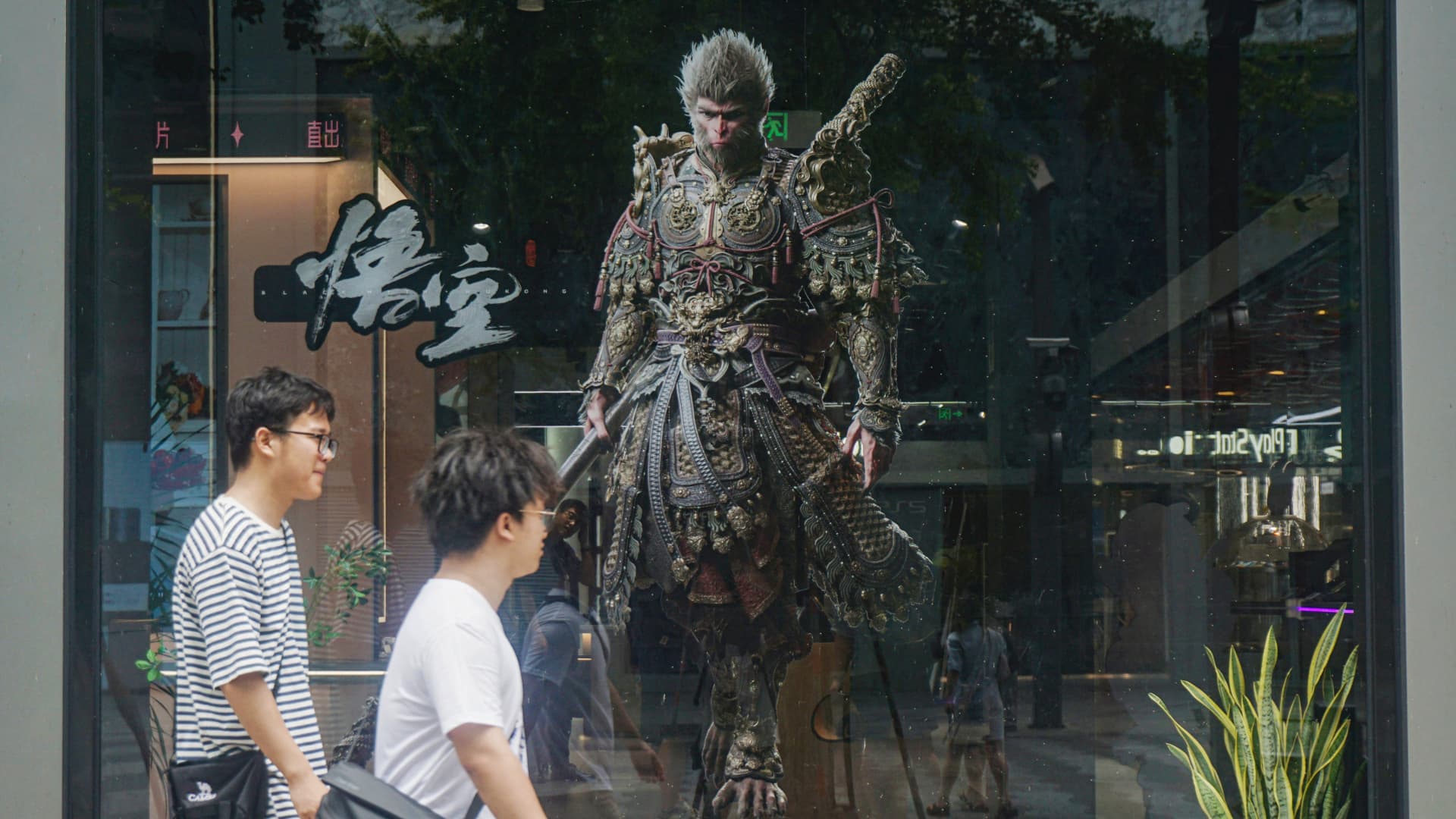
People walk past the image of the ‘Monkey King’ character, or ‘Sun Wukong’ of Chinese action role-playing game ‘Black Myth: Wukong’, developed by Chinese video game company Game Science, during its launch day in Hangzhou, in eastern China’s Zhejiang province on August 20, 2024.
Str | Afp | Getty Images
BEIJING – China’s first attempt at a top-tier video game has smashed world records, bolstering the industry’s global ambitions just a few years after Beijing’s gaming crackdown.
Black Myth: Wukong, an action game set in mythological China, sold more than 10 million units three days after its launch on Aug. 20. Ten days later, the title still ranked second by revenue in the U.S., and No. 1 globally, according to the Steam video game platform where it sells for around $60 or more.
“I think the next triple-A game is likely very close, because Black Myth: Wukong has shown everyone that a China-made AAA game can reach such high global sales,” said Dino Ying, chairman of Hero Games, which co-published the game and was an early investor in its developer Game Science. That’s according to a CNBC translation of his Mandarin-language remarks in an exclusive interview Thursday.
Ying said he knew of at least one such game under development, which his business partner at Hero Games has invested in. But he declined to share a timeframe.
As for how well Black Myth: Wukong has done, Ying only said sales have since increased by “much more” than the 10 million unit figure, although he indicated it had not yet doubled.

He said that in the future, the company’s game releases will have a global strategy from the start. He also expects foreign AAA game developers to realize how large China’s market is and tailor more features to Chinese players.
AAA games generally refer to titles with high graphics quality and significant marketing. That’s meant such video games have tended to come from companies such as Nintendo, Ubisoft and Electronic Arts.
“China is a big country. We’re talking about 1 million concurrent players,” said Ivan Su, senior equity analyst at Morningstar. “China has 600 million gamers.”
He said the reason why China hasn’t previously developed its own AAA game, which are typically played on computers and consoles, is the years-long production time. “It’s much more cost-effective if you create mobile games,” Su said.
Apple’s Tim Cook visited Hero Games
When Hero Games first invested in Game Science, Apple CEO Tim Cook visited in 2017 and was so impressed by the first game, Art of War: Red Tides, he gave it the front page of the iOS App store in 178 countries, Ying said.
But that wasn’t a commercial success.
Apple CEO Tim Cook visited the office of Hero Games in 2017 after it invested in Game Science, which went on to develop Black Myth: Wukong.
Hero Games
Hero Games had already spent three years investing 60 million yuan (about $8.5 million today) in two failed projects from Game Science when the developer approached Ying and his team in August 2020 about Black Myth: Wukong, he said.
“We’re very lucky, we didn’t give up on Game Science before it succeeded,” Ying said, noting his business partner Daniel Wu, now CEO of Hero Games, had first discovered the startup.
“We aren’t saying to blindly wait for all people,” he said. “When you see that kind of talent, you need to be confident that that talent has been underappreciated. It may not have found the right direction. [So you just need to] help it to find it.”
‘Best game that I have seen’
Two days before Game Science planned to release a promotional video for Black Myth: Wukong, the company showed it to Ying and asked his team for at least 100 million yuan more, he said. If not, he said the startup planned to ask Bilibili, a major Chinese video streaming and game platform.
After watching the video, Ying said he told his team that “I really don’t want to miss this opportunity because this is the best game that I have seen in my life.”
Tencent then bought a 5% stake, but said it would not interfere with Game Science’s plans, Ying said. “Because this was an AAA game, under the normal process of a big business, there was no way it would have been approved.”
Hero Games’ initial investment in Game Science was for a 20% stake.
Beijing has only in the last two years started to approve games, after suspending new titles and limiting how many hours minors could play in 2021.
Black Myth: Wukong got China’s government approval in February. No part of the game needed to be changed for it to pass, Ying said.
“Personally I think in the past two years the regulation is increasingly respectful of the game industry and is beneficial to its development,” Ying said, noting that one or two years ago, there “was a misunderstanding.”
Massive market potential
In the first half of this year, domestic game sales in China reached 147.27 billion yuan, said Ashley Dudarenok, founder of China digital consultancy ChoZan, citing industry figures.
But console game revenue was just 0.5% of that, she said.
Ying pointed out that many people in China bought PlayStations or upgraded their graphics cards after Black Myth: Wukong’s release, similar to how many people first bought the Nintendo Switch because of Zelda.
Something that’s lasted 1,000 years, people will definitely like it
Dino Ying
Hero Games, chairman
As for the global market, Dudarenok said overseas sales of China-developed games rose to $16.4 billion in 2023, up from $11.6 billion in 2019.
“Chinese games often incorporate rich cultural elements that appeal more and more to a global audience,” she said. “This unique cultural flavor sets them apart from games developed in other regions”
Ying said he expects China has at least five to 10 other stories that have been passed down over the last millennia that can be turned into games.
“If I create a new thing, I don’t know if people will like it. But something that’s lasted 1,000 years, people will definitely like it,” Ying said. “We don’t know why it was preserved over so many years. But we just need to respect the [original] artisans.”
He said Game Science sent teams and equipment to ancient temples in China to scan and replicate the designs, boosting the game’s immersive feel.
Indie Chinese games
In the more niche market of independent games, Chinese companies are also on the rise.
Shanghai-based Cotton Game, which has a staff of 70 people, won the 2024 award for best development team in indie games from the French-supported Game Connection organization and ChinaJoy, which runs a major annual game conference in China.
“It depends on how capable we are, but [we hope to] use games as a way to share art, philosophy and thoughtful content,” the company’s CEO, who goes by the English name Cotton Guo, said in Mandarin translated by CNBC.
Cotton Game’s Sunset Hills – which took five years to draw by hand – also won the “Game of the Year” and “Best Indie Game” awards. The $20 game launched on Aug. 21 on Steam after raising $13,000 on Kickstarter.
The game follows an anthropomorphic dog through a Europe-like village, accompanied by the sounds of nature and music. Players solve puzzles along the way.
“Everyone is quite tired. In society today, the speed of life is very fast,” Robin Luo, the manager of Sunset Games. Its main character is based on his own dog. “So my hope while making Sunset Hills was that everyone playing the game could [find it] refreshing.”





Treasury Bond Volatility Forces Bessent to Double Debt Buyback Size as Yields Swing

Nvidia Earnings Preview: What Wall Street Expects From the AI Bellwether’s Q2 Report

SEC’s Semiannual Reporting Proposal Faces Investor Pushback: What CFOs Need to Know

Armanino adds Strategic Accounting Outsourced Solutions

New 2023 K-1 instructions stir the CAMT pot for partnerships and corporations

Tax Strategy: Employee Retention Credit update
-

 Economics1 week ago
U.S. Retail Sales Fall for the First Time in Nine Months as Consumer Spending Slows
-
 Economics1 week ago
Nvidia’s Potential $3 Billion SB Energy Investment Could Reshape AI Infrastructure
-

 Economics4 days ago
Top 10 Largest Economies by 2030: IMF & World Bank GDP Projections for Global Powerhouses
-

 Stock News4 days ago
How to understand Intel $15B Stock Offering
-
 Technology1 week ago
U.S.-China AI Competition Intensifies as Washington Pushes Allies to Choose Sides
-

 Economics4 days ago
Economic Profile of the United States of America (2026–2030 Horizon)
-
 Economics3 days ago
U.S. National Debt Surpasses $40 Trillion for the First Time: What It Means for the Economy
-

 Leaders3 days ago
Jackson Hole 2026: What the First Symposium Under Fed Chair Kevin Warsh Means for Markets