
Personal Finance
‘Climate gentrification’ fuels higher prices for longtime Miami residents

A development towers over the Lyric Theater in Miami’s Overtown neighborhood.
Greg Iacurci
MIAMI — Nicole Crooks stood in the plaza of the historic Lyric Theater, a royal blue hat shielding her from the midday sun that baked Miami.
In its heyday, the theater, in the city’s Overtown neighborhood, was an important cultural hub for the Black community. James Brown, Sam Cooke, Ray Charles, Aretha Franklin and Ella Fitzgerald performed there, in the heart of “Little Broadway,” for esteemed audience members such as Jackie Robinson and Joe Louis.
Now, on that day in mid-March, the towering shell of a future high-rise development and a pair of yellow construction cranes loomed over the cultural landmark. It’s a visual reminder of the changing face of the neighborhood — and rising costs for longtime residents.
Located inland, far from prized beachfront real estate, Overtown was once shunned by developers and wealthy homeowners, said Crooks, a community engagement manager at Catalyst Miami, a nonprofit focused on equity and justice.
Nicole Crooks stands in the plaza of the Lyric Theater in Overtown, Miami.
Greg Iacurci
But as Miami has become ground zero for climate change, Overtown has also become a hot spot for developers fleeing rising seas and coastal flood risk, say climate experts and community advocates.
That’s because Overtown — like districts such as Allapattah, Liberty City, Little Haiti and parts of Coconut Grove — sits along the Miami Rock Ridge. This elevated limestone spine is nine feet above sea level, on average — about three feet higher than Miami’s overall average.
A development boom in these districts is changing the face of these historically Black neighborhoods and driving up prices, longtime residents tell CNBC. The dynamic is known as “climate gentrification.”
More from Personal Finance:
Why your finances aren’t insulated from climate change
People are moving to Miami and building there despite climate risk
Here’s how to buy renewable energy from your electric utility
Gentrification due to climate change is also happening in other parts of the U.S. and is one way in which climate risks disproportionately fall on people of color.
“More than anything, it’s about economics,” Crooks said of the encroachment of luxury developments in Overtown, where she has lived since 2011. “We’re recognizing that what was once prime real estate [on the coast] is not really prime real estate anymore” due to rising seas.
If Miami is ground zero for climate change, then climate gentrification makes Overtown and other historically Black neighborhoods in the city “ground zero of ground zero,” Crooks said.
Why the wealthy ‘have an upper hand’
When a neighborhood gentrifies, residents’ average incomes and education levels, as well as rents, rise rapidly, said Carl Gershenson, director of the Princeton University Eviction Lab.
Because of how those elements correlate, the outcome is generally that the white population increases and people of color are priced out, he said.
Gentrification is “inevitable” in a place such as Miami because so many people are moving there, including many wealthy people, Gershenson said.
But climate change “molds the way gentrification is going to happen,” he added.
Part of the building site of the Magic City development in Little Haiti.
Greg Iacurci
Indeed, climate gentrification has exacerbated a “pronounced housing affordability crisis” in Miami, particularly for immigrants and low-income residents, according to a recent analysis by real estate experts at Moody’s.
Asking rents have increased by 32.2% in the past four years to $2,224 per unit, on average — higher than the U.S. average of 19.3% growth and $1,825 per unit, according to Moody’s.
The typical renter in Miami spends about 43% of their income on rent, making the metro area the least affordable in the U.S., according to May data from Zillow.
Housing demand has soared due to Miami’s transition into a finance and technology hub, which has attracted businesses and young workers, pushing up prices, Moody’s said.

But rising seas and more frequent and intense flooding have made neighborhoods such as Little Haiti, Overtown and Liberty City — historically occupied by lower-income households — more attractive to wealthy people, Moody’s said.
The rich “have an upper hand” since they have the financial means to relocate away from intensifying climate hazards, it said.
“These areas, previously overlooked, are now valued for their higher elevation away from flood-prone zones, which leads to development pressure,” according to Moody’s.
These shifts in migration patterns “accelerate the displacement of established residents and inflate property values and taxes, widening the socio-economic divide,” it wrote.
Indeed, real estate at higher elevations of Miami-Dade County has appreciated at a faster rate since 2000 than that in other areas of the county, according to a 2018 paper by Harvard University researchers.
Many longtime residents rent and therefore don’t seem to be reaping the benefits of higher home values: Just 26% of homes occupied in Little Haiti are occupied by their owners, for example, according to a 2015 analysis by Florida International University.
In Little Haiti, the Magic City Innovation District, a 17-acre mixed-use development, is in the early stages of construction.
Robert Zangrillo, founder, chairman and CEO of Dragon Global, one of the Magic City investors, said the development will “empower” and “uplift” — rather than gentrify — the neighborhood.
He said the elevation was a factor in the location of Magic City, as were train and highway access, proximity to schools and views.
“We’re 17 to 20 feet above sea level, which eliminates flooding,” he said. “We’re the highest point in Miami.”
Effects of high costs ‘simply heartbreaking’
Comprehensive real estate data broken down according to neighborhood boundaries is hard to come by. Data at the ZIP-code level offers a rough approximation, though it may encompass multiple neighborhoods, according to analysts.
For example, residents of northwest Miami ZIP code 33127 have seen their average annual property tax bills jump 60% between 2019 and 2023, to $3,636, according to ATTOM, a company that tracks real estate data. The ZIP code encompasses parts of Allapattah, Liberty City and Little Haiti and borders Overtown.
That figure exceeds the 37.4% average growth for all of Miami-Dade County and 14.1% average for the U.S., according to ATTOM.
Higher property taxes often go hand in hand with higher property values, as developers build nicer properties and homes sell for higher prices. Wealthier homeowners may also demand more city services, pushing up prices.
A high-rise development in Overtown, Miami.
Greg Iacurci
Average rents in that same ZIP code have also exceeded those of the broader region, according to CoreLogic data.
Rents for one- and two-bedroom apartments jumped 50% and 52%, respectively, since the first quarter of 2021, according to CoreLogic.
By comparison, the broader Miami metro area saw one-bedroom rents grow by roughly 37% to 39%, and about 45% to 46% for two-bedroom units. CoreLogic breaks out data for two Miami metro divisions: Miami-Miami Beach-Kendall and West Palm Beach-Boca Raton-Delray Beach.
“To see how the elders are being pushed out, single mothers having to resort to living in their cars with their children in order to live within their means … is simply heartbreaking for me,” Crooks said.
‘Canaries in the coal mine’
Climate gentrification isn’t just a Miami phenomenon: It’s happening in “high-risk, high-amenity areas” across the U.S., said Princeton’s Gershenson.
Honolulu is another prominent example of development capital creeping inland to previously less desirable areas, said Andrew Rumbach, senior fellow at the Urban Institute. It’s a trend likely to expand to other parts of the nation as the fallout from climate change worsens.
Miami and Honolulu are the “canaries in the coal mine,” he said.
But climate gentrification can take many forms. For example, it also occurs when climate disasters reduce the supply of housing, fueling higher prices.
Smoke from the Marshall Fire in Louisville, Colorado.
Chris Rogers | Photodisc | Getty Images
In the year following the 2021 Marshall Fire in Colorado — the costliest fire in the state’s history — a quarter of renters in the communities affected by the fire saw their rents swell by more than 10%, according to survey data collected by Rumbach and other researchers. That was more than double the region-wide average of 4%, he said.
The supply that’s repaired and rebuilt generally costs more, too — favoring wealthier homeowners, the researchers found.
Across the U.S., high-climate-risk areas where disasters serially occur experience 12% higher rents, on average, according to recent research by the Georgia Institute of Technology and the Brookings Institution.
“It’s basic supply and demand: After disasters, housing costs tend to increase,” said Rumbach.
‘My whole neighborhood is changing’
Fredericka Brown, 92, has lived in Coconut Grove all her life.
Recent development has irreparably altered her neighborhood, both in character and beauty, she said.
“My whole neighborhood is changing,” said Brown, seated at a long table in the basement of the Macedonia Missionary Baptist Church. Founded in 1895, it’s the oldest African-American church in Coconut Grove Village West.
The West Grove district, as it’s often called, is where some Black settlers from the Bahamas put down roots in the 1870s.
“They’re not building single-family [houses] here anymore,” Brown said. The height of buildings is “going up,” she said.
Fredericka Brown (L) and Carolyn Donaldson (R) at the Macedonia Missionary Baptist Church in Coconut Grove.
Greg Iacurci
Carolyn Donaldson, sitting next to her, agreed. West Grove is located at the highest elevation in the broader Coconut Grove area, said Donaldson, a resident and vice chair of Grove Rights and Community Equity.
The area may well become “waterfront property” decades from now if rising seas swallow up surrounding lower-lying areas, Donaldson said. It’s part of a developer’s job to be “forward-thinking,” she said.
Development has contributed to financial woes for longtime residents, she added, pointing to rising property taxes as an example.
“All of a sudden, the house you paid for years ago and you were expecting to leave it to your family for generations, you now may or may not be able to afford it,” Donaldson said.
Why elevation matters for developers
Developers have been active in the City of Miami.
The number of newly constructed apartment units in multifamily buildings has grown by 155% over the past decade, versus 44% in the broader Miami metro area and 25% in the U.S., according to Moody’s data. Data for the City of Miami counts growth in overall apartment inventory in buildings with 40 or more units. The geographical area includes aforementioned gentrifying neighborhoods and others such as the downtown area.
While elevation isn’t generally “driving [developers’] investment thesis in Miami, it’s “definitely a consideration,” said David Arditi, a founding partner of Aria Development Group. Aria, a residential real estate developer, generally focuses on the downtown and Brickell neighborhoods of Miami and not the ones being discussed in this article.
Flood risk is generally why elevation matters: Lower-lying areas at higher flood risk can negatively affect a project’s finances via higher insurance rates, which are “already exorbitant,” Arditi said. Aria analyzes flood maps published by the Federal Emergency Management Agency and aims to build in areas that have lower relative risk, for example, he said.
“If you’re in a more favorable flood zone versus not … there’s a real sort of economic impact to it,” he said. “The insurance market has, you know, quadrupled or quintupled in the past few years, as regards the premium,” he added.
A 2022 study by University of Miami researchers found that insurance rates — more so than the physical threat of rising seas — are the primary driver of homebuyers’ decision to move to higher ground.
“Presently, climate gentrification in Miami is more reflective of a rational economic investment motivation in response to expensive flood insurance rather than sea-level rise itself,” the authors, Han Li and Richard J. Grant, wrote.
Some development is likely needed to address Miami’s housing crunch, but there has to be a balance, Donaldson said.
“We’re trying to hold on to as much [of the neighborhood’s history] as we possibly can and … leave at least a legacy and history here in the community,” she added.
Tearing down old homes and putting up new ones can benefit communities by making them more resilient to climate disasters, said Todd Crowl, director of the Florida International University Institute of Environment.
However, doing so can also destroy the “cultural mosaic” of majority South American and Caribbean neighborhoods as wealthier people move in and contribute to the areas’ “homogenization,” said Crowl, a science advisor for the mayor of Miami-Dade County.
“The social injustice part of climate is a really big deal,” said Crowl. “And it’s not something easy to wrap our heads around.”
It’s basic supply and demand: After disasters, housing costs tend to increase.
Andrew Rumbach
senior fellow at the Urban Institute
Paulette Richards has lived in Liberty City since 1977. She said she has friends whose family members are sleeping on their couches or air mattresses after being unable to afford fast-rising housing costs.
“The rent is so high,” said Richards, a community activist who’s credited with coining the term “climate gentrification.” “They cannot afford it.”
Richards, who founded the nonprofit Women in Leadership Miami and the Liberty City Climate & Me youth education program, said she began to notice more interest from “predatory” real estate developers in higher-elevation communities starting around 2010.
She said she doesn’t have a problem with development in Liberty City, in and of itself. “I want [the neighborhood] to look good,” she said. “But I don’t want it to look good for someone else.”
It’s ‘about fiscal opportunity’
Carl Juste at his photo studio in Little Haiti.
Greg Iacurci
Carl Juste’s roots in Little Haiti run deep.
The photojournalist has lived in the neighborhood, north of downtown Miami, since the early 1970s.
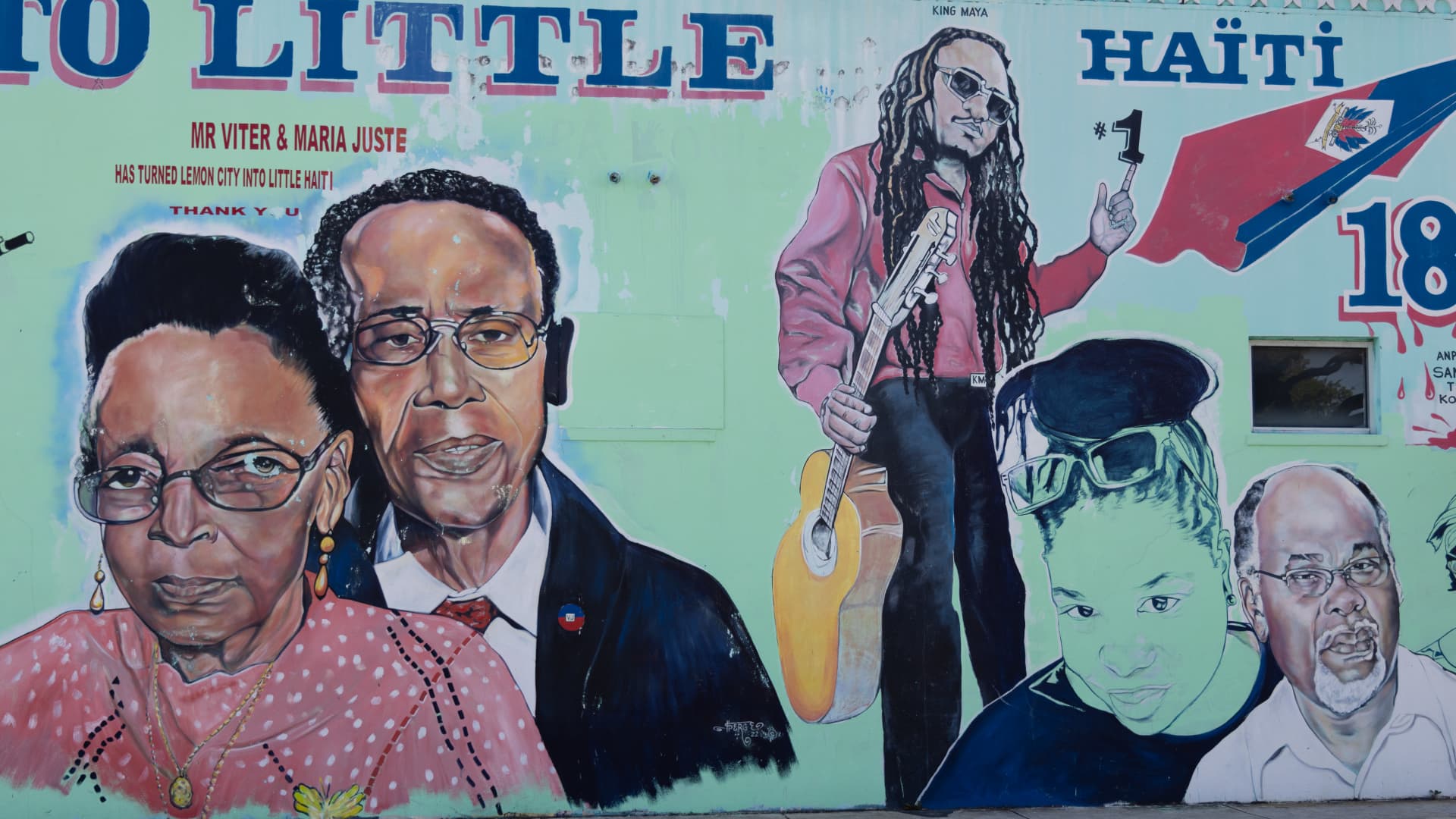
A mural of Juste’s parents — Viter and Maria Juste, known as the father and mother of Little Haiti — welcomes passersby outside Juste’s studio off Northeast 2nd Avenue, a thoroughfare known as an area of “great social and cultural significance to the Haitian Diaspora.”
“Anybody who comes to Little Haiti, they stop in front of that mural and take pictures,” Juste said.
A mural of Viter and Maria Juste in Little Haiti.
Greg Iacurci
A few blocks north, construction has started on the Magic City Innovation District.
The development is zoned for eight 25-story apartment buildings, six 20-story office towers, and a 420-room hotel, in addition to retail and public space, according to a webpage by Dragon Global, one of the Magic City investors. Among the properties is Sixty Uptown Magic City, billed as a collection of luxury residential units.
“Now there’s this encroachment of developers,” Juste said.
“The only place you can go is up, because the water is coming,” he said, in reference to rising seas. Development is “about fiscal opportunity,” he said.
Plaza Equity Partners, a real estate developer and one of the Magic City partners, did not respond to CNBC’s requests for comment. Another partner, Lune Rouge Real Estate, declined to comment.
Magic City development site in Little Haiti.
Greg Iacurci
But company officials in public comments have said the development will benefit the area.
The Magic City project “will bring more jobs, create economic prosperity and preserve the thriving culture of Little Haiti,” Neil Fairman, founder and chairman of Plaza Equity Partners, said in 2021.
Magic City developers anticipate it will create more than 11,680 full-time jobs and infuse $188 million of extra annual spending into the local economy, for example, according to a 2018 economic impact assessment by an independent firm, Lambert Advisory. Likewise, Miami-Dade County estimated that a multimillion-dollar initiative launched in 2015 to “revitalize” part of Liberty City with new mixed-income developments would create 2,290 jobs.
Magic City investors also invested $31 million in the Little Haiti Revitalization Trust, created and administered by the City of Miami to support community revitalization in Little Haiti.

Affordable housing and homeownership, local small business development, local workforce participation and hiring programs, community beautification projects, and the creation and improvement of public parks are among their priorities, developers said.
Zangrillo, the Dragon Global founder, sees such investment as going “above and beyond” to ensure Little Haiti is benefited by the development rather than gentrified. He also helped fund a $100,000 donation to build a technology innovation center at the Notre Dame d’Haiti Catholic Church, he said.
Developers also didn’t force out residents, Zangrillo said, since they bought vacant land and abandoned warehouses to construct Magic City.
But development has already caused unsustainable inflation for many longtime Little Haiti residents, Juste said. Often, there are other, less quantifiable ills, too, such as the destruction of a neighborhood’s feel and identity, he said.
“That’s what makes [gentrification] so perilous,” he said. “Exactly the very thing that brings [people] here, you’re destroying.”


Personal Finance
Next-Generation Retirement Planning: Managing Longevity Risk and Variable Income Streams


U.S.- Canada Trade Talks Collapse; Carney Says Retaliatory Tariffs Begin September 8

Flock Cameras and the Future of Public Security

AI Infrastructure Boom Hits Physical Limits: Power, Financing, and Supply Chain Strain

Armanino adds Strategic Accounting Outsourced Solutions

New 2023 K-1 instructions stir the CAMT pot for partnerships and corporations

Tax Strategy: Employee Retention Credit update
-

 Stock News1 week ago
Nvidia Q2 FY2027 Earnings beats Wall Street Expectation with Record $96.2 Billion Revenue
-
 Technology6 days ago
AI Infrastructure Boom Hits Physical Limits: Power, Financing, and Supply Chain Strain
-
 Economics4 days ago
U.S.- Canada Trade Talks Collapse; Carney Says Retaliatory Tariffs Begin September 8
-
 Technology4 days ago
Flock Cameras and the Future of Public Security