
Personal Finance
What Kamala Harris’ financial disclosure reveals about her investments

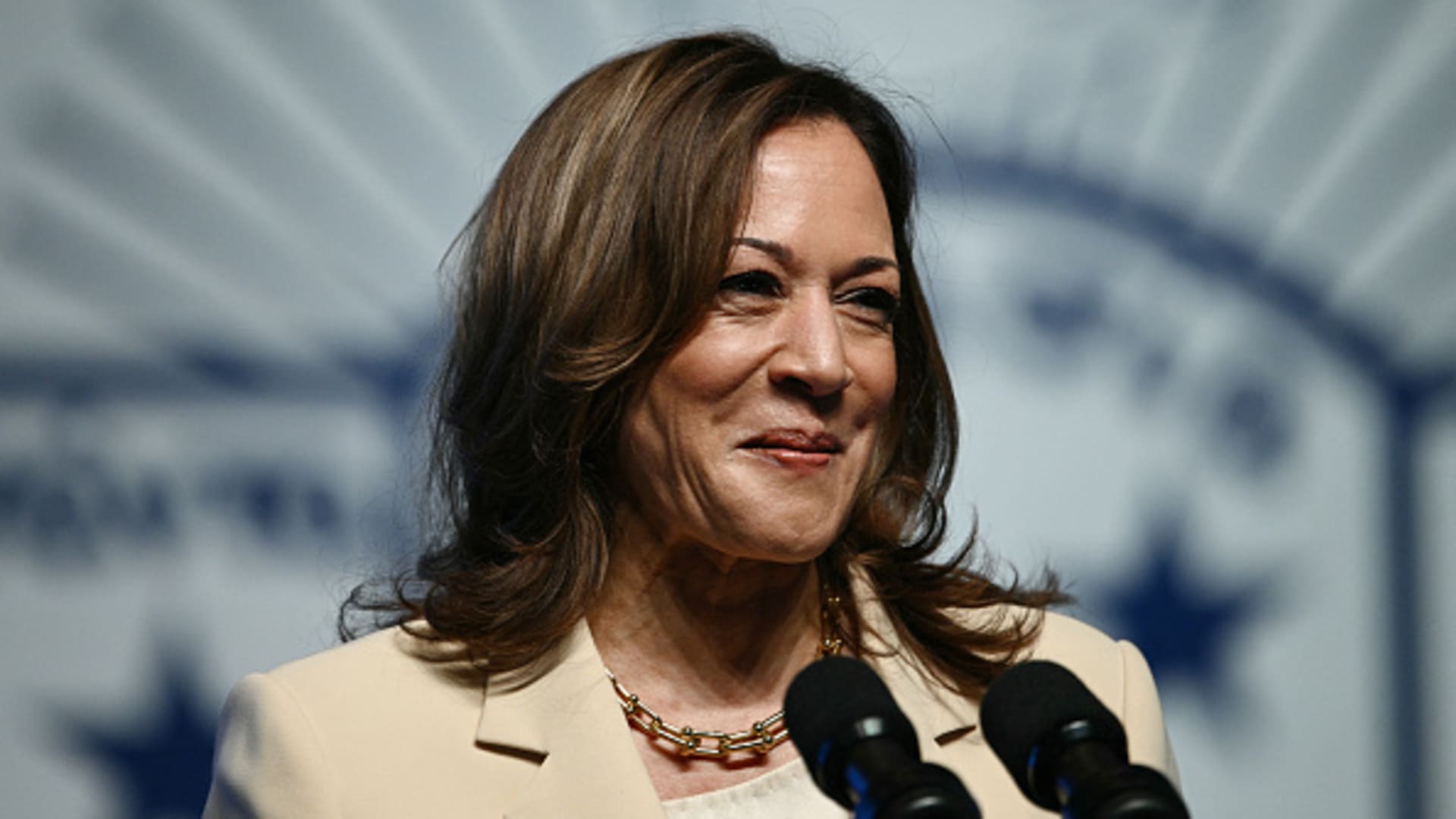
US Vice President and Democratic Presidential candidate Kamala Harris delivers keynote speech at Zeta Phi Beta Sorority, Inc.’s Grand Boulé event at the Indiana Convention Center in Indianapolis, Indiana, on July 24, 2024.
Brendan Smialowski | AFP | Getty Images
Financial experts describe Vice President Kamala Harris‘ investment style in one word: Boring.
For a woman seeking the highest office in the U.S., it also means she is relatively free of financial conflicts.
In her role as vice president, Harris filed a public financial disclosure report for 2023, which was signed in May. It reveals she favors passively managed index funds in her investment portfolio.
“For me, it was quite refreshing that it appears to be very passive,” said Dustin Thackeray, a chartered financial analyst and chief investment officer at Crewe Advisors in Salt Lake City, who reviewed Harris’ disclosure.
“She’s definitely not attempting to trade on any inside type of information,” Thackeray said.
Carolyn McClanahan, a certified financial planner and founder of Life Planning Partners in Jacksonville, Florida, who also reviewed Harris’ financial disclosure, said it makes her “heart sing” to see Harris investing in low-cost passive investment strategies.
“To me, she has the cleanest portfolio you’ll see in a politician,” said McClanahan, who is also a member of the CNBC Financial Advisor Council.
“She owns a bunch of index funds; there’s no way she that she can game the system,” McClanahan said.
More from Personal Finance:
How a Harris presidency could shape a middle-class tax credit
JD Vance once called on GOP to fight student loan forgiveness
What a Kamala Harris administration could mean for your wallet
Harris’ disclosure comes as members of Congress are debating whether elected leadership should be restricted on the kinds of investments they can own.
A group of senators is pushing for a bill that would prohibit members of Congress — as well as their spouses and dependents — from buying certain investments like individual stocks, as opposed to diversified investment funds or Treasury securities. While a Senate panel voted this week to approve the bill, it’s unclear whether it will eventually become law.
In addition to Harris’ favoring of passive investments, the disclosure also reveals more about her financial circumstances that may hold lessons for other investors, according to experts who reviewed the document.
Too many funds
Harris lists eight different funds she’s invested in as part of two separate 457(b) deferred compensation plans from her time working in California, in addition to participation in certain defined benefit pension plans.
At the same time, her husband, Second Gentleman Douglas Emhoff, lists more than 30 fund investments that are mostly passively managed.
Notably, the disclosure only lists certain asset ranges for each fund, rather than specific amounts invested.
Experts who reviewed Harris’ document said the couple could cut down on the number of funds they own, and therefore reduce any overlapping exposure.
“She’s very well diversified, maybe even more than necessary, owning many funds with similar holdings, just in different weightings,” said Barry Glassman, a certified financial planner and founder and president of Glassman Wealth Services.
Glassman is also a member of CNBC’s Financial Advisor Council.

McClanahan also said the couple could reduce the number of funds they own.
“They could consolidate, keep it simpler,” she said.
The portfolio includes allocations to foreign equities and fixed income funds, said Thackeray, who has been encouraging his own clients to consider more foreign investment exposure. There may be less expensive opportunities outside the U.S., he said, where investments have become more expensive in recent years.
While Harris’ disclosure lists a lot of buy and sell transactions over the year, mostly for lower dollar ranges, that may just be the result of quarterly rebalancing activity, Thackeray said.
How much impact those transactions have on the couple’s tax bill depends on whether those trades are happening inside or outside of their retirement accounts.
It’s unclear whether Harris and Emhoff work with a financial advisor. Harris’ office declined to comment.
Cash on the sidelines
Harris and Emhoff also reveal cash holdings that may add up to around $850,000 or more, depending on the exact balances based on the ranges given.
Having such a large cash pool as a safety net is common among his clients today, Thackeray said.
“The good thing about cash balances today is that they are actually making an investment return, where they hadn’t for many, many years prior to higher rates,” Thackeray said.
Yet because it is up to investors to shop around for the best rates, it’s not a guarantee that Harris and Emhoff are earning the best returns possible.
“I hope all that cash in the bank is earning attractive interest,” Glassman said.
Adjustable-rate mortgage
Harris lists a 2020 mortgage at a 2.625% rate for a personal residence ranging between more than $1 million to $5 million.
But the catch is it is a 7-year adjustable-rate mortgage, which means that low rate won’t last. Adjustable-rate mortgages typically offer an initial fixed interest rate that expires after a certain period of time, and then changes annually.
Since 2020, mortgage rates have increased substantially, which means the couple missed their chance to lock in a low rate for a longer term.
McClanahan said she urged everyone to lock in the record low mortgage rates that were available back then.
“Personally, I would have locked in a longer-term mortgage at that time,” Thackeray said.
While the couple may be in for a shock in 2027, they can always refinance or pay off the mortgage, McClanahan said.
It is possible mortgage rates may be lower in 2027 than where they are today, Thackeray said.
Extra ‘side gig’ income
Harris also lists more than $8,000 in royalty income from the 2019 children’s picture book she authored, “Superheroes are Everywhere,” as well as a smaller sum from her 2019 memoir, “The Truths We Hold.”
While the income is not a lot of money, it is a good example of the way a side hustle can help contribute to a household’s bottom line, according to Ted Jenkin, a certified financial planner and the CEO and founder of oXYGen Financial, a financial advisory and wealth management firm based in Atlanta. Jenkin is also a member of CNBC’s Financial Advisor Council.
Beyoncé tickets
Harris is using Beyoncé’s “Freedom” as her campaign song.
Yet Harris was a Beyoncé fan well before the recent pick of that song, her latest financial disclosure reveals. In 2023, Harris was gifted tickets valued at more than $1,600 to a Beyoncé concert. The source listed for that gift: Beyoncé Knowles-Carter.


Personal Finance
Next-Generation Retirement Planning: Managing Longevity Risk and Variable Income Streams


U.S.- Canada Trade Talks Collapse; Carney Says Retaliatory Tariffs Begin September 8

Flock Cameras and the Future of Public Security

AI Infrastructure Boom Hits Physical Limits: Power, Financing, and Supply Chain Strain

Armanino adds Strategic Accounting Outsourced Solutions

New 2023 K-1 instructions stir the CAMT pot for partnerships and corporations

Tax Strategy: Employee Retention Credit update
-

 Stock News1 week ago
Nvidia Q2 FY2027 Earnings beats Wall Street Expectation with Record $96.2 Billion Revenue
-
 Technology6 days ago
AI Infrastructure Boom Hits Physical Limits: Power, Financing, and Supply Chain Strain
-
 Economics4 days ago
U.S.- Canada Trade Talks Collapse; Carney Says Retaliatory Tariffs Begin September 8
-
 Technology4 days ago
Flock Cameras and the Future of Public Security