
Personal Finance
College graduates are struggling to find jobs. AI is partly to blame

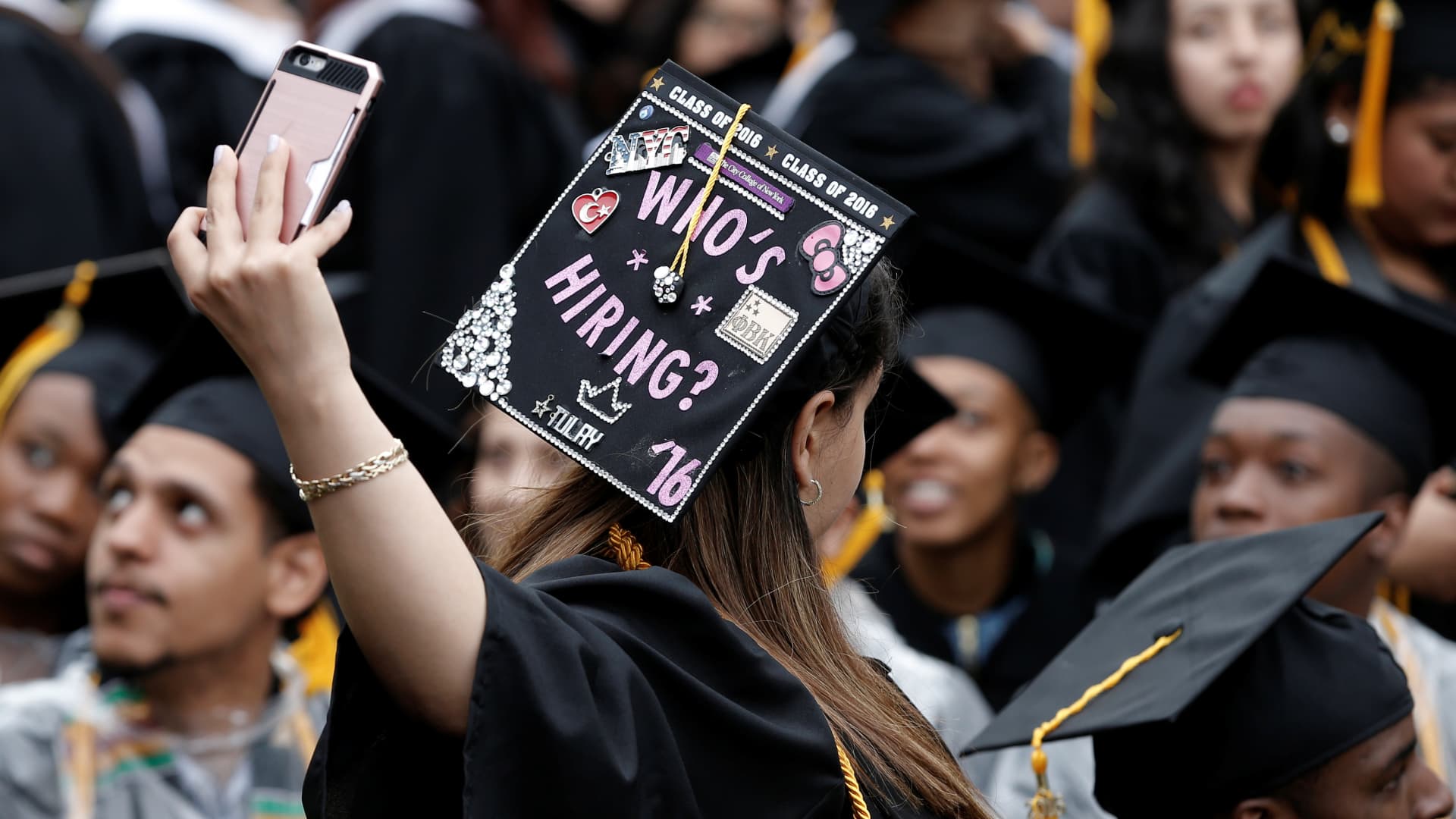

Even as the U.S. economy adds jobs, there are fewer employment prospects for college graduates just starting out, as those armed with a newly minted diploma are facing one of the toughest job markets in a decade, studies show.
“Right now is a really difficult time to find a job,” Cory Stahle, senior economist at Indeed Hiring Lab, told CNBC.
By many measures, the labor market is still relatively strong. The U.S. economy added more jobs than expected in September, according to the Bureau of Labor Statistics. However, the overall unemployment rate edged up to 4.4%, and for younger workers, ages 16 to 24, unemployment was 10.4% in September.
The current job market “is an enormous challenge for members of Gen Z who are just now entering the labor force,” a report published this week by Oxford Economics says.
Rising youth unemployment could be an “early indicator that the economy is slowing down or maybe even heading towards a recession,” said Anders Humlum, assistant professor of economics at the University of Chicago.
A college degree is often considered the best pathway to a well-paying job, but that may no longer be as true as it once was, experts say.
“For the first time in modern history, a bachelor’s degree is no longer a reliable path to professional employment,” Gad Levanon, chief economist at the Burning Glass Institute, told CNBC.
An analysis by Goldman Sachs found that the “safety premium” of a college degree is shrinking. Although college graduates are still less likely to be unemployed than their non-degree counterparts, the advantage is smaller than it’s been in decades.
Job market worsens for recent grads
For recent college graduates, the cracks are starting to show.
Some large employers have said they’re replacing entry-level workers with artificial intelligence in order to streamline operations and cut costs. Concerns about the economy, persistent inflation and a slowdown in consumer spending are also likely contributors to an erosion of entry-level opportunities, other research shows.
Although members of the Class of 2025 submitted more job applications than did their 2024 counterparts — 10 and six, respectively — they received fewer job offers on average than did the previous class, with mean numbers of .78 and .83, respectively, the National Association of Colleges and Employers found. NACE’s study, conducted April 1-May 30, 2025, surveyed 1,479 graduating seniors.
According to a report by education technology company Cengage Group, in its survey conducted in June and July 2025 only 30% of 2025 graduates said they had secured a full-time job in their field and only 41% of the Class of 2024 said they had done so. The survey included 971 recent graduates across the U.S.
“These workers are a vital part of the labor market, and if they’re having a hard time, that means the economy could be having a hard time,” said Indeed’s Stahle.
The market for 2026 graduates could be as bad or worse.
Employers are less optimistic about the overall job market for upcoming grads than they were in the last several years, according to a separate report by the National Association of Colleges and Employers.
About half, or 51%, of employers rated the job market for this year’s college seniors as poor or fair, the highest share since 2020-21.
‘A long-term scarring impact’
A weak labor market can have a negative effect on younger workers’ economic well-being over time, particularly in terms of wage growth and earning potential, according to Oxford’s report.
“Unemployment is rising and wage growth is declining for young adults, which could have a long-term scarring impact,” said Grace Zwemmer, associate economist at Oxford Economics and author of the report.
“If these workers have a hard time getting into jobs now … that also impacts their earning capabilities,” Stahle said. “You start to add these things together and it really can lead to further widening in income inequality.”
“There are big economic implications down the road,” he said.


Personal Finance
Next-Generation Retirement Planning: Managing Longevity Risk and Variable Income Streams


U.S.- Canada Trade Talks Collapse; Carney Says Retaliatory Tariffs Begin September 8

Flock Cameras and the Future of Public Security

AI Infrastructure Boom Hits Physical Limits: Power, Financing, and Supply Chain Strain

Armanino adds Strategic Accounting Outsourced Solutions

New 2023 K-1 instructions stir the CAMT pot for partnerships and corporations

Tax Strategy: Employee Retention Credit update
-

 Stock News1 week ago
Nvidia Earnings Preview: What Wall Street Expects From the AI Bellwether’s Q2 Report
-

 Accounting1 week ago
SEC’s Semiannual Reporting Proposal Faces Investor Pushback: What CFOs Need to Know
-

 Stock News1 week ago
Nvidia Q2 FY2027 Earnings beats Wall Street Expectation with Record $96.2 Billion Revenue
-

 Finance1 week ago
Treasury Bond Volatility Forces Bessent to Double Debt Buyback Size as Yields Swing
-
 Technology4 days ago
AI Infrastructure Boom Hits Physical Limits: Power, Financing, and Supply Chain Strain
-
 Technology2 days ago
Flock Cameras and the Future of Public Security
-
 Economics2 days ago
U.S.- Canada Trade Talks Collapse; Carney Says Retaliatory Tariffs Begin September 8