
Economics
deeply unpopular despite growth and jobs


US President Joe Biden delivers his farewell address to the nation from the Oval Office of the White House in Washington, DC, on Jan. 15, 2025.
Mandel Ngan | Via Reuters
To the untrained eye, Joe Biden leaves the presidency with what appears to be a sterling economic record: hiring proceeding at a solid clip, gross domestic product on the rise and consumers still spending at a strong pace.
There’s just one problem, and it is one that will forever taint Biden’s legacy, the one that sank him and his party politically and for which he will always be remembered.
Inflation and its onerous burden on households, particularly those at the lower end of the income spectrum, has dwarfed all the other good that happened on Biden’s watch. Even with the pace of inflation slowing markedly from its mid-2022 peak, consumers, investors and business owners continually cite it as their most pressing issue.
“Biden inherited an economy that was flat on its back because of the pandemic, and he’s bequeathing an economy that’s flying high,” said Mark Zandi, chief economist at Moody’s Analytics. “Having said that, there are blemishes in the minds of many Americans … They feel ripped off.”
So even with an unemployment rate down dramatically from when he took office, even with growth at 3%, and even with an economy that is cited by top officials as the envy of the rest of the world, the Biden economic story is one that has an unhappy ending as Donald Trump prepares to head back to the White House on Monday.

“To me, that is the lasting legacy and differentiator between the two administrations,” said Joseph LaVorgna, chief U.S. economist at SMBC Nikko Securities and a senior economist in the first Trump administration. “Inflation was two-and-a-half times higher under President Biden than it was under President Trump. That essentially was the key catalyst for the return to Trump’s policy, which was one of very good growth and low and stable inflation.”
Biden leaves office with just a 36% approval rating overall, the lowest point of his presidency, with just 33% approving of the way he handled the economy, according to a CNN poll.
A look through various data points helps tell the story of inflation and how that has fed into the perception about the economy as a whole.
Biden by the numbers
Indeed, the cumulative inflation rate during Trump’s first term from 2017-21 was below 8%, as measured by the consumer price index. For Biden, it’s been 21%. That the economy has expanded in real terms by 11% under Biden — compared to 8.6% under Trump — doesn’t seem to matter. Inflation peaked above 9% in June 2022 and has stayed above the Federal Reserve’s 2% target every month since March 2021.
As the prices of various goods and services increased and stayed elevated, wages have struggled to keep pace. Even with a pickup in 2024, the 19% increase in average hourly earnings under Biden is still below the inflation rate.
Consequently, the disparity between wages and prices has pushed consumer confidence 6% lower under Biden than when he took office, as measured by the widely followed University of Michigan sentiment survey. That’s saying something considering that when Biden took office in January 2021 the economy was still under the shadow of Covid, with many folks choosing to spend the holiday season in late 2020 away from friends and family because of the spread of the omicron variant.
Why are consumers feeling so blue?
After all, even though the price of eggs has soared 180% in four years, household net worth has surged and consumers have continued spending. Retail sales have grown more than 20% and household net worth now totals $169 trillion, or 28% higher than at the end of 2020, according to Fed data.
The big contributors to the household balance sheet have been a meteoric if volatile rise in stocks as well as the value of real estate.
Since Biden took over, tech companies, powered by advancements in artificial intelligence, have pushed equity prices ever higher. The Dow Jones Industrial Average alone has risen more than 40%, and the Nasdaq Composite, which is weighted more towards Silicon Valley high-flyers, has jumped close to 50%.
Home prices during the same period have pushed 24% higher, while the value of real estate at the household level has risen 42%, according to the Fed.
Still, the dream of home ownership has grown more and more elusive as prices have risen and borrowing rates have gone with them. The typical 30-year mortgage rate is over 7% now, more than double where it was in January 2021.
The surge in wealth, particularly in the stock market, also has skewed benefits, mostly tilting toward those with the resources to buy stocks.
The share of total net worth held by the richest 1% stands at 30.8%, its highest in about three years, according to Fed data. Similarly, 1 percenters control just shy of 50% of all stock market-related wealth, a number that also has gradually increasedover the past few years. The lowest 50% of earners hold just 1% of stock market wealth, a number that actually has doubled during the Biden years.
All of the various metrics seem to tie back into the inflation question and how we got here.
A question of history
Economists and policymakers diagnose the issue similarly, though there are some diversions: Supply-demand imbalances at the beginning of the pandemic drove up the costs for goods over services by hitting supply chains. Trillions in fiscal and monetary stimulus aimed at stemming the damage from Covid exacerbated the issue by sending too much money chasing too few goods. Finally, a monetary response in the form of, first low then high interest rates that even Fed officials have admitted was slow-footed helped stoke prices further.
Biden lobbed a fusillade of fiscal ammunition at the post-Covid economy, including the controversial $1.9 trillion American Rescue Plan and the 2022 Inflation Reduction Act that critics say added to the inflation burden, though supporters say the measures provided critical infrastructure and climate mitigation spending that will yield benefits for years to come.
“We have had very good growth and we’ve had a reasonably strong labor market,” LaVorgna said. “The question is, at what price?”
The labor market in fact has been powerful, cranking out millions of jobs as employers sought to meet their own supply-demand mismatch that at one point had open positions outnumbering available workers by a 2-to-1 margin. The Biden economy has seen the unemployment rate slashed by more than 2 percentage points, and looking stable lately despite a blip higher in mid-2024.
Again, though, it all seems to come back to inflation.
The price to which LaVorgna alluded came in the form of a bloated federal budget in which the deficit hit $1.8 trillion in 2024 and is tracking so far in well north of that in fiscal 2025 to finance a $36.2 trillion debt. Taxpayers last year shelled out more than $1 trillion just in interest costs on the debt, and are expected to pay some $1.2 trillion this year, a total that eclipses all other outlays except Social Security, defense and healthcare.
The 6% deficit to GDP ratio the government is running is unheard of in an expansionary economy. Prior to the 2008 financial crisis, the U.S. had not run a shortfall that massive relative to total output since 1945 as the nation was escaping the World War II economy.
The tab, then, will be picked up future generations saddled with today’s debt and deficits.
“That’s a problem, a big problem,” Zandi said.
In fact, much of the job growth has come in government and health care, both sectors linked to expansionary fiscal policy, as well as leisure and hospitality, a sector that took until May 2024 to regain the jobs it lost during Covid.
Despite the challenges that abound, most officials say the U.S. economy is healthy.
Zandi said his global clients frequently ask him what the “secret sauce” is that has kept the U.S. so vibrant compared to its global counterparts. Fed Chair Jerome Powell, who frequently has called the U.S. fiscal path “unsustainable,” said he gets similar questions.
“In these international meetings that I attend, this has been the story .. how well the U.S. is doing,” Powell said at a December news conference. “If you look around the world, there’s just a lot of slow growth and continued struggles with inflation. So I feel very good about where the economy is and the performance of the economy, and we want to keep that going.”
Uncertainty over where the Fed is headed, though, is a cloud that will hang over the Trump economy.
The central bank spiked its key borrowing rate by 5.25 percentage points during its inflation fight but has lowered it a full point since then as officials grow more comfortable with where inflation is heading. However, there’s considerable uncertainty over what happens from here, with markets cautiously pricing in another quarter- or half-point in cuts for the remainder of 2025.
As Biden walks away from the White House, he leaves behind myriad questions of what could have been done to make things better — and how it easily could have been worse.
“Economists looking at this 20 years from now are going to view this as quite an amazing performance,” Zandi said. “The story here is still not over. But my sense is history will judge this period as one to follow in future crises.”












Economics
U.S. National Debt Surpasses $40 Trillion for the First Time: What It Means for the Economy



Executive Summary & Core Macro Outlook
The United States enters the 2026–2030 macroeconomic window as the unquestioned heavyweight of nominal economic output, retaining its status as the primary engine of global financial liquidity, private enterprise innovation, and high-margin technological deployment. According to multi-year projections from the International Monetary Fund (IMF) World Economic Outlook and complementary datasets from the World Bank, the US nominal Gross Domestic Product (GDP) is projected to reach $32.38 trillion by 2026, accounting for approximately 25% of global nominal output and roughly 14.5% of world GDP measured at Purchasing Power Parity (PPP).
Unlike many of its advanced-economy peers across Western Europe and East Asia—which are grappling with acute demographic contraction and structural energy shocks—the United States demonstrates remarkable macroeconomic resilience. The IMF projects a real GDP Compound Annual Growth Rate (CAGR) of 2.1% to 2.3% through 2030. This expansion is sustained by three structural anchors: unmatched capital depth driving massive private-sector investment in Artificial Intelligence (AI) infrastructure, complete energy independence as a net exporter of hydrocarbons and liquefied natural gas (LNG), and high labor productivity gains that cushion the economy against rising debt-servicing costs.
Macroeconomic Data Matrix (2026–2030 Projections)
| Economic Metric | IMF / World Bank Baseline (2026–2030) | Global Benchmark & Context |
| Nominal GDP (2026 Projection) | ~$32.38 Trillion | Rank #1 Globally |
| GDP at Purchasing Power Parity (PPP) | ~$32.40 Trillion | Rank #2 Globally (Behind China’s ~$38.5T PPP) |
| Projected Real GDP CAGR (2026–2030) | 2.1% – 2.3% | Top decile among G7 advanced economies |
| Gross Public Debt (% of GDP) | ~122.5% – 128.0% | Structural fiscal deficit trajectory |
| Core Inflation Rate (PCE Target) | Stabilizing at 2.0% – 2.2% | Federal Reserve inflation target alignment |
| Current Account Balance (% of GDP) | -2.8% to -3.2% | Persistent capital import & reserve currency demand |
Deep Structural Growth Drivers
1. The AI Infrastructure Hyper-Cycle & TFP Expansion
The defining growth catalyst for the US economy over the 2026–2030 horizon is the unprecedented scale of private capital expenditure (Capex) poured into artificial intelligence infrastructure, enterprise software integration, and advanced computing hardware.
Major technology mega-caps and private equity funds are directing hundreds of billions of dollars annually into hyper-scale data centers, domestic semiconductor fabrication, high-voltage electrical grid upgrades, and AI-driven workflow platforms. According to World Bank economic research, technological adoption across American service and manufacturing sectors is driving a notable uptick in Total Factor Productivity (TFP). This productivity surge allows US companies to expand profit margins and output even in an environment characterized by higher structural real interest rates and tight skilled-labor markets.
2. Deep Capital Markets and Private Sector Liquidity
The structural backbone of US economic outperformance remains its financial system. US capital markets represent over 40% of global equity market capitalization and a vast majority of global venture capital and private credit assets.
This liquidity creates an efficient mechanism for capital allocation: high-potential emerging industries (such as quantum computing, synthetic biology, and advanced defense technology) receive early-stage funding at a scale that no other national market can match. When global monetary conditions tighten, global capital flees toward safety and yield, reinforcing US capital depth and lowering the relative cost of equity capital for American corporations.
3. Net Energy Independence & Industrial Cost Advantages
Unlike industrial hubs in Germany, Japan, or South Korea—which remain highly vulnerable to volatile sea-lane logistics and imported fuel price spikes—the United States operates as a major net exporter of petroleum, natural gas, and refined chemical products.
Access to abundant, cheap domestic natural gas provides US heavy industry, advanced manufacturing, and electricity-hungry data centers with a persistent structural cost advantage. Furthermore, federal policy frameworks (including the CHIPS and Science Act and clean energy tax provisions) continue to catalyze domestic private manufacturing investment, re-shoring high-value supply chains from East Asia back to the American Sunbelt and Midwest.
Macroeconomic Vulnerabilities & Downside Risks
1. Structural Sovereign Debt Trajectory
The most significant medium-term threat to US macroeconomic stability is the path of federal public debt. With gross national debt exceeding 120% of GDP and annual federal deficits running between 5% and 7% of GDP, the US fiscal baseline faces increasing structural pressure.
As older legacy low-yield Treasury bonds mature, they are refinanced at higher prevailing interest rates. According to IMF fiscal monitor assessments, federal net interest payments are absorbing an expanding share of total fiscal revenue, crowding out discretionary spending and narrowing the government’s capacity to deploy counter-cyclical fiscal stimulus during future downturns.
2. Commercial Real Estate (CRE) & Banking Sector Realignment
The structural transformation toward hybrid work models has permanently altered office space utilization across major US metropolitan areas. Regional and community banks, which hold a disproportionate share of commercial real estate debt, face ongoing balance-sheet pressure as legacy office loans mature and require refinancing at lower property valuations and higher interest rates. While systemic money-center banks remain well-capitalized, localized credit tightening from regional lenders presents a headwind for small-and-medium enterprise (SME) borrowing.
High-Outperformance Sector Matrix (2026–2030)
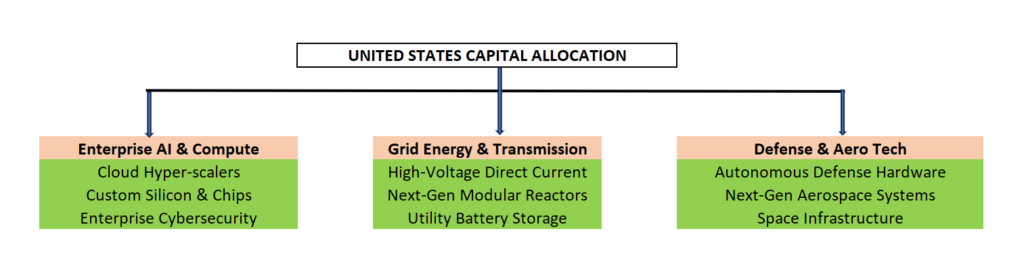
- Enterprise AI, Cloud Compute, & Cybersecurity: Companies building enterprise-grade software, AI agents, cloud architectures, and specialized hardware protection layers.
- Next-Generation Energy & Grid Modernization: Power generation utilities, high-voltage electrical equipment makers, small modular nuclear reactor (SMR) developers, and energy storage systems catering to exponential data center energy demands.
- Advanced Defense Technology & Aerospace: Autonomous systems, satellite networks, hypersonic defense, and advanced materials supplying both domestic security needs and global allied demand.
Strategic Summary for Global Investors & Executives
The United States through 2030 remains the ultimate high-volume, high-yield destination for institutional capital. While fiscal debt risks require long-term monitoring, the immediate 5-year outlook is defined by strong technology-driven productivity, resilient private consumption, and unmatched market liquidity. For global corporations and institutional allocators, exposure to the US economy remains an indispensable pillar of long-term growth strategy.
Top 65 Largest Economies in the World for 2027
Top 10 Largest Economies by 2030: IMF & World Bank GDP Projections for Global Powerhouses

U.S.- Canada Trade Talks Collapse; Carney Says Retaliatory Tariffs Begin September 8

Flock Cameras and the Future of Public Security

AI Infrastructure Boom Hits Physical Limits: Power, Financing, and Supply Chain Strain

Armanino adds Strategic Accounting Outsourced Solutions

New 2023 K-1 instructions stir the CAMT pot for partnerships and corporations

Tax Strategy: Employee Retention Credit update
-

 Stock News1 week ago
Nvidia Earnings Preview: What Wall Street Expects From the AI Bellwether’s Q2 Report
-

 Accounting1 week ago
SEC’s Semiannual Reporting Proposal Faces Investor Pushback: What CFOs Need to Know
-

 Stock News1 week ago
Nvidia Q2 FY2027 Earnings beats Wall Street Expectation with Record $96.2 Billion Revenue
-

 Finance1 week ago
Treasury Bond Volatility Forces Bessent to Double Debt Buyback Size as Yields Swing
-
 Technology5 days ago
AI Infrastructure Boom Hits Physical Limits: Power, Financing, and Supply Chain Strain
-
 Technology2 days ago
Flock Cameras and the Future of Public Security
-
 Economics2 days ago
U.S.- Canada Trade Talks Collapse; Carney Says Retaliatory Tariffs Begin September 8