
Personal Finance
Federal workers at risk of more missed paychecks as shutdown continues

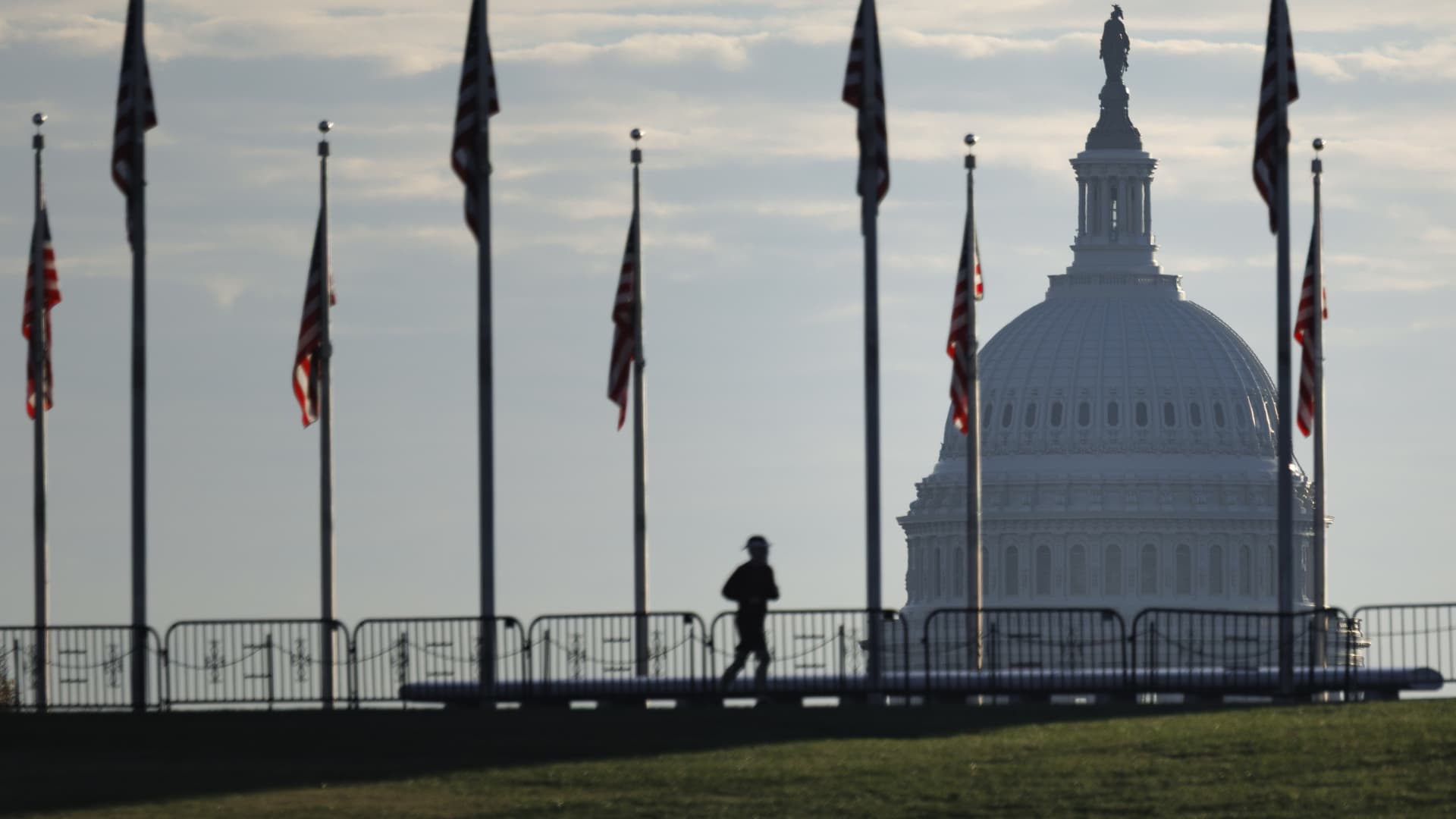
A visitor jogs past the Washington Monument during sunrise on November 5, 2025 in Washington, D.C. The record for longest shutdown in the U.S. Government was broken Wednesday as it entered its 36th day.
Tom Brenner | Getty Images News | Getty Images
The ongoing federal government shutdown is now the longest in U.S. history.
As the standoff goes on, hundreds of thousands of federal employees who rely on the government for paychecks continue to see their incomes dry up.
At least 670,000 federal employees have been furloughed and approximately 730,000 individuals are still working without pay, according to the Bipartisan Policy Center.
If the shutdown lasts through Dec. 1, federal agency workers will collectively miss about 4.5 million paychecks, or $21 billion in total federal wages, BPC estimates. The average federal paycheck is approximately $4,700 in fiscal year 2025, according to the Washington, D.C.-based think tank.
Military workers’ pay may also be affected by the shutdown, with almost 4.2 million paychecks at stake if the shutdown continues to Dec. 1, according to BPC, assuming money is not reallocated. The Trump administration has said it plans to use legislative and Defense Department funds to pay military members.
As the government shutdown continues, the financial burden for federal workers and their families becomes more pronounced.
“Maybe a family can weather one missed paycheck, but then two missed paychecks and beyond, it certainly gets much harder,” said Caleb Quakenbush, associate director at the Bipartisan Policy Center’s economic policy program.
Families may face additional challenges with some safety-net programs, , curtailed as a result of the shutdown. Local food banks and other nonprofits, which are the next line of defense, may experience funding gaps with federal grant money on hold, too.
The federal government shutdown began on Oct. 1 and has dragged on, with Washington lawmakers at an impasse over soon-to-expire enhanced tax credits for Affordable Care Act marketplace insurance premiums. Democrats want to extend the subsidies as part of a deal to end the shutdown, while Republicans have said they want to negotiate the subsidies separately.
Without a continuing resolution or a full-year appropriations bill, non-essential government services and operations have halted.
More pay at risk as federal shutdown continues
Closed signage is seen around the National Gallery of Art Sculpture Garden on the National Mall on October 12, 2025 in Washington, D.C.
Anna Moneymaker | Getty Images News | Getty Images
On Wednesday, the shutdown crossed the 36-day mark, making it the longest federal funding lapse in the country’s history.
The previous 35-day record was set in late 2018 to early 2019 during President Donald Trump’s first term. In January 2019, Trump signed into law the Government Employee Fair Treatment Act to guarantee retroactive pay for both furloughed workers and excepted employees who continued to work during that shutdown and future lapses.
During a Tuesday press briefing, White House press secretary Karoline Leavitt declined to confirm that furloughed federal employees will receive back pay. “Republicans in the White House are very much open to discussing this with Democrats,” Leavitt said.
Near the start of the shutdown, a draft White House memo suggested not all furloughed federal workers would be eligible for back pay.
The White House did not respond to CNBC’s request for further comment by press time.
Democrats and Republicans have been working on legislation to pay federal employees during the shutdown, though so far, they have not been able to agree on the terms.

The government is incurring an obligation to pay employees who continue to work without compensation, according to Quakenbush. In the past, Congress has also typically appropriated back pay for furloughed workers, he said. However, contractors who are not directly employed by the government may be vulnerable to income losses if the shutdown prevents them from working.
Even once this conflict is resolved, it may have lasting effects on the government’s ability to attract talent, according to Quakenbush.
Many federal workers could be making more in the private sector, but choose to do the work they do because of a sense of mission or purpose, he said.
“But our ability to attract quality federal workers in the long term, it really matters how we how we treat them,” Quakenbush said.
Sidelined federal workers should focus on triage
Affected workers should focus now on “financial triage,” according to Melissa Caro, a certified financial planner and founder of My Retirement Network, a financial education company.
“Assess the situation the way an ER nurse would,” Caro said.
The first steps would be to “stop the bleeding” — secure cash flow, call lenders and delay what can be delayed, she said.
It’s OK to let go of routines like investing in retirement and savings accounts if you’re facing a cash crunch, Caro said. Just be sure to return to those habits when things return to normal, she said.
Next, take steps to protect essentials like health coverage, housing and access to medication and food, she said.
“I think people don’t realize how much flexibility there is if you just pick up the phone and make a call,” Caro said, particularly when it comes to housing or utility bills.
Federal workers facing a pay lapse may also want to consider renegotiating payments on their debts, where possible, said Emmanuel Eliason, a CFP and founder and CEO at Eliason Wealth Management in Centennial, Colorado. But they should be wary of predatory lenders who may seek to take advantage of their need for cash, he said.


Personal Finance
Next-Generation Retirement Planning: Managing Longevity Risk and Variable Income Streams


U.S.- Canada Trade Talks Collapse; Carney Says Retaliatory Tariffs Begin September 8

Flock Cameras and the Future of Public Security

AI Infrastructure Boom Hits Physical Limits: Power, Financing, and Supply Chain Strain

Armanino adds Strategic Accounting Outsourced Solutions

New 2023 K-1 instructions stir the CAMT pot for partnerships and corporations

Tax Strategy: Employee Retention Credit update
-

 Stock News1 week ago
Nvidia Earnings Preview: What Wall Street Expects From the AI Bellwether’s Q2 Report
-

 Accounting1 week ago
SEC’s Semiannual Reporting Proposal Faces Investor Pushback: What CFOs Need to Know
-

 Stock News1 week ago
Nvidia Q2 FY2027 Earnings beats Wall Street Expectation with Record $96.2 Billion Revenue
-

 Finance1 week ago
Treasury Bond Volatility Forces Bessent to Double Debt Buyback Size as Yields Swing
-
 Technology5 days ago
AI Infrastructure Boom Hits Physical Limits: Power, Financing, and Supply Chain Strain
-
 Technology2 days ago
Flock Cameras and the Future of Public Security
-
 Economics2 days ago
U.S.- Canada Trade Talks Collapse; Carney Says Retaliatory Tariffs Begin September 8