
Personal Finance
Here’s what travelers need to know about FAA airport flight reductions

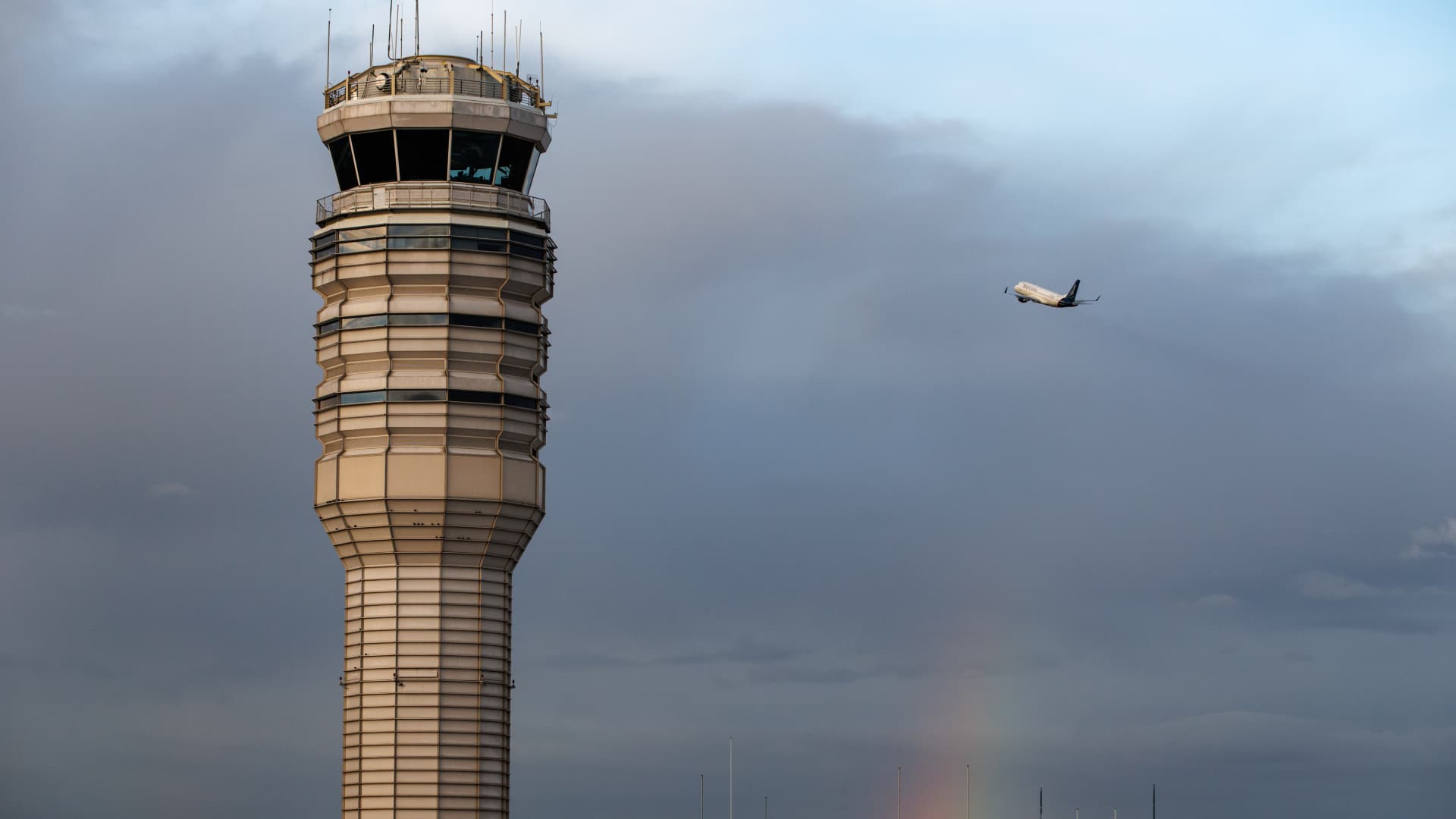
A Republic Airways plane takes off near the air traffic control tower at Ronald Reagan Washington National Airport (DCA) in Arlington, Virginia, US, on Tuesday, Oct. 28, 2025.
Samuel Corum | Bloomberg | Getty Images
Airlines rushed to provide travelers updates after the Federal Aviation Administration said Wednesday that it would reduce flights across 40 airports as the longest government shutdown in history continues to drag on.
Many major airlines said they would waive cancellation fees for even their most basic tickets, which often come with penalties for changes.
Transportation Secretary Sean Duffy previously said he would reduce flight capacity by roughly 10%, affecting 3,500 to 4,000 flights daily. The FAA has not yet announced which “high traffic” airports would be affected.
On Wednesday, Duffy said the reduction was a “proactive” measure due to the delays and cancellations already occurring due to the shutdown. Air traffic controllers, who are considered essential employees required to work during a shutdown, have missed paychecks, and the FAA has said the closure has also raised concerns about already thin staffing among controllers.
Duffy said he expects more cancellations as a result of the reduction, which has no set end time.
“We thought 10% was the right number based on the pressure we were seeing,” Duffy added.
Earlier this week, Duffy told CNBC’s “Squawk Box” that he could “shut the whole airspace down” if the shutdown drags on.
FAA Administrator Bryan Bedford said Wednesday that additional measures may be implemented after the reduction, which he said he has never seen before in his time in the industry. The officials said they were planning to meet with airlines to discuss which flights would be cut.

Airline response
In a Wednesday memo to United Airlines employees, CEO Scott Kirby said the airline will not be reducing long-haul international flying and hub-to-hub flying, instead reducing regional and domestic flights that do not fly between hubs.
The airline also offered all customers refunds even if their flights are not impacted. Kirby said that included “non-refundable tickets and those customers with basic economy tickets.”
In a statement, Delta Air Lines said it expects to operate the “vast majority” of its flights as scheduled and will offer changes, cancellations or refunds for customers’ flights during the impacted period. Delta also said that would include basic economy fares, without penalty.
Frontier Airlines CEO Barry Biffle said he highly recommends travelers flying Friday or in the next 10 days book a backup ticket on another carrier as the flight reductions begin to avoid getting stranded due to flight cancellations.
“I’m sorry this is happening. Hopefully the shutdown is over soon,” Biffle wrote on LinkedIn. “Just giving everyone practical travel advice.”
American Airlines said it expects the “vast majority of customers’ travel will proceed as planned,” adding that the airline will reach out to travelers proactively as schedule changes occur.
The airline also said it will offer immediate rebooking options for all impacted travelers and that customers whose flights are canceled for any reason will be able to change their flight or request a refund without penalty. As of Thursday morning, the airline was still awaiting clarifying information from the FAA about which of its flights will be impacted.
Southwest Airlines also released a statement saying that the majority of its flights will not be impacted and that its international flights should operate as usual. The airline said it will “proactively communicate well in advance and will offer flexibility in travel plans.”
The Association of Flight Attendants, representing 55,000 flight attendants at 20 airlines, released a statement Wednesday urging Congress to end the shutdown so air traffic controllers and Transportation Security Administration workers can get paid.
“The false narrative that this shutdown is a choice of either paying federal workers or protecting affordable healthcare is outrageous when both crises were manufactured by the exact people who can fix it,” the statement read.
What travelers need to know
Passengers check in at an American Airlines’ counter at Ronald Reagan Washington National Airport in Arlington, Virginia, the United States, on Oct. 10, 2025.
Li Rui | Xinhua News Agency | Getty Images
Experts recommend consumers who are set to travel in the next week stay on top of flight cancellations and delays through the websites and apps.
Nick Ewen, senior editorial director at travel site The Points Guy, said flexibility “is going to be key” as travelers rush to rebook, adding it’s important to download each airline’s mobile app and enable all notifications.
“A lot of the times, you have to actually enable notifications on individual trips or in your account to text you if there are changes or disruptions,” Ewen told CNBC.
He recommended anyone with non-urgent travel reschedule their trips, though that likely only applies to a small number of travelers, and consider choosing other forms of transportation instead. For essential trips, Ewen said passengers should be prepared for long wait times, use self-service rebooking tools and be aware of the fact that many other people will also be rebooking and scrambling for limited seats.
Ewen said he has been covering the industry for many years, and the last time he and his colleagues saw a major, national disruption in air travel like this was 9/11.
“The biggest thing is a lot of kindness goes a long way,” he said. “So if you’re at an airport and you find out that your flight is canceled, I promise you screaming at that airline employee is not going to get you rebooked any faster — in fact, it’s probably going to make them less likely to be willing to help you. So recognize that everyone is in this together.”
AAA spokesperson Aixa Diaz said the company recommends arriving at the airport extra early to avoid long lines and avoid checking in a bag if possible in case flights get canceled.
“Ultimately, there’s a lot that’s out of travelers’ control — so control what you can, and be as flexible as possible,” Diaz said.
Travel insurance
Travel insurance can reimburse consumers for certain costs and inconveniences incurred from a trip disruption, like flight cancellations, delays, lost luggage, or unforeseen costs for lodging and meals.
Consumers have been buying travel insurance at an elevated rate amid the government shutdown, but travel and insurance experts warn that such policies don’t offer blanket protection for shutdown-related travel snafus, and a lot depends on the fine print.
For example, a policyholder generally can’t get insurance benefits if they choose to cancel their travel plans to avoid any headaches. Cancel-for-any-reason coverage is an exception, though it also comes with its own caveats.
Whether or not a policyholder gets compensated may come down to the rationale an airline provides for a delayed or canceled flight.
Many insurers only pay benefits if a delay or cancellation is attributable to a “common carrier” disruption like a mechanical failure, travel experts said.
“Airlines typically won’t cite causes other than operational terms like ‘mechanical issues’ or general delays, cancellations, or lost belongings, even during a government shutdown,” Lauren McCormick, a spokesperson for Squaremouth, an online platform for comparing travel insurance policies, wrote in a recent blog post. “So, these are generally still covered under most comprehensive travel insurance plans.”


Personal Finance
Next-Generation Retirement Planning: Managing Longevity Risk and Variable Income Streams


U.S.- Canada Trade Talks Collapse; Carney Says Retaliatory Tariffs Begin September 8

Flock Cameras and the Future of Public Security

AI Infrastructure Boom Hits Physical Limits: Power, Financing, and Supply Chain Strain

Armanino adds Strategic Accounting Outsourced Solutions

New 2023 K-1 instructions stir the CAMT pot for partnerships and corporations

Tax Strategy: Employee Retention Credit update
-

 Stock News1 week ago
Nvidia Earnings Preview: What Wall Street Expects From the AI Bellwether’s Q2 Report
-

 Accounting1 week ago
SEC’s Semiannual Reporting Proposal Faces Investor Pushback: What CFOs Need to Know
-

 Stock News1 week ago
Nvidia Q2 FY2027 Earnings beats Wall Street Expectation with Record $96.2 Billion Revenue
-

 Finance1 week ago
Treasury Bond Volatility Forces Bessent to Double Debt Buyback Size as Yields Swing
-
 Technology5 days ago
AI Infrastructure Boom Hits Physical Limits: Power, Financing, and Supply Chain Strain
-
 Technology3 days ago
Flock Cameras and the Future of Public Security
-
 Economics3 days ago
U.S.- Canada Trade Talks Collapse; Carney Says Retaliatory Tariffs Begin September 8