
Personal Finance
Federal workers’ money questions answered

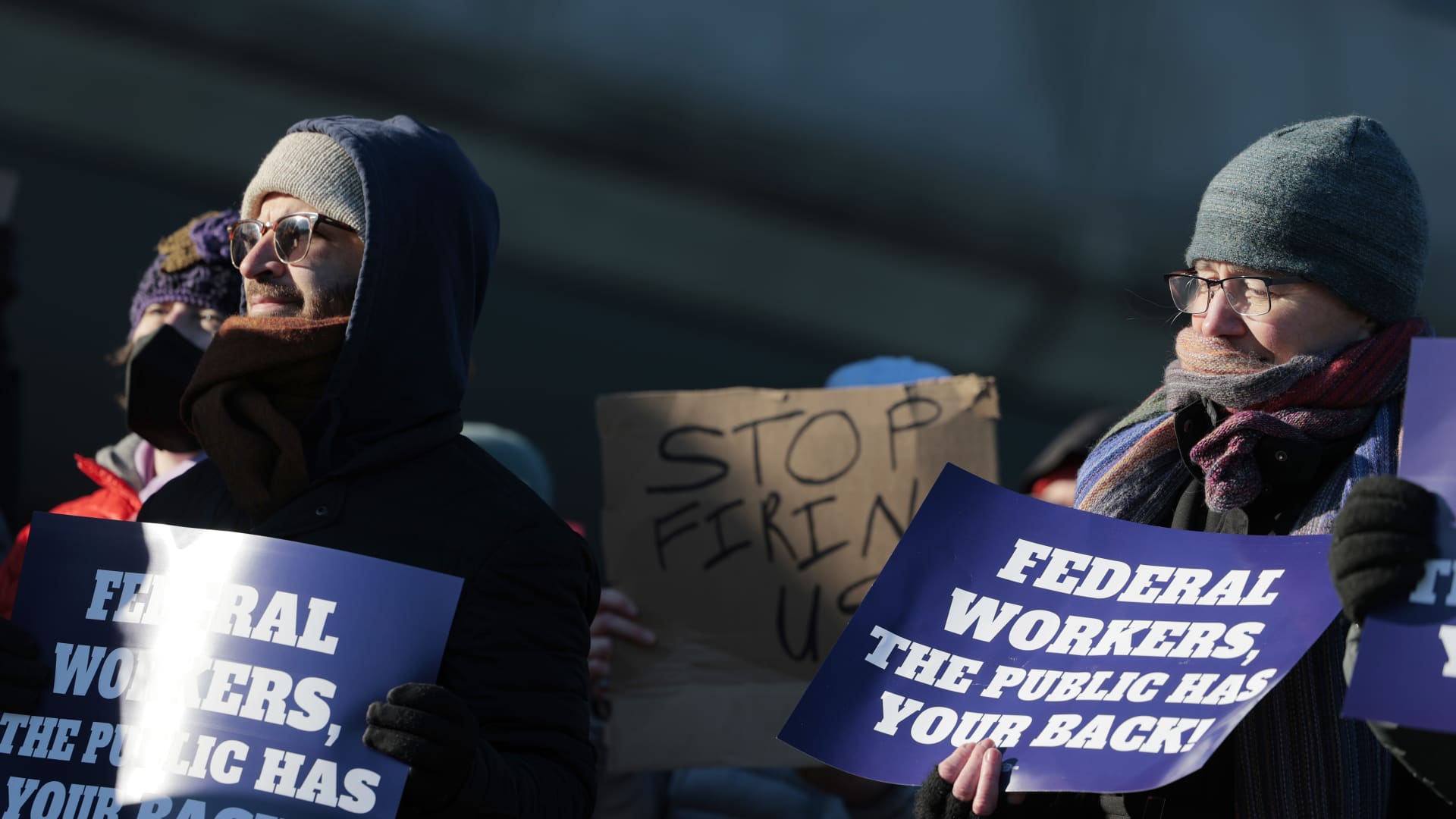
Protesters demonstrate in support of federal workers outside of the U.S. Department of Health and Human Services on Feb. 14, 2025 in Washington, DC.
Anna Moneymaker | Getty Images
On Feb. 11, Elizabeth Aniskevich, an attorney at the Consumer Financial Protection Bureau, received a notice that she was being terminated immediately.
“I was completely shocked,” said Aniskevich, 39. She had been with the CFPB for nine months and imagined spending her entire career in the federal government.
“I didn’t expect it to unfold this way,” she said.
More than a week later, she’s still scrambling for basic answers. “There’s no information about what’s going on with my benefits, or what I need to do with unemployment,” Aniskevich said.
She’s worried about how she’ll pay the mortgage on her Washington, D.C., apartment after her emergency savings runs out in a few months.
“I’ve worked really hard to be financially stable,” Aniskevich said.
Elizabeth Aniskevich.
Courtesy: Elizabeth Aniskevich
Aniskevich is one of thousands of federal workers laid off by the new Trump administration in recent weeks and thrown into financial and career uncertainty. President Donald Trump and Elon Musk‘s secretive government-slashing effort, the Department of Government Efficiency or DOGE, are working to shrink the federal workforce.
Losing one’s job is always difficult. But the suddenness and speed of the firings, which have affected offices from the Environmental Protection Agency to the U.S. Department of Education, have left workers especially in the dark about their rights and next steps, experts said.
“Most people would have selected the public sector because it has a reputation of being a more stable work environment than the private sector,” said Don Moynihan, a public policy professor at the University of Michigan. “But in this case, that stability proved to be an illusion.”
CNBC spoke with financial advisors and policy experts to get answers to some of the many important questions terminated federal workers likely have right now.
Workers may be able to appeal, take legal action
The Trump administration and Musk’s DOGE have largely targeted workers on a probationary status for cuts.
That’s because probationary workers, who have typically been in their position for a year or less, have fewer protections after they’re removed than do career civil servants, said David Eric Lewis, a political science professor at Vanderbilt University.
For example, probationary workers might not meet the requirements to appeal their termination to the U.S. Merit Systems Protection Board. The board reviews cases in which federal workers were laid off or suspended.
Still, there are limited cases when they can appeal, experts said. You should speak to an employment lawyer or your union representative for more details, experts recommend.
The name and logo for the Consumer Financial Protection Bureau (CFPB) is seen scraped off the door of its building in Washington, D.C., U.S., Feb. 20, 2025.
Brian Snyder | Reuters
“They can also seek legal relief,” Lewis said. Your union may help you file your lawsuit in federal court, he added.
It can be more effective to bring your legal challenge as a group, with other terminated federal workers, Lewis said.
“That’s what is happening,” he said. “There’s a hope that there is at least a stop to these orders.”
A federal judge Thursday denied a bid by labor unions to block the mass layoffs across the federal workforce. The National Treasury Employees Union alongside four other groups filed a lawsuit against the firings on Feb. 12.
What to know about unemployment benefits
Federal workers can collect unemployment benefits through the Unemployment Compensation for Federal Employees (UCFE) program. Some government employees — including ex-military personnel discharged under honorable conditions and former members of the National Oceanographic and Atmospheric Administration — receive benefits through a separate program, known as the Unemployment Compensation for Ex-servicemembers (UCX).
The jobless benefits, which are supposed to arrive within two or three weeks after you apply for them, are nearly identical to those of private-sector workers, said Michele Evermore, senior fellow at the National Academy of Social Insurance.
States — as well as U.S. territories and the District of Columbia — administer the payments. Workers must submit an application with the appropriate workforce agency. You should apply in the state or district where your last official duty station was located, Evermore said.
Those working remotely on a full-time basis likely need to file a claim in their state of residence, Evermore said.
Workers should apply for unemployment as soon as possible, experts said. Delays are likely amid the purge of government workers.
Those claiming UCFE benefits will likely need to include certain documents with their claim, including a SF-8, or a Notice to Federal Employee About Unemployment Insurance, as well as a SF-50, or a Notification of Personnel Action, according to the U.S. Labor Department.
Those applying for UCX benefits should have a copy of their service and discharge documents — DD-214 or a similar form, the Labor Department said.
Federal employers are supposed to provide these forms to workers upon separation, but Aniskevich said the Consumer Financial Protection Bureau still hadn’t given her those documents as of Friday.
For now, she filed her unemployment application in Washington, D.C., without them.
“It’s stressful to have uncertainty about whether my claim can be processed given the lack of forms,” Aniskevich said.
Federal agencies appear to be citing lackluster performance as rationale for many job cuts in termination letters, experts said. Even so, workers should still apply for benefits, Evermore said. The cause must generally rise to the level of “gross misconduct” to prevent people from receiving aid.
This could delay benefits if the government contests a claim, however, experts said.
Health coverage for terminated workers
Meanwhile Chris, who worked as a transportation program specialist at the Federal Transit Administration, was laid off on February 14. Like Aniskevich, he was a probationary worker, and had been employed by the FTA for around nine months. (He requested to use his first name only, out of fear of retaliation from the Trump administration.)
Despite the financial stability usually associated with a federal job, he found himself with no protections.
“There was no severance pay,” said Chris, 33, who is based in the Los Angeles area.
Chris did learn that his health benefits will continue for 31 calendar days after Valentine’s Day.
Similarly, federal employees should try to determine the specific date their health coverage will end, experts said. While the timelines may vary, most probationary workers will need to find new health insurance soon.
Those who wish to continue with their current health care should look into the federal government’s Temporary Continuation of Coverage, experts say. Under this option, you’re able to extend your federal workplace plan for up to 18 months after termination. (It’s similar to COBRA, or the Consolidated Omnibus Budget Reconciliation Act, for private-sector workers.)
Keep in mind that, with TCC, you’ll be responsible for the full cost of your premiums, plus any administrative fees.
“It’s going to be [a] pretty big hike,” said Brennan Rhule, a Reston, Virginia-based certified financial planner who specializes in federal workers.
If the new premium cost is too high to shoulder under TCC, you may qualify for a special enrollment period of the Affordable Care Act marketplace, according to Kate Ende, leader of the policy team at the Consumers for Affordable Health Care, a nonprofit. The special enrollment period typically gives you 60 days to sign up for a marketplace plan after you lost your coverage.
Medicaid might also be an option, Ende said, and if you qualify you can enroll at any time for it.
Relief options for recurring bills
Federal workers concerned about staying current with their bills should reach out to their lenders and explain their situation, consumer advocates said.
For instance, contact your mortgage lender and ask about forbearance or deferment options, said John Breyault, vice president of public policy at the National Consumers League. If you’re a renter, landlords and property managers may offer temporary payment plans or deferments.
More from Personal Finance:
How IRS layoffs could impact your tax filing, refund
As tariffs ramp up, here’s an investment option
DOGE’s FDIC firings put banking system at risk
Some auto lenders allow deferments, too, especially if you have a good payment track record. Meanwhile, your auto insurer may be able to adjust your coverage and lower your costs if you will no longer be driving long distances to work, Breyault said.
For utilities like electricity, water, gas, internet and phone service, see if your providers offer a grace period or deferred payments, Breyault said.
Those with student loan bills can request an unemployment deferment with their servicer.
Keep in mind that such concessions and breaks can be helpful in the near-term, but read the terms thoroughly. There could be long-term costs associated, such as interest continuing to accrue or other fees.
Watch out for ‘undoable’ retirement account missteps
Federal workers who find themselves unexpectedly out of work may be tempted to take money from their retirement plans. However, experts emphasize it is important to know the ins and outs of each plan’s rules to avoid unexpected costs.
“Before you do anything, make sure you talk to somebody who understands and can guide you,” said CFP Mark Keen, who is a federal benefits expert with the National Active and Retired Federal Employees Association.
“Make sure that you don’t make any mistakes that are undoable,” said Keen, who is also a partner at Keen & Pocock.
Federal workers generally have access to a pension through the Federal Employee Retirement System, or FERS, and to a defined contribution savings plan, known as the Thrift Savings Plan, or TSP.
FERS provides a guaranteed income stream once a worker reaches a certain age, a perk that’s mostly unavailable in the private sector, Keen said.

Federal workers may withdraw their FERS contributions if they leave federal employment, but that may not be the best choice. It will take a while to build your pension back up if you return to federal service, said Katelyn Murray, a chartered federal employee benefits consultant and director of relationship management at Serving Those Who Serve.
If you leave the balance intact, you retain the years of service you’ve accumulated, Murray said. Having a FERS pension also allows retirees to continue health coverage through the Federal Employees Health Benefits, or FEHB, in retirement.
Even if you’re not sure you may return to federal work, you may want to think twice before cashing out, Murray said.
“It’s more about flexibility and keeping your options open,” Murray said.
Federal workers may have some flexibility with a Thrift Savings Plan that is like a 401(k) plan and allows employees to make contributions that are matched by government agencies.
Generally, participants who are at least age 59½ can make withdrawals without penalties.
In some cases, workers may qualify for the Rule of 55, which may allow them to take withdrawals from the TSP without having to pay a 10% early withdrawal penalty, provided they are at least age 55 when they leave their job (or age 50 for some public safety employees).
If you haven’t found another job yet, you can’t take a TSP loan, but you may be able to look at doing a hardship withdrawal, Murray said. Importantly, by doing so you may incur taxes and/or penalties, as well as delay your anticipated retirement date.


Personal Finance
Next-Generation Retirement Planning: Managing Longevity Risk and Variable Income Streams


U.S.- Canada Trade Talks Collapse; Carney Says Retaliatory Tariffs Begin September 8

Flock Cameras and the Future of Public Security

AI Infrastructure Boom Hits Physical Limits: Power, Financing, and Supply Chain Strain

Armanino adds Strategic Accounting Outsourced Solutions

New 2023 K-1 instructions stir the CAMT pot for partnerships and corporations

Tax Strategy: Employee Retention Credit update
-

 Stock News1 week ago
Nvidia Q2 FY2027 Earnings beats Wall Street Expectation with Record $96.2 Billion Revenue
-
 Technology5 days ago
AI Infrastructure Boom Hits Physical Limits: Power, Financing, and Supply Chain Strain
-
 Technology3 days ago
Flock Cameras and the Future of Public Security
-
 Economics3 days ago
U.S.- Canada Trade Talks Collapse; Carney Says Retaliatory Tariffs Begin September 8