
Personal Finance
Here’s why young adults in Puerto Rico are struggling financially

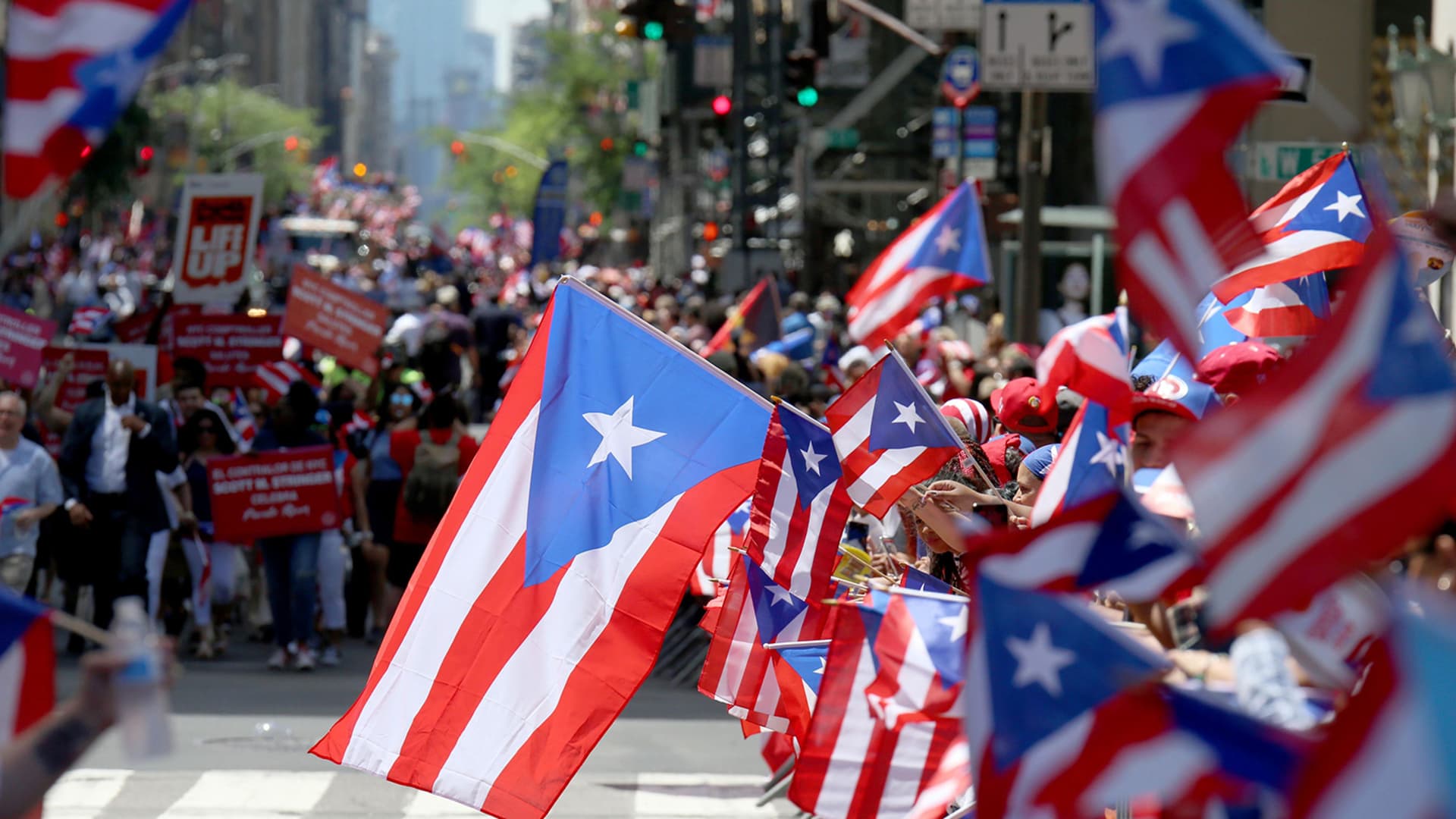
Parade attendees wave Puerto Rican flags on Fifth Avenue in Manhattan during the annual Puerto Rico Day Parade.
Luiz C. Ribeiro | New York Daily News | Tribune News Service | Getty Images
Young adults in Puerto Rico are on shaky financial ground, a study finds.
About 47% of respondents in the U.S. territory are financially fragile, meaning they lack confidence in their ability to absorb a $2,000 economic shock, according to a September report from the Financial Industry Regulatory Authority Investor Education Foundation.
“This is the first time a study of this nature has been done on Puerto Rico,” said report co-author Harold Toro. He is also the research director and chair in economic development research at the Center for a New Economy, an economy-focused think tank based on the island.
“It highlights things that people feel and experience, but that are hard to find numbers for,” Toro said.
More than half, or 59%, of adults ages 18 to 29 on the island are financially fragile, compared to 47% of those ages 30 to 54 and 41% of those age 55 or older, FINRA found. The organization in 2021 polled 1,001 adults who live in Puerto Rico.
“The financial fragility and capability more broadly in Puerto Rico … it’s pretty dire when we compare it to the mainland United States,” said report co-author Olivia Valdés, senior researcher at the FINRA Investor Education Foundation.
Financial fragility, particularly for young adults, is much higher in Puerto Rico than on the mainland U.S. More than half, or 59%, of 18 to 29-year-olds are financially struggling in Puerto Rico compared to 38% of the same age group in the U.S., according to FINRA data.
About 30% of U.S. residents overall were considered financially fragile in 2021, according to FINRA’s latest Financial Capability in the United States report, which polled 27,118 U.S. adults in 2021. The Puerto Rico survey was separate, but fielded at the same time.
The younger generation has experienced financial strain for over two decades.
Vicente Feliciano
founder and president of Advantage Business Consulting, a market analysis and business consulting firm in San Juan, Puerto Rico
Many young adults leave Puerto Rico to try and improve their financial situation, by seeking education or employment in the United States or in other countries. For the young adults who stay, the generation must contend with an economy under recovery, an electric grid hanging on by a thread and sky-high costs for basic needs like housing.
Understanding why young Puerto Ricans are financially fragile could help with efforts to retain younger residents and bring working professionals back to the island, experts say.
But “living in Puerto Rico can’t just be a matter of survival, it also has to be a place where you can thrive,” said Fernando Tormos Aponte, an assistant professor of sociology at the University of Pittsburgh.
Young Puerto Ricans are ‘having a tougher time’
To be sure, a certain degree of financial strain is typical for people just starting out. Generally speaking, financial standing gets better with age.
But financial fragility is more prominent among young adults in Puerto Rico compared to the U.S.
“People who are younger seem to be … having a tougher time,” Toro said.
Adults age 18 to 29 in Puerto Rico are less likely than adults ages 30 and over to report having emergency and retirement savings, FINRA found.
Less than a quarter, 22%, of 18- to 34-year-olds in Puerto Rico have any type of retirement account. Among that age group on the mainland U.S., 43% do, according to the broader FINRA analysis.
Young adults in Puerto Rico are also more likely than older residents to have student loan and medical debt.
Younger generations only know a Puerto Rico in crisis
Puerto Rico’s economy “is doing quite well,” said Vicente Feliciano, founder and president of Advantage Business Consulting, a market analysis and business consulting firm in San Juan, Puerto Rico.
The job market has improved, and salaries are growing at a faster pace than inflation, thanks to the increase in minimum wage, Feliciano said. While the federal minimum wage in the U.S. is $7.25, it’s $10.50 in Puerto Rico.
Employment in the private sector was at a 15-year high since mid- 2022, according to the Federal Reserve Bank of New York.
Still, the median household income on the island was just $25,621 in 2023, less than a third of the $80,610 median household income in the mainland U.S., per Census data.
Even though the last couple of years have been better, for adults under 40 in Puerto Rico, “most of their working lives have been overshadowed by the depression that Puerto Rico fell through from 2006 through 2015,” Feliciano said.
“The younger generation has experienced financial strain for over two decades,” he said. “They have seen many of their friends leave the country. They are frustrated. They blame the traditional [political] parties for something that may or may not be their fault, but is very real.”
‘We want people to come back’
Alejandro Talavera Correa moved to Washington, D.C. in 2019 for a job in finance. The role and pay were too good to pass up, he said: “People have to leave in order to get a competitive salary.”
But within a few years, he found himself moving back to Puerto Rico.
Talavera Correa, now 28, found an opportunity to return to Puerto Rico through El Comeback, an online job board that is tailored to include job postings that meet market salary standards or offer benefit packages for prospective applicants.

“We want people to come back,” said Ana Laura Miranda, project manager of El Comeback. “We need to be realistic. We need to invest in employees and if we don’t have the salaries, then we need to create benefit packages.”
According to Miranda, the audience that mostly uses the platform are in their late 20s to those in their mid to late 30s. They vary from single adults to families with kids.
More from Personal Finance:
Latino caregivers face higher financial strain
Latino student loan borrowers face extra challenges
Over 3 million financially insecure Latinas live in abortion-restricted states
The initiative is still in its early stages, and has attracted and retained 51 candidates, Miranda said.
Candidates are often looking to be close to family or regain the sense of belonging or warmth that comes with being in Puerto Rico, said Miranda. But young workers returning to Puerto Rico may face new financial challenges.
“There’s always going to be a certain pay cut,” as six figure salaries are not as common on the island as they are in the U.S. And “Puerto Rico is not cheap,” said Miranda. “The cost of living … it’s real. We cannot miss that.”
The island — like the mainland U.S. — has a housing market that’s unaffordable for many residents, and having a car is essential to get around because public transportation services can be unreliable.
Talavera Correa was fortunate to buy a condo during the pandemic when mortgage rates were low.
“If you don’t have that kind of money, you’re essentially stuck either renting or living with your parents,” said Talavera Correa.
Yet, like most Puerto Ricans on the island, he still struggles with regular blackouts and electricity problems. Those send him to his mom’s house, where service is more reliable due to her solar panels.
“Blackouts and problems with electricity are quite recurrent,” said Advantage Business Consulting’s Feliciano. “Electricity is a major distinction between the U.S. and Puerto Rico and it hits the younger generation harder than it hits the wealthier, older generation.”
Despite the challenges, Talavera Correa is happy with his decision.
“It’s essentially the quality of life that you can have here in Puerto Rico. You have the beaches, everything outdoors, and the opportunity that you can have to have a happy life,” he said.
“But if that comes with economic restraints, or just overall living situations regarding the electricity, water … that disappoints a lot of people [who] come back.”


Personal Finance
Next-Generation Retirement Planning: Managing Longevity Risk and Variable Income Streams


U.S.- Canada Trade Talks Collapse; Carney Says Retaliatory Tariffs Begin September 8

Flock Cameras and the Future of Public Security

AI Infrastructure Boom Hits Physical Limits: Power, Financing, and Supply Chain Strain

Armanino adds Strategic Accounting Outsourced Solutions

New 2023 K-1 instructions stir the CAMT pot for partnerships and corporations

Tax Strategy: Employee Retention Credit update
-

 Stock News1 week ago
Nvidia Q2 FY2027 Earnings beats Wall Street Expectation with Record $96.2 Billion Revenue
-
 Technology6 days ago
AI Infrastructure Boom Hits Physical Limits: Power, Financing, and Supply Chain Strain
-
 Technology4 days ago
Flock Cameras and the Future of Public Security
-
 Economics4 days ago
U.S.- Canada Trade Talks Collapse; Carney Says Retaliatory Tariffs Begin September 8