
Personal Finance
What a new Trump administration could mean for your money, advisors say

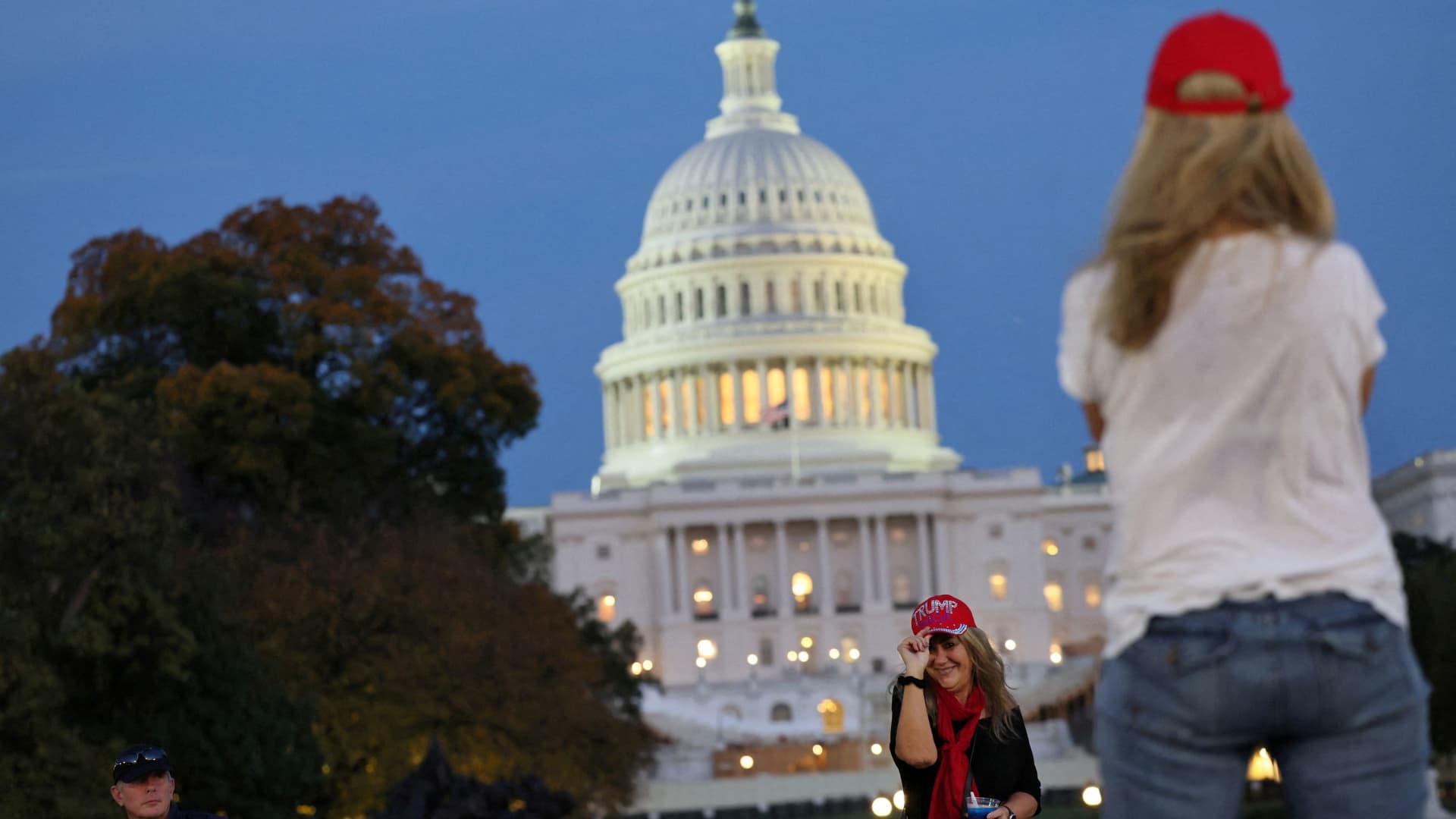
Trump supporters take photographs near the U.S. Capitol building as the sun sets the day U.S. President Elect Donald Trump was declared the winner of the presidential election in Washington, U.S., November 6, 2024.
Leah Millis | Reuters
Now that Donald Trump has been elected president, many individual investors are wondering what that means for their money.
The markets rallied this week on news of Trump’s win, with the Dow Jones Industrial Average climbing past 44,000 for the first time on Friday.
Yet, when it comes to long-term performance of the markets and policies that Trump proposed on the campaign trail, financial advisors say it’s best to take a wait-and-see approach before making any big money decisions.
“If clients have a financial plan, have a long-term strategy that meets their goals, our best advice is to stay with that plan and strategy,” said Jude Boudreaux, a certified financial planner who is a partner with The Planning Center in New Orleans.
“Then we’ll make adjustments as more details come forward,” said Boudreaux, who is also a CNBC FA Council member.
Lee Baker, a CFP and owner of Claris Financial Advisors in Atlanta, said he’s also told clients not to make wholesale financial changes now.
“That’s not to suggest that, based on the policies, that there might not be tweaks or tilts, depending on how things play out,” said Baker, who is also a CNBC FA Council member.
Markets may be volatile
The markets reacted favorably to Trump’s win. However, it remains to be seen whether that upward trajectory will continue.
“One thing that I’ve cautioned people about is don’t necessarily confuse the market pop that we saw being an affirmation of all things Trump,” Baker said.
Markets generally don’t like uncertainty, and experts say the post-election rally is evidence of that.

“The markets could be reacting with relief that this toss-up election actually really did produce a clear, undisputed winner,” said CFP Stacy Francis, CEO of Francis Financial, based in New York City.
Many investors expect Trump to lead with faster economic growth and more market friendly policies, said Francis during a Friday webcast on what Trump’s presidency could mean for investors’ money. Francis is also a CNBC FA Council member.
For individual investors, it’s still best to base asset allocations on their individual situation, such as personal goals, time horizon and risk tolerance, said Marguerita Cheng, CEO of Blue Ocean Global Wealth in Gaithersburg, Maryland.
Those factors should not change based on the outcome of the election, said Cheng, a CNBC FA Council member.
Because Trump is expected to be easier on regulation, some investors expect to see a boost for energy, financial and industrial stocks. To mitigate risk, individuals may get exposure to those sectors by investing in a broad-based index, she said.
Ultimately, market moves do not necessarily depend on who is president.
“The stock market tends to perform well no matter which party holds the White House,” Francis said.
Lower taxes could be extended
The Tax Cuts and Jobs Act, which was enacted in 2017 during Trump’s first presidential term, ushered in lower tax rates. That legislation — which included a higher standard deduction, a $2,000 child tax credit and a $10,000 cap on the state and local deduction — is due to expire at the end of 2025. With Trump’s re-election, many of the tax changes could be extended, advisors say.
Both individuals and corporations are expecting tax cuts with Trump’s win, Francis noted during her Friday webcast, which may have also been a factor in this week’s stock market surge.
“These tax cuts are expected to lead to somewhat faster economic growth in both 2026 as well as 2027,” Francis said.
On the campaign trail, Trump also floated the idea of eliminating taxes on Social Security benefits, as well as on tips and overtime pay. While those policies would put more money in Americans’ pockets, Francis noted, other experts say it’s too soon to count on those changes.
“You don’t know what the law or policy is going to be if it hasn’t even been properly drafted yet, much less adopted,” David Haas, a CFP and owner of Cereus Financial Advisors in Franklin Lakes, New Jersey, told CNBC.com earlier this week, referring to the proposed Social Security changes.
Inflation could go up
The Federal Reserve has helped to bring the pace of inflation down, close to its 2% target.
Yet, some policies proposed by Trump may risk elevating inflation.
Tariffs could prompt prices on imported goods and services to go up. Inflation may also increase if individuals have more money in their pockets due to Trump’s pro-business policies as well as tax cuts, Francis said.
That could change the trajectory of the Federal Reserve’s interest rate policy. The central bank cut interest rates by 25 basis points on Thursday. However, any coming moves in 2025 could be impacted by Trump’s leadership.


Personal Finance
Next-Generation Retirement Planning: Managing Longevity Risk and Variable Income Streams


U.S.- Canada Trade Talks Collapse; Carney Says Retaliatory Tariffs Begin September 8

Flock Cameras and the Future of Public Security

AI Infrastructure Boom Hits Physical Limits: Power, Financing, and Supply Chain Strain

Armanino adds Strategic Accounting Outsourced Solutions

New 2023 K-1 instructions stir the CAMT pot for partnerships and corporations

Tax Strategy: Employee Retention Credit update
-

 Stock News1 week ago
Nvidia Q2 FY2027 Earnings beats Wall Street Expectation with Record $96.2 Billion Revenue
-
 Technology6 days ago
AI Infrastructure Boom Hits Physical Limits: Power, Financing, and Supply Chain Strain
-
 Technology4 days ago
Flock Cameras and the Future of Public Security
-
 Economics4 days ago
U.S.- Canada Trade Talks Collapse; Carney Says Retaliatory Tariffs Begin September 8