
Personal Finance
How EVs and gasoline cars compare on total cost

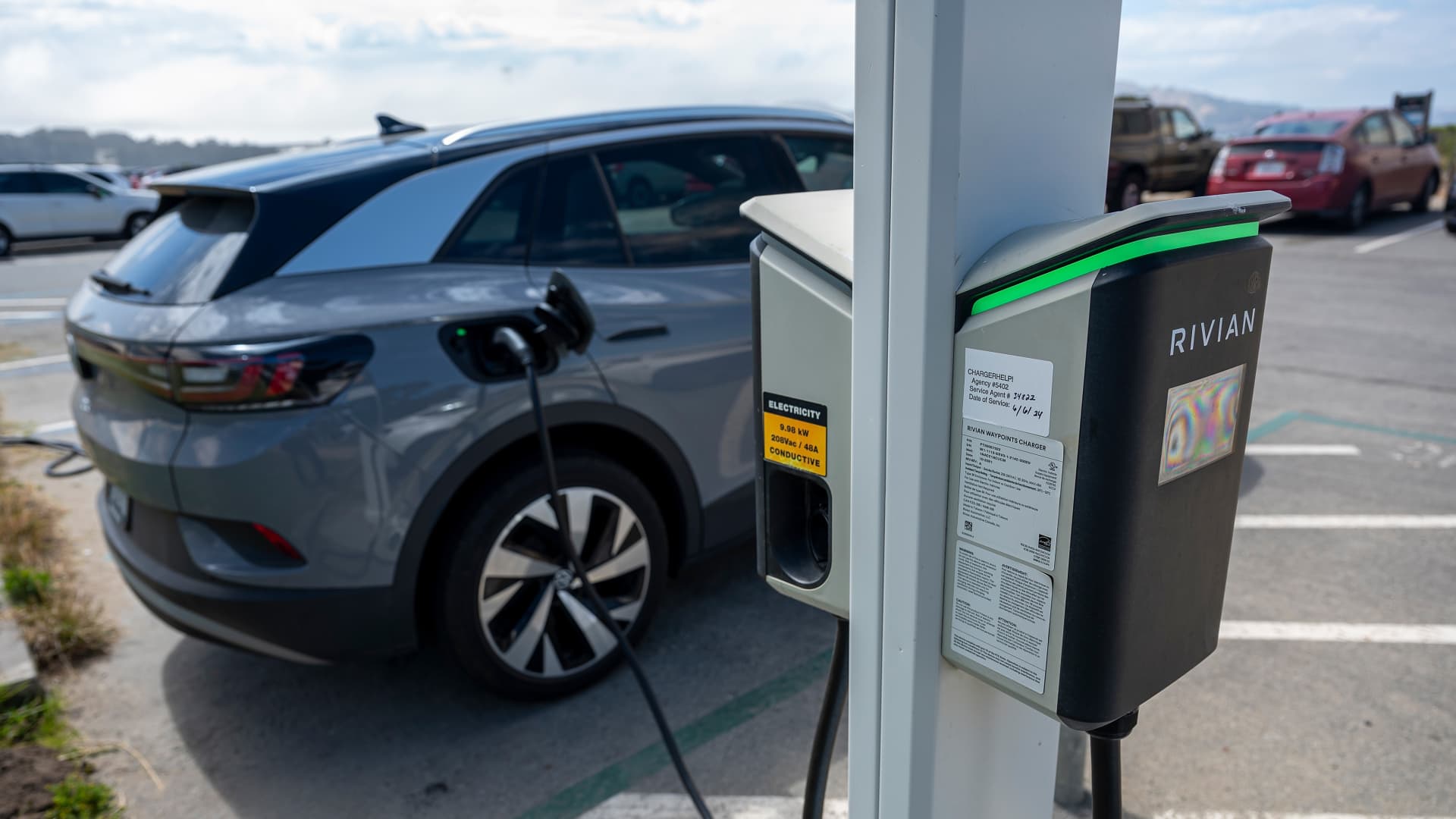
David Paul Morris/Bloomberg via Getty Images
Electric vehicles may save consumers money over the long-term relative to traditional gasoline-powered cars.
While EVs still tend to cost more upfront to purchase, recurring charges for fuel and maintenance are generally cheaper — adding up to a total lifetime cost that can be lower than that of a gas vehicle, experts said.
However, whether or not EVs beat gasoline cars on total cost depends on factors such as EV model, where the buyer lives and how they charge the battery, research shows.
EVs are expected to more easily reach cost parity with gasoline cars as battery prices continue to fall, experts said.
Some EV prices ‘starting to break even’ with gas models
The average consumer paid about $56,000 to buy a new EV in June 2024, relative to $49,000 for a gas-powered vehicle, according to Kelley Blue Book.
That financial gap is narrowing, however.
Car makers have been cutting EV prices, and the federal government also offers a tax credit up to $7,500 to qualifying buyers of new EVs. Consumers can opt to receive that tax break as an upfront discount on the car.
States and utilities may also offer tax breaks to defray the cost of the vehicle purchase or charging infrastructure.

“The expectation is EVs will continue to get cheaper, largely driven by [lower] battery costs,” said Maxwell Woody, a researcher at the University of Michigan’s Center for Sustainable Systems who co-authored a recent study on EV and gasoline car costs.
Relative to gas car prices, some smaller EVs “are already starting to break even, even without the incentives,” Woody said.
But most people still pay an EV premium, said Chris Harto, senior transportation and energy policy analyst at Consumer Reports.
For buyers, “it’s really a question of, what’s the [long-term] payback on that extra cost?” Harto said.
Why EVs may win out in the long run
Owning an EV saves the typical driver $6,000 to $12,000 over the life of the vehicle, relative to a comparable gas-powered model, according to a Consumer Reports study published in 2023.
“If anything, the [total] savings might be a little bit better today,” Harto said.
EVs are less likely to need repair and maintenance, partly because they have fewer moving parts than cars with conventional fuel engines, according to the U.S. Department of Energy.
It’s also “significantly cheaper” to refuel an EV due to its higher energy efficiency and generally lower electricity prices relative to gasoline, Woody said.
More from Personal Finance:
Some may go into debt back-to-school shopping
Free school lunches for all may become a campaign issue
Most households can weather a $400 financial shock
The Consumer Reports study examined six popular EVs that qualified for a federal tax credit, Harto said. Tax breaks from states, municipalities or utilities weren’t included.
Similarly, a 2024 J.D. Power study found EVs beat their gas-powered counterparts on total cost over a five-year ownership period in all states except Maine and West Virginia.
EV buyers in Colorado, Illinois, Nevada and New Jersey would save more than $8,000 over that period, according to the analysis, published in Automotive News last month.
Why geography matters
The J.D. Power analysis highlights a key caveat: The relative financial benefits derived from an EV depend heavily on case-by-case factors like a driver’s geographical location.
For example, the total lifetime cost of a midsize electric SUV with a 300-mile range can vary by $52,000 — or nearly 40% — depending on location, according to the University of Michigan study.
Such disparities are largely due to regional differences in prices for electricity and gasoline, Woody said.
“In places like Texas with particularly low gas prices, it’s harder for an EV to break even,” Woody said.
Additionally, EVs generally make more financial sense for those who recharge their batteries at home, Woody said. Public charging generally costs more, he said.
This is especially true in areas where EV owners can take advantage of lower residential electricity prices during off-peak hours, like overnight charging, Woody said.
“If you don’t have access to home charging, it’s going to be really hard to save money with an EV,” he said.
Home charging access reduces the lifetime cost of a 300-mile midsize SUV by roughly $10,000, on average, and up to $26,000, according to the University of Michigan study.

“Cities that are particularly friendly for [EVs] have several things in common, including a low cost of electricity (or at least time-of-use pricing that includes an option with low prices), high gasoline prices, moderate climates, and direct purchase incentives,” according to the study, which analyzed costs in 14 different U.S. cities.
Overall, small and low-range EVs (with about 200 miles) had a less expensive total cost of ownership than similarly sized gas vehicles across all cities, even without tax incentives, the study found.
Likewise, longer-range EVs with a roughly 300-mile range, especially for smaller vehicles like compact cars and midsize sedans, “can be comparable” without incentives. However, the longest-range models — about 400 miles — generally aren’t yet cost-competitive with gasoline vehicles, even with subsidies, it found.


Personal Finance
Next-Generation Retirement Planning: Managing Longevity Risk and Variable Income Streams


S&P 500 Outperforms Amid Strong Corporate Earnings as Treasury Yields Cap Equity Multiples

Climate Resilience and Offshore Wind and Land Restoration Milestones

Mandatory ESG Reporting Standards Demand Standardized Non-Financial Audit Trails

Armanino adds Strategic Accounting Outsourced Solutions

New 2023 K-1 instructions stir the CAMT pot for partnerships and corporations

Tax Strategy: Employee Retention Credit update
-

 Stock News1 week ago
Nvidia Q2 FY2027 Earnings beats Wall Street Expectation with Record $96.2 Billion Revenue
-

 Technology6 days ago
AI Infrastructure Boom Hits Physical Limits: Power, Financing, and Supply Chain Strain
-

 Economics4 days ago
U.S.- Canada Trade Talks Collapse; Carney Says Retaliatory Tariffs Begin September 8
-

 Technology4 days ago
Flock Cameras and the Future of Public Security
-
 Insights42 minutes ago
Climate Resilience and Offshore Wind and Land Restoration Milestones
-
 Accounting42 minutes ago
Mandatory ESG Reporting Standards Demand Standardized Non-Financial Audit Trails
-
 Finance16 minutes ago
S&P 500 Outperforms Amid Strong Corporate Earnings as Treasury Yields Cap Equity Multiples