
Personal Finance
How the U.S. has used tariffs through history — and why Trump is different

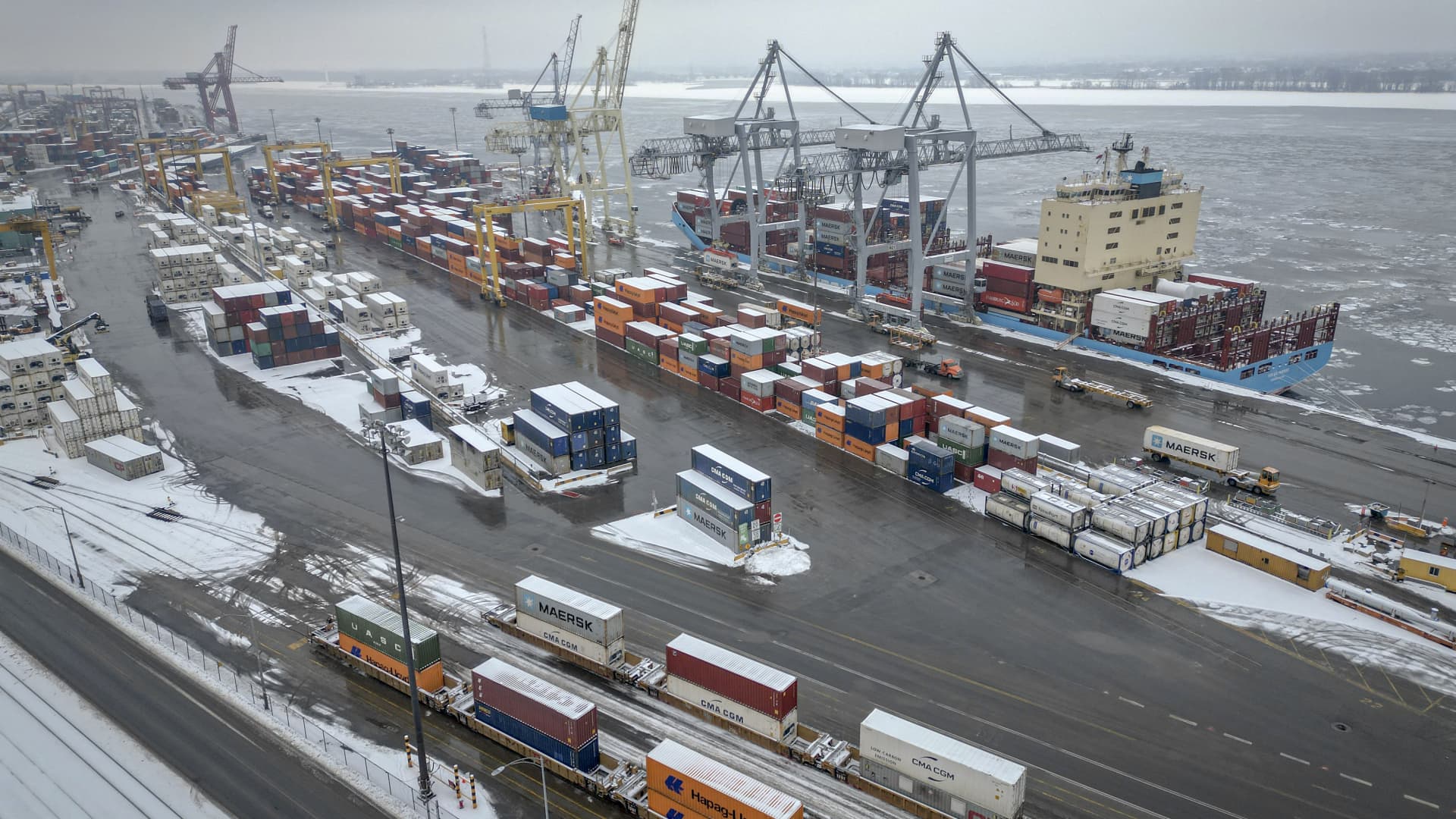
Shipping containers are seen at the Port of Montreal in Montreal, Canada, on Feb. 3, 2025.
Andrej Ivanov | Afp | Getty Images
President Donald Trump imposed broad tariffs on China on Tuesday, while tariff threats hang over other major trading partners like Canada, the European Union and Mexico.
That may lead some to wonder: How have tariffs been wielded through U.S. history, and is Trump unique in his use of them?
The ‘three Rs’ of tariffs
The U.S. has used tariffs since its founding in the 18th century.
In fact, the Tariff Act of 1789 was among the first bills ever passed by Congress.
Since then, the U.S. has used tariffs to achieve three broad goals, said Douglas Irwin, an economics professor at Dartmouth College and past president of the Economic History Association.
Irwin calls them the “three Rs” — revenue, restriction (import barriers to protect domestic industry) and reciprocity (a bargaining chip to cut deals with other countries).
Using tariffs for revenue
Tariffs are taxes on U.S. imports, paid by the entity that’s importing the foreign good. Those taxes raise revenue to help fund the federal government.
For roughly the first third of the nation’s history — from its founding until the Civil War — the revenue motivation was “paramount” as a driver to impose import duties, Irwin said. The federal government relied on tariffs for about 90% or more of its revenue during that period, he said.

But things changed after the Civil War, Irwin said. The U.S. started to impose other taxes, like excise taxes, that made the nation less reliant on tariffs.
Tariffs generated about half of federal revenue from about 1860 to 1913, when the income tax was created, Irwin said.
The scale of the government expanded significantly in the 1930s — with the creation of New Deal programs like Social Security — and later for defense spending during WWII and the Cold War, said Kris James Mitchener, an economics professor at Santa Clara University who studies economic history and political economy.
Today, “tariffs simply cannot raise enough revenue to fund government expenditure,” Mitchener said. “There’s no possible way you could support the size of the U.S. military on tariff revenue.”
Restriction and reciprocity
From the Civil War to the Great Depression, the U.S. primarily used tariffs as a restrictive measure on imports, to insulate the domestic market from foreign competition, Irwin said.
For example, the Tariff Act of 1930, popularly known as the Smoot-Hawley Tariff, levied protective tariffs on roughly 800 to 900 different types of goods, accounting for about 25% of all goods imported to the U.S., Mitchener said.
Then, the post-Depression era — especially the post-World War II period — ushered in an era of “reciprocity,” Irwin said.
The U.S. helped create the General Agreement on Tariffs and Trade in 1948, the precursor to the World Trade Organization, which set global rules for trade and ushered in an era of low tariffs.
More from Personal Finance:
What the ‘mother of all trade wars’ can teach us about U.S. tariffs
Could Trump’s tariffs replace the income tax?
Stockpiling ahead of higher tariffs is a big mistake
That said, the U.S. also used tariffs as a reciprocal bargaining chip before WWII.
For example, before the U.S. annexed Hawaii, it signed a free-trade agreement with the Kingdom of Hawaii in 1875. The treaty allowed for duty-free imports of Hawaiian sugar and other agricultural products into the U.S. In exchange, the U.S. got exclusive access to the harbor that would later be known as Pearl Harbor.
How the president’s tariff power grew
U.S. import taxes before the WWII era were pretty high, ranging from 20% to 50%, sometimes even reaching 60%, Irwin said. They have been “very low” since 1950 or so, he said.
The average duty on goods subject to a tariff was about 2% to 4% in the 2010s before Trump’s first term, Mitchener said.
“That’s what President Trump is trying to overturn, this sort of low period of tariffs we’ve had since World War II,” Irwin said.

Before 1934, it was Congress — not presidents — that had power over tariff rates and negotiations, said Andrew Wender Cohen, a history professor at Syracuse University.
But Democrats — then known as the political party of free trade — had an enormous majority around the New Deal era and passed the Reciprocal Trade Agreements Act of 1934, granting the president the right to negotiate tariffs in certain cases, Cohen said.
“That’s when the president gains a much more substantial authority,” Cohen said.
That power accelerated after 1948 during the “transformation of the whole global economic order,” he said.
Why Trump tariff policy is ‘very unusual,’ economists say
President Donald Trump in the Oval Office of the White House on Feb. 03, 2025.
Anna Moneymaker | Getty Images News | Getty Images
That said, Trump’s use of tariff policy is “very unusual” among modern U.S. presidents, Cohen said.
For one, Trump “likes all three Rs” — revenue, restriction and reciprocity, Irwin said.
For example, on the campaign trail, he suggested that tariffs could replace the U.S. income tax to fund the government. He said during his campaign that they would create U.S. factory jobs and has threatened to use them to strongarm Denmark to give up Greenland.
However, there are tradeoffs, Irwin said. For example, restricting imports somewhat negates tariffs’ ability to raise revenue, because it diminishes the tax base for tariffs, he said. (Those additional duties may cause companies to import less or push people to buy less, for instance.)
“You can’t really achieve all three objectives at same time,” he said.
Additionally, no previous president has tried to link a U.S. drug crisis to trade policy, as Trump did with fentanyl.
“That’s a novel take,” Mitchener said.
Many presidents have used tariffs. For example, George W. Bush, Ronald Reagan and Richard Nixon applied tariffs to protect the U.S. steel industry, as Trump did in his first term, Irwin said.
“What’s unusual about Trump is, he’s not just picking out particular industries that he thinks are of strategic importance, but he’s blocking imports across the board almost with some of these countries,” Irwin said.
Trump imposed a 10% additional tariff on all Chinese goods, for example, and threatened a 25% tariff on imports from Canada and Mexico.
“No president in recent memory has really used tariffs across the board or in a broad-brush way to achieve various objectives,” Irwin said. “They’ve sort of adhered to the rule that we belong to the WTO. That means we keep our tariffs low as long as other countries keep their tariffs low.”
Cohen agreed.

Global trade treaties, like the United States-Mexico-Canada Agreement (USMCA) Trump signed in his first term, establish a mechanism for nations to file grievances for alleged unfair trade practices, Cohen said. Nations can generally raise tariffs as a retaliatory measure if trade rules are breached, per the treaty terms, he said.
Trump’s recent unilateral tariff announcements are unique in this regard, he said.
“I can’t think of any precedent for that,” Cohen said.
“While the executive branch was given much more power since 1934, it’s always been subject to the specific terms of the agreements,” he said.


Personal Finance
Next-Generation Retirement Planning: Managing Longevity Risk and Variable Income Streams


U.S.- Canada Trade Talks Collapse; Carney Says Retaliatory Tariffs Begin September 8

Flock Cameras and the Future of Public Security

AI Infrastructure Boom Hits Physical Limits: Power, Financing, and Supply Chain Strain

Armanino adds Strategic Accounting Outsourced Solutions

New 2023 K-1 instructions stir the CAMT pot for partnerships and corporations

Tax Strategy: Employee Retention Credit update
-

 Stock News1 week ago
Nvidia Q2 FY2027 Earnings beats Wall Street Expectation with Record $96.2 Billion Revenue
-
 Technology5 days ago
AI Infrastructure Boom Hits Physical Limits: Power, Financing, and Supply Chain Strain
-
 Technology3 days ago
Flock Cameras and the Future of Public Security
-
 Economics3 days ago
U.S.- Canada Trade Talks Collapse; Carney Says Retaliatory Tariffs Begin September 8