
Personal Finance
How to file a homeowners insurance claim after Hurricane Helene, Milton

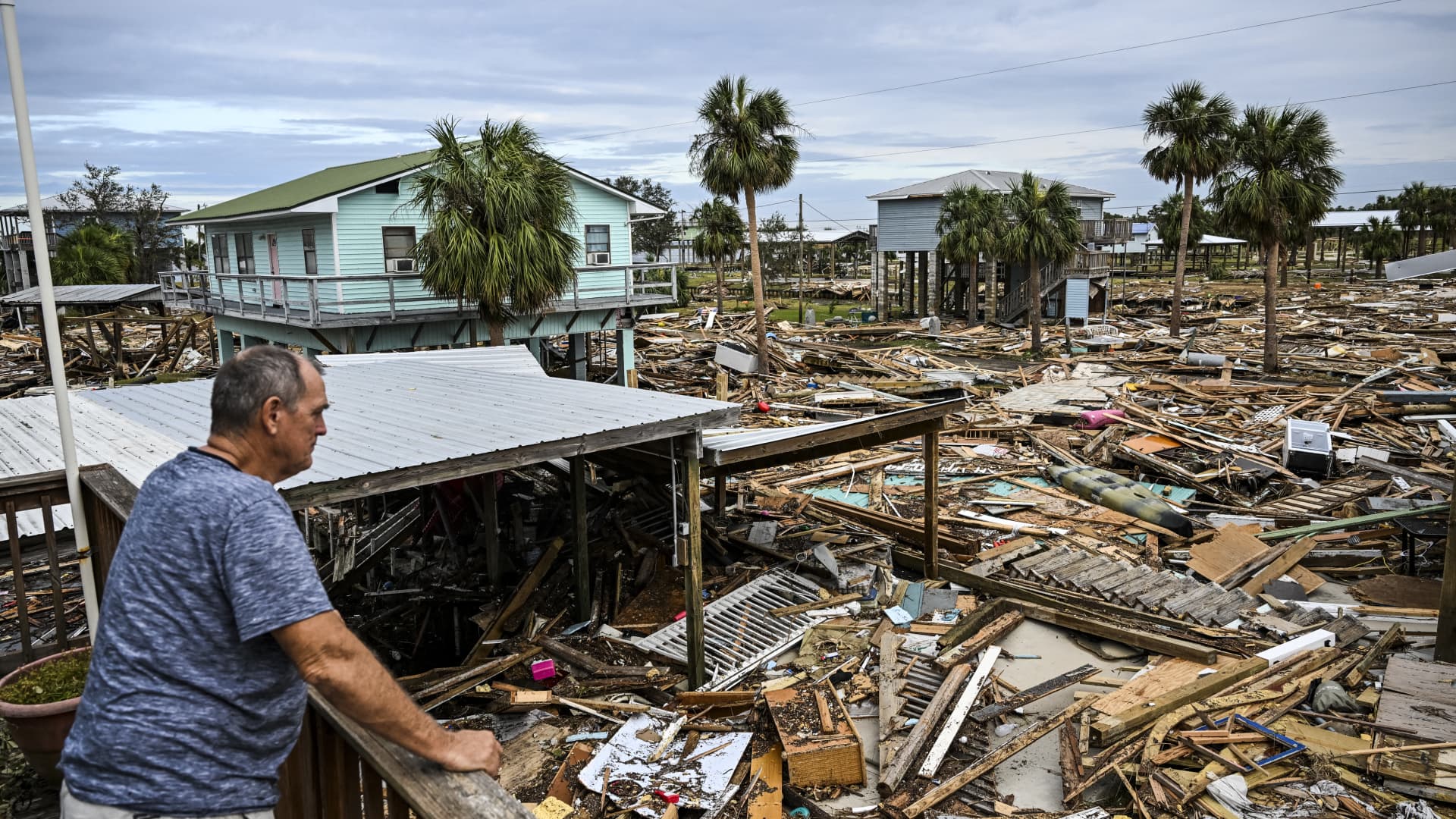
David Hester inspects damages of his house after Hurricane Helene made landfall in Horseshoe Beach, Florida, on September 28, 2024.
Chandan Khanna | Afp | Getty Images
It’s crucial to understand how to file a homeowners insurance claim after a natural disaster.
Insured losses alone for Hurricane Helene are now estimated at more than $6 billion.
Meanwhile, analysts anticipate that Hurricane Milton could be a “once-in-a-century” storm with the potential to generate record-breaking damage when it makes landfall along Florida’s west coast on Wednesday.
Once you’re safely out of harm’s way, starting the insurance claim process is an important consideration. The sooner you report a claim, the sooner your insurance company can start the process and you can begin rebuilding, experts say.
“Your adjuster is assigned on a first-come, first-serve basis,” said Shannon Martin, a licensed insurance agent and analyst for Bankrate.com.
More from Personal Finance:
A ‘man-made disaster’ could make it trickier to buy or sell a home
Here’s what’s not covered by flood insurance
How to prevent hurricane damage on your home
The processing arm of your insurance company is going to have a “tremendous amount of paperwork and claims coming through,” said Jeremy Porter, head of climate implications research at First Street Foundation, an organization focused on climate risk financial modeling in New York City.
“The longer you wait, you’re not only delaying the ability to have your claim approved and make its way to you, but you’re lengthening the time in which that claim will sit in the processing pipeline,” Porter said.
Here are three important steps to quickly file an insurance claim after a disaster, according to experts.
1. Call your insurer as soon as you can
Experts recommend including copies of your insurance policies and contact numbers in a disaster preparedness kit, that goes with you if you evacuate and is securely stored, otherwise.
Once a disaster has passed, immediately contact your insurance company to let them know that your home has damage from a recent disaster and you’d like to start the claims process, said Porter.
If you evacuated, “you can start the claim from anywhere,” Porter said. “You’ll eventually have to schedule with the insurance company to actually review and inspect the damage.”
But if you decide to wait out the storm in your house, you need to first prevent further damage to the home before calling, said Bankrate.com’s Martin.
A typical home insurance policy has language requiring homeowners to lessen the impact and prevent further damage, she said.
“Then you can call the insurance company, take pictures of the damage and [move] items into safer locations,” Martin said.
2. Make a log of damages
During your call, provide your insurance company with some initial details, like if your roof blew off or several windows broke, said Porter.
“But they really won’t make their assessment until they come in and inspect the damage,” he said.
While the insurer will make its own inspection, it’s always important to document your damages, including taking pictures, so that you can align that with the formal inspection record that comes out from the insurance company, Porter said.
This way, you can dispute any claims if you have to later, he said.

3. Keep a record of receipts
In the event of a loss, you have to give prompt notice to your insurer and you have a duty to protect the property, said Daniel Schwarcz, an insurance law professor at the University of Minnesota Law School.
You have to protect the property from further damage after the storm, make reasonable repairs and have an accurate record of repair expenses, Schwarcz said.
The receipts that you need to keep on file are for purchased materials used to prevent further damage on the property that’s already been damaged by a covered peril, said Schwarcz — meaning wind and trees, but not generally flooding unless you have a flood insurance policy. The insurer will generally reimburse you for reasonable expenses you incur.
If you don’t take such measures after the storm, and that inaction results in further damage, the insurer is not obligated to cover the loss, he said.
Materials purchased to protect the home before the natural disaster — for example, plywood to cover windows — are oftentimes not covered.
You also want to keep a record of receipts when you start working with contractors to rebuild from the damage, experts say.
Differentiating damage from back-to-back disasters
One of the reasons why you want to document the damage immediately with your insurer is so that you can attach it to the event itself, increasing the likelihood of the event being covered by your home insurance, said Porter.
“Filing the claim immediately is the number one most important thing to do,” Porter said.
It’s important to keep track of where the damage came from, and having evidence can help avoid problems down the road, he said.
Port offers the hypothetical of of someone whose home sustained wind damage from Hurricane Debbie or Helene, but hasn’t filed a claim before the Milton makes landfall and causes flood damage.
“All of a sudden, you have a problem where the National Flood Insurance Program, which covers flood, and your home insurance company, which covers wind, can potentially start to argue over what actually caused the damage to the property,” Porter said.
You want to make sure you file any claim within three to five days of when the incident occurred, said Martin. As long as you had submitted all of your information in a timely manner for the first incident, if something else arises, you’re able to show the adjuster that it happened from a second event, she said.


Personal Finance
Next-Generation Retirement Planning: Managing Longevity Risk and Variable Income Streams


U.S.- Canada Trade Talks Collapse; Carney Says Retaliatory Tariffs Begin September 8

Flock Cameras and the Future of Public Security

AI Infrastructure Boom Hits Physical Limits: Power, Financing, and Supply Chain Strain

Armanino adds Strategic Accounting Outsourced Solutions

New 2023 K-1 instructions stir the CAMT pot for partnerships and corporations

Tax Strategy: Employee Retention Credit update
-

 Stock News1 week ago
Nvidia Q2 FY2027 Earnings beats Wall Street Expectation with Record $96.2 Billion Revenue
-
 Technology5 days ago
AI Infrastructure Boom Hits Physical Limits: Power, Financing, and Supply Chain Strain
-
 Technology3 days ago
Flock Cameras and the Future of Public Security
-
 Economics3 days ago
U.S.- Canada Trade Talks Collapse; Carney Says Retaliatory Tariffs Begin September 8