Connect with us

Personal Finance

Hurricane risk Florida Home insurance

Published

on

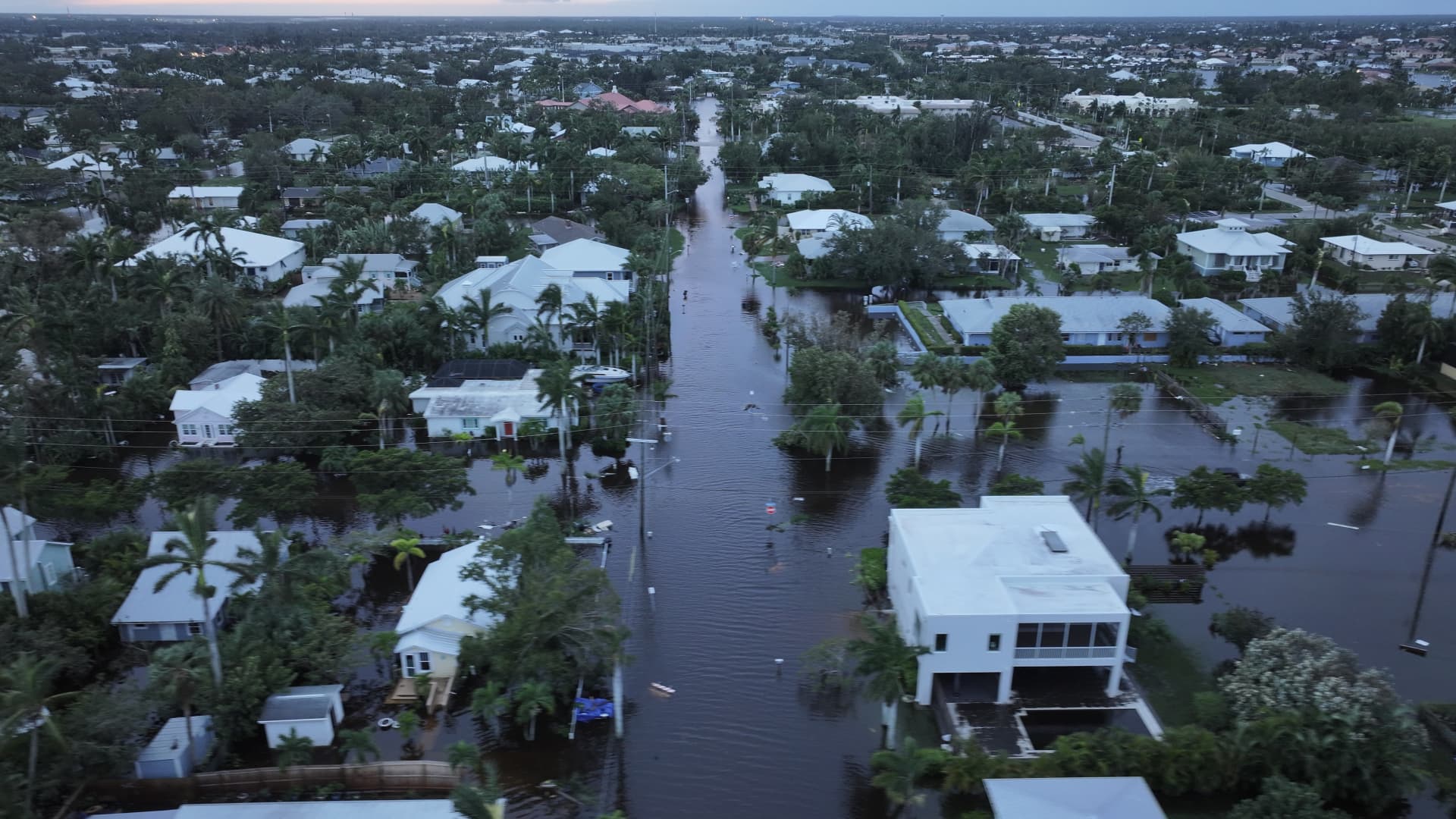
Dayna and Matt Fancher lost their home in Fort Myers Beach, Florida, to Hurricane Ian in 2022.

One month into this year’s hurricane season, the couple is still paying their home insurance policy — now twice as costly — while fighting the firm in court over their claim.

The Fanchers, who have lived in their Fort Myers Beach home for almost three decades, said their home insurance provider paid them only a third of what it would cost to rebuild their home, and that adjusters repeatedly disputed their storm damage claims. In the end, the Fanchers say, they took out construction loans to be able to move back into their home.

“We have the same coverage that we had, we’re paying double, and we didn’t get the assistance that we needed,” Matt Fancher said.

The Fanchers’ predicament is just one of many linked to the insurance crisis in hurricane-prone Florida. Rates are sky-high and expected to continue rising as catastrophe claims surge and Floridians face few insurance options and increased scrutiny during underwriting.

Since 2021, Florida has experienced four major hurricanes: Ian, Helene, Idalia and Milton, and premiums have climbed by nearly 30% statewide. Florida residents can now expect to pay almost $10,000 a year on average in premiums, making the state the most expensive place in the U.S. to buy homeowners insurance.

In Fort Myers Beach, a small town on narrow Estero Island off Fort Myers, annual premiums jumped from about $9,000 to almost $14,000 from 2019 to 2024, according to data obtained by First Street Foundation, a climate risk modeling firm.

In the wake of Hurricane Ian, Floridians filed more than half a million residential catastrophe claims, according to Florida’s Office of Insurance Regulation. Up against an estimated $50 billion to $65 billion in insurance losses associated with Hurricane Ian, several homegrown Florida property insurers were declared insolvent, while major national insurers like Farmers announced they would pull back or no longer offer coverage in the state due to increased hurricane risk.

Some legislative reforms have helped stabilize the market for insurance in Florida, according to Mark Friedlander, a spokesperson for the Insurance Information Institute, an industry association for insurers. He said in 2024, the state saw the lowest average statewide premium increases in the country for home insurance and that more than a dozen new insurers had entered the market there.

But hurricane risk in Florida is escalating as human-caused climate change warms the atmosphere and raises sea surface temperatures in the Gulf of Mexico. Hotter conditions are trapping moisture and fueling hurricane intensification, creating wetter, more powerful hurricanes that leave Florida increasingly vulnerable to storm damage. During Hurricane Helene, moisture trapped in the warming atmosphere increased extreme rainfall by 10%, bringing rainfall totals as high as 26.95 inches in parts of Florida.

Jeremy Porter, a climate risk expert at First Street Foundation, says that rising insurance costs signal the deep impacts of climate change in west Florida, as communities like Fort Myers Beach grapple with recurring damage and costly recoveries.

“Over the last few decades, we haven’t kept up with climate risk and quantified it properly in our risk modeling. Now, we’re playing catch-up and it’s driving up insurance rates very rapidly, and people are feeling that in their household budgets,” Porter said.

With scarce options for home insurance, more and more Floridians have started buying insurance from Citizens Insurance Property Corp., Florida’s not-for-profit state-backed insurer, and Porter says this rapid movement has also pushed up insurance costs.

By 2055, Porter says home insurance premiums could rise by 213% in the Tampa metro area because of hurricane risk. Climate risks are also disrupting insurance markets in other parts of the country. In Sacramento, California, residents may face a 137% increase due to increased wildfire danger, for example.

Porter said declining home prices in Florida could also affect home insurance rates and availability. When property values fall in places that are vulnerable to hurricanes or other extreme weather, insurers may interpret that decline as a warning sign of growing physical or market risk, leading to increased scrutiny during underwriting and potential spikes in premiums.

According to Zillow data, home values in Fort Myers Beach are down about $200,000 from their pre-Ian prices, and about 86% of sales over the last year came in under list price, a general sign that sellers are having a difficult time offloading their properties.

At its peak before Hurricane Ian, the average home value on Sanibel Island, a popular spot in Lee County for beach vacationers, was almost $1.3 million. Today, that value is $868,000, with 93% of all homes being sold under list price, according to Zillow.

Joanne Klempner, who has lived part time in Fort Myers Beach since 2016, says that selling her home is not a financially viable option after spending so much on reconstruction post-Hurricane Ian. With little choice but to stay in Fort Myers Beach, Klempner said she worries about how climate change will affect the future of her community.

“At this point, we’re in for the long haul because we have to be. I think whether people want to continue to invest in Fort Myers Beach is the bigger question,” Klempner said. “When you don’t have a hurricane for 30 years, the risk feels worth it to live in paradise. When you have three bad hurricanes within 18 months, it becomes questionable.”

Jacki Liszak, the president and CEO of the Fort Myers Beach Chamber of Commerce, says that Fort Myers Beach is still a great place to live and visit, and that the community is investing in resilient architecture and building homes well above the flood line.

“The houses have to be built strong and they have to be built high,” Liszak said. “I think that will help tremendously. People were already starting to come, and I think they will continue to come. People love this lifestyle. It’s a beautiful part of the world.”

Continue Reading

Personal Finance

Maximizing Returns in High Rate Climate and market uncertainty

Published

on

Maximizing Returns in High-Rate Climate

In the macroeconomic environment of late July 2026, personal cash management requires an active, structured approach to wealth preservation. With central bank benchmark rates remaining elevated to ensure long-term disinflation, conservative yield-bearing vehicles—such as short-term U.S. Treasury bills, money market funds, and high-yield savings accounts (HYSAs)—continue to offer reliable nominal returns between 4% and 5%. For individual investors, maximizing net returns requires moving beyond passive checking accounts and executing a disciplined cash laddering strategy.

Leaving substantial liquid capital in traditional bank deposits creates an invisible drag on personal net worth due to ongoing inflation. By implementing a tiered liquidity framework, individuals can split emergency cash reserves and short-term capital allocations across rolling maturities. Allocating cash into 4-week, 8-week, and 13-week Treasury bills creates a continuous cycle of maturing liquidity, allowing investors to continuously reinvest capital at prevailing market yields while maintaining immediate access to emergency funds.

Tax efficiency represents a critical dimension of high-yield cash optimization. For high-earning individuals residing in states with substantial local income taxes, direct holdings in short-term U.S. Treasury instruments often deliver superior net post-tax yields compared to standard commercial bank HYSAs. Because interest earned on federal Treasury bills is strictly exempt from state and local taxation, investors can retain a larger portion of their compounding interest gains without taking on additional credit or market risk.

Ultimately, personal wealth accumulation in mid-2026 relies on intentional capital deployment. Cash should be managed as a productive asset class that generates consistent, risk-free returns. Regularly auditing account yield terms, automating recurring transfers, and leveraging tax-advantaged fixed-income instruments ensures that personal liquidity remains fully optimized against macroeconomic fluctuations.

Continue Reading

Personal Finance

Algorithmic Wealth Management: Balancing Automated Financial Planning with Human Oversight

Published

on

Balancing Automated Financial Planning with Human Oversight

The personal finance industry in July 2026 is experiencing a technological evolution, driven by the wide deployment of next-generation algorithmic wealth management tools. Modern digital financial platforms have expanded far beyond basic automated index investing; today’s robo-advisors utilize real-time tax-loss harvesting, dynamic portfolio rebalancing, and hyper-personalized spending analysis to optimize retail investor outcomes. However, as these digital solutions become ubiquitous, investors face the crucial challenge of balancing automated execution with human strategic judgment.

The core advantage of automated financial planning platforms lies in their ability to remove emotional bias from investment execution. During periods of market volatility or localized sector realignments, automated algorithms systematically rebalance portfolios back to target asset allocations without falling victim to panic selling or speculative enthusiasm. Furthermore, integrated cash-flow monitoring algorithms analyze individual spending patterns in real time, automatically sweeping surplus income into designated retirement or debt-liquidation accounts to accelerate net worth accumulation.

Despite these operational advantages, algorithmic tools have inherent structural limitations when addressing complex, highly personalized financial life events. Decisions involving multi-generational estate planning, highly complex tax strategies, small business exits, or nuanced real estate transactions require contextual human judgment that software models cannot replicate. Relying solely on automated models without periodic human professional review can result in misaligned risk profiles or overlooked tax liabilities during major life transitions.

The optimal approach for personal financial planning in late 2026 is a hybrid advisory model. Individuals should utilize automated platforms for routine asset allocation, continuous tax optimization, and low-cost passive index tracking, while engaging qualified human financial advisors for periodic strategic planning, estate structuring, and qualitative risk evaluations. This dual approach ensures maximum cost efficiency and disciplined execution while retaining essential strategic guidance.

Continue Reading

Personal Finance

High-Yield Optimization: Structuring Personal Cash Reserves in a Sustained Rate Environment

Published

on

Structuring Personal Cash Reserves in a Sustained Rate Environment

In the financial environment of mid-2026, personal cash management has re-emerged as a vital component of holistic wealth building. With central bank policy rates holding firm to maintain long-term price stability, yield-bearing instruments such as money market funds, high-yield savings accounts (HYSAs), and short-term Treasury bills continue to offer compounding returns around 4% to 5%. For individual investors, effectively structuring cash reserves requires shifting away from passive bank deposits toward active yield optimization.

A frequent pitfall in personal asset management is leaving substantial liquid capital in traditional checking or low-yield savings accounts, where real returns are continuously eroded by baseline inflation. By implementing a disciplined ‘cash ladder’ strategy—allocating liquid funds across tiered maturities using ultra-short Treasury instruments and FDIC-insured high-yield accounts—individuals can secure maximal yields while retaining immediate liquidity for emergency expenses or tactical investment opportunities.

Simultaneously, investors must evaluate the tax efficiency of their cash holdings based on their tax bracket and geographic location. For high earners situated in states with high local income taxes, direct holdings in short-term U.S. Treasury bills often yield a higher net post-tax return than standard high-yield savings accounts, as Treasury interest is strictly exempt from state and local taxation. Understanding these nuanced tax distinctions allows individuals to capture significant incremental gains without taking on additional market risk.

Ultimately, personal financial health in late 2026 hinges on intentional liquidity management. Cash reserves should not be viewed merely as static emergency funds, but as a dynamic asset class that contributes positively to net worth growth. Regularly auditing yield terms, automating cash transfers, and optimizing for post-tax efficiency ensures that personal capital remains fully productive across all economic conditions.

Continue Reading

Trending