
Personal Finance
Trump’s ‘big beautiful bill’ includes key tax changes for 2025

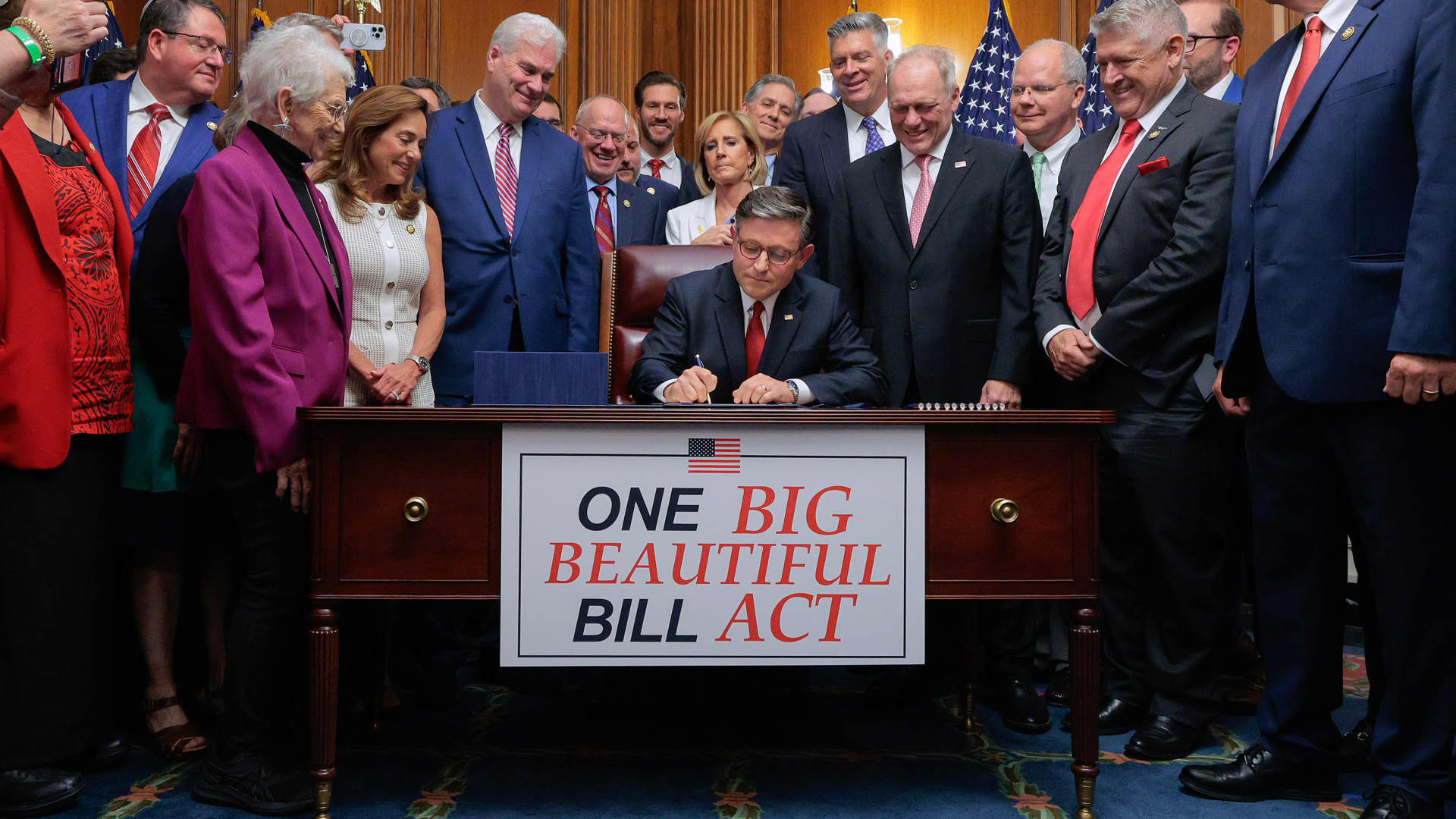
Speaker of the House Mike Johnson (R-LA) (C) signs the One Big Beautiful Bill Act during an enrollment ceremony with fellow Republicans in the Rayburn Room at the U.S. Capitol on July 03, 2025 in Washington, DC.
Chip Somodevilla | Getty Images News | Getty Images
It’s been about two weeks since President Donald Trump‘s “big beautiful bill” became law, and financial advisors and tax professionals are still digesting what the sweeping legislation means for clients.
Meanwhile, several changes are effective for 2025, which will impact tax returns filed in 2026.
While the Trump administration has been promoting “working family tax cuts,” the legislation’s impact depends on your unique situation — and some updates are complex, experts say.
“There are just so many moving pieces,” said certified financial planner Jim Guarino, managing director at Baker Newman Noyes in Woburn, Massachusetts. He is also a certified public accountant.
More from Personal Finance:
Trump’s ‘big beautiful bill’ caps student loans. What it means for you
Tax changes under Trump’s ‘big beautiful bill’ — in one chart
Trump’s ‘big beautiful bill’ adds 45.5% ‘SALT torpedo’ for high earners
Currently, many advisors are running projections — often for multiple years — to see how the new provisions could impact taxes.
Without income planning, you could reduce, or even eliminate, various tax benefits for which you are otherwise eligible, experts say.
When it comes to tax strategy, “you never want to do anything in a silo,” Guarino said.
Here are some of the key changes from Trump’s legislation to know for 2025, and how the updates could affect your taxes.
Trump’s 2017 tax cut extensions
The Republicans’ marquee law made permanent Trump’s 2017 tax cuts — including lower tax brackets and higher standard deductions, among other provisions — which broadly reduced taxes for Americans.
Without the extension, most filers could have seen higher taxes in 2026, according to a 2024 report from the Tax Foundation. However, the new law enhances Trump’s 2017 cuts, with a few tax breaks that start in 2025:
- The standard deduction increases from $15,000 to $15,750 (single filers) and $30,000 to $31,500 (married filing jointly).
- There is also a bump for the child tax credit, with the maximum benefit going from $2,000 to $2,200 per child.
If you itemize tax breaks, there is also a temporary higher cap on the state and local tax deduction, or SALT. For 2025, the SALT deduction limit is $40,000, up from $10,000.
The higher SALT benefit phases out, or reduces, for incomes between $500,000 to $600,000, which can create an artificially higher tax rate of 45.5% that some experts are calling a “SALT torpedo.”
This creates a “sweet spot” for the SALT deduction between $200,000 and $500,000 of earnings, based on other provisions in the bill, CPA John McCarthy wrote in a blog post this week.
Trump’s new tax changes for 2025
Trump’s tax and spending bill also introduced some temporary tax breaks, which are effective for 2025. Some of these were floated during his 2024 presidential campaign.
These provisions include a $6,000 “bonus” deduction for certain older Americans ages 65 and over, which phases out over $75,000 for single filers or $150,000 for married couples filing jointly.
There are also new deductions for tip income, overtime earnings and car loan interest, with varying eligibility requirements.
This chart shows a breakdown of some of the key individual provisions that are effective for 2025 compared to previous law.
Premium tax credit ‘subsidy cliff’ returns
During the pandemic, Congress boosted the premium tax credit through 2025, which made Marketplace health insurance more affordable.
But Trump’s legislation didn’t extend the enhanced tax break, which could raise Affordable Care Act premiums for more than 22 million enrollees if no action is taken, according to KFF, a health policy organization.
That could impact enrollees when choosing ACA health plans this fall, according to Tommy Lucas, a CFP and enrolled agent at Moisand Fitzgerald Tamayo in Orlando, Florida.

Starting in 2026, enrollees need to prepare for the ACA subsidy cliff, where enrollees lose the premium tax credit when income exceeds the earnings thresholds by even $1, he said.
Currently, most ACA enrollees receive at least part of the premium tax credit. However, the subsidy cliff means enrollees lose the benefit once earnings exceed 400% of the federal poverty limit. For 2025, that threshold was $103,280 for a family of three, according to The Peterson Center on Healthcare, a nonprofit for healthcare policy, and KFF.


Personal Finance
Next-Generation Retirement Planning: Managing Longevity Risk and Variable Income Streams


U.S.- Canada Trade Talks Collapse; Carney Says Retaliatory Tariffs Begin September 8

Flock Cameras and the Future of Public Security

AI Infrastructure Boom Hits Physical Limits: Power, Financing, and Supply Chain Strain

Armanino adds Strategic Accounting Outsourced Solutions

New 2023 K-1 instructions stir the CAMT pot for partnerships and corporations

Tax Strategy: Employee Retention Credit update
-

 Stock News1 week ago
Nvidia Earnings Preview: What Wall Street Expects From the AI Bellwether’s Q2 Report
-

 Accounting1 week ago
SEC’s Semiannual Reporting Proposal Faces Investor Pushback: What CFOs Need to Know
-

 Stock News1 week ago
Nvidia Q2 FY2027 Earnings beats Wall Street Expectation with Record $96.2 Billion Revenue
-

 Finance1 week ago
Treasury Bond Volatility Forces Bessent to Double Debt Buyback Size as Yields Swing
-
 Technology5 days ago
AI Infrastructure Boom Hits Physical Limits: Power, Financing, and Supply Chain Strain
-
 Technology3 days ago
Flock Cameras and the Future of Public Security
-
 Economics3 days ago
U.S.- Canada Trade Talks Collapse; Carney Says Retaliatory Tariffs Begin September 8