
Personal Finance
Kamala Harris has supported affordable housing in the past

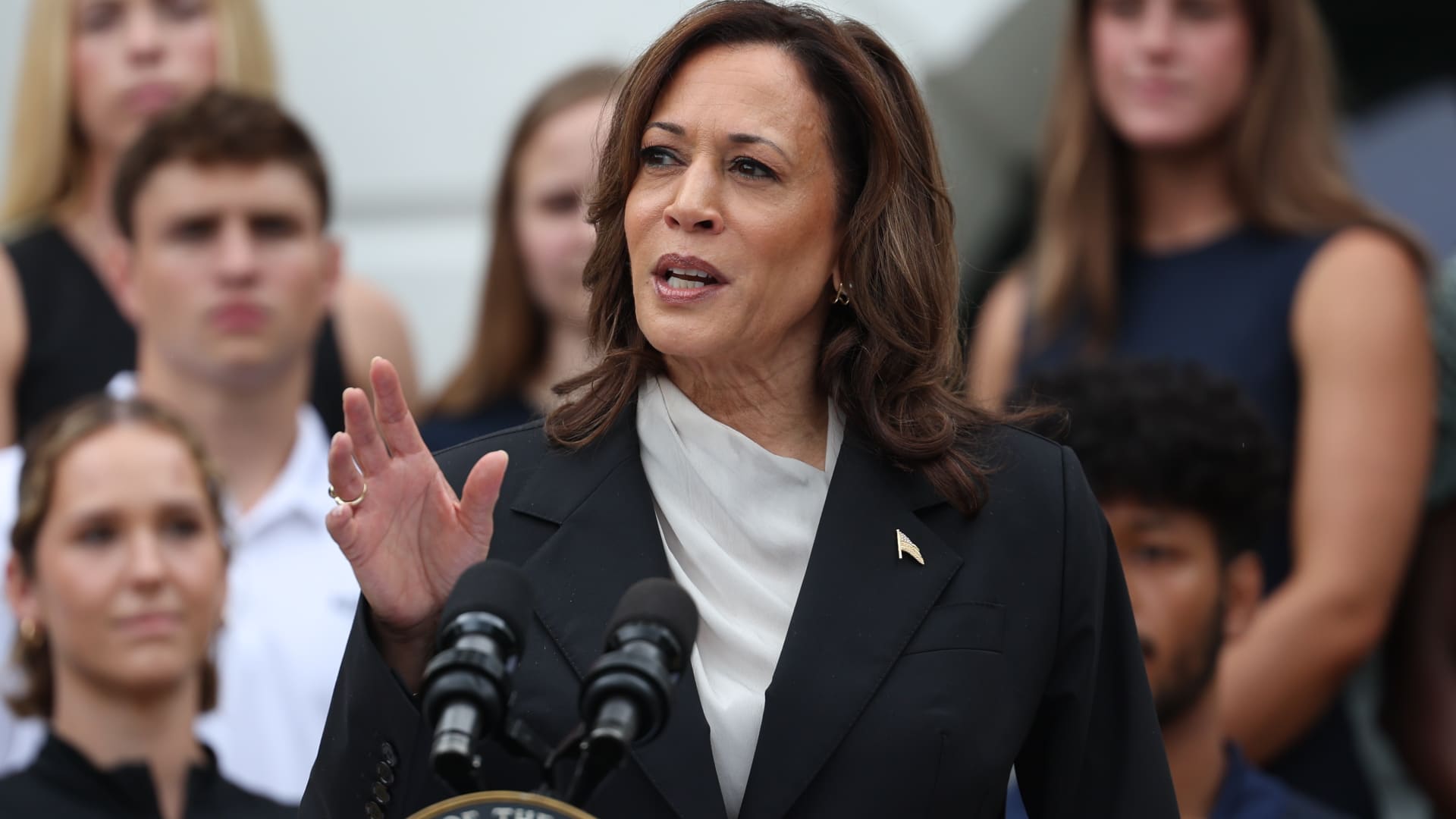
Vice President Kamala Harris speaks on the South Lawn of the White House in Washington, D.C., on July 22, 2024.
Ting Shen | Bloomberg | Getty Images
Harris’ record on housing issues
As attorney general for California, Harris drafted and helped pass the California Homeowner Bill of Rights. It is a set of laws designed to protect homeowners from unfair practices. The California Homeowner Bill of Rights became law on Jan. 1, 2013.
Harris secured an $18 billion agreement as part of a national multistate settlement to benefit thousands of homeowners who lost their homes due to improper foreclosure or fraud in 2012.
As senator, Harris introduced the Rent Relief Act in 2018, a bill that offers tax credits to renters who earn below $100,000 and spend more than 30% of their income on rent and utilities.
Harris resubmitted a second variation of the bill in 2019, which includes a mechanism from the Treasury to pay the tax credit on a monthly basis to eligible households. The latter version also caps the credit at 100% of small area fair market rents instead of 150% of FMR.
Harris last month announced the recipients of an $85 million grant under the Pathways to Removing Obstacles to Housing, or PRO Housing, a first-of-its-kind project through the U.S. Department of Housing and Urban Development aimed to increase building activity and lower housing and rental costs for families in the U.S.

That news came on the heels of a May announcement from Harris budgeting $5.5 billion through the HUD to boost affordable housing, invest in economic growth, build wealth and address homelessness in communities across America.
Such policies come at a time when the country is facing rising homelessness rates and burdensome costs to buy or rent. In 2023, a record 653,100 people experienced homelessness in 2023, up from 256,600 the year prior, according to a report by the Harvard University Joint Center for Housing Studies.
‘There’s potential for a lot of good’
The latest housing policies the Biden administration has rolled out generally aim at increasing the supply of affordable housing and lowering costs for buyers and renters.
Harris has been involved in Biden’s housing policy-making, and it is likely that her campaign will carry on similar blueprints for housing, experts say.
“Generally speaking, it does seem like affordable housing, zoning has been something that has been a talking point of hers for a while now,” said Jacob Channel, a senior economist at LendingTree. “If they keep on the same course that the Biden administration was on, I think there’s potential for a lot of good.”
As a Harris candidacy begins to look more likely, people have been talking about a policy Harris originally floated in her 2020 presidential campaign: the LIFT the Middle Class Act.
The bill would give a refundable tax credit of up to $3,000 per person, or $6,000 per married couple that files joint tax returns, for qualifying middle- and working-class Americans.
Some experts point out the LIFT Act might be better for renters than the 5% rent cap increase Biden proposed in mid-July.
The proposal calls on Congress to cap rent increases from landlords with 50 existing units or more at 5% or risk losing federal tax breaks.
“The concern with the rent cap is that the supply of housing would change,” said Francesco D’Acunto, an associate professor of finance at Georgetown University.
While the rent cap may lead consumers to believe prices will not increase more than a certain amount, it could lead to negative side effects, such as landlords taking their properties off the rental market, said Karl Widerquist, an economist and professor of philosophy at Georgetown University.
Landlords who lose access to tax breaks will still be able to raise rents and the plan would exclude new construction and buildings undergoing major renovations, Channel explained.
The tax credit would not create the same distortions as the rent cap, and it also targets the negative effects of rent inflation, D’Acunto said.
Harris’ LIFT the Middle Class Act has received pushback in the past. While it is not a perfect policy, the LIFT Act is “essentially an expansion in the right direction,” Widerquist said.


Personal Finance
Next-Generation Retirement Planning: Managing Longevity Risk and Variable Income Streams


S&P 500 September Outlook: Tech Rally Holds Index at 7,600

India Unveils ‘Saptadhara’ Reform Agenda Targeting Technology, Youth Skilling, and Growth

S&P 500 Outperforms Amid Strong Corporate Earnings as Treasury Yields Cap Equity Multiples

Armanino adds Strategic Accounting Outsourced Solutions

New 2023 K-1 instructions stir the CAMT pot for partnerships and corporations

Tax Strategy: Employee Retention Credit update
-

 Stock News1 week ago
Nvidia Q2 FY2027 Earnings beats Wall Street Expectation with Record $96.2 Billion Revenue
-

 Technology6 days ago
AI Infrastructure Boom Hits Physical Limits: Power, Financing, and Supply Chain Strain
-

 Economics4 days ago
U.S.- Canada Trade Talks Collapse; Carney Says Retaliatory Tariffs Begin September 8
-

 Technology4 days ago
Flock Cameras and the Future of Public Security
-

 Insights2 hours ago
Climate Resilience and Offshore Wind and Land Restoration Milestones
-
 Stock News55 minutes ago
S&P 500 September Outlook: Tech Rally Holds Index at 7,600
-

 Accounting2 hours ago
Mandatory ESG Reporting Standards Demand Standardized Non-Financial Audit Trails
-
 Finance2 hours ago
S&P 500 Outperforms Amid Strong Corporate Earnings as Treasury Yields Cap Equity Multiples