
Finance
L.A. wildfire victims face financial anxiety amid recovery

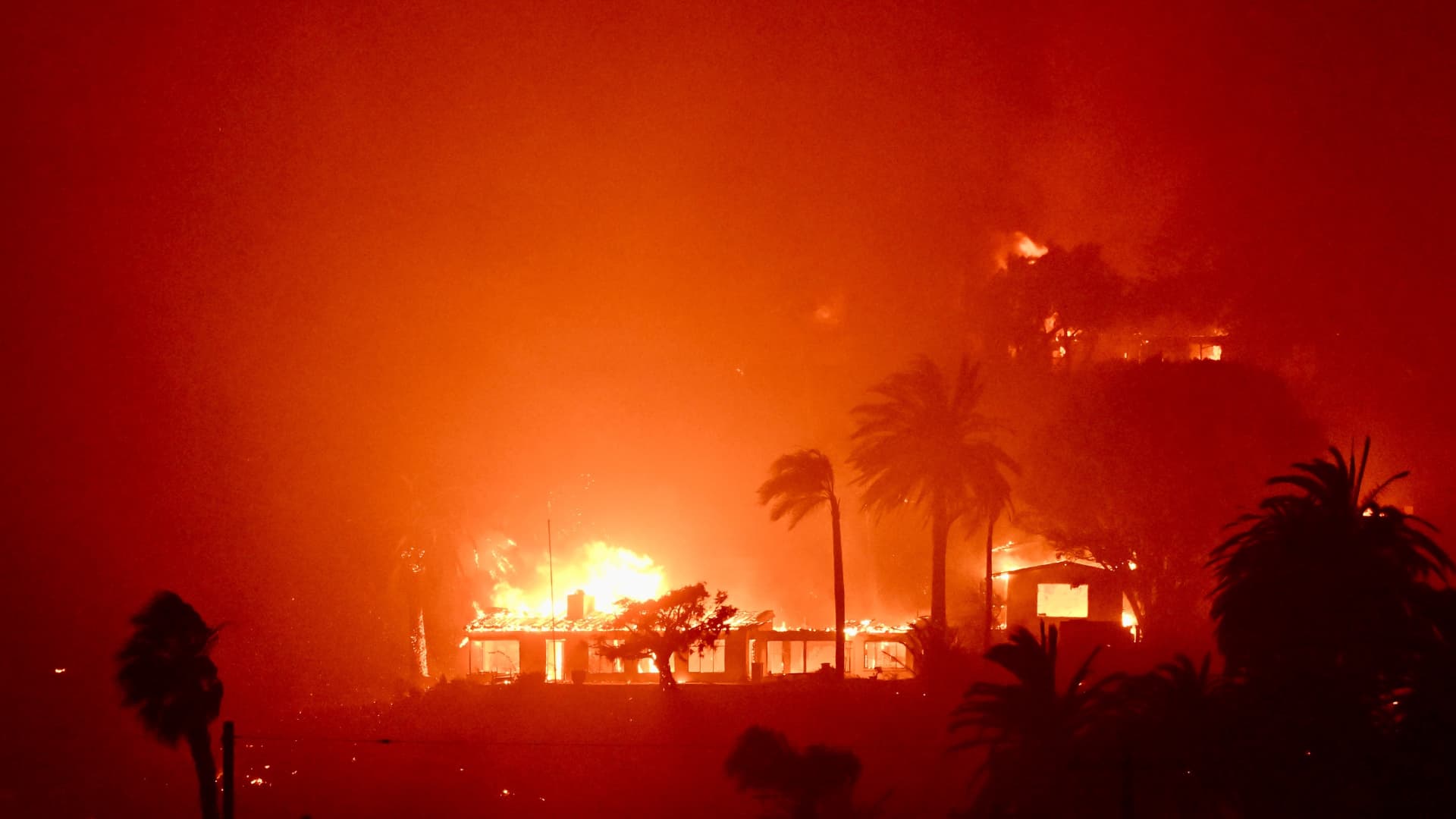
Homes burn above Pacific Coast Highway during the Palisades Fire on Jan. 8, 2025, in Pacific Palisades, Calif.
Photo by Jeff Gritchen/MediaNews Group/Orange County Register via Getty Images
Alicia Kalvin awoke the morning of Jan. 7 to an urgent text from a friend: “There’s a fire on your street.” She hurried outside, alarmed to see red skies and low-flying planes dumping water.
“I have to get out of here,” thought Kalvin, 53, who lives in the Pacific Palisades of Los Angeles.
Back inside, she glanced out the bathroom window and saw a hellish scene unfolding. It was a neighbor’s house engulfed in flames, embers spewing into her own yard.
Kalvin frantically threw on clothing. She grabbed her purse, her dog, a can of dog food and her mother’s ashes before fleeing her childhood home. She didn’t get an evacuation warning.
Flames licked the hills of the Los Angeles enclave as Kalvin drove away. She says she’s had nightmares ever since.
Three days later, she returned to the area with a police escort.
“I promised myself I wouldn’t look, but of course I looked,” said Kalvin. “It looks like 10 nuclear bombs went off. The whole neighborhood was just leveled — markets, churches, schools. It looked like a war zone.”
A mobile home park is destroyed during the Palisades Fire on Jan. 8, 2025.
Jeff Gritchen/MediaNews Group/Orange County Register via Getty Images
In one sense, Kalvin is lucky because her home, somehow, is still standing.
But questions about her financial future abound — as they do for thousands of L.A. residents whose lives were upended by the recent wildfires.
There’s significant damage to Kalvin’s home. Some sections of the exterior, including the roof, are scorched; the landscaping and artificial lawn are destroyed; the interior smells of smoke; and ash, blown in through broken windows, blankets the hallways, Kalvin said.
She’s trying to untangle what her home insurance policy — the California FAIR plan, the state’s insurer of last resort, which steps in when residents can’t obtain coverage elsewhere — might cover.
“I’m very concerned at how much I’m going to have to spend if and when I fix up this house,” said Kalvin, who is single and doesn’t have kids. “Because insurance won’t cover everything.”
Even before the Palisades Fire, Kalvin faced financial challenges.
Work has dried up in Hollywood in recent years; Kalvin — an educator hired to teach child actors on television, movie and commercial sets — has had trouble finding gigs. She collects unemployment some weeks and funds income shortfalls with savings originally earmarked for retirement.
“My future is very up in the air,” she said. “And the uncertainty is very unsettling.”
‘There are no answers right now’
Patrick O’Neal sifts through the remains of his home after it was destroyed by the Palisades wildfire, in Malibu, California, Jan. 13, 2025.
Brandon Bell | Getty Images
The recent wildfires that erupted in Greater Los Angeles — fueled by hurricane-force winds and exceptionally dry conditions, exacerbated by climate change — are estimated to be among the costliest in U.S. history. They’ve killed at least 29 people.
AccuWeather estimates the blazes caused more than $250 billion in total damage and economic loss.
S&P Global Ratings projects the L.A. fires will cause roughly $40 billion of insured losses. That sum would exceed the roughly $13 billion of the Camp Fire in Paradise, Calif., in 2018, which was the costliest blaze in U.S. history.
“There are all sorts of costs associated with a disaster,” said Andrew Rumbach, a senior fellow at the Urban Institute who studies household risk to natural hazards and climate change.
“They pile up, and many Americans don’t have a [financial] cushion to rely on,” Rumbach said. “Our main way of dealing with that as an economy is going into debt. That lingers for a long time.”

The fires, largely contained, were still burning as of Thursday.
The blazes — the largest being the Palisades and Eaton Fires — have scorched more than 50,000 acres, an area exceeding the size of San Francisco, and destroyed more than 16,000 structures.
Most of those structures have been residential houses, S&P Global Ratings analysts wrote in a recent note.
The disaster pushed thousands of L.A. residents into one of the nation’s most expensive housing markets overnight. They were left with countless financial questions, compounding deep emotional scars: Considerations like where to live, how to clean up, whether to rebuild — and how to afford it all.
“Individuals are dealing with insurance, mortgages, the replacement cost of belongings, temporary housing,” said Sam Bakhshandehpour, 49, who’s lived in the Pacific Palisades for 13 years. “There are lots of near- and long-term variables and frankly there are no answers right now.”
I’m very concerned at how much I’m going to have to spend if and when I fix up this house. Because insurance won’t cover everything.
Alicia Kalvin
Pacific Palisades resident
Bakhshandehpour, an investment banker turned restaurateur, said the extent of damage to his home is unclear.
He wants to continue living in the Palisades, which he calls an “oasis” in L.A. — but acknowledges cleanup of debris and toxic materials and repair to local infrastructure “could be years.”
Indeed, the recovery period for L.A. residents could be two to five years or longer, Rumbach estimates.
Some residents may never be able to move back.
“Even if there is a desire on the part of the homeowners [to rebuild], it is unclear as to whether the land will be re-zoned such that it can no longer be developed,” according to S&P Global Ratings.
A ‘massive’ financial drain
Bakhshandehpour was able to find an unfurnished apartment in the interim. But furnishing a home from scratch has been a “massive” financial drain, he said.
There are some financial backstops that can help allay such displacement costs.
For example, victims may qualify for FEMA assistance. Applicants can get up to $770 upfront for basic needs like food and shelter while the government vets their application for more aid, potentially worth tens of thousands of dollars.

During a state of emergency, California law also requires home insurers to issue a cash advance worth at least 30% of a policyholder’s “dwelling” insurance limit, up to $250,000, without filing an itemized claim. They must also advance at least four months of coverage for living expenses.
“There is no comparison to the dollars you get from a home insurance policy,” said Amy Bach, executive director of United Policyholders, a nonprofit consumer advocacy group. “It has long been the most important source of funds to repair and rebuild, much more than any government program, for the vast majority of people.”
Some insurers are paying policyholders even more than the law demands, Ricardo Lara, the California insurance commissioner, said Jan. 23. However, others “are not adhering” to those consumer protections, Lara said.
Only a ‘ghost town hellscape’ remains
Melted lawn chairs are seen near the remains of a burnt home after the Palisades Fire.
Agustin Paullier | Afp | Getty Images
The rules on advance insurance payments only apply for policyholders with a “total loss.”
But Julia Pollak’s home is considered a “partial” loss. Her insurer, State Farm, paid a $15,000 advance on the home’s contents and also authorized coverage for two months of living expenses. Both amounts are less than guarantees for those with a total loss.
Her house, in the Marquez Knolls part of the Pacific Palisades, is damaged but still standing — a white home now surrounded by “wasteland,” she said.
“There’s a row of seven houses standing. All the rest are gone,” said Pollak, a labor economist. “My house now looks out on a ghost town hellscape.”
She and her family — a husband and four kids, including a newborn — are in limbo in many respects.

For one, the insurance proceeds they’ve received so far aren’t enough to commit to a long-term lease, Pollak said.
“I looked into liquidating my 401(k) for emergency purposes, but the tax consequences are not very nice,” Pollak said. “So, I’m going to try not to do it.”
Thus far, the family has hopped from AirBnb to AirBnb. They don’t know where they’ll live after Feb. 5, when their current rental expires on a two-bedroom in Santa Monica.
More from Personal Finance:
How climate change is reshaping home insurance in the U.S.
7 steps homeowners and renters should take after a wildfire
Wildfire victims may receive a one-time $770 payment
State Farm urged Pollak to use its third-party vendor to find future temporary housing — a cost the insurer would pay for directly, rather than via reimbursement. As of Thursday, Pollak was awaiting approval for certain properties she’d identified. She worries they’ll be snapped up in the interim.
“As Feb. 5 approaches, I am getting pretty nervous,” she said.
Then, there are longer-term questions.
The back side of their home is scorched. Everything inside reeks of smoke; various consultants have warned the smell won’t disappear unless insulation and ducting is replaced. Contractors have recommended a “full gut” and a replacement of all porous, hard-to-clean items like carpets, couches and upholstered beds, Pollak said. They must wait for the insurer’s determination.
To stay or to go?
There’s an additional tension here: It may be difficult to stay in the Palisades, but it’s also financially difficult to leave.
Pollak and others she knows whose homes are still standing worry insurers will deem their homes livable in a few months. She wonders, would they be residing in a construction zone for five years with no neighbors, businesses or schools nearby?
Emergency vehicles are on the side of the road as flames from the Hughes Fire race up the hill in Castaic, a northwestern neighborhood of Los Angeles, California, on January 22, 2025.
Frederic J. Brown | Afp | Getty Images
Pollak and her husband bought their home in 2019 for about $2.75 million. Its value had grown to about $3.8 million before the wildfires, according to a Redfin estimate — the family’s biggest financial asset.
Now, they likely can’t sell or rent it for anything close to pre-fire value, Pollak said.
“Ideally, we’d keep it and enjoy it in five to 10 years when it blossoms again,” Pollak said. “But the carrying costs are so high that we can’t pay the mortgage without living there and also pay for comparable accommodation elsewhere.”
An uncertain future
Search and rescue members work with firefighters through residential damage from the Eaton Fire as wildfires cause damage and loss through LA region on Jan. 14, 2025 in Altadena, California.
Benjamin Fanjoy | Getty Images
For all she and her family have endured, Pollak considers herself lucky: At least they have insurance.
Many insurers have stopped writing policies in California or limited their exposure due to wildfire risk. Homeowners who lost coverage may not have renewed it, while others may have foregone insurance altogether in the face of higher premiums — and those rates will likely increase in the future after the L.A. fires, said S&P Global.
Two-thirds or more of L.A. fire victims will find they were underinsured, said Bach of United Policyholders. That means their insurance policy won’t cover the full cost of rebuilding or repairing property.
For example, 36% of victims who filed insurance claims after the 2021 Marshall Fire in Boulder County, Colorado, were “severely” underinsured, according to a recent study by researchers at the University of Colorado Boulder and University of Wisconsin-Madison.
Their coverage was less than 75% of the actual cost to fix their home, the study found. That means policyholders rebuilding a $1 million home would need an extra $250,000 or more out of pocket, Tony Cookson, finance professor at the University of Colorado Boulder and a co-author of the study, said in a statement.
My house now looks out on a ghost town hellscape.
Julia Pollak
Pacific Palisades resident
State Farm, the state’s largest insurer, dropped Kalvin, the L.A. resident and teacher, in July 2024. She switched to the California FAIR Plan.
The policy has more meager coverage than her former policy, Kalvin said. She’s filed an insurance claim but hasn’t yet received any funds. As of Thursday, an insurance adjuster hadn’t yet been assigned to her case.
For now, her basic needs are being met. Kalvin is staying with a friend in Santa Monica and doesn’t have a mortgage on her Palisades home. While her bills are limited — largely for groceries, and health and auto insurance — she feels stretched given it’s been hard to get more than two days of work per week.
She doesn’t know what her future holds — and whether it will be in the Palisades.
“I probably would continue living there, because I have such love for the Palisades,” she said. “It’s home. But it’s so changed now. And I don’t know how I would feel.”





Nvidia Q2 FY2027 Earnings beats Wall Street Expectation with Record $96.2 Billion Revenue

Treasury Bond Volatility Forces Bessent to Double Debt Buyback Size as Yields Swing

Nvidia Earnings Preview: What Wall Street Expects From the AI Bellwether’s Q2 Report

Armanino adds Strategic Accounting Outsourced Solutions

New 2023 K-1 instructions stir the CAMT pot for partnerships and corporations

Tax Strategy: Employee Retention Credit update
-

 Economics1 week ago
Nvidia’s Potential $3 Billion SB Energy Investment Could Reshape AI Infrastructure
-

 Economics4 days ago
Top 10 Largest Economies by 2030: IMF & World Bank GDP Projections for Global Powerhouses
-

 Stock News4 days ago
How to understand Intel $15B Stock Offering
-

 Technology1 week ago
U.S.-China AI Competition Intensifies as Washington Pushes Allies to Choose Sides
-
 Stock News1 day ago
Nvidia Earnings Preview: What Wall Street Expects From the AI Bellwether’s Q2 Report
-

 Economics4 days ago
Economic Profile of the United States of America (2026–2030 Horizon)
-
 Leaders3 days ago
Jackson Hole 2026: What the First Symposium Under Fed Chair Kevin Warsh Means for Markets
-

 Economics3 days ago
U.S. National Debt Surpasses $40 Trillion for the First Time: What It Means for the Economy