
Accounting
Looking back with Barry Melancon

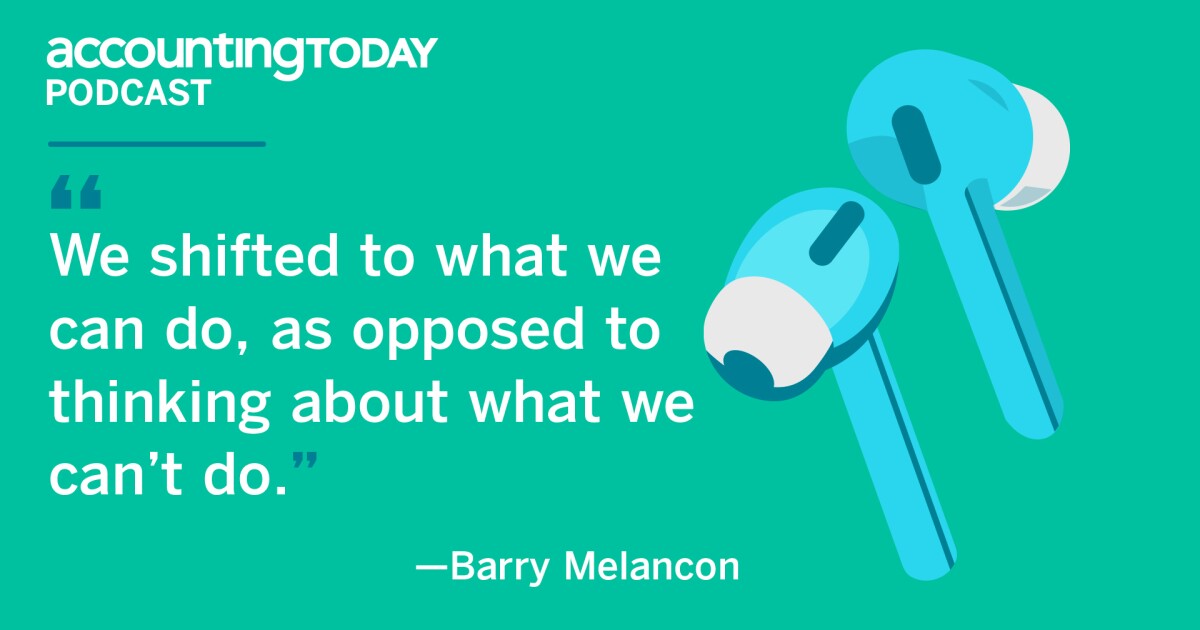

As he prepares to step down from his long tenure as president and CEO of the American Institute of CPAs, Barry Melancon looks back at how the institute —- and the accounting profession — have changed over the past 30 years.
Transcription:
Transcripts are generated using a combination of speech recognition software and human transcribers, and may contain errors. Please check the corresponding audio for the authoritative record.
Transcripts are generated using a combination of speech recognition software and human transcribers, and may contain errors. Please check the corresponding audio for the authoritative record.
Dan Hood (00:03):
Welcome to On the Air With Accounting Today, I’m editor-in-chief Dan Hood. Most people in accounting can’t remember a time when Barry Melancon wasn’t the head of the American Institute of CPAs. It’s a job he started way back in 1995, in which he’s stepping down from at the end of this year, marking an epic in the history of the modern profession. We’re lucky to have him join us on the podcast, and so since no single episode could contain him, we’re going to do two with this first episode, taking a bit of a historical focus on the changes he has, and in many cases he has initiated over the course of his 30 years at the AICPA. Barry, thanks so much for joining us,
Barry Melancon (00:34):
Dan. It’s always great to be with you and obviously all the listeners. I don’t know about the epic part, but it’s been a fun ride. And it’s also, I think when you say it that way, it’s indicative of the fact that I’m getting old. So that’s the other side of that coin.
Dan Hood (00:51):
Veteran, seasoned, I think is the phrase I keep hearing.
Barry Melancon (00:53):
Very good.
Dan Hood (00:53):
No one says old anymore, they say seasoned,
(00:56):
But I think one of the things, people have been talking about this since you announced that you’d be stepping down and have been thinking about your tenure, which is unprecedented. I think we talked about how the vast majority of heads of the AICPA had been 10 to maybe 15 years, but over the course of 30 years, an enormous amount has changed. And I want to get a sense to start of how different the AICPA was in 1995. I’m not sure that people have a sense of how much ground you’ve covered since you joined in. How would you describe the AICPA in 1995?
Barry Melancon (01:31):
Well, people all remember this, but it was pretty lethargic. It was obviously not technologically aligned with even the technologies of ’95. One of the things I did in the first 90 days was a massive reorganization of people and approaches, and that was purposely done. That was to change what we were doing. I think for the most part, the way I would summarize it, Dan, is professional bodies in general are about stopping things in professions under the guise of protection and all of those types of things. And my view and my position and was supported very clearly by our board of directors of the day was that no, we needed to be an enabler, that it is in the public interest for the profession to be able to do a wider variety of things that were attuned to what was happening in the marketplace, which clearly in the mid nineties was really the internet and things of that nature that was at the birth.
(02:35):
And I think that’s probably the thing I’m most proud of is that we really shifted the notion of what is a professional body to be an enabler, a permission granter, yes, with guardrails to make sure that the profession lives up to its obligations of trust and competency that you would expect from the profession. But it’s what we can do as opposed to thinking about what we can’t do. And honestly, and people sometimes will disagree, but I honestly believe that is in the public interest because our economy is fueled on the relationship with the profession. And frankly, when the economy does better because of what we bring as a profession to the table, whether we’re working in business and industry or whether we are in public practice, then that is a positive and that is in the public interest.
Dan Hood (03:22):
Right, right. Well, I mean there’s certainly been, I think that change has been true. We’re going to talk a little bit later about how you’ve seen the AICPA change, but I think that specific point of it’s become an enabler and certainly an organization that looks forward and points the way forward for accounting firms and accountants, certainly that’s a big change. And if it wasn’t doing that in 1995, that alone is a big achievement. Maybe we’d take a broader picture even and talk about the profession itself. If the institute was protective and inward focused, what was the profession like?
Barry Melancon (03:54):
Well, the profession was accounting and auditing and tax and a little bit in the largest firms, the big eight, the consulting and advisory. But I think not so tremendous even in the next tier of firms, some dabbling in that space. And I think we unleashed a lot of that change. I think the leadership of, let’s say the next 100 firms from a size perspective, really were just beginning to embrace that notion. And I think we fueled that to a large degree. So I think that the typical practitioner viewed themselves being in the profession of, and I know this is a video, but if you could see me, I’ve got my hands sort of narrowly put together narrowly thinking about accounting and auditing and tax and what I say, and a lot of my presentations today, I say, if you take nothing away other than this, it’s that we have to think of ourselves in this business, this bigger business information space.
(04:51):
And that’s what people want. Our skillset, our competencies, our trust and our capabilities to really deliver to the table. And accounting and auditing is as important part of that, or accounting in tax or big important parts of that, but it’s not where the sphere ends. It’s a much wider piece of impact, and that includes business processes and evolution and strategy and consulting and today cast and things of that nature that really is about a bigger set of information. Some people in our profession aren’t happy with that. I mean, they’re more comfortable. But I think the shift is that that was overwhelmingly the attitude of the profession back then. And I think now some in the profession have that narrow attitude. The vast majority have that broader attitude.
Dan Hood (05:43):
Yeah, it definitely, it seems from what one hears about the period that it was a much more insular, narrowly focused profession that there are accountants out there now currently doing things that the leaders of the profession in 1995 couldn’t imagine or wouldn’t have imagined.
Barry Melancon (05:58):
That’s right. And I think some of those things, we’ve been very successful with some of those things. We have competition in different spaces, and maybe that’s another one, Dan, to really focus. I do think we have to be better competitors in the marketplace as particularly from a public practice perspective, because if you think about accounting and auditing basically a reserve service in statute, you add tax, a marketplace permission that’s pretty strongly affiliated with the profession, but some of these evolutionary activities that’s been occurring in the last 30 years, we face competition in different ways and then I’ll come back to our trust and ethics that sets us apart.
Dan Hood (06:40):
You talked a little bit about the restructuring issue in the first year or two when you took the helm at the AICPA. Maybe we could dive a little bit into that. What was involved or how did it free up the institute to focus? I keep saying phrasing it as focusing more on the future, but focusing more outwardly more broadly. How did that work?
Barry Melancon (06:59):
Yeah, it wasn’t the first year or two. It continued in the first year or two. It was literally in the first 90 to 120 days where I really wanted to set that tone. And I think I was hired to do that, to set the tone of something different for the organization. And we made very significant shifts. And I think obviously the technical knowledge that the institute brings to the table is really important, but we emphasized it with bringing other aspects to it. We had some work there that was talking about this broader information set. It was actually chaired by a gentleman named Ed Jenkins who is no longer with us, but he went on to become chair of the FASB, but it was about this bigger business information set. Interestingly, I’ll give you a little side note that very few people know from a historical perspective.
(07:50):
It talked about the need for us to be able to handle special purpose entities differently, which if you know the history in Enron, that was actually the sort of abuse of special purpose entities was to a large degree the downfall of Enron. And so we were really ahead of that. The whole notion of broader assurance services came about in that period of time and broader assurance services, meaning our ability to take our skillset and attest to things other than just accounting information. Today, of course, SOC reports as an example, millions of SOC reports are being issued around the globe, which was thought of an output of some of that early thinking in that broader notion of that. But as it relates to the specific reorganization, we put different emphasis in different places. We put greater emphasis in firm services. That was some of the early days of peer review then called quality review.
(08:48):
We made that hopefully much more workable from the standpoint of what was being built early in those days and more sort of this r and d notion of what the profession could do in these broader spaces. And frankly, we brought some things out, for instance, in the internet notion that actually didn’t catch on, but it changed the attitude of how we think about the types of services that we can bring forward. And then within a two or three years, we had the whole big discussion about the creation of what is today, cpa.com. And basically my message on that was at that point in an internet world, WebMD had been created and was created not by the medical profession, but by some people unaffiliated with the medical profession. And I was a firm believer that we couldn’t do that in the profession. We couldn’t let what became known as cpa.com to be not something affiliated with the profession. And of course today everybody would agree that that was the right strategy.
Dan Hood (09:55):
Sure, yeah. I mean, when you look at what cpa.com, it’s becoming what it does for the profession. He has no question. I wonder, I think there’s some things we’re not really making clear. You talked about sort what you were hired for, and it’s worth pointing out that you were 36, 37 by far the youngest, certainly the youngest head of the AICPA, the youngest of the candidates for the job at the time, you felt when you were brought in, we were talking at some point, you were talking about how you went to a meeting with a recruiter and assuming that you weren’t going to get the job. And so instead of doing an interview, you sort of said, here’s what I think needs to be done to the AICPA. Is that a fair…
Barry Melancon (10:34):
One hour meal turned into a four hour meal, and it basically started with me saying, look, you and I know that the AICPA isn’t good. Her, I was 36 at the time, a 36-year-old. It was from South Louisiana and never worked in a public company audit, not big eight firm, not Ivy League educated. And I said, so these are odds stacked against this conversation. So let me just tell you what I think ought to happen. And I laid out, it ended up being four hours of this and that and the other things, and I got the chance to try to do most of those things
Dan Hood (11:09):
I was going to say. So I mean, you’re figuring from that interview, you’re granted permission if they go with you, they’re granting you some permission to shake things up, to make things different, and you certainly did. And I want to talk about some more of the ways in which you’ve shaken up the AICPA in the profession in a minute, but we’re going to take a quick break. Alright. And we’re back. We’re talking with Barry Melancon of the AICPA. We’re going to do two of these episodes. One looking back and one looking forward. And I have to say some of the looking back stuff to me is absolutely fascinating because as I mentioned, for many people, you’re the only head of the AICPA. They’ve known and many of them don’t know some of the, particularly the first steps when you first joined, took the home there, major restructuring.
(11:53):
There’s since been plenty of other changes, but one of the biggest ones, and I just want to highlight this one for a second, is because it’s a major, major milestone for the institute was the combination with CIMA and I want to say 2016, but the pandemic has completely messed with my time, my sense of time. I think it’s 2016. But anyways, I would like to just talk a little bit about that because it is a major, elevation might be one word, but a major expansion of the institute and of the AICPA. And maybe talk a little bit about how that came about and what drove that and where you see it heading.
Barry Melancon (12:29):
There was several parts there. It’s a great question and I do think it was a major element. So let’s understand the strategy behind it. First off, at that point in time, we had about 140,000 of almost 400,000 members that worked in corporate America. And how did you create different sort of services and expertise? And in today’s world, as we sit here in 2024, the transformation in the corporate finance space is epic. And you use that word earlier because it really is very significant and is sort of the early stages of what happens in the accounting profession overall. So CIMA was fully focused on management accounting, the people working in corporate, they were not in the US and they were in the rest of the world. And that the second sort of strategic driver of that was I felt very strongly that while we were the largest professional body, even prior to the combination, that there were other forces in play that would have some impact on the US’ standing in driving the profession of the profession.
(13:34):
Quite frankly, we are the most local, most national and most global of all professions. And that global is really important because business is global and how can we ensure that impact not only in 2016 or not only in 2024, but in the decades to come and we had to have a different global footprint. And literally we had the decision of do we, and we had members all over the world because CPAs relocate all over the world. Do you go try to build that? Not that you don’t buy a fellow membership organization, but in the corporate sense, do you buy that or do you bring that in from already built? And we felt that was the most effective way. But what it came down to in the simplest way, Dan, was we clearly, and I say we because our board was fully behind, ultimately AICPA council was fully behind the largest firms, the mid-size firms.
(14:26):
89% of our membership voted for It was that I think it’s really important as to who has a seat at the table about those things affecting the profession forever and how do we make sure of that and guaranteeing to be a voice from both the corporate and public accounting perspective and being the largest ensures that, and we have to continue to build on that as the years go by. But I will say in such things as sustainability as an example where we have been the only professional accountancy body with a seat at the table, we’ve sort of proven that strategy out and it’s a complex world. And so we’ve got to be really, really good in the states. We’ve got to be really, really good at Washington dc get the national, but we also have to be really good from a global perspective because that’s actually what the profession looks like,
Dan Hood (15:17):
Right? And certainly as you look at some of the opportunities for the future, many of them have more of a global element to them. We’re going to talk about that though in the second episode. I don’t want to steal too much from that. And I do look a little bit back because at some point I was making a list of things that have happened at the AICPA or because of the AICPA over the past 30 years, and it’s a very long list. We’ve touched on a couple of them. The restructuring when you first joined the creation of cpa.com, the merger combination with sema, and I wanted to get a sense from you as you look back, obviously those are three big things that happened with the AICPA. If there are other big changes to the AICPA that you’ve seen, but also you talked about Enron, maybe we can talk about some of the major turning points or events for the profession as a whole. Why don’t we start with looking at the AICPA? Have we missed any major changes at the A SPA other than those three big ones we talked about?
Barry Melancon (16:13):
So I want to sort of throw into that the computerization of the CPA exam. And I think that was a big one, not the fact that the exam would become computerized, because ultimately that was certainly going to be the case. But because it was very early, it was 2004, which meant we started working on that. Actually, it was the largest project ever for the AICPA. We started working on that in 2000. We had to sell all of the state boards, the regulatory bodies in the states, and that was a major element that was really critically component. What I used to say back then is you could not say to the world we’re this modern profession that can do all of these services and has all these skill sets and literally test people with a paper and pencil exam that used the dollar 99 calculator. And I said that so many times that people got tired of hearing it.
(17:04):
But we had to be very early on that and we built simulations and some modern approaches to it. And I think that was a major change in that notion. I would also say, because today we have a lot of debate about human capital and pipeline from 1990, so remember I started in 1995. From 1990 to 1999, we had a reduction by 50% of those people majoring in accounting in that decade. By the time we got to 2005, we had record numbers of people majoring in accounting. And a lot of that was because of the dotcom bust. A lot of that actually was because of Enron and some of the focal point, the purpose-driven aspect of what the profession did. And I would say things today, how do we manage AI and how do we deal with environmental issues is also rejuvenating people’s interests back in accounting because of the purpose aspect of the profession.
(17:59):
I do think another one was just getting through Enron and WorldCom, but what people don’t focus on that I think was critically important. People criticize what we did, but the profession did extraordinarily well coming through in running WorldCom, much more so than other people thought. But one of the key components was we fought very hard to keep the private company elements of the self-regulatory process, peer review, auditing standards and ethics. And that paid huge dividends for our profession because frankly, some of the PCOB activities and the auditing standards of public companies had become bogged down in a lot of politics and other things. We’ve been able to keep moving the profession forward because of that self-regulatory process and the modernization. And most people would agree, the modernization of the audit, for instance, and the broader assurance footprint we’ve been able to deliver because we do have that responsibility.
Dan Hood (18:56):
And you can certainly, I mean in all elements there, the AICPA has been active. I mean, one of the things on my long list of things was sort of focused on audit quality and different ways of setting up the audit quality centers and the Center for Audit quality itself, but then also the individual groups that they’re working on different kinds of audits and improving those. When you mentioned the computerization to the CPA a exam, I always think of the internationalization of the CPA exam. It seems as if for a while we’ve been expanding it to, I’m hearing from people all around the world who are saying, I’m a CPA, and I’m like, how did you become a CPA in the Palestinian Territories or so on? I mean, these are big changes in expansions.
Barry Melancon (19:33):
The number one volume space internationally today is India. And so yeah, we all over the world with it, not in China, but else, pretty much everywhere else in the world. And that’s the attractiveness to the US CPA on a global stage.
Dan Hood (19:47):
There you go. Very exciting. We talked about Enron. WorldCom profession also made it pretty well through the pandemic. I think it’s another, it’s recent enough that we think of it’s recent history, but some point it will become full on history. And it’s worth, I think, talking about a little bit about the profession’s role, not just in surviving it and making it through and Alzheimer, but as a first responder and the institute in particular playing a major role inside the beltway response to the pandemics. Maybe you could just take us through that a little bit.
Barry Melancon (20:14):
Yeah, that was very interesting time. I always say that the history books of Covid probably won’t include a chapter on the profession’s role, but they should. And frankly, we were very, our profession, when I say we, I’m not talking about the institute per se, but institute differently. We did have a role in that, but the men and women on the front lines, particularly in firms, particularly firms servicing small business, were just incredible. And we took a lot of risk on that because the government was lethargic by the nature of government with a lot of things that were pretty interesting. And I tell this story because it’s not something that I think anyone would’ve ever predicted in my 30 year career that I would’ve ever said. But we were quite upfront saying to the government, look, and this specifically was related to PPP, you need to do this fast and you need to accept fraud in the process.
(21:07):
Because if you try to build a system that’s going to minimize fraud to the degree that we probably would all agree should be minimization, we’re going to be late. The government’s response is going to be late, and the economy is going to suffer, and you have to take that risk. And we took that risk with the government. And as you recall, Dan, there were a lot of things that were unanswered. And we told our members, look, the government’s not going to answer this. Here’s how we would answer it, and we’ll defend you because you’re going to follow what we’re saying on that particular spot. And sort of the collective effort of the men and women on the front lines and what we were willing to do, I think paid huge dividends to the entrepreneurial businesses of America. And we really weathered that storm extraordinarily well.
Dan Hood (21:57):
Yeah, no, there’s no question the profession came out of it in a better position, but everybody that they worked with came out in a better position for having worked with them. So yeah, it’s definitely a success story. It probably won’t go into history books, as you say, but we’ll know what everyone did. We’ll know what the accountants did. Just as a sort of final wrap up, any sort of overarching thoughts on how the profession has changed in the last 30 years? We talked a little bit earlier about how you mentioned that there are firms out there that are getting pioneering, that are exploring new things, that are taking a more expansive view. Any other major changes you see in accounting?
Barry Melancon (22:32):
Well, overall, I think the profession is much more progressive. I think it’s much more agile. You have a wide variety of business models today inside of firms. I think that the skill sets and competencies inside corporate America and finance functions has changed dramatically. Clearly. We’re seeing different ownership structures that are pretty prevalent with the private equity era, if you want to call it that. We’ve shifted the generational leadership aspect pretty smoothly as a profession compared to what a lot of people were predicting maybe a decade or so ago that was going to be very difficult to do. The next generation has been phenomenal. And stepping up to leadership positions in the profession, I think you mentioned some of the quality. We’ve identified quality areas that needed to be focused on, and yes, that’s painful sometimes, but the profession has stepped up and we haven’t talked about tax, frankly, our market positioning as a profession in tax, which is not a reserve service.
(23:34):
It’s a marketplace permissioning. As I said earlier. Our profession does a remarkable job in that area, including some pretty complex things, a lot of change management in that process. And really what we’re seeing change, and we’ve been talking about this for a decade or so, is that the tax return, which for this sort of newer generation, is viewed as a byproduct of a broader notion of tax and personal planning, life planning. I’m not saying just financial planning as an investments, a broader notion of that planning has shifted very dramatically and clearly those firms that are super successful in the tax area, those who approach it as the tax return is a byproduct. Now, of course, we still face the notion of heavy workloads. We have, hopefully, when we see a tax act in 2025, we’ll see that what we call the Safe Act, which changes the individual extension process. We’ve been working on that for a long time. So it’s not a perfect panacea by any stretch of the imagination. But tax practice has evolved dramatically, and we’ve grown market share as a profession and the complexity and actually the global and multi-state elements of tax are right in the sweet spot of our profession and are really critical today. And that’s been part of a past decade of evolution.
Dan Hood (25:02):
Yep. And it’s pointing directly at the future, which is why we’re going to stop right now and save all the future facing stuff for our next episode. But for now, Barry Melancon of the AICPA thank you so much for joining us, for giving us this look back at your remarkable tenure. Thank you.
Barry Melancon (25:20):
Thank you, Dan. It’s been great to be with you.
Dan Hood (25:23):
And thank you all for listening. This episode of On the Air was produced by Accounting Today with audio production by Kellie Malone Yee. Rate and review us on your favorite podcast platform and see the rest of our content on accountingtoday.com. Thanks for going to our guest, and thanks for listening.





Nvidia Q2 FY2027 Earnings beats Wall Street Expectation with Record $96.2 Billion Revenue

Treasury Bond Volatility Forces Bessent to Double Debt Buyback Size as Yields Swing

Nvidia Earnings Preview: What Wall Street Expects From the AI Bellwether’s Q2 Report

Armanino adds Strategic Accounting Outsourced Solutions

New 2023 K-1 instructions stir the CAMT pot for partnerships and corporations

Tax Strategy: Employee Retention Credit update
-
 Economics1 week ago
Nvidia’s Potential $3 Billion SB Energy Investment Could Reshape AI Infrastructure
-

 Economics4 days ago
Top 10 Largest Economies by 2030: IMF & World Bank GDP Projections for Global Powerhouses
-
 Stock News4 days ago
How to understand Intel $15B Stock Offering
-

 Technology1 week ago
U.S.-China AI Competition Intensifies as Washington Pushes Allies to Choose Sides
-
 Stock News1 day ago
Nvidia Earnings Preview: What Wall Street Expects From the AI Bellwether’s Q2 Report
-

 Economics4 days ago
Economic Profile of the United States of America (2026–2030 Horizon)
-
 Leaders3 days ago
Jackson Hole 2026: What the First Symposium Under Fed Chair Kevin Warsh Means for Markets
-

 Economics3 days ago
U.S. National Debt Surpasses $40 Trillion for the First Time: What It Means for the Economy