Connect with us

UNCATEGORIZED

PCAOB Really Flexed Its Enforcement Muscles in 2023

Published

on

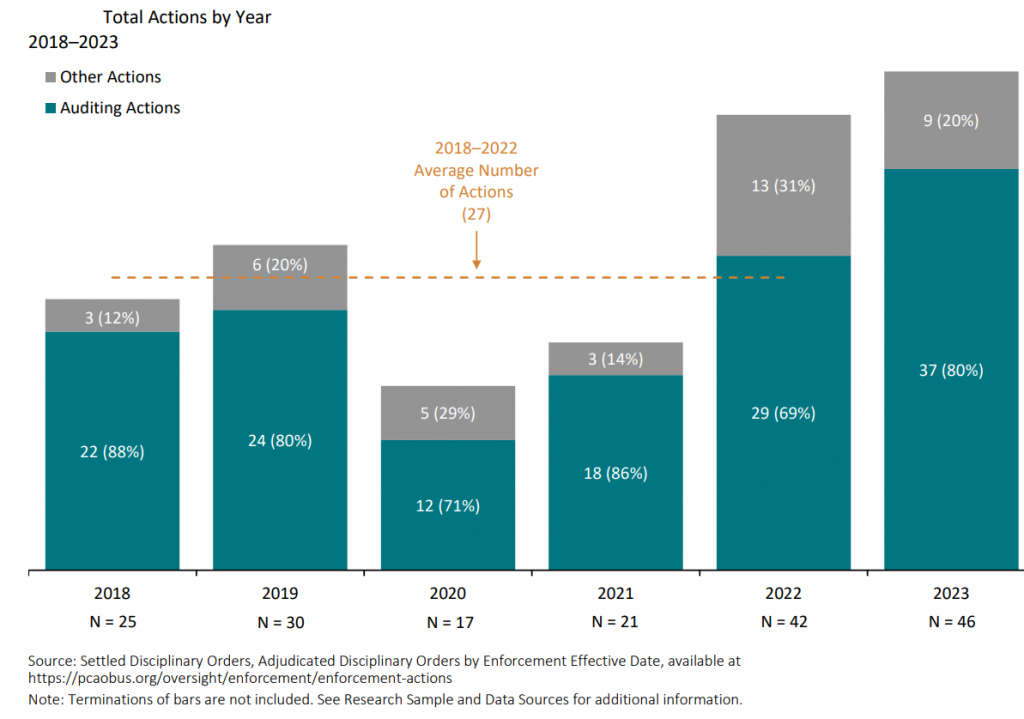
2023 definitely was a banner year for the enforcement division of the Public Company Accounting Oversight Board (PCAOB) as total enforcement activity reached its highest level since 2017 and monetary penalties doubled compared to the record set in 2022, according to a new study from Cornerstone Research.

The PCAOB disclosed 46 total enforcement actions in 2023, 37 of which related to the performance of an audit, up more than 28% from 2022. Twenty-nine of the 37 auditing actions were revealed during the second half of 2023, matching the total number of auditing actions for all of 2022.
Data courtesy of Cornerstone Research

In addition, monetary penalties last year totaled $19.7 million, nearly doubling the previous record of approximately $10.5 million in 2022. Of that $19.7 million, $18.8 million were imposed on audit firms, nearly twice the $9.5 million imposed on firms in 2022, according to Cornerstone Research. Fifteen percent of firms sanctioned by the PCAOB were required to hire an independent consultant to review their quality control policies and procedures and recommend improvements.

“More than two-thirds of the PCAOB’s record-setting monetary penalties were imposed on non-U.S. respondents in 2023, even though non-U.S. respondents accounted for less than half of the auditing actions during the year,” Russell Molter, a principal at Cornerstone Research and report co-author, said in a statement. 

Last year, there were 34 PCAOB auditing enforcement actions against firms versus 19 against individuals, a notable shift from previous years when there were more actions taken against individuals than firms. For example, individuals were sanctioned more by the U.S. audit regulator than firms (26 vs. 17) in 2022.

The vast majority—79%—of auditing actions in 2023 included alleged violations of auditing standards. Sixty percent of those actions included additional allegations related to ethics and independence standards, quality control standards, or both. And for the first time, the PCAOB included allegations related to critical audit matters in enforcement actions, with three actions including such allegations, the study says.

Other key trends noted in the study include:

  • The PCAOB settled four actions involving three China-based firms after securing access to inspect and investigate Chinese firms in 2022.
  • For the second consecutive year, there were no enforcement actions related to a company’s disclosure of a material weakness in internal control. In contrast, Securities and Exchange Commission enforcement actions that referred to an announced restatement and/or material weakness in internal control reached their highest levels in recent years.
  • Violations of quality control standards were alleged in more than half of the actions involving firm respondents.
  • Nearly 80% of the total monetary penalties in 2023 were assessed on just six defendants.
  • The proportion of individual respondents who were barred increased from 64% in 2022 to 85% in 2023.

Continue Reading

UNCATEGORIZED

Hardware Rally Diverges From Software Stocks

Published

on

Hardware Rally Diverges From Software Stocks

As midyear earnings reports flood Wall Street during the week of July 21, 2026, a sharp performance divergence has emerged within the technology sector. Equity indices reflect robust institutional buying in semiconductor manufacturers, data center infrastructure providers, and specialized power equipment suppliers. Conversely, enterprise Software-as-a-Service (SaaS) equities are facing notable valuation pressure as institutional investors demand clear, high-margin top-line revenue growth to justify elevated price-to-earnings multiples.

The sustained momentum in hardware equities is anchored in massive, multi-billion-dollar capital expenditure budgets allocated by mega-cap technology corporations. Demand for next-generation computing architectures, high-density server hardware, and specialized cooling infrastructure remains unyielding as enterprises globally build out localized computing clusters. Semiconductor foundries and equipment manufacturers continue to report record order backlogs, granting these companies exceptional pricing power and revenue visibility despite broader macroeconomic uncertainty.

In contrast, the enterprise software segment is navigating a rigorous fundamental reassessment. While software vendors have aggressively integrated automated digital features across their applications, enterprise customers are closely scrutinizing software licensing expenditures. Corporate IT departments are demanding verifiable productivity metrics before expanding user licenses, leading to extended sales cycles for software providers. Firms that fail to demonstrate direct, measurable return on investment are experiencing sharp post-earnings corrections.

For equity portfolio managers, navigating the midyear technology landscape requires strict balance sheet analysis and disciplined stock selection. Investors should focus on hardware leaders with defensible technological moats and enterprise software firms featuring deep workflow integration and proven monetization models. Maintaining a balanced, highly selective exposure protects capital while capturing structural technological growth.

Continue Reading

UNCATEGORIZED

Hardware vs. Software Divergence: Navigating Midyear 2026 Tech Sector Earnings

Published

on

Hardware vs. Software Divergence: Navigating Midyear 2026 Tech Sector Earnings

As the midyear 2026 earnings season accelerates through the week of July 20, the technology sector is displaying a notable operational split between hardware infrastructure providers and enterprise software-as-a-service (SaaS) platforms. Market indices reflect strong institutional demand for companies supplying core computing hardware, advanced power management systems, and specialized optical networking components. Conversely, software providers are facing intense margin scrutiny as Wall Street demands concrete, high-margin revenue growth to justify elevated software valuations.

The sustained outperformance of hardware equities is anchored in ongoing, multi-billion-dollar global capital investments into data center infrastructure, grid capacity expansion, and high-performance chip architecture. Semiconductor foundries and specialized component suppliers have consistently reported robust order backlogs, driven by enterprise commitments to build out secure, localized computing clusters. Investors have rewarded these companies due to their tangible, order-backed revenue visibility and strong pricing power in a constrained supply environment.

On the other hand, the software sector is navigating a transition phase. While enterprise software vendors have heavily invested in integrating automated AI capabilities across their product suites, corporate clients are scrutinizing software licencing costs and requiring clear return-on-investment metrics before expanding enterprise seat licenses. Consequently, software vendors that rely on generic feature upgrades without demonstrable productivity improvements are seeing extended sales cycles and valuation compression during quarterly earnings calls.

For equity investors, navigating the tech market for the remainder of 2026 requires rigorous fundamental analysis focused on capital efficiency and cash flow generation. Strategic focus should be directed toward hardware leaders with unassailable technological moats and enterprise software companies possessing deep workflow integration and proven monetization models. Maintaining a balanced, selective exposure ensures participation in technological growth while hedging against localized valuation corrections.

Continue Reading

UNCATEGORIZED

Utilities Re-Valuation: How Industrial Power Demand Driven by AI Upgrades Sector Equities

Published

on

How Industrial Power Demand Driven by AI Upgrades Sector Equities

Traditionally viewed as defensive, low-growth dividend plays, utility equities are undergoing a remarkable structural re-valuation across major stock exchanges in July 2026. Driven by an unprecedented surge in industrial power requirements—stemming from high-density data centers, advanced domestic manufacturing plants, and widespread electrification initiatives—utility providers are presenting revenue growth profiles historically reserved for growth sectors. This transition has repositioned power and energy infrastructure equities into prime targets for institutional capital.

The driver of this market shift is the long-term contractual nature of commercial energy demand. Tech giants and industrial manufacturers are entering into multi-decade power purchase agreements (PPAs) with utility operators to secure guaranteed baseload power. To meet this demand, utility companies are undertaking massive capital expenditure programs to modernize electrical transmission networks, integrate next-generation nuclear and renewable power facilities, and enhance regional grid resilience. Regulated utility models allow these companies to earn predictable returns on these substantial capital investments.

Furthermore, equity analysts highlight that the sector offers an attractive blend of growth potential and downside protection in a sustained high-interest-rate environment. While elevated capital costs increase borrowing expenses for grid infrastructure upgrades, the sheer volume of new industrial power demand provides strong top-line revenue expansion that offsets debt-servicing expenses. Investors seeking reliable yield combined with structural capital appreciation are increasingly allocating capital to regulated electric utilities and independent power producers.

Moving through the second half of 2026, portfolio managers recommend evaluating utility equities based on regional regulatory environments and capital execution track records. Companies operating in regions with streamlined permitting processes, supportive state regulatory commissions, and direct proximity to expanding industrial corridors are best positioned to deliver superior long-term shareholder value.

Continue Reading

Trending