
Accounting
Tax Strategy: Trump tax proposals and 2025 tax legislation

2025 promises to be a very big year for tax legislation.
Having the White House, House and Senate all in control of the same party increases the likelihood that major tax legislation can be agreed upon. The Tax Cuts and Jobs Act was enacted in the first year of Donald Trump’s first term when Republicans also had control of the White House and Congress. Republicans are also likely to use budget reconciliation to enable the legislation to be enacted without any Democratic support by avoiding the filibuster rules of the Senate.
Republicans will still have to keep almost all their members on board given their narrow majorities in both the House and Senate. Budget reconciliation will also require Republicans to agree on a budget resolution that will specify the spending, taxes, and deficit to be allowed under the budget resolution, and then require the congressional committees to follow that resolution in crafting the legislation.
The two main focuses of the 2025 tax legislation are likely to be extension of and other tinkering with the provisions of the TCJA, many of which are currently set to expire after 2025, and enactment of the many tax-related proposals Trump has made on the campaign trail. The legislation will still be difficult to pull together, with many of the tax proposals coming at a high cost, and growing concern about increasing the size of the federal deficit.
Expiring TCJA provisions
President-elect Trump has proposed extending almost all the expiring provisions of the TCJA. These include:
- Maintaining the current tax rate brackets with a top rate of 37%;
- Maintaining the TCJA’s elevated standard deduction, which has resulted in around 80% of taxpayers claiming the standard deduction rather than itemizing;
- Continuing the elimination of the personal exemption;
- Continuing the elimination of miscellaneous itemized deductions in excess of the 2% floor, including unreimbursed employee business expenses, investment expenses, tax preparation fees, and safe deposit box rental expenses;
- Continuing the elimination of the Pease limit on overall itemized deductions;
- Continuing the 60% of adjusted gross income limit on charitable contribution deductions;
- Continuing the current $750,000 limit on the mortgage interest deduction;
- Continuing the current $2,000 Child Tax Credit with a $1,400 refundable amount;
- Continuing the current, more limited, individual alternative minimum tax; and,
- Continuing the current high level of the unified estate and gift tax exclusion amount, which is $13,990,000 for 2025.
The TCJA also included the $10,000 limit on the state and local tax deduction. Trump has mentioned perhaps letting that limit expire. Other proposals include at least doubling it for married filing jointly to $10,000 for each spouse or otherwise increasing the limit.
Several business provisions are also already phasing down. Republicans included retroactively extending these provisions in the Tax Relief for American Families and Workers bill in 2024. However, that bill failed to pass the Senate. These include:
- Restoration of 100% deduction for research and experimentation expenses;
- Restoration of 100% bonus depreciation, currently phasing down to 60% in 2024 and 40% in 2025; and,
- Restoration of the business interest deduction limitation to not include adjustments for depreciation, depletion and amortization.
A few business-related provisions of the TCJA are also scheduled to expire after 2025. These include:
- The 20% qualified business income deduction;
- The disallowance of the moving expense deduction, other than for members of the armed forces; and,
- Empowerment Zones and the New Markets Tax Credit, expiring at the end of 2025, and Opportunity Zones, expiring at the end of 2026.
Several of the international tax provisions of the TCJA are modified after 2025:
- BEAT increases to 12.5% from 10%;
- GILTI deduction drops from 50% to 37.5%;
- FDII drops from 37.5% to 21.875%; and,
- The look-through rule for controlled foreign corporations from other related CFCs expires.

Ian Maule/Getty Images
Trump’s campaign proposals
President-elect Trump made a number of tax proposals at campaign stops during the election campaign. Most of them lack detail as to how they would be implemented.
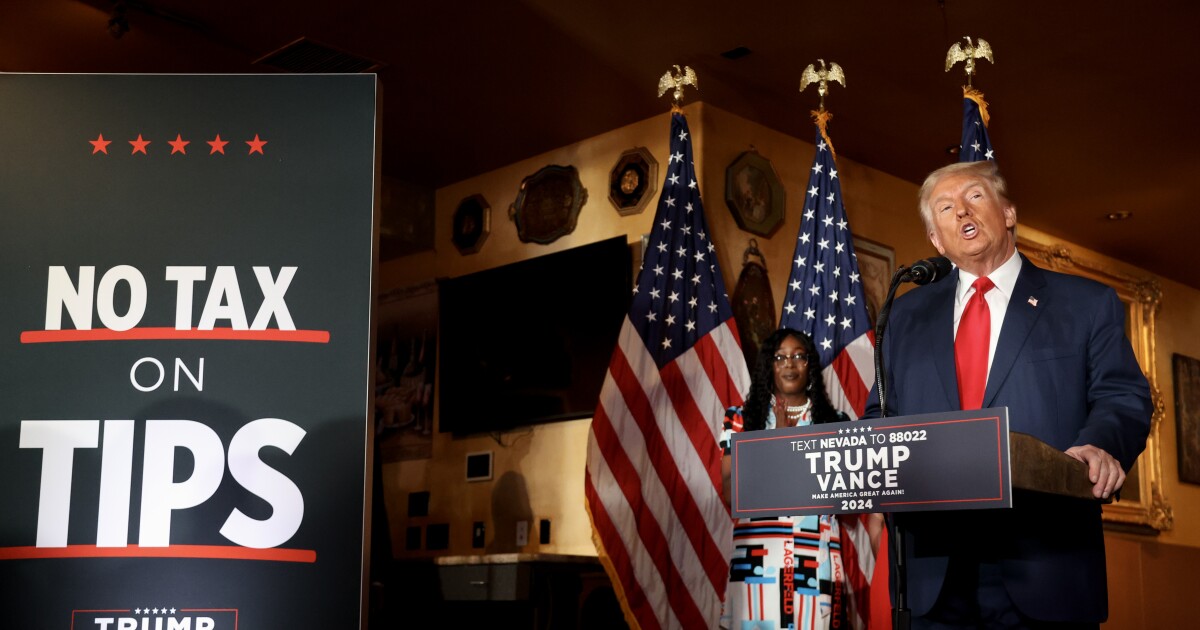
- No taxation of tip income. This would be a new concept in the tax law. It would favor workers receiving tip income over other low-wage workers who do not receive tip income and might encourage employers to try to push more employees into tip income. It is not clear if it would include tips in kind or only cash tips. Taxation of tip income was already difficult to administer, and it is not clear if this would simplify administration or further complicate the issue. The proposal would be expensive.
- No taxation of overtime. This would also be a new concept in the tax law. It also raises definitional questions of what constitutes overtime — e.g., does it include an employee who works more than 40 hours per week because the employee holds two jobs? It might encourage employees to try to maximize overtime pay versus regular pay. The proposal would also be expensive.
- No taxation of Social Security benefits. This would be relatively easy to incorporate into the tax law since Social Security benefits are already not taxed to recipients under certain income levels. The proposal would be expensive and contribute to a more rapid depletion of the Social Security Trust Fund.
- Deduction of car loan interest. This would be relatively easy to incorporate into the tax law since there is already a deduction for home mortgage interest. This proposal would also be expensive to adopt. It might help more taxpayers qualify for itemized deductions in excess of the standard deduction.
- Elimination of double taxation of citizens living abroad. There are already several tax provisions designed to limit double taxation of citizens living abroad. These include tax treaties, the foreign tax credit, the foreign earned income exclusion, and the foreign housing deduction and exclusion. It is not clear if this proposal would try to modify these provisions or seek to revise the fundamental U.S. tax policy of taxing U.S. citizens on their worldwide income regardless of where they reside.
- Elimination of clean energy credits. Trump has specifically proposed eliminating the clean energy credits with respect to electric vehicles. It is not clear how far this extends to other clean energy credits. Many Republican lawmakers have voiced support for some of the clean energy credits. This proposal would help to raise some revenue to offset the expense of some of the other proposals.
- Corporate income tax. Although the corporate income tax rate established by the TCJA is permanent at 21% and not set to expire, Trump has proposed lowering it further to 18% or 20% and 15% for domestic manufacturers. This would also be an expensive provision that might be dropped due to deficit concerns.
- Sovereign wealth fund. Trump has proposed establishing a sovereign wealth fund for investment activities by the government, similar to funds operated by several other countries. Trump has proposed funding it with tariffs and has predicted that it would be a revenue raiser for the country.
- Tariffs. Trump has proposed a variety of tariffs as a favorite revenue raiser. These include a broadly applicable 10% or 20% tariff on imports, a 60% tariff of imports from China, and a 100% tariff on vehicles from Mexico. He has also recently proposed 25% tariffs on Canada and Mexico and an additional 10% tariff on China related to control of drugs coming into the U.S. Trump would have some freedom under current law to impose tariffs by executive action, although Congress could act to restrict that authority. Trump has suggested that tariffs could pay for many of his other tax proposals, although some commentators doubt that tariffs could raise that level of income. Trump has also suggested that tariffs could at some point replace the U.S. income tax, although again many commentators doubt that it could raise sufficient revenue. Tariffs would also tend to be much more regressive than the current income tax.
Summary
These are likely to be the discussion points around which 2025 tax legislation develops. As was done with the TCJA, there may be a tendency to try to get in as many tax breaks as possible, but to try to control the revenue cost by including phasedowns and phaseouts to stay within budget reconciliation requirements. The negotiations are likely to be difficult but also likely to end up with significant tax legislation enacted in 2025.





U.S.- Canada Trade Talks Collapse; Carney Says Retaliatory Tariffs Begin September 8

Flock Cameras and the Future of Public Security

AI Infrastructure Boom Hits Physical Limits: Power, Financing, and Supply Chain Strain

Armanino adds Strategic Accounting Outsourced Solutions

New 2023 K-1 instructions stir the CAMT pot for partnerships and corporations

Tax Strategy: Employee Retention Credit update
-

 Stock News1 week ago
Nvidia Earnings Preview: What Wall Street Expects From the AI Bellwether’s Q2 Report
-

 Accounting1 week ago
SEC’s Semiannual Reporting Proposal Faces Investor Pushback: What CFOs Need to Know
-

 Stock News1 week ago
Nvidia Q2 FY2027 Earnings beats Wall Street Expectation with Record $96.2 Billion Revenue
-

 Finance1 week ago
Treasury Bond Volatility Forces Bessent to Double Debt Buyback Size as Yields Swing
-
 Technology5 days ago
AI Infrastructure Boom Hits Physical Limits: Power, Financing, and Supply Chain Strain
-
 Technology3 days ago
Flock Cameras and the Future of Public Security
-
 Economics3 days ago
U.S.- Canada Trade Talks Collapse; Carney Says Retaliatory Tariffs Begin September 8