
Finance
The Fed’s biggest interest rate call in years happens Wednesday. Here’s what to expect

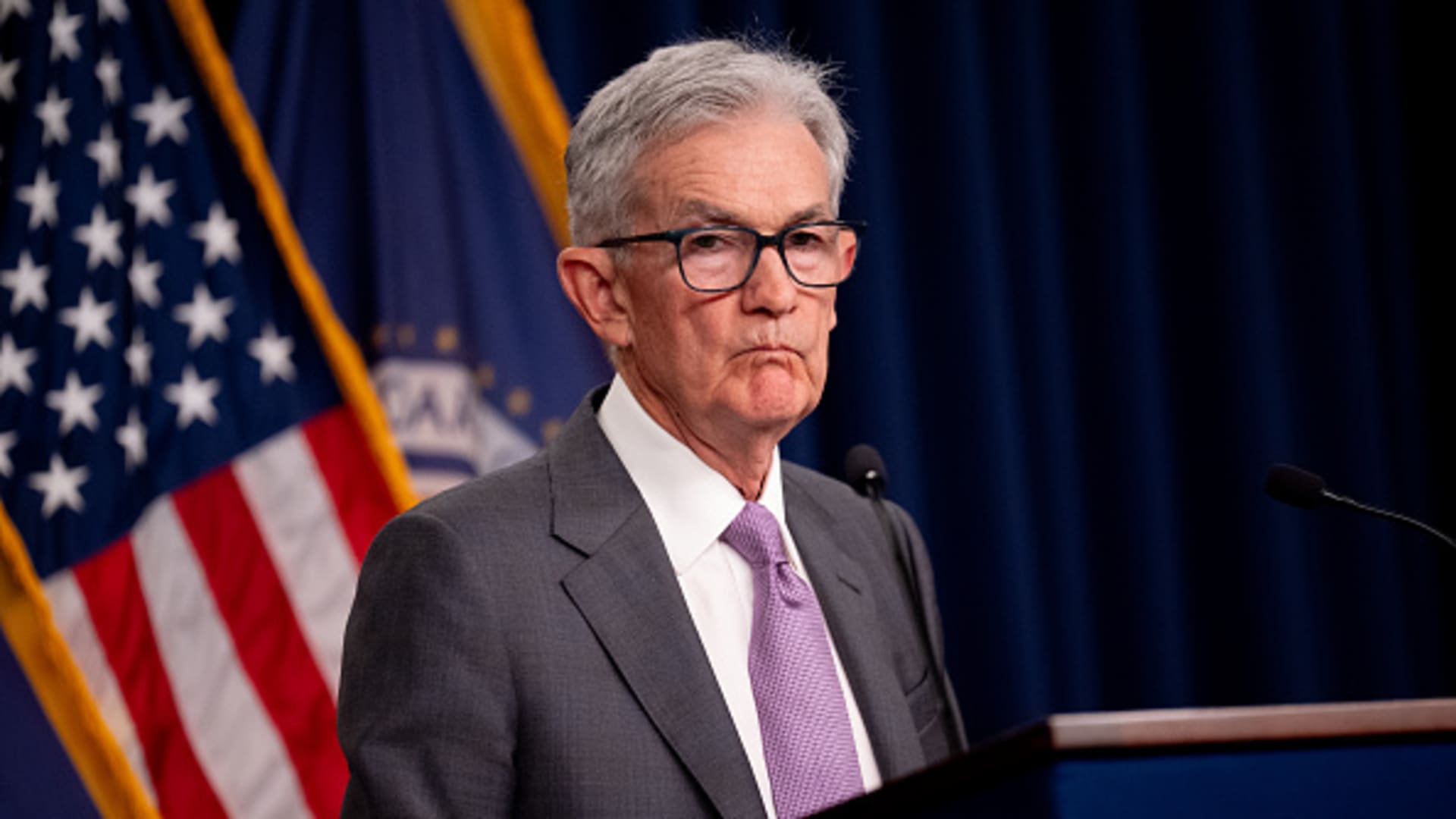
Federal Reserve Chairman Jerome Powell takes a question from a reporter during a news conference following a Federal Open Market Committee meeting at the William McChesney Martin Jr. Federal Reserve Board Building on July 31, 2024 in Washington, DC.
Andrew Harnik | Getty Images
For all the hype that goes into them, Federal Reserve meetings are usually pretty predictable affairs. Policymakers telegraph their intentions ahead of time, markets react, and everyone has at least a general idea of what’s going to happen.
Not this time.
This week’s gathering of the central bank’s Federal Open Market Committee carries an uncommon air of mystery. While markets have made up their collective mind that the Fed is going to lower interest rates, there’s a vigorous debate over how far policymakers will go.
Will it be the traditional quarter-percentage-point, or 25-basis-point, rate reduction, or will the Fed take an aggressive first step and go 50, or half a point?
Fed watchers are unsure, setting up the potential for an FOMC meeting that could be even more impactful than usual. The meeting wraps up Wednesday afternoon, with the release of the Fed’s rate decision coming at 2 p.m. ET.
“I hope they cut 50 basis points, but I suspect they’ll cut 25. My hope is 50, because I think rates are just too high,” said Mark Zandi, chief economist at Moody’s Analytics. “They have achieved their mandate for full employment and inflation back at target, and that’s not consistent with a five and a half percent-ish funds rate target. So I think they need to normalize rates quickly and have a lot of room to do so.”
Pricing in the derivatives market around what the Fed will do has been volatile.

Until late last week, traders had locked in on a 25-basis-point cut. Then on Friday, sentiment suddenly shifted, putting a half point on the table. As of Wednesday afternoon, fed funds futures traders were pricing in about a 63% chance of the bigger move, a comparatively low level of conviction against previous meetings. One basis point equals 0.01%.
Many on Wall Street continued to predict the Fed’s first step would be a more cautious one.
“The experience of tightening, although it seemed to work, didn’t work exactly how they thought it was going to, so easing should be viewed with just as much uncertainty,” said Tom Simons, U.S. economist at Jefferies. “Thus, if you’re uncertain, you shouldn’t rush.”
“They should move quickly here,” Zandi said, expressing the more dovish view. “Otherwise they run the risk of something breaking.”
The debate inside the FOMC meeting room should be interesting, and with an unusual division among officials who generally have voted in unison.

“My guess is they’re split,” former Dallas Fed President Robert Kaplan told CNBC on Tuesday. “There’ll be some around the table who feel as I do, that they’re a little bit late, and they’d like to get on their front foot and would prefer not to spend the fall chasing the economy. There’ll be others that, from a risk management point of view, just want to be more careful.”
Beyond the 25 vs. 50 debate, this will be an action-packed Fed meeting. Here’s a breakdown of what’s on tap:
The rate wait
The FOMC has been holding its benchmark fed funds rate in a range between 5.25%-5.5% since it last hiked in July 2023.
That’s the highest it’s been in 23 years and has held there despite the Fed’s preferred inflation measure falling from 3.3% to 2.5% and the unemployment rate rising from 3.5% to 4.2% during that time.
In recent weeks, Chair Jerome Powell and his fellow policymakers have left no doubt that a cut is coming at this meeting. Deciding by how much will involve a calculus between fighting inflation while staying mindful that the labor market has slowed considerably in the past several months.
“For the Fed, it comes down to deciding which is a more significant risk — reigniting inflation pressures if they cut by 50 bps, or threatening recession if they cut by just 25 bps,” Seema Shah, chief global strategist at Principal Asset Management, said in written commentary. “Having already been criticized for responding to the inflation crisis too slowly, the Fed will likely be wary of being reactive, rather than proactive, to the risk of recession.”
The ‘dot plot’
Perhaps just as important as the rate cut will be the signals meeting participants send about where they expect rates to go from here.
That will happen via the “dot plot,” a grid in which each official will signal how they see things unfolding over the next several years. The September plot will offer the first outlook for 2027.
In June, FOMC members penciled in just one rate cut through the end of the year. That almost surely will accelerate, with markets pricing in the equivalent of up to five, or 1.25 percentage points, worth of cuts (assuming 25 basis point moves) with only three meetings left.
In all, traders see the Fed hacking away at rates next year, taking off 2.5 percentage points from the current overnight borrowing rate before stopping, according to the CME Group’s FedWatch gauge of futures contracts.
“That feels overly aggressive, unless you know the economy is going to start to weaken more significantly,” Zandi said of the market’s outlook. Moody’s expects quarter-point cuts at each of the three remaining meetings this year, including this week’s.
Economic projections
The dot plot is part of the FOMC’s Summary of Economic Projections, which provides unofficial forecasts for unemployment, gross domestic product and inflation as well.
The biggest adjustment for the SEP likely will come with unemployment, which the committee almost certainly will ratchet up from the 4.0% end-year forecast in June. The jobless rate currently stands at 4.2%.
Core inflation, pegged in June at 2.8% for the full year, likely will be revised lower, as it last stood at 2.6% in July.
“Inflation appears on track to undershoot the FOMC’s June projections, and the higher prints at the start of the year increasingly look more like residual seasonality than reacceleration. A key theme of the meeting will therefore be a shift in focus to labor market risks,” Goldman Sachs economists said in a note.
The statement and the Powell presser
In addition to adjustments to the dot plot and SEP, the committee’s post-meeting statement will have to change to reflect the expected rate cut along with any additional forward guidance the committee will add.
Released at 2 p.m. ET, the statement and the SEP are the first things to which the market will react, followed by the Powell press conference at 2:30.
Goldman expects the FOMC “will likely revise its statement to sound more confident on inflation, describe the risks to inflation and employment as more balanced, and re-emphasize its commitment to maintaining maximum employment.”
“I don’t think that they’re going to be particularly specific about any kind of forward guidance,” said Simons, the Jefferies economist. “Forward guidance at this point in the cycle is of little use when the Fed doesn’t actually know what they’re going to do.”






Treasury Bond Volatility Forces Bessent to Double Debt Buyback Size as Yields Swing

Nvidia Earnings Preview: What Wall Street Expects From the AI Bellwether’s Q2 Report

SEC’s Semiannual Reporting Proposal Faces Investor Pushback: What CFOs Need to Know

Armanino adds Strategic Accounting Outsourced Solutions

New 2023 K-1 instructions stir the CAMT pot for partnerships and corporations

Tax Strategy: Employee Retention Credit update
-

 Economics1 week ago
U.S. Retail Sales Fall for the First Time in Nine Months as Consumer Spending Slows
-

 Economics1 week ago
Nvidia’s Potential $3 Billion SB Energy Investment Could Reshape AI Infrastructure
-
 Economics4 days ago
Top 10 Largest Economies by 2030: IMF & World Bank GDP Projections for Global Powerhouses
-
 Stock News4 days ago
How to understand Intel $15B Stock Offering
-

 Technology1 week ago
U.S.-China AI Competition Intensifies as Washington Pushes Allies to Choose Sides
-
 Economics4 days ago
Economic Profile of the United States of America (2026–2030 Horizon)
-
 Leaders3 days ago
Jackson Hole 2026: What the First Symposium Under Fed Chair Kevin Warsh Means for Markets
-

 Economics3 days ago
U.S. National Debt Surpasses $40 Trillion for the First Time: What It Means for the Economy