
Finance
The legend leads Berkshire to new heights

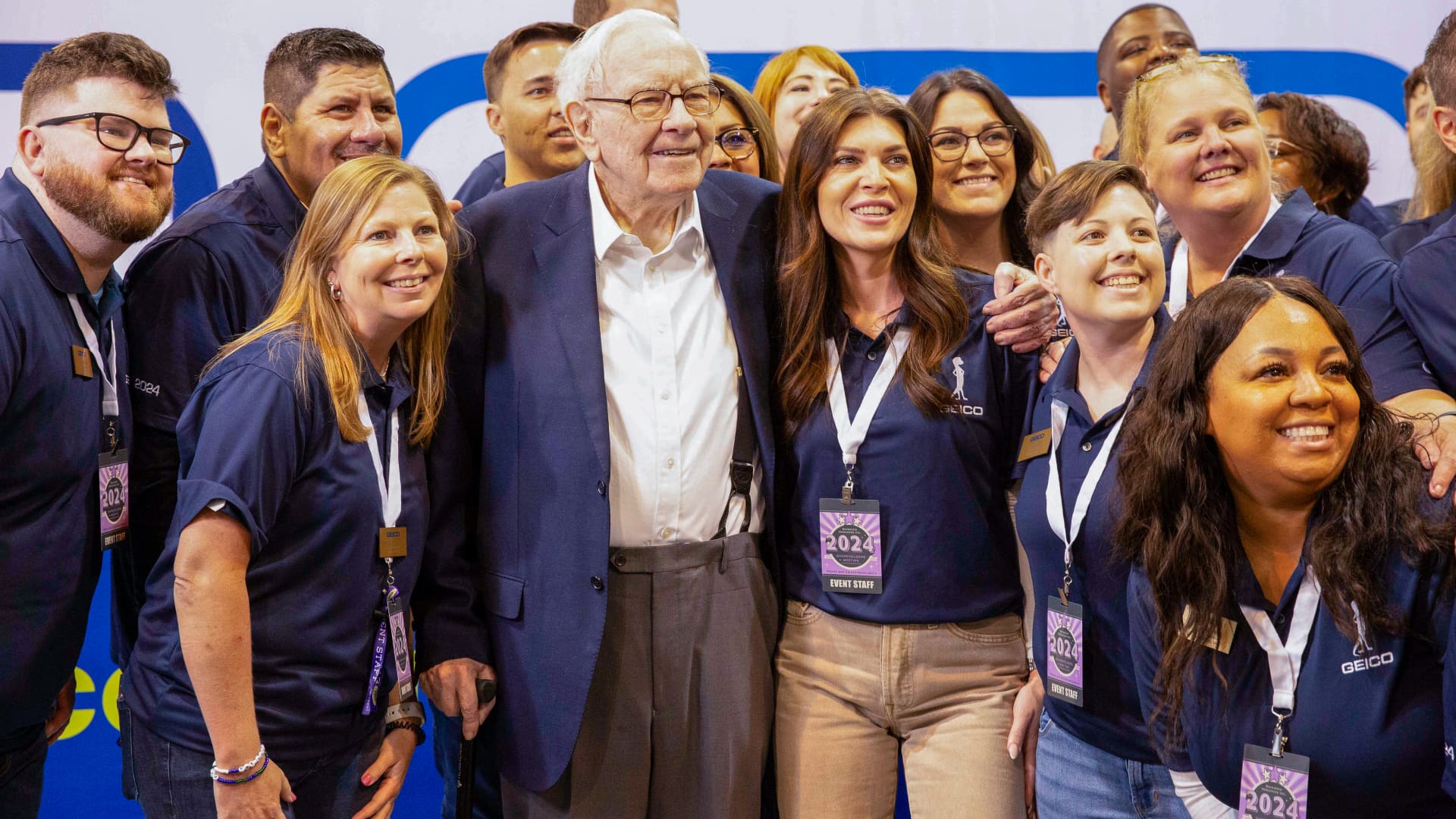
Warren Buffett walks the floor ahead of the Berkshire Hathaway Annual Shareholders Meeting in Omaha, Nebraska on May 3, 2024.
David A. Grogen | CNBC
Warren Buffett turned 94 on Friday and his sprawling, one-of-a-kind conglomerate has never been worth more than it is today.
Berkshire Hathaway became the first nontechnology company to top a $1 trillion market capitalization this week. Berkshire Class A shares also topped $700,000 apiece for the first time ever.
Howard Marks, a great investor in his own right and friend of Buffett’s, credits three things that have allowed the “Oracle of Omaha” to lead Berkshire to new heights, even at his advanced age.
“It’s been a matter of a well-thought-out strategy prosecuted for seven decades with discipline, consistency and unusual insight,” said Marks, co-founder and co-chairman of Oaktree Capital Management. “Discipline and consistency are essential, but not sufficient. Without the unusual insight, he clearly wouldn’t be the greatest investor in history.”
“His record is a testament to the power of compounding at a very high rate for a very long period of time, uninterrupted. He never took a leave of absence,” Marks added.

Berkshire Hathaway
In the midst of the go-go stock market of the 1960s, Buffett used an investment partnership he ran to buy what was then a failing New England textile company named Berkshire Hathaway. Today, his company is unrecognizable from what it once was, with businesses ranging from Geico insurance to BNSF Railway, an equity portfolio worth more than $300 billion and a monstrous $277 billion cash fortress.
Eye-popping returns
Generations of investors who study and imitate Buffett’s investing style have been wowed by his shrewd moves for decades. The Coca-Cola bet from the late 1980s made a lesson for patient value investing in strong brands with wide moats. Injecting a lifeline investment in Goldman Sachs in the depth of the financial crisis showed an opportunistic side during crises. Going all in on Apple in recent years spoke to his flexibility at adopting his value approach to a new age.
Buffett made headlines earlier this month by revealing he had dumped half of that Apple holding, ringing the bell a bit on an extremely lucrative trade. (While Apple is widely viewed as a growth stock, Buffett has long argued all investing is value investing — “You are putting out some money now to get more later on.”)
Decades of good returns snowballed and he has racked up an unparalleled track record. Berkshire shares have generated a 19.8% annualized gain from 1965 through 2023, nearly doubling the 10.2% return of the S&P 500. Cumulatively, the stock has gone up 4,384,748% since Buffett took over, compared with the S&P 500’s 31,223% return.
“He’s the most patient investor ever, which is a big reason for his success,” said Steve Check, founder of Check Capital Management with Berkshire as its biggest holding. “He can sit and sit and sit. Even at his age where there’s not that much time left to sit, he’ll still sit until he feels comfortable. I just think he’ll just keep doing as best he can right to the end.”
Buffett remains chairman and CEO of Berkshire, although Greg Abel, vice chairman of Berkshire’s noninsurance operations and Buffett’s designated successor, has taken on many responsibilities at the conglomerate. Earlier this year, Buffett said Abel, 62, will make all investing decisions when he’s gone.
Buffett and Marks
Oaktree’s Marks said Buffett reinforced concepts that are integral to his own approach. Like Buffett, he is indifferent to macro forecasting and market timing; he seeks value relentlessly, while sticking to his own circle of competence.
Howard Marks, co-chairman, Oaktree Capital.
Courtesy David A. Grogan | CNBC
“He doesn’t care about market timing and trading, but when other people get terrified, he marches in. We try to do the same thing,” Marks said.
Buffett, who at Columbia University studied under Benjamin Graham, has advised investors to view their stock holdings as small pieces of businesses. He believes volatility is a huge plus to the real investor as it offers an opportunity to take advantage of emotional selling.
Oaktree, with $193 billion in assets under management, has grown into one of the biggest alternative investments players in the world, specializing in distressed lending and bargain-hunting.
Marks, 78, has become a sharp, unequivocal contrarian voice in the investing world. His popular investment memos, which he started writing in 1990, are now viewed as required reading on Wall Street and even received a glowing endorsement from Buffett himself — “When I see memos from Howard Marks in my mail, they’re the first thing I open and read. I always learn something.”
The two were introduced in the aftermath of the Enron bankruptcy in the early 2000s. Marks revealed that Buffett ultimately motivated him to write his own book — “The Most Important Thing: Uncommon Sense for the Thoughtful Investor“ — over a decade ahead of his own schedule.
“He was very generous with his comments. I don’t think that book would have been written without his inspiration,” Marks said. “I had been planning to write a book when I retired. But with his encouragement, the book was published 13 years ago.”
Buffett’s trajectory and his ability to enjoy what he does into his 90s also struck a chord with Marks.
“He says that he skips to work in the morning. He tackles investing with gusto and joy,” Marks said. “I still haven’t retired, and I hope never to do so, following his example.”





Treasury Bond Volatility Forces Bessent to Double Debt Buyback Size as Yields Swing

Nvidia Earnings Preview: What Wall Street Expects From the AI Bellwether’s Q2 Report

SEC’s Semiannual Reporting Proposal Faces Investor Pushback: What CFOs Need to Know

Armanino adds Strategic Accounting Outsourced Solutions

New 2023 K-1 instructions stir the CAMT pot for partnerships and corporations

Tax Strategy: Employee Retention Credit update
-

 Economics1 week ago
U.S. Retail Sales Fall for the First Time in Nine Months as Consumer Spending Slows
-

 Economics1 week ago
Nvidia’s Potential $3 Billion SB Energy Investment Could Reshape AI Infrastructure
-
 Economics4 days ago
Top 10 Largest Economies by 2030: IMF & World Bank GDP Projections for Global Powerhouses
-
 Stock News4 days ago
How to understand Intel $15B Stock Offering
-

 Technology1 week ago
U.S.-China AI Competition Intensifies as Washington Pushes Allies to Choose Sides
-

 Economics4 days ago
Economic Profile of the United States of America (2026–2030 Horizon)
-

 Economics3 days ago
U.S. National Debt Surpasses $40 Trillion for the First Time: What It Means for the Economy
-
 Leaders3 days ago
Jackson Hole 2026: What the First Symposium Under Fed Chair Kevin Warsh Means for Markets