
Personal Finance
This 79-year-old lost home to California wildfires, hopes to rebuild

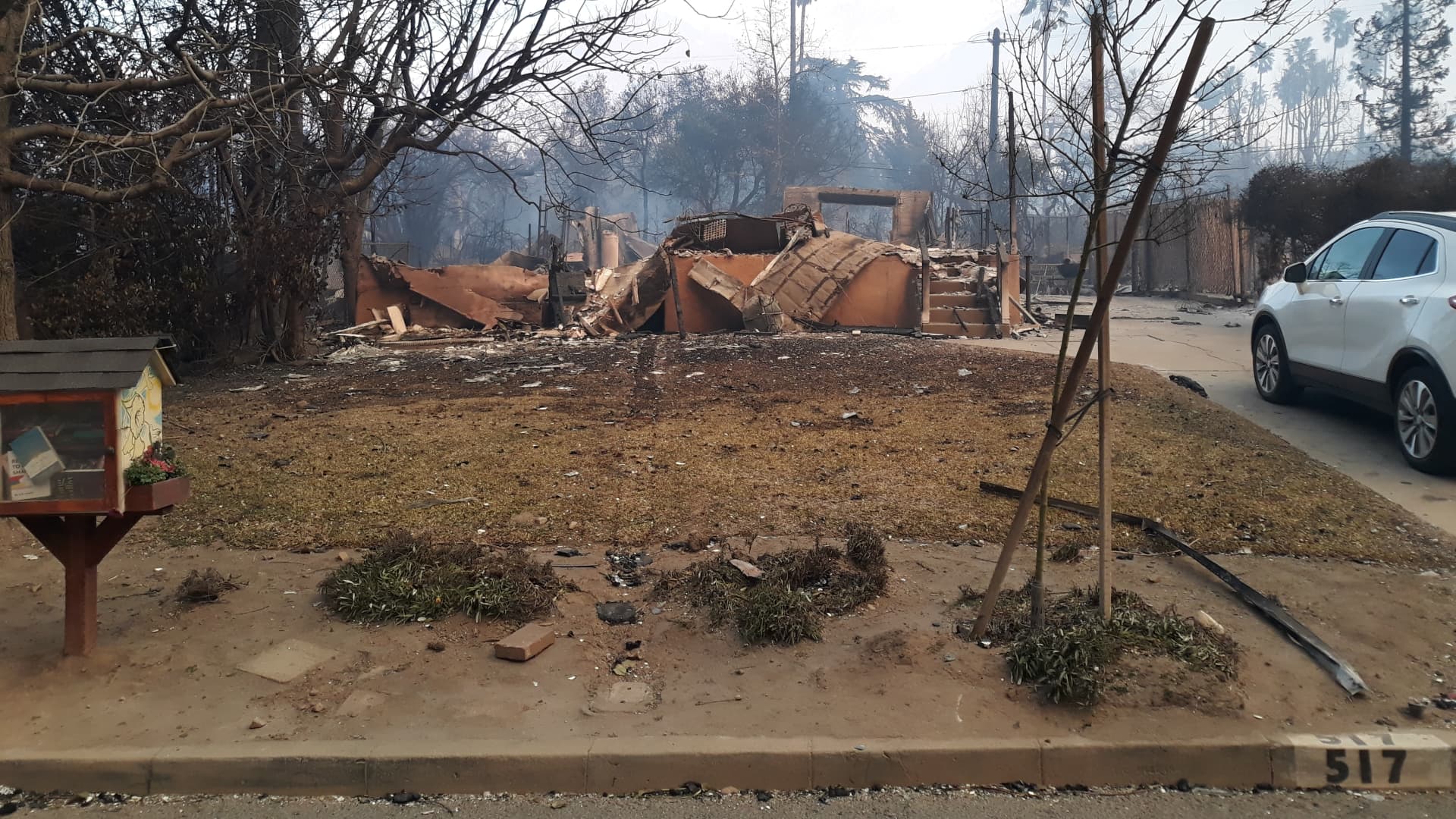
Remains of Karen Bagnard’s Altadena, California, house after it burned in the January 2025 Los Angeles-area wildfires.
Courtesy: Chelsea
On the night of Jan. 7, Karen Bagnard sat in her Altadena, California, house in the dark.
Forceful winds had caused her home to lose power, and she also had no running water, save for one bathroom.
“My daughter called and said, ‘Mom, do you realize there’s a fire?'” said Bagnard, who is 79 years old and legally blind. “I had no idea there was a fire.”
At that point, the evacuation zone for the Eaton Fire was far enough away for her to feel safe.
“I thought, ‘Oh, they’ll never get to my house,'” Bagnard said.
More from Personal Finance:
How climate change is reshaping home insurance costs
California wildfire victims may receive a one-time $770 payment
Top-rated charities active in Los Angeles fire relief efforts
About 30 minutes later, her daughter Chelsea Bagnard called back. With the fire spreading quickly, Bagnard’s home was now near the border of the evacuation zone.
After Bagnard’s grandson, Dalton Sargent, who is 32 and also lives in her home, came back from work, the two decided to leave for the night.
In the more than 50 years she lived in the house, Bagnard had been close to evacuating before but had never actually left.
“I thought, ‘Okay, we’ll evacuate this time, but we’ll be back,'” she said.
That was the last time she stepped foot in her home.
The next day, Bagnard’s daughter and grandson returned to the neighborhood to check on the home before authorities sealed off the area. What they found was a “smoldering pile of debris,” her daughter wrote on Facebook, with only larger appliances such as the refrigerator and stove recognizable.
It was Jan. 22 before Bagnard was able to return to her neighborhood to see the devastation for herself.
“They brought a chair for me, and I sat in the driveway, and what I could see was just the land,” Bagnard said of the surreal scene. “I started looking at it in terms of, ‘How would we rebuild?'”
Karen Bagnard, 79, sits in the ruins of her Altadena, California, home, after it burned in the Los Angeles-area wildfires of January 2025. “I hope to live long enough to see it rebuilt,” she said.
Courtesy: Chelsea Bagnard
Older adults especially vulnerable to natural disasters
The Los Angeles-area wildfires destroyed tens of thousands of acres, ruining homes and entire neighborhoods. Insured losses could climb to $50 billion, according to estimates from JP Morgan.
Additionally, an unknown number of residents have been left homeless.
For older individuals, the catastrophe comes at a vulnerable time in their lives, when relocating and coping with physically difficult conditions can be more challenging.
By 2034, we’ll have more people over 65 than under 18 in our country, according to Danielle Arigoni, an urban planning and community resilience expert and author of the book “Climate Resilience for an Aging Nation.”
Yet those demographics are not used as a lens for climate resilience planning in most cases, she said.
“In two decades, we have not seen any improvement in the fatality rate of older adults in these kinds of disasters,” Arigoni said. “When you see that kind of trend line, to me that just screams for a different approach.”
The LA-area wildfires forced some assisted living facilities to evacuate, and some burned down, according to Joyce Robertson, CEO and executive director of Foundation for Senior Services.
In the aftermath of the fire, the public charity is focusing on providing supplies, including wheelchairs, and is working with nursing and assisted living facilities to help fill gaps for services and resources.
“You can imagine the stress for all those seniors having to evacuate,” Robertson said.
For older individuals who live on their own, the risk is that they will not be able to leave their homes, said Carolyn Ross, co-executive director of the Village Movement California, a coalition of 50 neighborhood-based community organizations that provide community programming and expertise to help older residents age in place.
“In natural disasters, they are disproportionately affected, more likely to be the ones found in their homes because they couldn’t evacuate,” Ross said.

The hardest hit of the Village Movement’s communities — Pasadena Village — had around 60 members displaced by the fires, and 19 lost their homes entirely, including Bagnard.
“It’s been heartbreaking,” said Katie Brandon, executive director at Pasadena Village.
“But it’s also been really beautiful to see the older adults really support each other, be there for each other, and see the communities of support that they’ve built over the last months and years really work for them,” Brandon said.
As Bagnard searched for a new residence, one of the Pasadena Village members stepped up to offer her a six-month temporary lease to live with her in her home, though the two women had not previously met.
Bagnard has been a valued member of the Pasadena Village for many years, according to Brandon, having hosted many events and programs at her “beautiful house, outside on her patio.”
As Bagnard regroups, the Pasadena Village is replacing the computer she lost with the accessibility features she needs due to her vision loss. The community organization is working with other affected area residents to help provide the equipment they need, such as air purifiers and computer printers. Where possible, it’s also encouraging older residents to continue to gather socially.
“The insurance companies seem to be pretty good at reacting and seeing what they can replace, but sometimes it’s quite a process,” Brandon said. “The sooner we can get our older adults the resources and equipment that they need, the better off they’ll be in this recovery period.”
Older victims face greater health, financial risks
Experts emphasize that older individuals may face a prolonged recovery.
In the aftermath of a disaster, there tends to be a lot of people helping, providing donations and other support, said Joan Casey, associate professor at the University of Washington’s School of Public Health.
Yet in the rebuilding period that follows, there’s often a lull, where volunteer efforts and donations dry up, she said.
Yet more than a year from now, those same disaster victims may still be displaced from their homes, she said.
“It’s that medium-term disaster period where we still want to check in on people,” Casey said.
They may be more susceptible to certain health and financial risks, particularly if they do not have a community safety net.
Nearly 80% of older adults have two or more chronic conditions, according to research from the National Council on Aging. If that includes respiratory or heart disease, the worsened air quality may be even more harmful to their health.
Older adults may also have paid off their homes, which means they may not be required to have homeowners’ insurance. Consequently, some may be completely uninsured, while others may be underinsured in an effort to keep their monthly expenses down, Arigoni said.
Scientific literature on how disasters affect older adults is “pretty mixed,” especially with regard to mental health, according to Casey. Some neurologists have found natural disasters may be a tipping point in cognitive function for older adults, she said.
Yet there’s also evidence that older individuals may be more resilient because they have developed better strategies to deal with stress over time, Casey said. They may have already experienced a disaster before, and therefore may be better prepared to handle another event.
‘I hope to live long enough to see it rebuilt’
Remains of Karen Bagnard’s Altadena, California, house after it burned in the January 2025 Los Angeles-area wildfires.
Courtesy: yesterday, my mom saw her home of over 50 years for the first time since it burned
Prior to losing her home in the wildfire, Bagnard, a professional visual artist, had recently gone through a big life adjustment as she dealt with her vision loss.
In early 2024, she held a show of her work at Pasadena Village, where she talked about coming to terms with blindness. Her favorite piece — of a sphere falling — played on darkness and light amid a color scheme of blue, teal and black, a symbol of her own journey.
“Knowing that you’re going blind is like a free fall into the darkness, and then at some point you realize that you bring the light with you, so it isn’t really dark,” Bagnard said. “You have a different kind of light; the light is inside.”
That piece was destroyed and is now among her home’s ashes, along with most of her other artwork.
For most of her life, Bagnard did pen-and-ink drawings with watercolor washes. Since the onset of her vision loss, she has transitioned to other methods, using decoupage and handmade papers as well as writing haikus.
The process of coping with her vision loss has helped her to keep the more recent loss of her home in perspective, she said, though she admits she still has moments of frustration.
To help rebuild, she has applied for a Small Business Administration loan, and her daughter started a GoFundMe account.
Other community organizations, in addition to Pasadena Village, have also stepped in to offer support.
A local nonprofit organization, Better Angels, has provided grant money to Bagnard and her grandson. And Journey House, a provider of foster care services, has promised to help Bagnard’s grandson, a former foster youth, who also lost everything in the fire.
Amid her home’s rubble, Bagnard said she has also seen signs of hope. A Danish plate with a mermaid, which Bagnard considers an art muse, survived the fire, as well as cement stairs she had painted with images of the four seasons.
She has told her two daughters and grandson it is up to them to decide what to do with the property they will eventually inherit.
“I’m going to be 80 next month, and I hope to live long enough to see it rebuilt,” Bagnard said.

Personal Finance
Next-Generation Retirement Planning: Managing Longevity Risk and Variable Income Streams


U.S.- Canada Trade Talks Collapse; Carney Says Retaliatory Tariffs Begin September 8

Flock Cameras and the Future of Public Security

AI Infrastructure Boom Hits Physical Limits: Power, Financing, and Supply Chain Strain

Armanino adds Strategic Accounting Outsourced Solutions

New 2023 K-1 instructions stir the CAMT pot for partnerships and corporations

Tax Strategy: Employee Retention Credit update
-

 Stock News1 week ago
Nvidia Q2 FY2027 Earnings beats Wall Street Expectation with Record $96.2 Billion Revenue
-
 Technology5 days ago
AI Infrastructure Boom Hits Physical Limits: Power, Financing, and Supply Chain Strain
-
 Technology3 days ago
Flock Cameras and the Future of Public Security
-
 Economics3 days ago
U.S.- Canada Trade Talks Collapse; Carney Says Retaliatory Tariffs Begin September 8