
Personal Finance
Trump’s backlash isn’t ‘game over’ for ESG investing

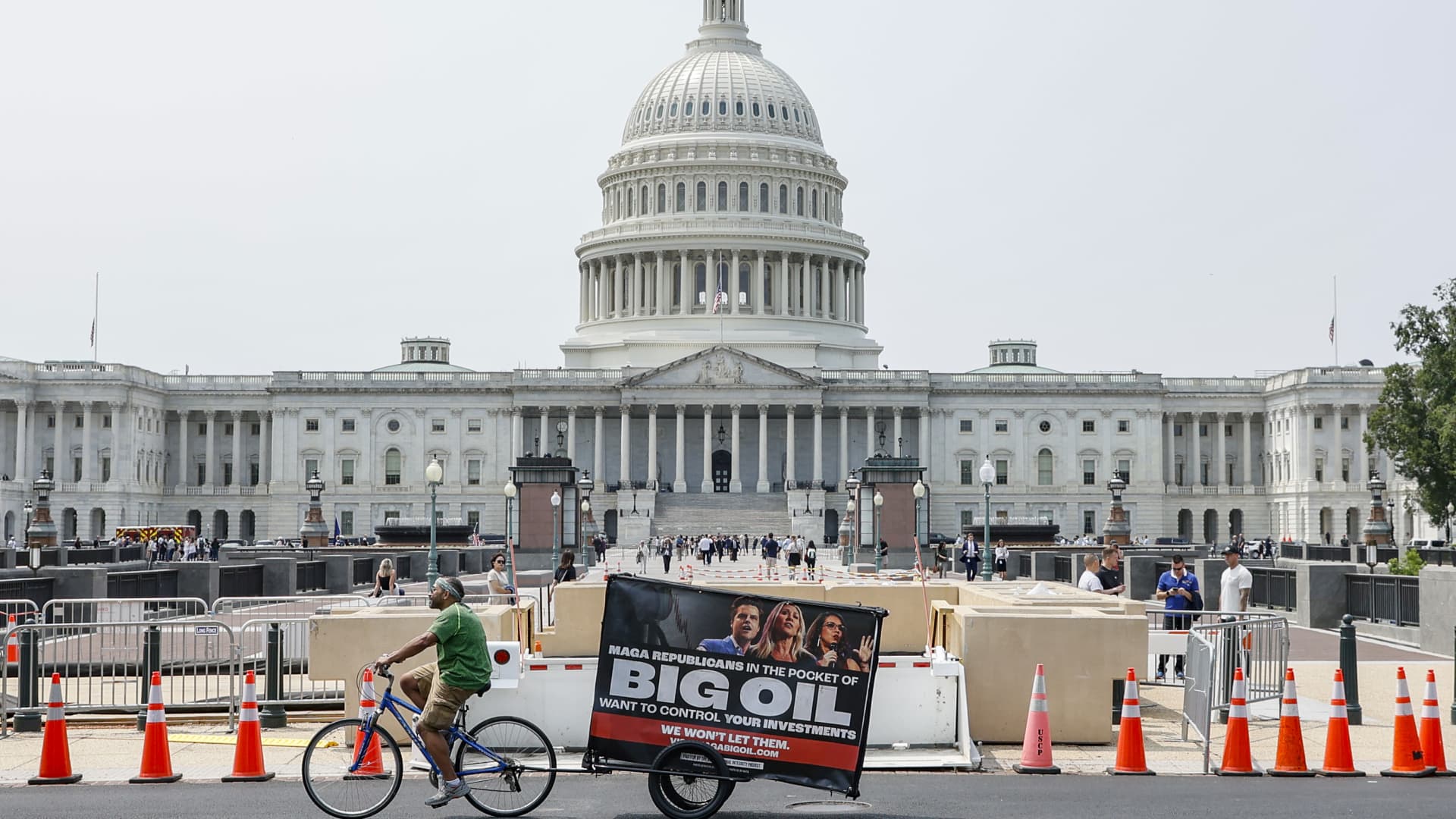
A mobile billboard rolls past the U.S. Capitol on May 10, 2023.
Jemal Countess | Getty Images Entertainment | Getty Images
Investors have pulled money from so-called ESG funds in recent years, amid political backlash, high interest rates and other headwinds.
But analysts say the outlook and long-term investment thesis for the fund category, which stands for “environmental, social and governance,” are favorable.
President Donald Trump’s agenda “isn’t ‘game over’ for ESG investing,” Diana Iovanel, a senior markets economist at Capital Economics, wrote in a research note on Tuesday.
Demand for ESG investments “is here to stay” even in the face of political pressure, Iovanel wrote.
ESG outflows amid ‘anti-ESG backlash’
ESG investing is known by many names, such as socially responsible, sustainable, impact or values-based investing. Such funds allow people to invest according to certain values, like climate change or corporate diversity.
Investors yanked almost $20 billion from U.S. ESG mutual and exchange-traded funds in 2024, after withdrawing about $13 billion in 2023, according to Morningstar.
By contrast, investors poured $740 billion into the overall universe of mutual funds and ETFs in 2024, Morningstar found.
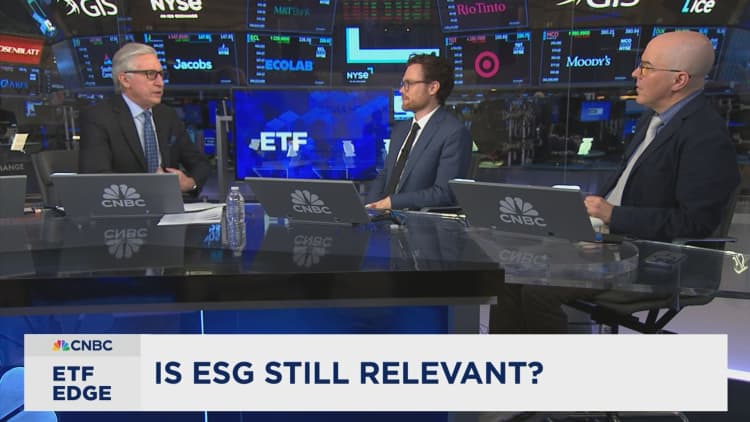
“I don’t think we really expected something different, because of the anti-ESG backlash in the U.S. and the political environment there,” said Hortense Bioy, head of sustainable investing research at Morningstar.
Critics call ESG a form of “woke capitalism” that sacrifices returns for the sake of liberal goals.
Advocates argue that ESG investing positions investors for higher long-term returns because companies that adopt such practices are poised to be more resilient, and therefore more successful, than peers.
Outflows follow years of steady growth
Two years of consecutive outflows — in 2023 and 2024 — followed years of steady ESG growth.
Investors have funneled a total $130 billion into U.S. ESG funds over the past decade, according to Morningstar. For example, investors pumped more than $50 billion into ESG funds in 2020 and almost $70 billion in 2021, a record high, according to Morningstar.
More from Personal Finance:
Tariff whiplash triggers surge in fear-based shopping
Investors will be ‘miles ahead’ if they avoid these 3 things
Social Security Administration delays identity proofing policies
Despite outflows, overall ESG fund assets grew slightly in 2024, to $344 billion, due to market appreciation, Morningstar found.
Investor demand also appears relatively high, especially among younger investors, analysts said.
About 84% of individual investors in the U.S. are interested in sustainable investing, according to a 2024 Morgan Stanley survey. Roughly two thirds, 65%, of respondents said their interest had increased in the prior two years.
Politics poses headwinds for ESG
But the political backlash against initiatives underlying ESG funds has intensified “very quickly” since President Trump was elected, Bioy said.
Within the first few days of his inauguration, Trump pulled the U.S. out of the Paris agreement, blocked subsidies for electric vehicles, pushed for more fossil-fuel production and started a “huge pushback” against diversity, equity and inclusion policies, Iovanel of Capital Economics wrote.
The Republican-led Securities and Exchange Commission on Thursday said it would stop defending a climate-change disclosure rule in court. The regulation required a baseline transparency around climate risks and greenhouse gas emissions from certain U.S. publicly listed companies.
There’s also uncertainty about the fate of the Inflation Reduction Act, a historic climate change mitigation law signed by President Joe Biden.
Even before President Trump’s second term, at least 18 Republican-led states had adopted “anti-ESG legislation,” prompting some large asset managers to “pare back” their ESG efforts, Iovanel wrote.
The number of ESG funds contracted for the first time ever in 2024 — to 587 from 646 in 2023, a 9% decline, according to Morningstar. That means asset managers made fewer options available for investors.
“It’s very tricky for any asset manager now to be selling ESG products,” Bioy said. “They don’t want to draw attention.”
Non-political headwinds
ESG funds have suffered from non-political headwinds, too, analysts said.
In fact, high interest rates have likely been more of a hindrance than politics, analysts said. High borrowing costs negatively impact sectors like clean energy more than others because they’re more capital-intensive, analysts said.
Performance has also lagged in recent years. For example, less than half — 42% — of sustainable funds ranked in the top half of their respective investment categories, according to a Morningstar analysis of investment returns.
It’s very tricky for any asset manager now to be selling ESG products. They don’t want to draw attention.
Hortense Bioy
head of sustainable investing research at Morningstar
Underperformance in recent years is partly due to high interest rates, analysts said.
Additionally, oil and gas prices boomed after Russia invaded Ukraine in 2022. The top 10 stocks in the S&P 500 that year were from the energy sector, for example. ESG portfolios that minimize fossil-fuel exposure looked like relative laggards as a result, analysts said.
However, performance was “very good” prior to 2022, Bioy said.
For example, the typical U.S. ESG stock fund beat returns of its peers by about 4 percentage points in 2020, according to a Morgan Stanley analysis. ESG bond funds outperformed by about 1 point that year, it found.
“Any investment and any ESG investment are no different — they go through lows and highs,” Bioy said.
ESG is investing, ‘not philanthropy’
But it’s the long term, not the short term, where ESG investing is poised for clear outperformance, analysts say.
McKinsey research found that companies with C-suite leaders “who chase growth without considering how their strategies could impact people, the planet, and their firm’s long-term sustainability” are less likely to “lead their companies to full growth potential,” the consultancy said in a 2023 analysis of the 10,000 largest global companies from 2016 to 2022.
The goal of ESG investing is to reduce a portfolio’s long-term risk, said Jennifer Coombs, the head of content and development at the U.S. Sustainable Investment Forum, known as US SIF.
Money managers who oversee ESG portfolios also don’t aim to sacrifice investment returns for the sake of pursuing an environmental or social agenda, Coombs said. Instead, they generally believe that investing according to ESG principles ultimately boosts risk-adjusted returns for long-term investors, she said.
“This is investing,” Coombs said. “It’s not philanthropy.”
“Sustainability takes a long time,” she said. “It’s long term. And that’s the whole idea.”


Personal Finance
Next-Generation Retirement Planning: Managing Longevity Risk and Variable Income Streams


U.S.- Canada Trade Talks Collapse; Carney Says Retaliatory Tariffs Begin September 8

Flock Cameras and the Future of Public Security

AI Infrastructure Boom Hits Physical Limits: Power, Financing, and Supply Chain Strain

Armanino adds Strategic Accounting Outsourced Solutions

New 2023 K-1 instructions stir the CAMT pot for partnerships and corporations

Tax Strategy: Employee Retention Credit update
-

 Stock News1 week ago
Nvidia Q2 FY2027 Earnings beats Wall Street Expectation with Record $96.2 Billion Revenue
-
 Technology5 days ago
AI Infrastructure Boom Hits Physical Limits: Power, Financing, and Supply Chain Strain
-
 Technology3 days ago
Flock Cameras and the Future of Public Security
-
 Economics3 days ago
U.S.- Canada Trade Talks Collapse; Carney Says Retaliatory Tariffs Begin September 8