
Personal Finance
Why fewer young adults are able to invest in homeownership

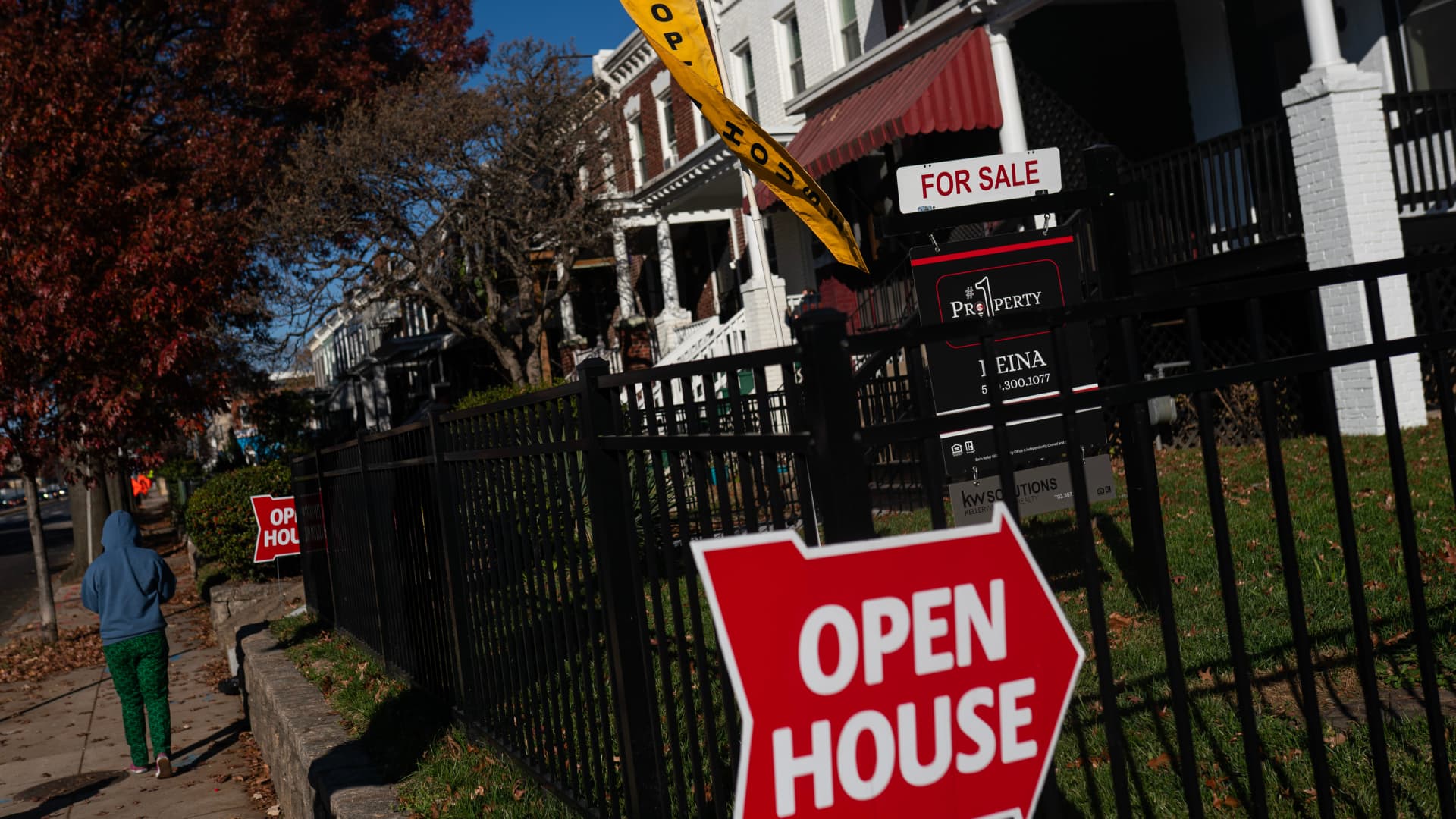
FILE PHOTO: An “Open House” sign outside of a home in Washington, DC, US, on Sunday, Nov. 19, 2023.
Nathan Howard | Bloomberg | Getty Images
When Maryland Governor Wes Moore was 8 years old, his mother told him she wanted to send him to military school to correct his behavior.
Yet it wasn’t until he was 13 that she finally did send him to a military school in Pennsylvania. He ran away five times in the first four days.
“That place ended up really helping me change my life,” said Moore while speaking about retirement security at a BlackRock conference in Washington, D.C., on March 12.
One obstacle — the tuition costs — prevented his mother from sending him sooner, he said.

Moore was able to attend the school thanks to help from his grandparents, who borrowed against the home they bought when they immigrated to the U.S., to help pay for the first year’s tuition.
“They ended up sacrificing part of their American dream so I could achieve my own,” Moore said.
“That’s what housing helps provide,” Moore said. “It’s not just shelter. It’s security; it’s an investment. It’s a chance you can tap into something if an emergency happens. It’s a chance that you now have an asset that you can hold onto, and you can pass off to future generations.”
After retirement funds, housing generally represents the second-most-valuable asset people have, Moore said.
Some now less likely to own homes than in 1980
Yet achieving that homeownership status can feel unattainable to prospective first-time buyers in today’s economy.
Around 30% of young Maryland residents are thinking of leaving the state because of high housing costs, Moore said.
Both renters and homeowners across the U.S. are struggling with high housing costs, according to a 2024 report from the Joint Center for Housing Studies of Harvard University. The number of cost-burdened renters — meaning those who spend more than 30% of their income on rent and utilities — climbed to an all-time high in 2022. At the same time, millions of prospective homebuyers have been priced out by high home prices and interest rates.
Many hopeful first-time home buyers may feel that it was easier for their parents and grandparents’ generations to reach home ownership status.
Research shows those feelings are justified.
More from Personal Finance:
Here’s when to list your home for sale this spring
Tax season is prime time for scams. How to protect yourself
How rent can make or break your credit
Since 1980, median home prices have increased much faster than median household incomes, according to recent research from the Urban Institute.
Across the country, today’s 35- to 44-years olds — who are in their critical homebuying years — are less likely to be homeowners than in 1980, according to the research.
For that age cohort, the homeownership rate has dropped by more than 10% compared to 45 years ago, the Urban Institute found. Because today’s 35- to 44-year-olds are also forming households at a lower rate, that number is likely understated, according to the research.
Ultimately, that can have lasting impacts on their ability to build wealth, said Jun Zhu, a non-resident fellow at the Urban Institute’s Housing Finance Policy Center.
“When you have a house, when the house appreciates, you’re going to earn home equity,” Zhu said. “Earning home equity is actually a very important way to earn wealth.”
Those 35- to 44-year-olds who are in lower income quartiles have seen the biggest declines in homeownership compared to their peers. That is driven in part by the fact that people who are married are more likely to be homeowners, while lower-income individuals are less likely to be married.
Education is also a factor in widening the homeownership gap, according to the Urban Institute, as a smaller share of heads of households who have the lowest incomes are getting college degrees.
Racial divide in homeownership rates persists
Separate research from the National Association of Realtors also points to a racial divide with regard to housing affordability.
In 2023, the latest data available, the Black homeownership rate of 44.7% saw the greatest year-over-year increase among racial groups but was still well behind the white homeownership rate of 72.4%. Other groups fell in between, with Asians having a 63.4% and Hispanics having a 51% homeownership rate.
Strong wage growth and younger generations reaching prime home buying age contributed to the increase in Black homeownership in 2023, said Nadia Evangelou, senior economist and director of real estate research at the National Association of Realtors.
Yet the Black homeownership rate has stayed below 50% over the past decade, Evangelou said, which means most continue to rent instead of owning. That ultimately limits their ability to grow their net worth and accumulate wealth.
Policy changes could make it easier for Americans to buy their first home. That could include providing educational opportunities for low-income households, offering down payment assistance and encouraging housing production by reducing zoning restrictions or other regulatory barriers, according to the Urban Institute.


Personal Finance
Next-Generation Retirement Planning: Managing Longevity Risk and Variable Income Streams


U.S.- Canada Trade Talks Collapse; Carney Says Retaliatory Tariffs Begin September 8

Flock Cameras and the Future of Public Security

AI Infrastructure Boom Hits Physical Limits: Power, Financing, and Supply Chain Strain

Armanino adds Strategic Accounting Outsourced Solutions

New 2023 K-1 instructions stir the CAMT pot for partnerships and corporations

Tax Strategy: Employee Retention Credit update
-

 Stock News1 week ago
Nvidia Q2 FY2027 Earnings beats Wall Street Expectation with Record $96.2 Billion Revenue
-
 Technology5 days ago
AI Infrastructure Boom Hits Physical Limits: Power, Financing, and Supply Chain Strain
-
 Technology3 days ago
Flock Cameras and the Future of Public Security
-
 Economics3 days ago
U.S.- Canada Trade Talks Collapse; Carney Says Retaliatory Tariffs Begin September 8