
Economics
Trump’s tariffs are slowly finding their way into consumer prices


Vegetables on display in a grocery store on August 15, 2025 in Delray Beach, Florida.
Joe Raedle | Getty Images
From clothing to auto parts to electronics and more, tariffs are making everyday items cost more at a time when the labor market is looking increasingly fragile.
A key Bureau of Labor Statistics inflation report released Thursday showed price increases for a variety of tariff-sensitive items.
Apparel prices rose 0.5% as did video and audio products. Motor vehicle parts climbed 0.6% while new car prices were up 0.3% and energy increased 0.7%. Groceries accelerated 0.6%, the biggest monthly move since August 2022. Furniture and bedding saw a 0.3% hit and are up 4.7% from a year ago while tools and hardware had a 0.8% jump, part of manufacturing-related goods that are particularly impacted.
(See here for a full inflation breakdown by item.)
More broadly, goods excluding food and energy rose 0.3% on the month and are up 1.5% from a year ago, the fastest rate since May 2023, according to Fitch Ratings. Coffee rose 3.6% on the month and is up 20.9% from a year ago.
Together, the increases may not sound dramatic. But they are enough to give both consumers and Federal Reserve policymakers at least some cause for concern.
“We’ve already been seeing tariffs in the data for several months,” said Luke Tilley, chief economist at Wilmington Trust. “Consumers were not in a really good place to handle the increased prices that are coming from tariffs.”
Consumers feel the hit
Moreover, the inflation numbers might be worse if it weren’t for consumers, wary of the higher prices from tariffs, cutting back on spending, particularly on services, Tilley added. That has meant companies have less pricing power, so the tariff impact has been less acute.
Still, inflation running near 3% on both core and headline is a good distance from the Fed’s 2% target and could jeopardize an economy that relies on consumer spending as the primary growth engine.
“The middle-class squeeze from tariffs is here,” said Heather Long, chief economist at Navy Federal Credit Union. “It’s troubling that so many basic necessities now cost more. Food, gas, clothing and shelter all had big cost jumps in August. And this is only the beginning of the price hikes. The situation will worsen in the coming months as more costs are passed along to American consumers.”
President Donald Trump and administration officials have insisted that the tariffs will not drive inflation higher.
Historically, that has been the case.
Economists generally view tariffs as a temporary price impetus but not contributing to longer-lasting inflation. Still, the persistence in prices combined with weakness in the labor market presents a stagflationary conundrum for the Fed.
Policy impact
Central bank officials are set to meet next week to vote on whether to lower their key overnight funds rate, currently running around 4.3%.
Markets rallied Thursday as hopes built that the Fed not only will cut when the meeting concludes Wednesday but also will lower rates at its ensuing two meetings this year and will continue easing through 2026, according to the CME Group’s FedWatch.

In all, the market is pricing in the equivalent of six quarter-percentage-point cuts during the period, well ahead of the four that Fed officials penciled in during their last outlook published in June. The view is based on the idea that policymakers will look through the price increases and focus on job weakness.
“We expect over the next several months for it to be pretty clear that the Fed should be cutting rates,” Tilley said. “The somewhat minor pressure that we’re getting from tariffs on the goods side really is being outweighed by the slowdown in the economy, the slowdown in the labor market, the slowdown in consumer spending.”
While the Fed ponders inflation, it also will have to weigh labor market weakness.
Initial unemployment insurance claims last week hit their highest level since October 2021, though the main cause was what could be an anomalous spike in Texas and distortions from the Labor Day holiday. However, recent data indicate that the economy added virtually no jobs this year, a factor that would push the Fed to lower rates.
(Learn the best 2026 strategies from inside the NYSE with Josh Brown and others at CNBC PRO Live. Tickets and info here.)











Economics
U.S. National Debt Surpasses $40 Trillion for the First Time: What It Means for the Economy



Executive Summary & Core Macro Outlook
The United States enters the 2026–2030 macroeconomic window as the unquestioned heavyweight of nominal economic output, retaining its status as the primary engine of global financial liquidity, private enterprise innovation, and high-margin technological deployment. According to multi-year projections from the International Monetary Fund (IMF) World Economic Outlook and complementary datasets from the World Bank, the US nominal Gross Domestic Product (GDP) is projected to reach $32.38 trillion by 2026, accounting for approximately 25% of global nominal output and roughly 14.5% of world GDP measured at Purchasing Power Parity (PPP).
Unlike many of its advanced-economy peers across Western Europe and East Asia—which are grappling with acute demographic contraction and structural energy shocks—the United States demonstrates remarkable macroeconomic resilience. The IMF projects a real GDP Compound Annual Growth Rate (CAGR) of 2.1% to 2.3% through 2030. This expansion is sustained by three structural anchors: unmatched capital depth driving massive private-sector investment in Artificial Intelligence (AI) infrastructure, complete energy independence as a net exporter of hydrocarbons and liquefied natural gas (LNG), and high labor productivity gains that cushion the economy against rising debt-servicing costs.
Macroeconomic Data Matrix (2026–2030 Projections)
| Economic Metric | IMF / World Bank Baseline (2026–2030) | Global Benchmark & Context |
| Nominal GDP (2026 Projection) | ~$32.38 Trillion | Rank #1 Globally |
| GDP at Purchasing Power Parity (PPP) | ~$32.40 Trillion | Rank #2 Globally (Behind China’s ~$38.5T PPP) |
| Projected Real GDP CAGR (2026–2030) | 2.1% – 2.3% | Top decile among G7 advanced economies |
| Gross Public Debt (% of GDP) | ~122.5% – 128.0% | Structural fiscal deficit trajectory |
| Core Inflation Rate (PCE Target) | Stabilizing at 2.0% – 2.2% | Federal Reserve inflation target alignment |
| Current Account Balance (% of GDP) | -2.8% to -3.2% | Persistent capital import & reserve currency demand |
Deep Structural Growth Drivers
1. The AI Infrastructure Hyper-Cycle & TFP Expansion
The defining growth catalyst for the US economy over the 2026–2030 horizon is the unprecedented scale of private capital expenditure (Capex) poured into artificial intelligence infrastructure, enterprise software integration, and advanced computing hardware.
Major technology mega-caps and private equity funds are directing hundreds of billions of dollars annually into hyper-scale data centers, domestic semiconductor fabrication, high-voltage electrical grid upgrades, and AI-driven workflow platforms. According to World Bank economic research, technological adoption across American service and manufacturing sectors is driving a notable uptick in Total Factor Productivity (TFP). This productivity surge allows US companies to expand profit margins and output even in an environment characterized by higher structural real interest rates and tight skilled-labor markets.
2. Deep Capital Markets and Private Sector Liquidity
The structural backbone of US economic outperformance remains its financial system. US capital markets represent over 40% of global equity market capitalization and a vast majority of global venture capital and private credit assets.
This liquidity creates an efficient mechanism for capital allocation: high-potential emerging industries (such as quantum computing, synthetic biology, and advanced defense technology) receive early-stage funding at a scale that no other national market can match. When global monetary conditions tighten, global capital flees toward safety and yield, reinforcing US capital depth and lowering the relative cost of equity capital for American corporations.
3. Net Energy Independence & Industrial Cost Advantages
Unlike industrial hubs in Germany, Japan, or South Korea—which remain highly vulnerable to volatile sea-lane logistics and imported fuel price spikes—the United States operates as a major net exporter of petroleum, natural gas, and refined chemical products.
Access to abundant, cheap domestic natural gas provides US heavy industry, advanced manufacturing, and electricity-hungry data centers with a persistent structural cost advantage. Furthermore, federal policy frameworks (including the CHIPS and Science Act and clean energy tax provisions) continue to catalyze domestic private manufacturing investment, re-shoring high-value supply chains from East Asia back to the American Sunbelt and Midwest.
Macroeconomic Vulnerabilities & Downside Risks
1. Structural Sovereign Debt Trajectory
The most significant medium-term threat to US macroeconomic stability is the path of federal public debt. With gross national debt exceeding 120% of GDP and annual federal deficits running between 5% and 7% of GDP, the US fiscal baseline faces increasing structural pressure.
As older legacy low-yield Treasury bonds mature, they are refinanced at higher prevailing interest rates. According to IMF fiscal monitor assessments, federal net interest payments are absorbing an expanding share of total fiscal revenue, crowding out discretionary spending and narrowing the government’s capacity to deploy counter-cyclical fiscal stimulus during future downturns.
2. Commercial Real Estate (CRE) & Banking Sector Realignment
The structural transformation toward hybrid work models has permanently altered office space utilization across major US metropolitan areas. Regional and community banks, which hold a disproportionate share of commercial real estate debt, face ongoing balance-sheet pressure as legacy office loans mature and require refinancing at lower property valuations and higher interest rates. While systemic money-center banks remain well-capitalized, localized credit tightening from regional lenders presents a headwind for small-and-medium enterprise (SME) borrowing.
High-Outperformance Sector Matrix (2026–2030)
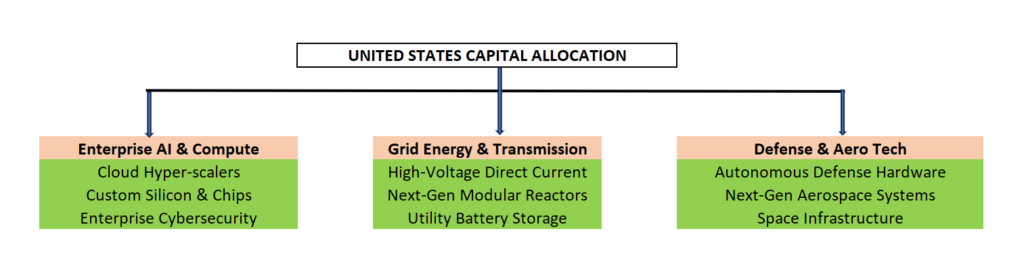
- Enterprise AI, Cloud Compute, & Cybersecurity: Companies building enterprise-grade software, AI agents, cloud architectures, and specialized hardware protection layers.
- Next-Generation Energy & Grid Modernization: Power generation utilities, high-voltage electrical equipment makers, small modular nuclear reactor (SMR) developers, and energy storage systems catering to exponential data center energy demands.
- Advanced Defense Technology & Aerospace: Autonomous systems, satellite networks, hypersonic defense, and advanced materials supplying both domestic security needs and global allied demand.
Strategic Summary for Global Investors & Executives
The United States through 2030 remains the ultimate high-volume, high-yield destination for institutional capital. While fiscal debt risks require long-term monitoring, the immediate 5-year outlook is defined by strong technology-driven productivity, resilient private consumption, and unmatched market liquidity. For global corporations and institutional allocators, exposure to the US economy remains an indispensable pillar of long-term growth strategy.
Top 65 Largest Economies in the World for 2027
Top 10 Largest Economies by 2030: IMF & World Bank GDP Projections for Global Powerhouses

U.S.- Canada Trade Talks Collapse; Carney Says Retaliatory Tariffs Begin September 8

Flock Cameras and the Future of Public Security

AI Infrastructure Boom Hits Physical Limits: Power, Financing, and Supply Chain Strain

Armanino adds Strategic Accounting Outsourced Solutions

New 2023 K-1 instructions stir the CAMT pot for partnerships and corporations

Tax Strategy: Employee Retention Credit update
-

 Stock News1 week ago
Nvidia Earnings Preview: What Wall Street Expects From the AI Bellwether’s Q2 Report
-

 Accounting1 week ago
SEC’s Semiannual Reporting Proposal Faces Investor Pushback: What CFOs Need to Know
-

 Finance1 week ago
Treasury Bond Volatility Forces Bessent to Double Debt Buyback Size as Yields Swing
-

 Stock News1 week ago
Nvidia Q2 FY2027 Earnings beats Wall Street Expectation with Record $96.2 Billion Revenue
-
 Technology4 days ago
AI Infrastructure Boom Hits Physical Limits: Power, Financing, and Supply Chain Strain
-
 Economics2 days ago
U.S.- Canada Trade Talks Collapse; Carney Says Retaliatory Tariffs Begin September 8
-
 Technology2 days ago
Flock Cameras and the Future of Public Security