
Personal Finance
Tuition-free colleges in 2025


With more families concerned about how they will afford college, some schools are offering an unbeatable deal.
While the total cost of college is nearing or crossing the $100,000 threshold at several institutions across the country, according to data provided by The Princeton Review, tuition is completely free for all students at handful of other colleges and universities in the U.S.
Although paying this tab is easy, getting in may not be. Each of these schools has high academic standards, experts say — and in return for a degree at no cost, the commitment they require, even after graduation, is steep.
More from Personal Finance:
These college majors have the best job prospects
Student loan forgiveness may soon be taxed again
Student loan borrowers — how will the end of the SAVE plan impact you? Tell us
“This is a self-selecting group in a lot of ways,” said Robert Franek, editor in chief at The Princeton Review. Yet “it gives some hope for parents who worry about making college affordable — these colleges are doing just that.”
For those up for the challenge, The Princeton Review compiled a list of the colleges that cost nothing. Here are the nine schools that don’t charge tuition at all.
Berea College
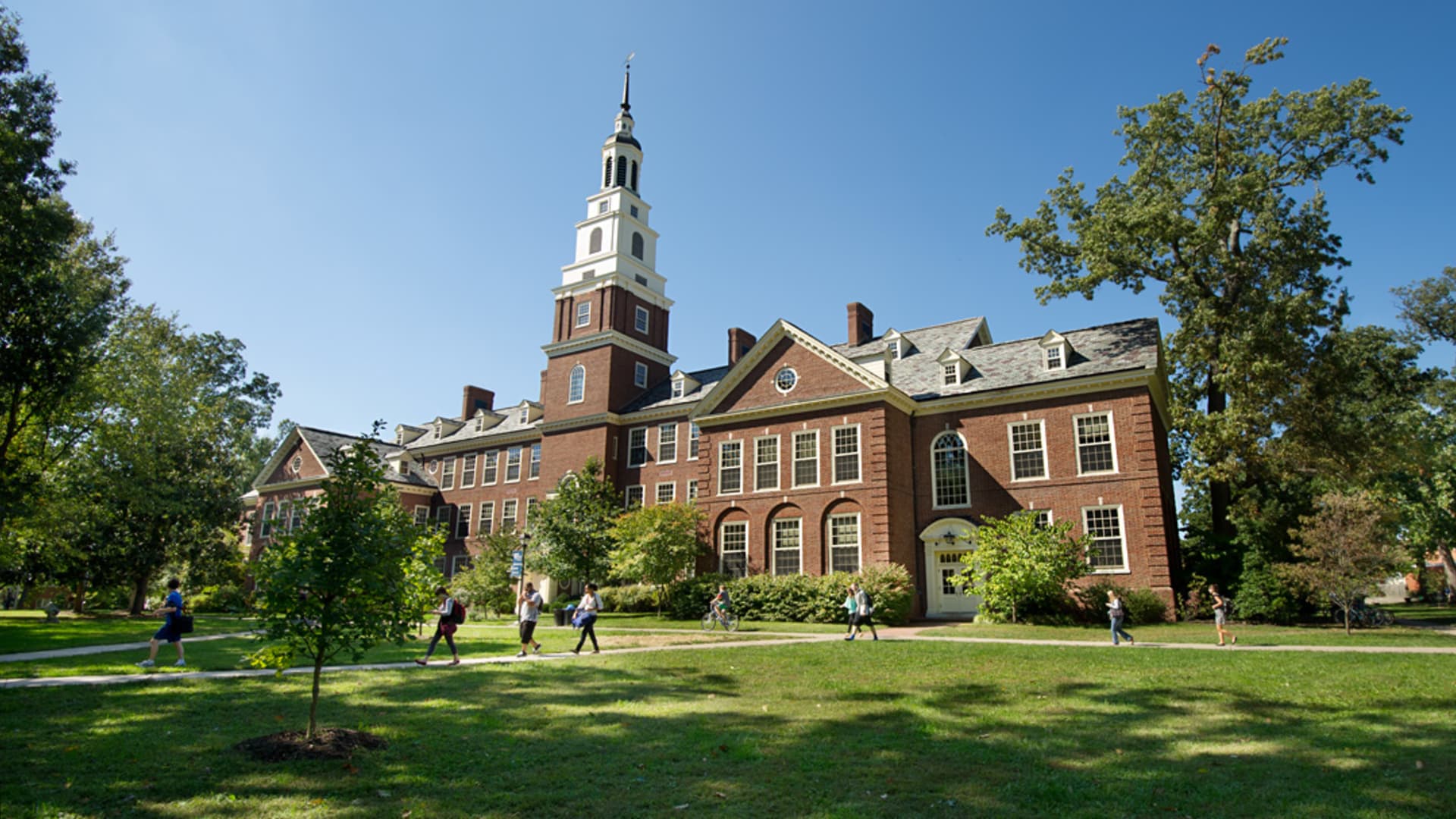
Berea College in Berea, Kentucky.
Source: Berea College | Wikipedia CC
For over 150 years, this small school in Berea, Kentucky has strived to reach first-generation and low-income students who otherwise could not afford to pay for college, according to the school. But it doesn’t stop there: Berea gives every student a laptop and funds to cover internship opportunities and even professional clothing for job interviews.
College of the Ozarks
Students walk on the campus of the College of the Ozarks in Point Lookout, Mo.
Cliff Schiappa | AP
Dubbed “Hard Work U,” College of the Ozarks is a coed Christian school in rural Missouri geared toward serving students in the Ozark region. In return for a full scholarship, undergraduates must work 15 hours a week, plus two 40-hour weeks during the academic year as part of the school’s work program.
Deep Springs College
Deep Springs College students vote on issues of governance during student meeting, the meeting which decide everything from when to harvest to whom the college should hire to teach often last until late into the evening.
Spencer Weiner | Los Angeles Times | Getty Images
Only 12 to 15 students are admitted each year to this all-male liberal arts college in California’s remote High Desert, according to the school. However, every student is awarded a scholarship that covers tuition and room and board. Since Deep Springs is a two-year school with no majors, many graduates go on to transfer to four-year programs to complete a Bachelor of Arts or Bachelor of Science degree.
U.S. Air Force Academy
Fighter jet on grounds of the United States Air Force Academy, Colorado Springs, Colorado.
Education Images | Universal Images Group | Getty Images
In addition to free tuition and room and board, students receive a stipend to cover all other costs at this academy near Colorado Springs, Colorado. In exchange, the academic and physical demands are rigorous, according to The Princeton Review, with classes from 7:30 a.m. to 3:30 p.m. followed by fitness training multiple times a week. After four years, graduates are commissioned as second lieutenants in the Air Force or U.S. Space Force and commit to several years of active duty.
U.S. Coast Guard Academy
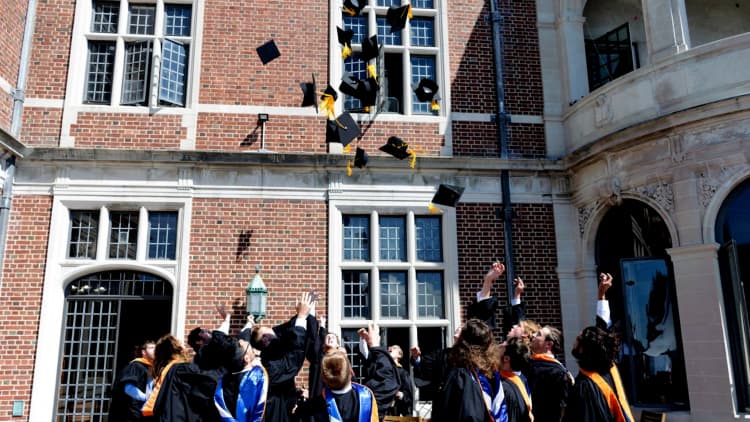
Newly commissioned officers toss their hats during the US Coast Guard Academy’s 144th Commencement in New London, Connecticut, on May 21, 2025.
Joseph Prezioso | Afp | Getty Images
This New London, Connecticut-based academy is also highly selective and demanding, according to The Princeton Review. The extremely structured four-year program, which is fully paid for by the government, offers 10 academic majors, including civil engineering and marine science. After completing their schooling, students commit to five years of service, although many opt to stay in the Coast Guard for much longer, the academy says.
U.S. Merchant Marine Academy
United States Merchant Marine Academy
Yana Paskova/For The Washington Post via Getty Images
Tuition, room and board, uniforms and books are similarly covered at this service academy in Kings Point, New York. As part of the four-year program, cadets gain hands-on experience working aboard commercial and military vessels around the world. Once they graduate, midshipmen can enter any branch of the armed forces as an officer. The service obligation varies depending on what type of job they choose.
U.S. Military Academy – West Point
Closeup view of iconic United States Military Academy at West Point, seen from the Hudson River.
Brian Logan | Istock | Getty Images
Every cadet at this prestigious institution in West Point, New York receives free tuition and a scholarship that covers room and board, in addition to a stipend for uniforms, books, supplies and all other expenses. Armed with a BS degree, West Point graduates then serve at least five years of active duty and three years in the reserves and are “ready for a lifetime of service to the Army and nation,” according to the academy.
U.S. Naval Academy
Mahan Hall displays banners for the War of 1812 exhibit at the United States Naval Academy in Annaplois.
Loop Images | UIG | Getty Images
All students on campus, known as “the Yard,” in Annapolis, Maryland, receive a full scholarship that covers tuition, room and board and other costs, in return for at least five years of active duty after graduation, followed by the reserves. After their rigorous training, many midshipmen go on to have prominent careers within and outside the military, according to The Princeton Review.
Webb Institute
Webb Institute
Source: Webb Institute
Founded by the shipbuilder William Webb, this small, private college in Glen Cove, New York specializes in naval architecture and marine engineering. Every student receives a full scholarship to cover tuition and, along with little to no debt, they benefit from a 100% job placement rate upon graduation, according to the school.


Personal Finance
Next-Generation Retirement Planning: Managing Longevity Risk and Variable Income Streams


U.S.- Canada Trade Talks Collapse; Carney Says Retaliatory Tariffs Begin September 8

Flock Cameras and the Future of Public Security

AI Infrastructure Boom Hits Physical Limits: Power, Financing, and Supply Chain Strain

Armanino adds Strategic Accounting Outsourced Solutions

New 2023 K-1 instructions stir the CAMT pot for partnerships and corporations

Tax Strategy: Employee Retention Credit update
-

 Stock News1 week ago
Nvidia Earnings Preview: What Wall Street Expects From the AI Bellwether’s Q2 Report
-

 Accounting1 week ago
SEC’s Semiannual Reporting Proposal Faces Investor Pushback: What CFOs Need to Know
-

 Stock News1 week ago
Nvidia Q2 FY2027 Earnings beats Wall Street Expectation with Record $96.2 Billion Revenue
-

 Finance1 week ago
Treasury Bond Volatility Forces Bessent to Double Debt Buyback Size as Yields Swing
-
 Technology5 days ago
AI Infrastructure Boom Hits Physical Limits: Power, Financing, and Supply Chain Strain
-
 Technology3 days ago
Flock Cameras and the Future of Public Security
-
 Economics3 days ago
U.S.- Canada Trade Talks Collapse; Carney Says Retaliatory Tariffs Begin September 8