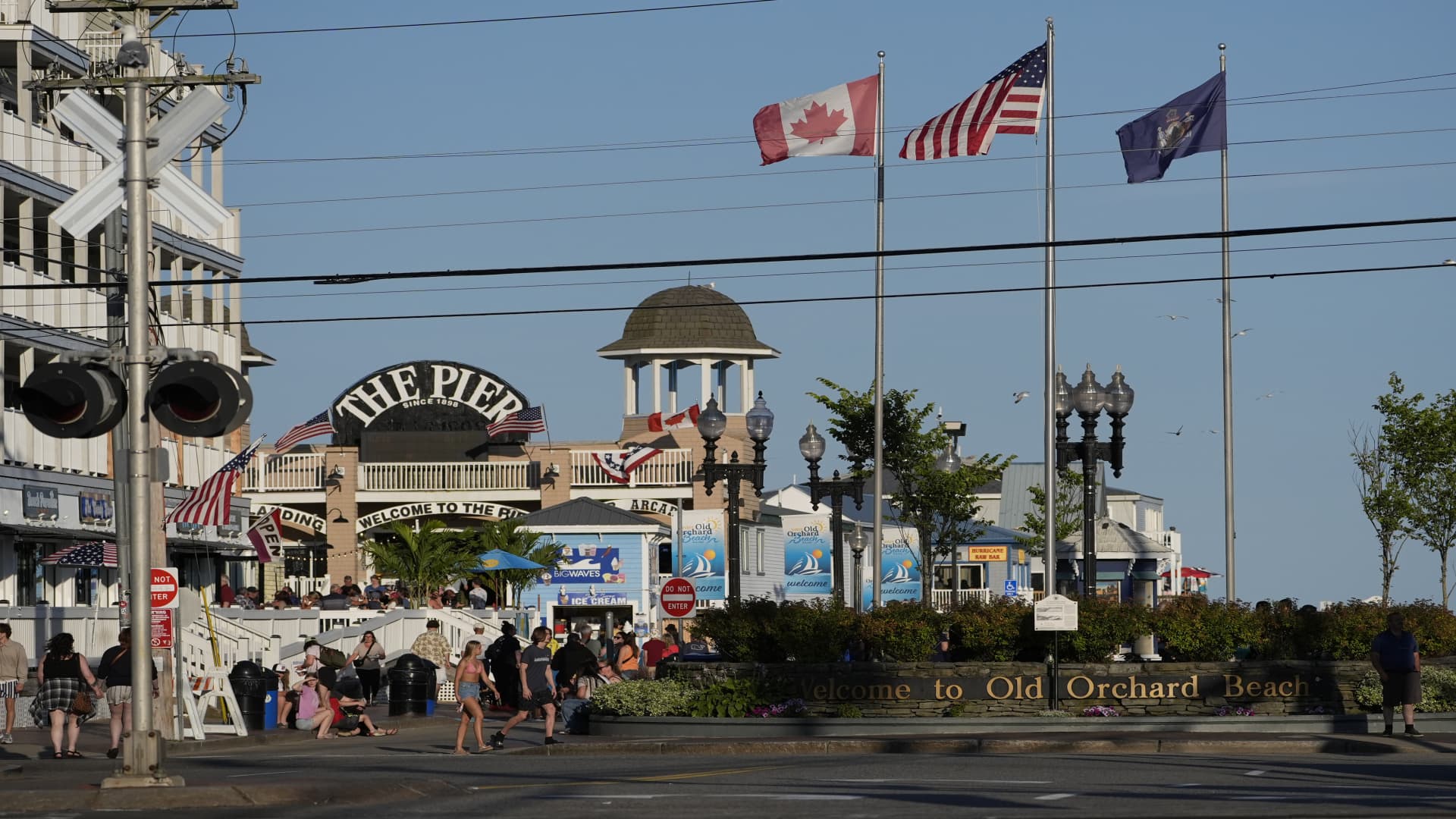
Visitors walk near in Old Orchard Beach, Maine, on July 22, 2025.
Robert F. Bukaty | AP Photo
The adage “time heals all wounds” is not holding true for Canadian travelers and their desire to vacation in America.
Visits to the United States from Canada are down 25.2%, year to date, with a 37% year-over-year drop in arrivals by car in July alone, according to Tourism Economics.
“Canadians were already concerned over their personal finances, but they’ve taken the rhetoric and policy announcements from the U.S. administration very personally,” said Amir Eylon, president and CEO of market research firm Longwoods International, which has been regularly surveying Canadian consumers.
“Unfortunately, things have gone from bad to worse,” he added.
A whopping 80% of Canadian travelers whose travel decisions are being influenced by U.S. policy and politics say U.S. tariffs and economic policy are the major negative influence. Seventy-one percent say political statements by U.S. leaders are a key negative factor, up from 64% in April, according to Longwoods International’s mid-July survey.
Instead of visiting the United States, where AAA says Labor Day weekend travelers will be enjoying lower year-over-year prices for everything from gas, hotels and flights to car rental costs, disgruntled Canadians are planning to travel within their own country or book flights to other nations.
“They’re choosing destinations such as Mexico, the Caribbean and Western Europe,” Eylon said.
It is not just Canadians who are staying away.
Geopolitical and policy-related concerns have also led to a decrease in visitors from Western Europe and Asia, experts say. Overseas arrivals to the U.S. dropped three months in a row, including a 3.1% drop in July, bringing the year-to-date decline to 1.6%, according to Tourism Economics.
Overall, the “sentiment drag has proven severe,” the group said in a data update released last week. In December, it had forecast an approximate 9% increase in overall international arrivals to the United States for 2025. It now expects an 8.2% decline.
Overseas visitor numbers throughout the United States may dip even further due to the $250 visa integrity fee set to go into effect on Oct. 1. The new charge would be layered on top of other visa fees and apply to most anyone applying for a nonimmigrant visa for travel to the United States, including visitors from China, Mexico and Brazil.
The U.S. Travel Association calls it “a misguided junk fee” that will hike the upfront costs of visiting the U.S. by 130% just as the cities across the country already reeling from the loss of international visitors are preparing for major global events such as the 2026 FIFA World Cup, America’s 250th birthday and the 2028 Summer Olympics.
The fee, part of Trump’s signature tax and spending law, requires coordination across agencies before it’s implemented, said a Department of Homeland Security spokesperson, who defended the measure. “President Trump’s One Big Beautiful Bill provides the necessary policies and resources to restore to our nation’s immigration system.”
Autumn of discontent
Destinations across the United States are bracing for further travel dips in the fall and are adjusting expectations and carefully crafting or holding off on new campaigns.
“Our international visitors were forecasted to grow by 15% in 2025 but are now forecast to drop by 10%,” said Dave O’Donnell, vice president of strategic communications for Meet Boston, the organization that markets and promotes tourism in greater Boston.
In response, the group is planning winter campaigns and media missions to Mexico, the United Kingdom and, most notably, Canada. The group plans to host an event in Toronto in September, O’Donnell said.
In Rochester, New York, 90 minutes from the Canadian-U.S. border, 12% to 15% of visitors have traditionally come from Canada.
Summer numbers aren’t in yet, but “we know some Canadians are choosing to stay home or travel to alternative destinations beyond the U.S.,” said Rachel Laber Pulvino, vice president of communications for Monroe County’s tourism agency, Visit Rochester.
Rochester’s tourist attractions include the George Eastman Museum, the Strong National Museum of Play and the National Susan B. Anthony Museum & House. The city’s summer and fall tourism promotion plans have shifted from traditional tourism marketing messages to a “softer” approach, Laber Pulvino said, including a “Dear Canada” campaign launched earlier this summer.
“It is essentially a love letter to our neighbors to the north. Our message is simple: When you’re ready, we will be here,” she said.
Canadians made 20.4 million visits to the United States in 2024. This year, the steep pullback of Canadian visitors is expected to most negatively affect northern cities such as Seattle; Portland, Oregon; and Detroit. In those cities, overall international visitors are expected to decline this year by about 27%, 18% and 17%, respectively, according to Tourism Economics.
“We typically like to be at the top of lists, but not this one,” Michael Woody, chief strategy officer for Visit Seattle, said.
Woody said the projected dip is “certainly concerning” for Seattle. But, he added, Seattle is having a great summer thanks to an uptick in domestic visitors, summer concerts by Lady Gaga and several other headliners, and a cruise season that the Port of Seattle estimates is bringing about 1.9 million passengers to the city.
“We’re looking forward to when Canadian visitor numbers bound back, but that’s driven by so many factors that we don’t have any control over,” he said.
In Portland, tourism has remained flat compared with last summer, largely due to a decline in Canadian visitors, said Jackie Hagan, director of communications for Travel Portland. But, heading into fall, Hagan said the tourism agency is taking a wait-and-see approach to reaching out to Canadian visitors.
“It’s important for us to acknowledge and respect their current decisions not to travel to the U.S., while also expressing that we look forward to their return when the time feels right,” she said.
How’s it going in Florida?
Not all states and cities are wringing hands over international visitor statistics.
Recently released data from Visit Florida Research estimates that 34.4 million visitors traveled to the Sunshine State in the second quarter of 2025, up 5% over the same period in 2024. That includes 640,000 Canadians — down 20% year over year — and 2.3 million overseas visitors, up 11.4% year over year.
In a statement celebrating the uptick in overall visits, Florida Gov. Ron DeSantis said, “People from all over the world come to the Free State of Florida to take advantage of our top-tier attractions, great weather, and our commitment to public safety.”
Greg Fisher, founder and CEO of Destin, Florida-based tour- and activity-booking site TripShock, is surprised that visitor numbers are up.
The tour operators his company works with report that business is either flat or down so far in 2025, he said. “Many of us in Florida are left wondering where these visitors are actually going and what they’re spending their money on,” he said.
Perhaps they are going to the Palm Beaches. There, international visitation for the first half of 2025 is up 2.56% year over year, according to Milton Segarra, CEO of tourism marketing organization Discover the Palm Beaches.
While Canadian visitors to the area dipped 4.4% year over year, international markets such as Brazil, the United Kingdom, Germany and Colombia saw growth, he said.
Segarra tied the increased visitation to factors such as new tourism offerings “and, of course, the global spotlight as President Trump’s selected home base.” Donald Trump’s Mar-a-Lago home is in ritzy Palm Beach.







 Stock News1 week ago
 Accounting1 week ago
 Stock News1 week ago
 Finance1 week ago

