
Personal Finance
What Trump’s presidency could mean for the housing market in the U.S.

Scott Olson | Getty Images News | Getty Images
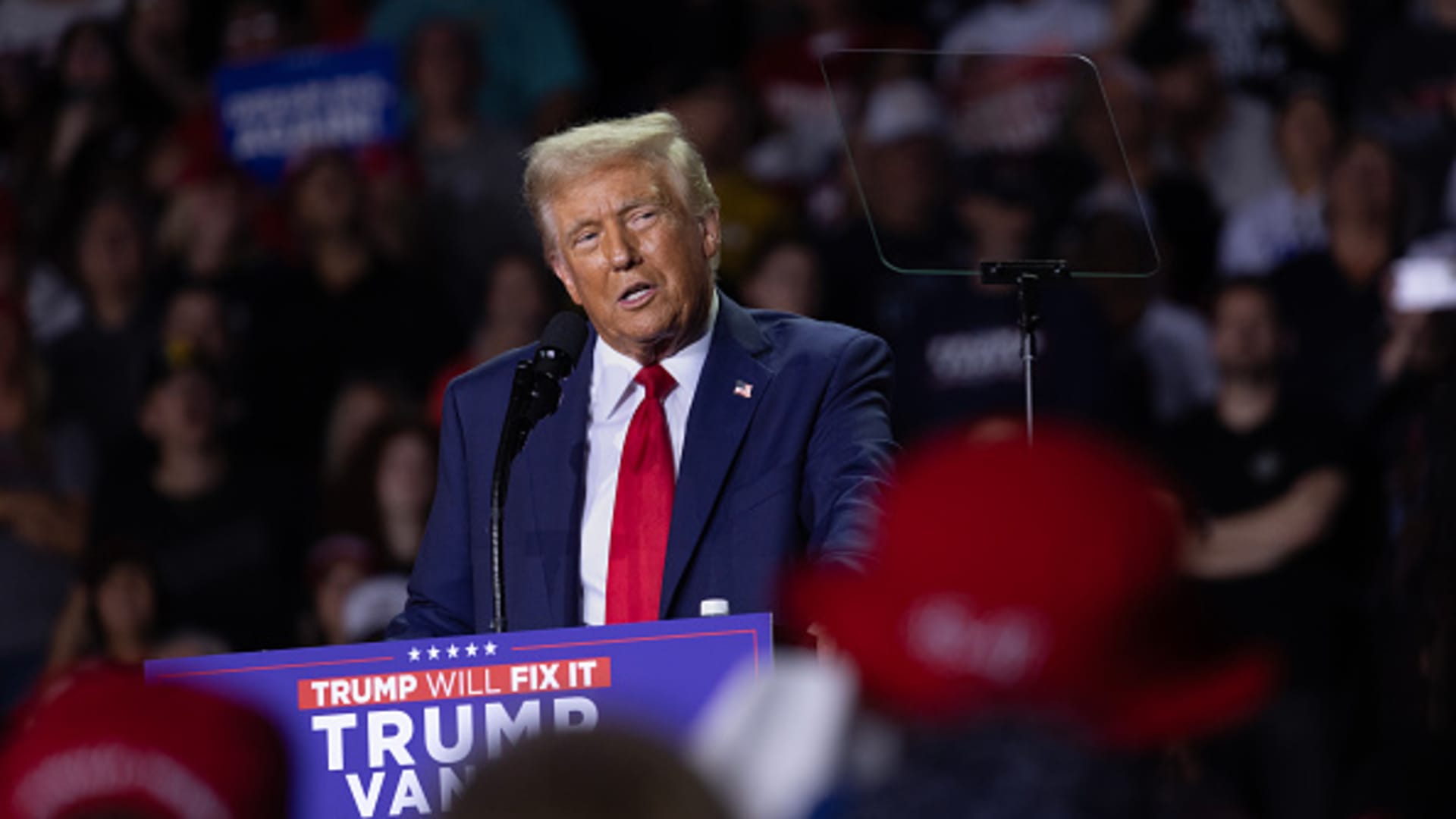
President-elect Donald Trump wants to address housing affordability in the U.S. by fomenting the construction of new homes.
“We’re going to open up tracks of federal land for housing construction,” Trump said during an Aug. 15 news conference. “We desperately need housing for people who can’t afford what’s going on now.”
As of mid-2023, there has been a housing shortage of 4 million homes in the U.S., according to the National Association of Realtors.
“It’s clear that the prescription for that crisis is more building,” said Jim Tobin, president and CEO of the National Association of Home Builders.
More from Personal Finance:
The typical first-time homebuyer is 38, an all-time high
The Federal Reserve cuts interest rates again
Trump has promised no taxes on Social Security benefits
There has been a small increase in new homes being built this year, but it’s still not enough to meet the high demand for housing, leaving a significant gap in the market where there are not enough homes available for buyers, experts say.
Single-family housing starts in the U.S., a measure of new homes that began construction, grew to 1,027,000 in September, according to U.S. Census data. That is a 2.7% jump from August.
While building more homes is the simpler answer to address the housing issue in the country, other promises Trump has made could deter affordability efforts, experts say.
For instance, Trump has talked about enacting a mass deportation of immigrants in the U.S. But doing so might lead to higher building costs, as the construction industry depends on immigrant labor, said Jacob Channel, senior economist at LendingTree.
He also claimed that he would pull down mortgage rates back to pandemic-era lows, although presidents do not control mortgage rates, experts say.
Here’s how some of Trump’s policies could affect the housing market during his administration, according to experts:
1. Deregulation to increase affordability
At the end of Trump’s first presidency, he signed an executive order creating “Eliminating Regulatory Barriers to Affordable Housing: Federal, State, Local and Tribal Opportunities.”
“That could be a blueprint going forward,” said Dennis Shea, executive director of the Bipartisan Policy Center’s Terwilliger Center.
During his 2024 campaign, Trump called for slashing regulations and permit requirements, which can add onto housing costs for homebuyers. Experts say that regulatory costs trickle down to the prices homebuyers face.
“We will eliminate regulations that drive up housing costs with the goal of cutting the cost of a new home in half,” Trump said in a speech at the Economic Club of New York on Sept. 5.
About 24% of the cost of a single-family home and about 41% of the cost of a multifamily home are directly attributable to regulatory costs at the local, state and federal level, Tobin said.
“If we reduce the regulatory burden on home construction or apartment construction, we’re going to lower costs [for] the consumer,” Tobin said.
2. Impacts on construction workforce
Trump has also blamed rising home prices on a surge of illegal immigration during the Biden administration. However, experts say that most undocumented immigrants are not homeowners.
Instead, they live in homes owned by U.S. citizens, Channel said. If a mass deportation were to happen, such homes would remain occupied, he added.
Yet, proposals like mass deportations and tighter border control could impact housing affordability, Tobin said.
About a third, or 31%, of construction workers in the U.S. were immigrants, according to the NAHB.
“Anything that threatens to disrupt the flow of immigrant labor will send shock waves to the labor market in home construction,” Tobin said.
It’s been difficult to recruit native-born workers into the construction industry, experts say.
According to a 2017 NAHB survey, construction trades are an unpopular career choice for young American adults. Only 3% showed interest in the field, the poll found.

Therefore, a mass sweeping of available workers can create a labor shortage in construction. And with fewer workers, wages might increase, which “will likely be passed onto consumers” through higher home prices, Channel said.
What’s more, it will take longer for construction companies to complete housing projects and therefore slow down efforts to increase supply, he added.
While “we are doing a better job” training the domestic workforce through trade schools, apprenticeship programs and other initiatives, the industry still heavily relies on immigrant labor, Tobin said.
3. Tariffs could hike building costs
Trump has proposed a 10% to 20% tariff on all imports across the board, as well as a rate between 60% and 100% for goods from China.
A blanket tariff at 10% to 20% on raw building materials like lumber could push housing costs higher, as well as materials for home renovations, experts say.
“Any tariffs that raise the cost of the products are going to flow directly to the consumer,” Tobin said.
On average, construction costs for single-family homes is around $392,241, according to a data analysis by ResiClub, a housing and real estate data newsletter.
“It depends on what the tariffs look like,” said Daryl Fairweather, chief economist at Redfin. “There could be varying impacts.”
Overall, homebuilders expect to construct about 1.2 million new single-family homes and around 300,000 multifamily units over the next year, Tobin said.
“We’re not quite building back up to the pace that we need to, but it’ll be higher,” he said. “It’ll be higher than this year.”
It might be too soon to tell if the Trump administration will prioritize housing costs as much as a Harris administration would have. And the aid Trump has mentioned might not help densely populated areas, said Fairweather.
Trump mentioned plans to release federal lands for housing, but federal lands tend to concentrate in rural areas, she said.
“That doesn’t do anything for these densely populated blue cities that really need the most help,” Fairweather said.

Personal Finance
Next-Generation Retirement Planning: Managing Longevity Risk and Variable Income Streams


U.S.- Canada Trade Talks Collapse; Carney Says Retaliatory Tariffs Begin September 8

Flock Cameras and the Future of Public Security

AI Infrastructure Boom Hits Physical Limits: Power, Financing, and Supply Chain Strain

Armanino adds Strategic Accounting Outsourced Solutions

New 2023 K-1 instructions stir the CAMT pot for partnerships and corporations

Tax Strategy: Employee Retention Credit update
-

 Stock News1 week ago
Nvidia Q2 FY2027 Earnings beats Wall Street Expectation with Record $96.2 Billion Revenue
-
 Technology6 days ago
AI Infrastructure Boom Hits Physical Limits: Power, Financing, and Supply Chain Strain
-
 Technology4 days ago
Flock Cameras and the Future of Public Security
-
 Economics4 days ago
U.S.- Canada Trade Talks Collapse; Carney Says Retaliatory Tariffs Begin September 8