
Finance
What you need to know

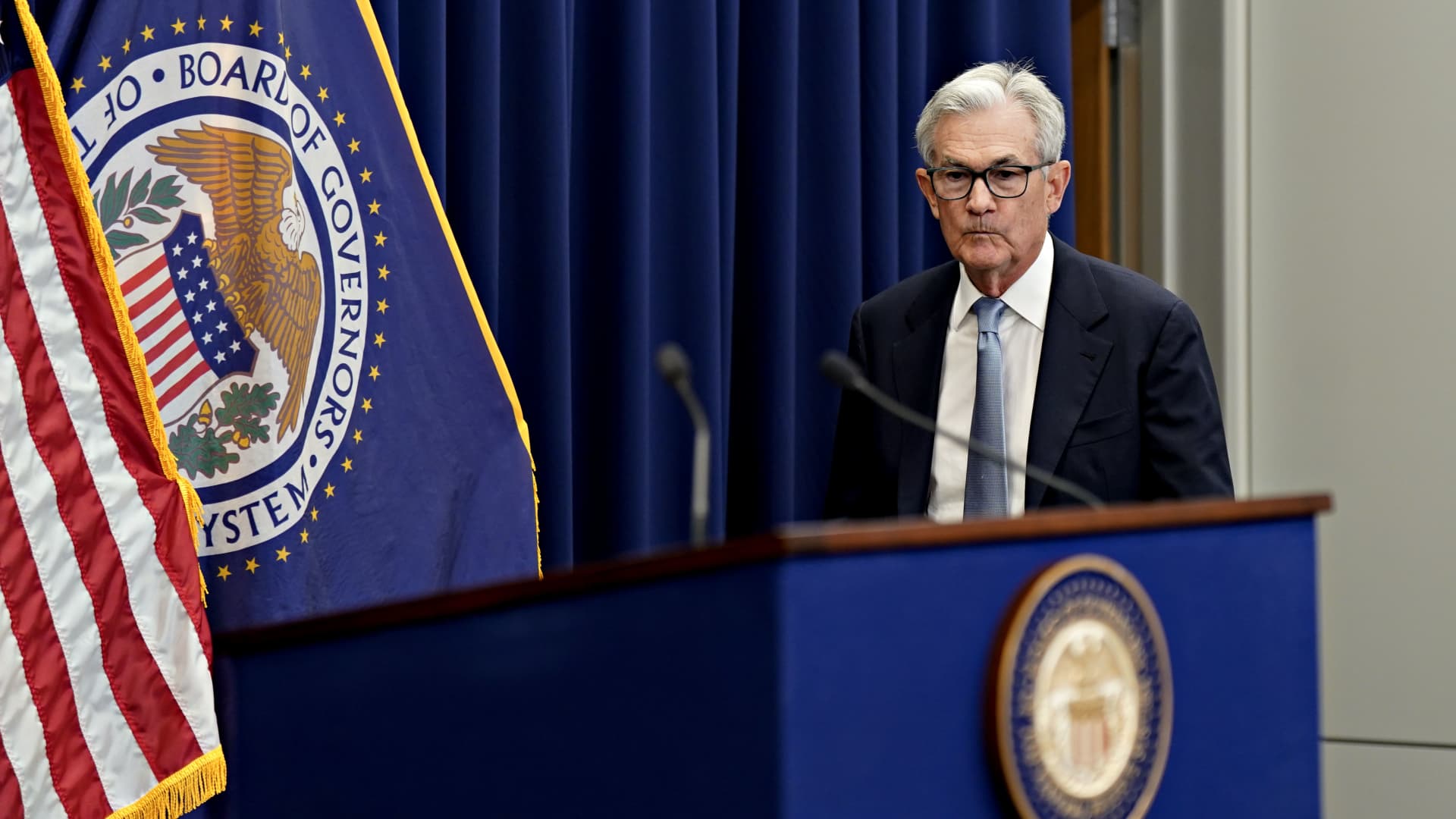
Jerome Powell, chairman of the US Federal Reserve, arrives to a news conference following a Federal Open Market Committee (FOMC) meeting in Washington, DC, US, on Wednesday, March 22, 2023.
Al Drago | Bloomberg | Getty Images
This week’s Federal Reserve meeting is not much about the present but potentially very much about the future.
If things go according to expectations, policymakers again will keep short-term interest rates on hold roughly from where they’ve been the past year.
However, with a raft of cooperating inflation data under their belts in recent months, central bankers are widely expected to lay the groundwork for interest rate cuts to begin in September. Just how aggressive they are in spreading those breadcrumbs is the main question markets will be looking to answer.
“Our expectation is that they’re going to keep rates unchanged,” said Michael Reynolds, vice president of investment strategy at Glenmede. “But there’s going to be a lot of focus on the [post-meeting] statement, perhaps teeing up September as whatever the opposite of liftoff is.”
Market pricing currently indicates an absolute certainty that the Fed will approve its first reduction in more than four years — when it meets Sept. 17-18. The central bank has kept its benchmark funds rate in a range of 5.25%-5.5% for the past year. The rate indicates what banks charge each other for overnight lending but sets a guidepost for a slew of other consumer debt products.
As for this week’s meeting, which concludes Wednesday, traders are assigning a very small possibility of a cut. However, there are expectations that the rate-setting Federal Open Market Committee will drop signals that as long as there are no major data hiccups, a September move is very much on the table.
Reynolds thinks the committee, along with Chair Jerome Powell at his news conference, will want to keep its options at least somewhat open.
“They’re going to want to strike a balance. They don’t want investors to start pricing in a rate cut coming in September and there’s literally nothing else that could possibly happen,” he said.
“Opening the door for that rate cut is probably the most appropriate thing for them at this point,” Reynolds added. “But the markets are already pretty excited about that, pricing it in with nearly 100% probability. So the Fed doesn’t have to do too much to change the narrative on that at all. I think if they just directionally tailor the statement, it’ll get the job done.”
Expectations for easing
Glenmede expects that starting in September, the Fed could cut at each of the three remaining meetings. That is largely in line with market expectations, as measured by the CME’s FedWatch gauge of pricing in 30-day fed funds futures contracts.
There are a few ways the Fed can guide markets on its likely intent without making too much of a commitment. Subtle language changes in the statement can help that along, and Powell could be expected to have some scripted answers ready for the press conference to convey the likely path of future policy.
Goldman Sachs economists see the FOMC making a few alterations.

One critical change could be a line in the statement that says the committee won’t reduce rates until it “has gained greater confidence that inflation is moving sustainably toward 2 percent.” Goldman Sachs economist David Mericle expects the Fed to qualify that statement to say it now needs only “somewhat greater confidence” to start easing.
“Recent comments from Fed officials … suggest that they will remain on hold at their meeting [this] week but have moved closer to a first interest rate cut,” Mericle said in a note. “The main reason that the FOMC is closer to cutting is the favorable inflation news from May and June.”
Indeed, the inflation news has gotten better though still isn’t great — most metrics have the pace of price increases still running a half a percentage point or more above the Fed’s target, but they have eased sharply from their mid-2022 peaks. The Fed’s preferred gauge, the personal consumption expenditures price index, showed 12-month inflation at a 2.5% rate in June; the consumer price index had it at 3% and showed an actual decline of 0.1% from the previous month.
Clearer signals sought
Still, don’t expect too much enthusiasm from Fed officials.
“The inflation numbers have bounced around a lot this year,” said Bill English, the Fed’s former director of monetary affairs and now a Yale professor. “We had quite high numbers last winter. We’ve had a couple of months of good data now. But, I think they are genuinely uncertain exactly where inflation is and where it’s headed.”
English expects the Fed to hint at a September move but stop short of providing a detailed road map of what’s to follow.
Central bankers mostly feel they can be patient on policy with inflation easing and broader measures of economic growth continuing to show strength despite the highest benchmark interest rates in 23 years. For instance, gross domestic product accelerated at a better-than-expected 2.8% annualized pace in the second quarter, and the labor market has been strong as well even with an unemployment rate that has drifted higher.
“Given where inflation is, given where the economy is, it’s appropriate to ease but not to be seen as committing to a whole chain of easing,” English said. “It’s difficult to communicate clearly about where monetary policy is going.”
The central bank will not provide an update on its quarterly summary of economic projections at this meeting. That includes the “dot plot” of individual members’ expectations for rates as well as informal forecasts on GDP, inflation and unemployment.
The FOMC does not meet in August except for its annual retreat in Jackson Hole, Wyoming, which traditionally includes a keynote policy speech from the chair.





S&P 500 September Outlook: Tech Rally Holds Index at 7,600

India Unveils ‘Saptadhara’ Reform Agenda Targeting Technology, Youth Skilling, and Growth

S&P 500 Outperforms Amid Strong Corporate Earnings as Treasury Yields Cap Equity Multiples

Armanino adds Strategic Accounting Outsourced Solutions

New 2023 K-1 instructions stir the CAMT pot for partnerships and corporations

Tax Strategy: Employee Retention Credit update
-

 Stock News1 week ago
Nvidia Q2 FY2027 Earnings beats Wall Street Expectation with Record $96.2 Billion Revenue
-

 Technology6 days ago
AI Infrastructure Boom Hits Physical Limits: Power, Financing, and Supply Chain Strain
-

 Economics4 days ago
U.S.- Canada Trade Talks Collapse; Carney Says Retaliatory Tariffs Begin September 8
-

 Technology4 days ago
Flock Cameras and the Future of Public Security
-
 Stock News1 hour ago
S&P 500 September Outlook: Tech Rally Holds Index at 7,600
-

 Insights2 hours ago
Climate Resilience and Offshore Wind and Land Restoration Milestones
-

 Accounting2 hours ago
Mandatory ESG Reporting Standards Demand Standardized Non-Financial Audit Trails
-
 Finance2 hours ago
S&P 500 Outperforms Amid Strong Corporate Earnings as Treasury Yields Cap Equity Multiples