
Personal Finance
Where SNAP benefits stand amid government shutdown negotiations

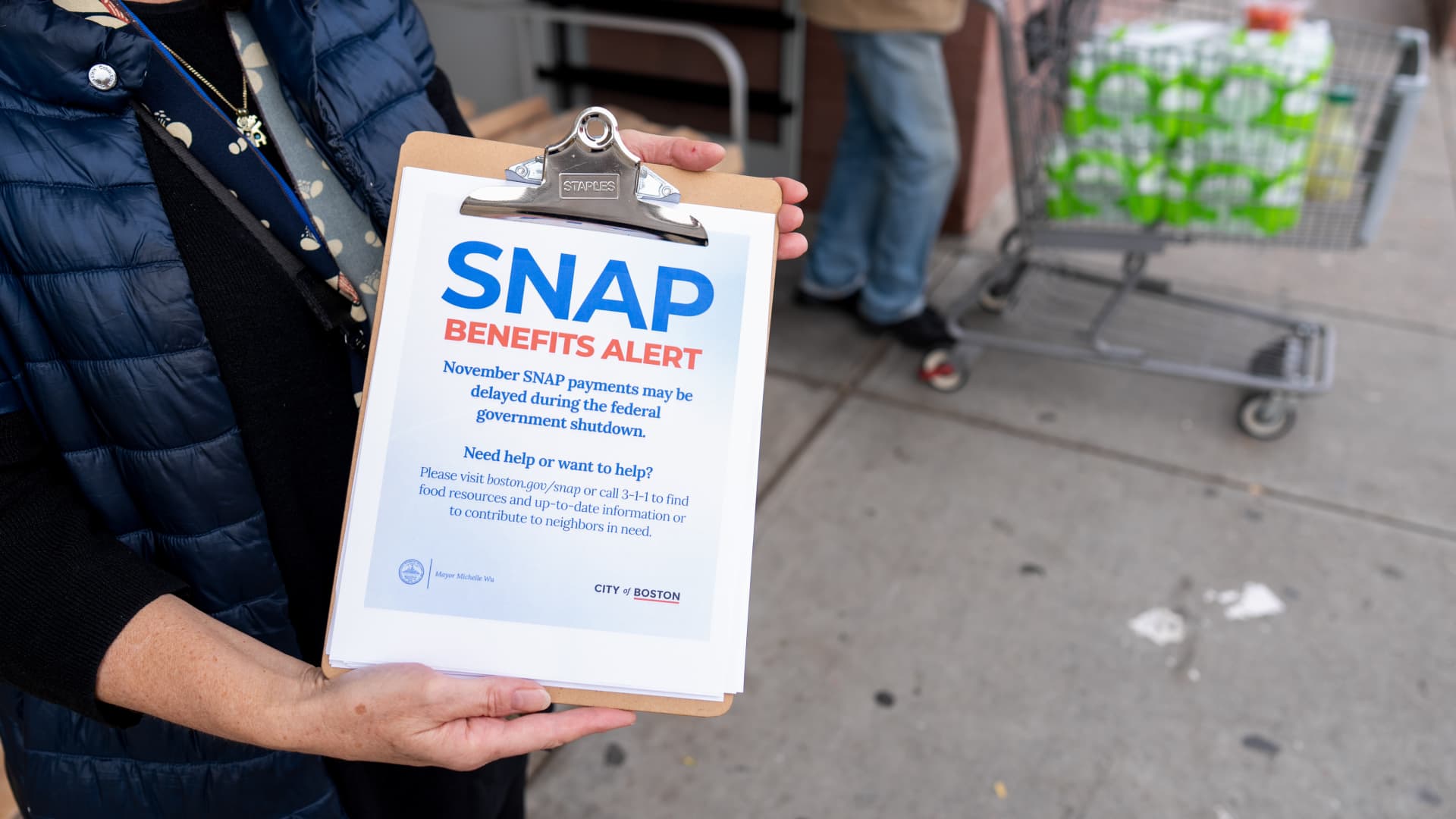
A volunteer displays information on the Supplemental Nutritional Assistance Program (SNAP) at a grocery store in Dorchester, Massachusetts, US, on Monday, Nov. 3, 2025.
Mel Musto | Bloomberg | Getty Images
As the longest federal shutdown nears an end, millions of Americans may also see an end to the conflict that has put their food benefits for November on the line.
The Supplemental Nutrition Assistance Program or SNAP, formerly known as food stamps, helps low-income individuals and families with monthly benefits toward food purchases.
The federal government shutdown, which began on Oct. 1, led to delays or interruptions in November SNAP benefits. A deal to end the shutdown is working its way through Congress that would include SNAP funding. The bill was passed by the Senate on Monday night and is now waiting for a House vote on Wednesday evening.
The Supreme Court on Tuesday extended a pause of a federal judge’s order that the Trump administration pay full SNAP benefits for November. The delay is slated to last until late Thursday. In the meantime, Congress may reach an agreement to end the shutdown and reinstate full SNAP benefits.
While the federal government is mandated to pay full benefits, the Trump administration said the funding to pay 100% was not available and has supported paying 65% of SNAP benefits during the shutdown through the use of contingency funds. Originally, the administration had said it would pay 50% of benefits.
The guidance has been changing daily and, in some cases, even hourly, according to Poonam Gupta, a research associate at the Urban Institute, a Washington, D.C., think tank.
“From the beneficiary perspective, it’s wildly confusing,” Gupta said, and comes at a challenging time — the holiday season tends to drive food spending up.
“The last 10 or 11 days have really highlighted how important SNAP is to the 42 million people across the country who participate in it and how critical it is to combating hunger and helping families put food on the table,” Crystal FitzSimons, president of the Food Research & Action Center, a non-profit focused on fighting poverty-related hunger, said Tuesday.
Experts say the interference with SNAP benefits during a government shutdown is unprecedented. Excluding the current pause, there have been 14 shutdowns since 1980, according to the Bipartisan Policy Center.
Yet this shutdown, which now holds the record for the longest, is the first time SNAP benefits have been affected, according to experts.
In previous shutdowns, “administrations of both parties have been energetic and creative in avoiding an interruption in benefits,” said David Super, professor of law at Georgetown University.
The first Trump administration “really bent over backwards” to make sure there wouldn’t be a SNAP interruption during the 35-day shutdown spanning late 2018 to early 2019, Super said. That is now the second-longest shutdown on record.
When to expect November SNAP benefits
As Congress moves towards finalizing a deal, that should also end the conflict around SNAP November payments, according to FitzSimons.
“We do expect everybody to receive full benefits soon,” FitzSimons said. “It’s just going to take some states more time than others.”

While some states have either moved forward with full benefits for November or announced their intention to pay 100% of benefits, other states have followed plans to pay 65% of the payments in accordance with the administration, FitzSimons said.
To help beneficiaries find out what is happening with benefits, the Food Research & Action Center has launched a shutdown tracker that follows changes in each state.
New ‘big beautiful’ law changes to cut benefits
President Donald Trump’s “big beautiful” legislation, passed earlier this year, includes big changes to SNAP that are due to start phasing in.
Adults up to age 65 will have a three-month time limit on their benefits every three years unless they can demonstrate that they have met certain work requirements, with a minimum of 80 hours per month. Those requirements will now apply to veterans, homeless individuals and former foster youth.
The new law also restricts SNAP eligibility for individuals who are not American citizens.
The “big beautiful” law will also shift more responsibility for both the administration of SNAP and the funding of the benefits onto states. SNAP administrative costs will move from a 50-50 share between federal and state to 25% federal and 75% state. Full federal funding of benefits is also due to stop, with states’ share depending on their error rates, or the accuracy of their eligibility and benefit determinations.
“There’s millions of people who are going to lose benefits and people who will lose some of their benefits,” FitzSimons said.
Research from the Urban Institute estimates 22.3 million families may lose some or all of their SNAP benefits as a result of the legislative changes.
Of those families, 5.3 million would lose at least $25 per month in SNAP benefits, according to the report. On average, those families would lose $146 in SNAP funding per month.
The “big beautiful” changes to SNAP that were enacted in July, followed by the limitations on the program during the government shutdown have turned the program into a “political tool,” Gupta said.
“At the end of the day, it’s just meant to be a program to help people afford food for their families,” Gupta said.


Personal Finance
Next-Generation Retirement Planning: Managing Longevity Risk and Variable Income Streams


U.S.- Canada Trade Talks Collapse; Carney Says Retaliatory Tariffs Begin September 8

Flock Cameras and the Future of Public Security

AI Infrastructure Boom Hits Physical Limits: Power, Financing, and Supply Chain Strain

Armanino adds Strategic Accounting Outsourced Solutions

New 2023 K-1 instructions stir the CAMT pot for partnerships and corporations

Tax Strategy: Employee Retention Credit update
-

 Stock News1 week ago
Nvidia Earnings Preview: What Wall Street Expects From the AI Bellwether’s Q2 Report
-

 Accounting1 week ago
SEC’s Semiannual Reporting Proposal Faces Investor Pushback: What CFOs Need to Know
-

 Stock News1 week ago
Nvidia Q2 FY2027 Earnings beats Wall Street Expectation with Record $96.2 Billion Revenue
-

 Finance1 week ago
Treasury Bond Volatility Forces Bessent to Double Debt Buyback Size as Yields Swing
-
 Technology5 days ago
AI Infrastructure Boom Hits Physical Limits: Power, Financing, and Supply Chain Strain
-
 Technology2 days ago
Flock Cameras and the Future of Public Security
-
 Economics2 days ago
U.S.- Canada Trade Talks Collapse; Carney Says Retaliatory Tariffs Begin September 8