
Personal Finance
Which prices are falling for consumers

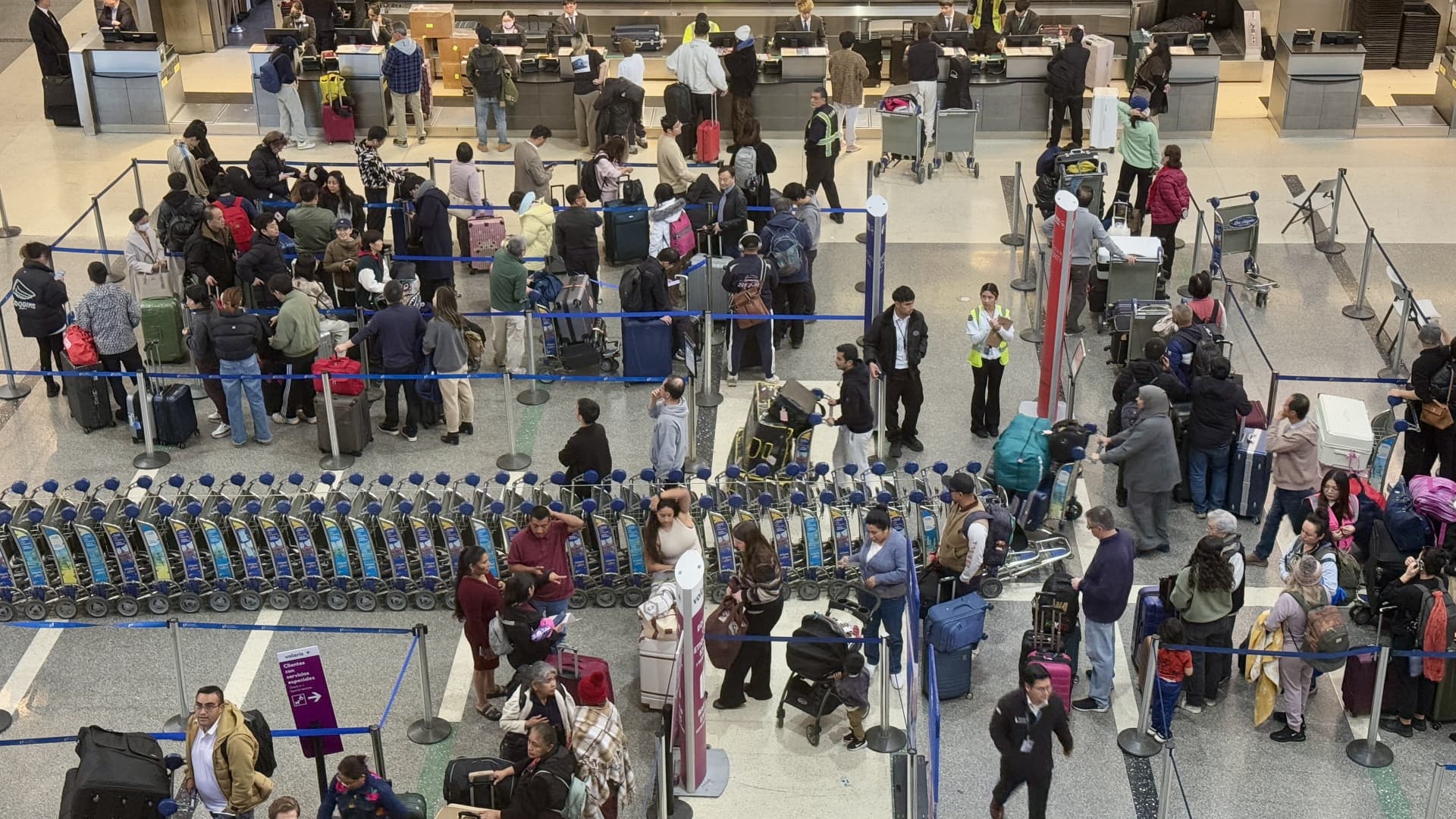
People line up at departures gates in Los Angeles International Airport.
Daniel Slim | Afp | Getty Images
Even though inflation hasn’t yet declined to policymakers’ target level, some pockets of the U.S. economy have seen prices fall recently.
Consumers have seen prices deflate for airfare, produce, household goods, electronics and gasoline, for example, according to the consumer price index, an inflation gauge. (Deflation is when prices decline, while disinflation is when prices continue to grow but at a slower pace.)
“There are a lot of idiosyncratic factors affecting certain categories,” said Ryan Sweet, chief U.S. economist at Oxford Economics. “In the end, it’s supply and demand that will affect prices.”
Of course, some categories are volatile and prone to extreme price gyrations — meaning price declines could quickly reverse. Tariffs also threaten to roil the picture and put upward pressure on many consumer prices.
“Consumers should enjoy these lower prices, because they’re not here to stay,” said Mark Zandi, chief economist at Moody’s. “They’re going away pretty quickly, I think, over the next few weeks and months.”
Here are some areas where consumers have seen a bit less stress on their wallets lately.
Gasoline
President Donald Trump claimed in a social media post Friday that gas prices had dipped to $1.98 per gallon for motorists. However, that claim isn’t true: The average retail gas price is more than $3 a gallon , according to the US. Energy Information Administration.
However, prices have broadly declined in the past year.
Gasoline prices are down almost 10% from a year ago, according to the latest CPI data. They fell about 6% just in the month from February to March, on a seasonally adjusted basis, the data shows.
Oil prices have a large bearing on the prices consumers pay at the pump, since gasoline is refined from oil.

Crude oil prices have fallen significantly. For example, futures prices for West Texas Intermediate, a U.S. oil benchmark, are down 22% over the past year.
Lower prices signal fears that the U.S. economy is slowing down, which would mean less demand for oil, Sweet said. Meanwhile, a group of oil-producing nations known OPEC+ agreed to raise production over the weekend, weakening prices amid greater supply.
“Prices can’t go much lower for very long or [oil] producers will start pulling back production,” Zandi said.
Airline fares
Lower oil prices are filtering through to many other areas of the economy, Zandi said.
Airline fares are one example, economists said.
Prices for airline tickets are down more than 5% from a year ago, according to CPI data. They fell about 5.3% in the month from February to March.
Jet fuel is a major input cost for airlines; jet fuel prices are down about 15% in the year through April 25, according to the International Air Transport Association.
More from Personal Finance:
Trump’s tax package could include ‘SALT’ deduction relief
Gold ETF investors may be surprised by their tax bill on profits
This is what typically happens to stocks after periods of high volatility
Weaker travel demand, particularly from international tourists to the U.S., has also put downward pressure on fares, economists said.
International visits to the U.S. fell about 14% in March 2025 from a year earlier, according to the U.S. Travel Association.
The international community is wary of traveling to the U.S. due to tensions from a U.S.-initiated trade war, and territorial declarations from the White House such as Canada becoming the 51st state or about a possible takeover of Greenland, economists said. People also fear the threat of being detained when entering the country, economists said.
Produce
A farm worker carries a bin with tomatoes in Immokalee, Florida.
Eva Marie Uzcategui for The Washington Post via Getty Images
Produce like tomatoes, lettuce and potatoes have seen sharp price declines.
Tomatoes, for example, have seen prices fall about 8% in the past year, according to CPI data. Those of lettuce and potatoes have pulled back about 5% and 2%, respectively.
Lower costs for diesel fuel — and, by extension, lower transportation costs from farm to grocery store shelf — have helped, economists said.
There are also seasonal supply-and-demand factors at play, they said.
“Tomato supplies are increasing as the Florida harvest is well underway,” Brad Rubin, sector manager at the Wells Fargo Agri-Food Institute, wrote in an e-mail. “The Mexico spring harvest is also plentiful in Culiacan. This includes round, Roma, and snacking tomato varieties.”
Tomatoes imported from Mexico will face new tariffs starting in mid-July, however, following a Trump administration withdrawal from a trade agreement between the two nations.
The lettuce crop has transitioned to Salinas, California, for the spring and the harvest has “plentiful yield and high quality,” Rubin wrote. The crop generally transitions to Yuma, Arizona, from November to April, but “production challenges” through the winter put upward pressure on prices, he wrote.
TVs, smartphones and other goods
Televisions and smartphones have seen prices fall 9% and 14% in the past year, according to CPI data. They each declined more than 1% in the month from February to March.
It’s common to see prices deflate for consumer electronics, because companies can generally make products like TVs and iPhones more efficiently over time, Sweet said.
“The flat screen TV you may have bought five years ago is a lot cheaper if you go out today,” he said. “That’s normal.”
Technology continually improves, meaning consumers get more for their money. The Bureau of Labor Statistics, which compiles CPI data, treats those quality improvements as a price decline, giving the illusion of falling prices on paper.
The reasons for price declines in other categories can be somewhat hard to pin down, economists said.
For example, certain household goods like dishes and flatware, sporting goods, and toys saw prices fall about 11%, 5% and 2%, respectively, in the past year. Similarly, segments of the clothing market like infants’ and toddlers’ apparel fell 4%.

Apparel, for example, can be “very seasonal,” Sweet said.
“It could be weather or the timing of certain holidays,” he said. “All of that can throw apparel prices for a loop.”
A potential explanation, Zandi said, is retailers who tried stockpiling certain goods in anticipation of tariffs may have bulked up their inventories more than expected, and may be pricing those goods more aggressively to reduce those inventories, he said.

Personal Finance
Next-Generation Retirement Planning: Managing Longevity Risk and Variable Income Streams


U.S.- Canada Trade Talks Collapse; Carney Says Retaliatory Tariffs Begin September 8

Flock Cameras and the Future of Public Security

AI Infrastructure Boom Hits Physical Limits: Power, Financing, and Supply Chain Strain

Armanino adds Strategic Accounting Outsourced Solutions

New 2023 K-1 instructions stir the CAMT pot for partnerships and corporations

Tax Strategy: Employee Retention Credit update
-

 Stock News1 week ago
Nvidia Earnings Preview: What Wall Street Expects From the AI Bellwether’s Q2 Report
-

 Accounting1 week ago
SEC’s Semiannual Reporting Proposal Faces Investor Pushback: What CFOs Need to Know
-

 Stock News1 week ago
Nvidia Q2 FY2027 Earnings beats Wall Street Expectation with Record $96.2 Billion Revenue
-

 Finance1 week ago
Treasury Bond Volatility Forces Bessent to Double Debt Buyback Size as Yields Swing
-
 Technology5 days ago
AI Infrastructure Boom Hits Physical Limits: Power, Financing, and Supply Chain Strain
-
 Technology3 days ago
Flock Cameras and the Future of Public Security
-
 Economics3 days ago
U.S.- Canada Trade Talks Collapse; Carney Says Retaliatory Tariffs Begin September 8