Economics
Why those who wish to see Trump jailed soon will be disappointed
Published
2 years agoon
Your browser does not support the <audio> element.
The prosecutors trying to convict Donald Trump face a highly unusual deadline. Retaking the presidency would offer Mr Trump his best escape from jeopardy: once back in the White House, he would be able to squelch or pause the four criminal cases lodged against him. Hence prosecutors’ urgency—and a public interest—in concluding those trials before November. Miss that opportunity and he may never be held accountable in a court of law for his alleged crimes.
The 91 felony charges against Mr Trump are both serious and picaresque. The weightiest are related to his role in the attack on the Capitol on January 6th 2021. His attempt to overturn his defeat in the 2020 election was the most shocking and serious assault on the constitution in decades, if not since the civil war; whether a jury would see Mr Trump as guilty or innocent has obvious salience as voters prepare to decide whether to return him to the presidency. There are additional allegations about election interference in Georgia and the mishandling of state secrets. And (as if a Trump saga could not be without a splash of tabloid entertainment) there is also a plot involving a payment to a porn star.
The pending criminal cases come on top of heavy losses Mr Trump has endured recently in adjudicated civil lawsuits. On February 16th a judge in New York fined Mr Trump and his business $355m (plus $99m and rising in interest) for misrepresenting asset values to lenders, and barred him from serving as a corporate director in the state for three years. Add the $88m in damages awarded to E. Jean Carroll, a writer whom Mr Trump sexually assaulted decades ago and then defamed, and he owes more than $500m. The judgments—which he will appeal against—could deplete his cash holdings and compel him to sell some of his assets.
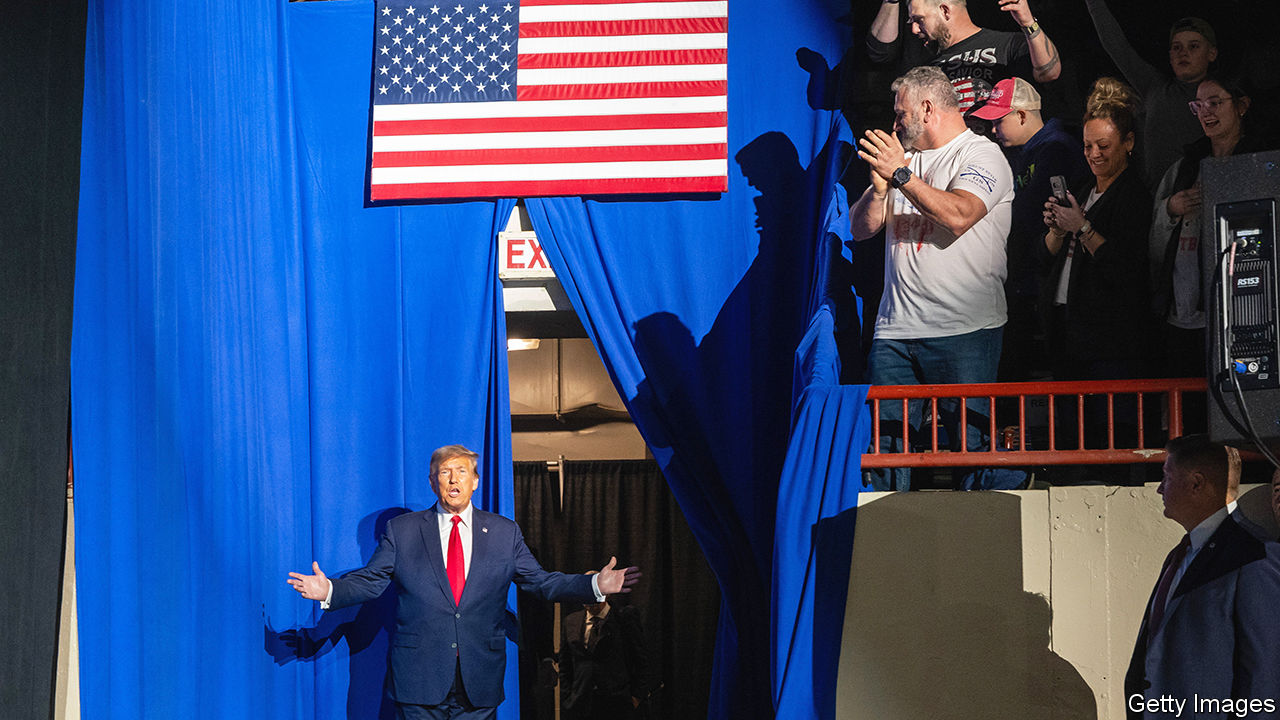
Mr Trump insists he has done nothing wrong in any of the cases discussed in this article, and has so far incorporated all of them deftly into his restoration narrative of victimhood and revenge-seeking. The fact that two of the criminal indictments were brought by district attorneys elected to their offices as Democrats has provided ballast for his claims that he is being targeted by political enemies. Still, he will frequently appear before judges as an accused felon over the remaining eight months of the campaign. Indeed, Americans are already growing accustomed to a split-screen of scowling courtroom appearances and MAGA rallies that has no precedent in past presidential elections.
Yet Democrats who wish to see him locked up by election day will be disappointed. It seems probable that at most one or two trials will conclude before voting starts, and even if the former president is convicted of one or more felonies, he is likely to avoid or at least delay a prison term until after the election is decided.
A trial in the January 6th case could take place in summer or early autumn, depending on how Mr Trump’s appeals unfold. If it does go forward during the campaign, wall-to-wall news coverage will refresh memories of how Mr Trump’s Big Lie and his attempt to stop Congress from certifying the vote led hundreds of his supporters to storm the Capitol. Five people died as a result of the attack and more than 150 police officers were injured.
However, instead of a trial-of-the-century about an event of plain historical significance, the flimsiest of the four cases may go forward first. That trial is scheduled for March 25th in Manhattan.
Alvin Bragg, a Democrat who is the borough’s elected district attorney, brought an indictment that does not lack ambition. Mr Trump stands accused of 34 felonies for falsifying business records to hide hush money paid to Stormy Daniels, a porn actress, before the 2016 election. Prosecutors allege that Mr Trump ordered his lawyer, Michael Cohen, to buy Ms Daniels’s silence for $130,000. After he won the election he reimbursed Mr Cohen and marked those payments as legal expenses.
First but not foremost
The case is convoluted. Normally the charge would be a misdemeanour. To elevate it to a felony, prosecutors must prove the records were falsified with intent to commit another crime. Mr Bragg has alluded to several other offences in legal filings. He could say the payments violated federal campaign-finance laws since they were not declared as contributions, or that taxes were not paid on them.
Mr Bragg’s case falls in a legal grey area. Federal election law pre-empts state prosecutors from bringing cases about federal races. By pursuing an untested legal theory Mr Bragg has bolstered Mr Trump’s claim that he is the target of a partisan prosecution, says Jed Shugerman of Boston University School of Law.
There are other problems with Mr Bragg’s case. The star witness, Mr Cohen, lacks credibility, having lied to Congress and a federal judge. The carnivalesque nature of the trial—a former tabloid publisher and a former Playboy model will probably testify—will play to Mr Trump’s advantage, making the case seem like reality TV, a format in which he is highly practised. Even if Mr Trump is convicted, there seems to be little chance that the judge would sentence him to prison on such novel charges involving the manipulation of records.
The January 6th case was lodged in federal court in Washington, DC, by Jack Smith, a special counsel in the Department of Justice (DoJ). Mr Smith charged Mr Trump with four crimes, including conspiracy to defraud the United States and to deny voters their rights by using lies, “fake” electors and other schemes to thwart the lawful certification of the electoral-college vote by Congress on January 6th. The indictment was tight, conservative and designed to move quickly, says Ryan Goodman of New York University School of Law. Though it lists six alleged co-conspirators, only Mr Trump was charged. (The others may be later.) No count relates directly to the violence of the Capitol riot. That would have been a heavier lift for prosecutors.
A charge of insurrection or seditious conspiracy—used to convict a number of far-right militia leaders who stormed the Capitol—would have required proof that Mr Trump knew the protests that day would turn violent. Incitement would have elicited a potentially strong First Amendment defence. Still, Mr Smith will need to show criminal intent. Mr Trump’s lawyers contend that he genuinely believed he won and that advisers said his pressure tactics were legal. That may not be a winning defence: plenty of people repeatedly told him he had lost. But it is a viable one. Rebecca Roiphe of New York Law School cautions against calling the case rock-solid.
Mr Smith faces another vulnerability. Two of the four charges—obstruction of an official proceeding and conspiracy to do so—relate to the disruption of the counting of electoral-college votes. More than 150 Capitol rioters have been convicted of or pleaded guilty to those felonies. Some of them have challenged the charges by arguing that the underlying criminal statute, which was passed after the Enron accounting scandal, applies only to evidence-tampering. This spring the Supreme Court will hear a Capitol defendant’s bid to invalidate the charges. A decision will come by July and could oblige Mr Smith to cut his indictment in half.
The biggest question-mark is the trial’s timing. Initially the presiding judge, Tanya Chutkan, an Obama appointee, moved the case along quickly. But in mid-December she froze trial preparation so that Mr Trump could argue in a federal appeals court that the case should be thrown out on presidential-immunity grounds. A three-judge appellate panel unanimously rejected his request earlier this month. The Supreme Court will probably decide by early March whether to take it up. If the justices agree to hear the case, that will add a delay of weeks and perhaps months.
By July at the latest Judge Chutkan should have a green light from the Supreme Court to unfreeze the proceedings. (Hardly anyone expects the justices to side with Mr Trump on immunity, assuming they even agree to take his case.) Several weeks of preparation will need to be recouped before the trial actually gets under way. Then the trial itself will take about two to three months. That gives decent odds of a verdict by election day.
If Mr Trump is convicted, sentencing will be up to Judge Chutkan. She has required prison time for every convicted Capitol rioter whose trial she has overseen. But that seems highly unlikely for a former president. A more plausible scenario would be a fine, probation or house arrest. In any event he would remain free while he appealed against the conviction.
The Georgia affair
If Mr Smith’s federal indictment over election interference is a targeted harpoon, its state counterpart in Fulton County, Georgia, is a giant trawl net. Both rely in essence on the same facts and witnesses. The big difference is that Fani Willis, a Democrat who is the elected district attorney in Fulton County, named 18 co-defendants alongside Mr Trump, whom she charged with 13 felonies. All were indicted under an anti-racketeering statute first used against the mafia. A conviction can result in prison time of five years or longer. Ms Willis says she wants the trial to start in August and, given the number of co-defendants, expects it to run into 2025. Three have pleaded guilty so far.
But the case has been derailed by revelations of an affair between Ms Willis and a lawyer she hired onto her team. The defendants want her disqualified, prompting a mini-trial about the nature of the relationship. They argue that Ms Willis has a personal stake in prosecuting them, to see her paramour enriched—he made $728,000 on the job, and paid for at least a share of the couple’s holidays together. Ms Willis denies any impropriety and delivered combative testimony in her own defence at a hearing on February 15th.
If the judge, Scott McAfee, disqualifies her, a state agency will appoint a new prosecutor, which could take a year or more. Her replacement could alter or even dismiss the charges. Even if Judge McAfee lets her stay, he will probably allow the defendants to appeal against his decision and pause the case. Don’t bank on a trial before the election, in other words. The best chance of that happening is if Ms Willis voluntarily takes a leave of absence and her deputy severs Mr Trump’s case from his co-defendants’, says Clark Cunningham of Georgia State University College of Law. Nothing suggests that will actually happen. But as the only televised trial it could have the biggest impact of the four.
On the face of it, the case brought by Mr Smith involving Mr Trump’s alleged mishandling of classified documents is the most straightforward. But the judge randomly assigned to the case, Aileen Cannon, who was appointed to the bench by Mr Trump, has moved slowly, and there appears to be little chance that it will reach trial before November.
Here the facts and the law are uncomplicated. Federal prosecutors charged Mr Trump with 40 felonies over his alleged wilful retention of national-defence papers and his refusal to give them back. According to prosecutors, after Mr Trump left the White House, he ordered aides to hide dozens of classified documents from the FBI. They were caught on video shuffling boxes. He appears to have misled his own lawyers, who certified to investigators that everything had been handed over. It took a raid on Mar-a-Lago, his Florida estate, to get them back. Some dealt with America’s nuclear arsenal. Mr Trump is said to have twice shown documents to visitors and acknowledged that they contained secrets.
What makes the case thorny has less to do with its merits than with procedural hold-ups. In national-security prosecutions the government tries its best to withhold classified evidence from the defence, not to mention jurors. The judge decides what material has to be disclosed and to whom; those decisions are contentious and can be appealed against. The back-and-forth means delays.
Judge Cannon has scheduled hearings and filing deadlines with unusually long gaps in between, says David Aaron, a former prosecutor who handled similar cases. Brandon Van Grack, another former DoJ lawyer, doubts the trial will begin before November despite a tentative start date of May 20th. Judge Cannon’s decisions so far, he says, show scepticism towards prosecutors who want to limit the disclosure of evidence. That could portend more adverse rulings, which would prompt appeals and drag things out.
Whenever the trial does start it will be held in Mr Trump’s backyard in Florida and could draw a sympathetic jury. A single holdout juror can block criminal convictions, which require unanimity in America. Even if he is convicted, sentencing will be up to Judge Cannon. In normal circumstances someone found guilty of the alleged crimes would risk going to prison for a few years. But again that seems unlikely in this instance.
I beg my pardon?
Say Mr Trump wins in November, and gets convicted and sentenced in any of the four cases before taking office: what then? If he is convicted in either of the two federal cases, he will appeal. After the inauguration he might try to pardon himself, or better yet issue a blanket prospective self-pardon. (His attempt to pardon himself would not help him in either of the state cases, since presidential pardons do not cover state crimes.) No president has ever attempted that. When Richard Nixon contemplated it during the Watergate scandal, the DoJ said it was improper and he was let off by his successor, Gerald Ford. In any event the Supreme Court would have the last word.
A surer bet would be for Mr Trump to appeal against his conviction, and then, while the case was winding through higher courts, order his attorney-general to drop it. Again, that trick would not work in Georgia or New York, since state cases sit outside the Justice Department’s purview. Yet DoJ policy says a sitting president cannot be prosecuted, and while the advisory opinion is unclear about state matters, it seems likely that all of Mr Trump’s criminal cases would be paused while he held the presidency. Prosecutions might resume in 2029 when he leaves the White House. At that point he would be 82.
Mr Trump is partly right about the charges he faces. They are political—not in the sense that the cases are partisan attacks, but because of how they may or may not change America’s political trajectory. Over the next eight months the American justice system will be tested by Mr Trump’s defiance and delay. How that system performs will provide a measure of its own integrity and resilience. It will also determine whether a candidate who sneers at the rule of law is able to manoeuvre his way past the charges against him long enough to win in November and become a law unto himself. ■
Stay on top of American politics with The US in brief, our daily newsletter with fast analysis of the most important electoral stories, and Checks and Balance, a weekly note from our Lexington columnist that examines the state of American democracy and the issues that matter to voters.
You may like
-
Top 65 Largest Economies in the World for 2027
-
U.S. Imposes New 50% Tariffs on Canadian Imports Under Rare Legal Provision
-
U.S. Treasury Introduces New $1 Coin Featuring President Trump for America’s 250th Anniversary
-
U.S. will finish the year with 3% GDP growth
-
Layoff announcements this year top 1.1 million, the most since 2020 when pandemic hit, Challenger says
-
Private payrolls unexpectedly fell by 32,000
Economics
US Inflation Matches Wall Street Projections as Core CPI Cools to 2.5%: Key Implications for Economy and Markets
Published
2 days agoon
August 12, 2026
The latest Consumer Price Index (CPI) report released by the U.S. Bureau of Labor Statistics on August 8th, 2026, for July reading, presents a reassuring picture of macroeconomic stability, confirming that inflationary pressures across the nation continue to cool in a highly predictable manner. According to the official data, headline inflation rose 0.1% month-over-month, bringing the annual inflation rate to 3.4%, exactly matching Wall Street forecasts. Meanwhile, Core CPI, which excludes volatile food and energy prices to provide a clearer view of underlying price trends, increased 0.2% for the month and 2.5% year-over-year.
For institutional investors, business leaders, and everyday consumers, the fact that these readings aligned perfectly with consensus expectations provides a welcome sense of operational certainty. Rather than delivering unexpected price spikes or worrisome contractionary drops, the inline CPI figures suggest that domestic price growth is settling into a manageable, downward trajectory toward long-term historical norms.
Key Drivers Behind the Inflation Numbers
A closer look at the primary expenditure categories reveals a balanced underlying structure within the official price index:
- Shelter and Housing: The modest 0.1% monthly uptick in headline CPI was largely sustained by shelter and housing costs, which continue to exhibit sticky but steadily decelerating price gains.
- Energy Relief: Offsetting these service-sector increases was a helpful drop in retail energy prices, driven primarily by lower gasoline costs at the pump.
- Food Price Stability: Food prices remained relatively stable throughout the month, providing household budgets with much-needed relief on essential weekly grocery purchases.
On the core side, the 0.2% monthly rise in Core CPI highlights that core goods and services are experiencing persistent disinflation. The annual core inflation rate easing to 2.5% marks a significant milestone, demonstrating that global supply chain normalizations and prior monetary policy tightening measures have successfully restrained broad-based price pressures across retail and commercial sectors.
Implications for the US Economy
For the broader U.S. economy, a 3.4% headline inflation rate paired with a 2.5% core rate strongly reinforces the narrative of a classic “soft landing”. Consumer spending—the primary engine of domestic economic growth—remains supported as real wage growth gradually catches up with living costs. As inflation moderates without triggering severe disruption or mass layoffs in the labor market, domestic businesses can formulate capital expenditure plans and workforce hiring strategies with heightened visibility.
Furthermore, the steady reduction in core inflation indicates that profit margins across consumer-facing industries are stabilizing without forcing companies to pass along aggressive price increases, fostering a healthier and more sustainable consumer environment.
Financial Market Impact and Federal Reserve Policy
Financial markets responded with notable stability following the CPI release. Sovereign Treasury yields and major equity benchmark futures held steady, as the absence of an upside inflation surprise eliminated immediate fears of renewed monetary tightening.
For the Federal Reserve’s Federal Open Market Committee (FOMC), this inline reading provides central bankers with enhanced policy flexibility. Although headline inflation at 3.4% remains above the Fed’s formal 2% long-term target, the steady progress in annual core CPI at 2.5% signals that baseline price momentum is firmly under control. With labor market conditions rebalancing, Fed officials are better positioned to evaluate prospective interest rate cuts in upcoming policy meetings, providing a favorable structural backdrop for corporate valuations and broader financial markets.
Looking ahead, market participants will closely monitor upcoming Producer Price Index (PPI) releases and employment metrics to confirm whether this balanced inflationary environment persists into subsequent quarters.
Comprehensive Global Macroeconomic Ranking and Analysis
Understanding the shifting balance of global economic power requires evaluating gross domestic product (GDP), GDP per capita, population dynamics, and underlying structural trends across advanced, emerging, and developing nations. Based on official projections from the International Monetary Fund (IMF) World Economic Outlook database, global output is expected to expand at a steady pace of 3.2% to 3.4% in 2027.
This comprehensive analysis ranks the top 150 economies in the world projected for 2027 based on nominal GDP, while detailing GDP per capita metrics, population scale, and primary growth catalysts.
Key Macroeconomic Highlights for 2027

Ships at the port
- Top 3 Leaders: The United States ($33.79T), China ($21.93T), and Germany ($5.64T) remain the three largest economies globally. India ($4.58T) follows closely in 4th position, actively closing the gap with major Western advanced economies.
- Emerging Asia Growth: India, Vietnam, Indonesia, and the Philippines continue to lead global expansion, recording real annual GDP growth rates between 5.0% and 6.7%.
- Wealth Disparities: Advanced economies such as Ireland ($144,104 GDP per capita) and Switzerland ($130,035 GDP per capita) maintain the highest standards of living despite smaller population bases.
Top 65 Largest Economies in the World (2027 Ranking)
1. United States
- Nominal GDP: $33.79 Trillion
- GDP per Capita: $98,278
- Projected Real GDP Growth: 2.10%
- Key Sectors: Technology, Financial Services, Healthcare, Energy, Consumer Retail
- Analysis: The United States maintains its rank as the world’s largest economy, driven by unprecedented productivity in artificial intelligence, technology infrastructure, and deep capital markets. Robust consumer demand and strong labor market metrics continue to support domestic expansion. High nominal output combined with an expanding population of approximately 343 million yields an exceptional GDP per capita near $98,278. Energy self-sufficiency via domestic oil and natural gas production provides a strategic hedge against international commodity shocks. Strategic investments in semiconductor manufacturing, green energy transition, and defense modernization solidify long-term economic resilience despite elevated federal debt levels.
2. China

Construction site in China
- Nominal GDP: $21.93 Trillion
- GDP per Capita: $15,678
- Projected Real GDP Growth: 4.03%
- Key Sectors: Advanced Manufacturing, Renewable Energy, Electronics, E-Commerce, Automotive
- Analysis: China retains its position as the world’s second-largest nominal economy while holding the top position in Purchasing Power Parity (PPP) terms. Economic growth is increasingly propelled by high-tech manufacturing, electric vehicle production, solar technology, and industrial automation. A population of over 1.4 billion people underpins a massive domestic consumer base, though demographic contraction poses long-term structural challenges. Policy adjustments focusing on real estate deleveraging and structural debt management have moderated growth compared to historic decades. Continued global trade integration across Asia, Africa, and Latin America ensures stable export demand for Chinese industrial output.
3. Germany
- Nominal GDP: $5.64 Trillion
- GDP per Capita: $67,613
- Projected Real GDP Growth: 1.18%
- Key Sectors: Automotive Engineering, Industrial Machinery, Chemicals, Renewable Energy, Pharmaceuticals
- Analysis: Germany stands as Europe’s largest national economy, relying heavily on advanced engineering, high-value manufacturing, and export-oriented industrial groups. The nation’s steady transition toward renewable energy and digital infrastructure investments helps stabilize long-term competitiveness. High productivity per worker supports an impressive GDP per capita of $67,613 across a population of roughly 83 million residents. Structural headwinds include demographic aging and energy cost recalibrations following geopolitical realignments across Central Europe. Nevertheless, deep integration within the European Union single market guarantees persistent demand for German industrial machinery and precision tools.
4. India
- Nominal GDP: $4.58 Trillion
- GDP per Capita: $3,075
- Projected Real GDP Growth: 6.53%
- Key Sectors: Information Technology, Pharmaceuticals, Renewable Energy, Consumer Services, Manufacturing
- Analysis: India continues its trajectory as the fastest-growing major economy globally, supported by a favorable demographic profile and rapid urbanization. Extensive government expenditure on national infrastructure—including high-speed rail, highways, and digital public goods—boosts domestic productivity. With a population exceeding 1.43 billion, domestic private consumption accounts for the majority of national output. Government manufacturing incentives continue to attract foreign direct investment in electronics assembly and semiconductor manufacturing. While GDP per capita remains relatively low at $3,075, rapid economic expansion is expanding the middle-class segment significantly.
5. Japan
- Nominal GDP: $4.56 Trillion
- GDP per Capita: $37,391
- Projected Real GDP Growth: 0.62%
- Key Sectors: Automotives, Robotics, Precision Electronics, Financial Services, Biotech
- Analysis: Japan maintains a prominent global position driven by technological innovation, corporate capital reserves, and leadership in industrial robotics. The nation achieves high living standards with a GDP per capita of $37,391 across its population of 122 million. Ongoing automation adoption across healthcare and service industries mitigates economic impacts from severe workforce aging. Foreign investments by Japanese multinational conglomerates yield substantial net primary income from international operations. Strategic initiatives focused on semiconductor supply chain security and green technology support baseline real growth.
6. United Kingdom
- Nominal GDP: $4.47 Trillion
- GDP per Capita: $63,704
- Projected Real GDP Growth: 1.30%
- Key Sectors: Banking & Insurance, Tech Startups, Aerospace, Life Sciences, Creative Industries
- Analysis: The United Kingdom remains a premier international hub for financial services, fintech innovation, legal infrastructure, and higher education. London continues to attract significant global venture capital and cross-border institutional investments. A population of approximately 70 million generates a GDP per capita of $63,704. Structural economic policies aimed at improving labor productivity, upgrading regional transportation networks, and expanding clean energy production support gradual output expansion. Export growth in specialized services balances challenges in goods trade following post-Brexit regulatory realignments.

7. France
- Nominal GDP: $3.67 Trillion
- GDP per Capita: $53,035
- Projected Real GDP Growth: 0.88%
- Key Sectors: Aerospace, Luxury Goods, Nuclear Energy, Tourism, Agriculture
- Analysis: France combines a strong industrial manufacturing base with world-leading services, tourism, and luxury goods exports. Its nuclear-dominated electricity grid grants the country lower energy costs and lower carbon intensity relative to peer European nations. A total population of nearly 69 million yields a strong GDP per capita metric of $53,035. State-backed investments in defense technology, green hydrogen, and microelectronics continue to drive domestic innovation. Labor market reforms and public pension adjustments aim to enhance long-term fiscal stability and private sector competitiveness.
8. Italy
- Nominal GDP: $2.81 Trillion
- GDP per Capita: $47,715
- Projected Real GDP Growth: 0.50%
- Key Sectors: High-End Manufacturing, Automotives, Fashion, Pharmaceuticals, Food Processing
- Analysis: Italy’s economy relies on specialized small-to-medium manufacturing enterprises concentrated across its industrial northern regions. High export demand for premium luxury brands, machinery, and agricultural products sustains economic output. The nation generates $47,715 per capita across a population of nearly 59 million people. Modernization projects funded by European Union recovery initiatives focus on digitalizing public administration and improving energy efficiency. High sovereign debt levels and demographic headwinds necessitate sustained structural reforms to boost baseline labor productivity.
9. Brazil
- Nominal GDP: $2.77 Trillion
- GDP per Capita: $12,882
- Projected Real GDP Growth: 1.96%
- Key Sectors: Agribusiness, Crude Oil, Mining, Financial Tech, Aviation
- Analysis: Brazil holds its standing as the preeminent economic power in Latin America, driven by vast natural resource reserves and major agricultural exports. The nation is a leading global supplier of soybeans, beef, iron ore, and offshore deepwater crude oil. A population of over 215 million underpins a substantial domestic retail and consumer banking ecosystem. Simplified tax structure reforms and infrastructure concessions have enhanced private investment sentiment. Expanding trade ties with Asian and European trade partners support long-term export expansion.

Workers in a Factory
10. Canada
- Nominal GDP: $2.64 Trillion
- GDP per Capita: $63,468
- Projected Real GDP Growth: 1.90%
- Key Sectors: Energy Extraction, Financial Services, Real Estate, Artificial Intelligence, Mining
- Analysis: Canada’s high-income economy benefits from extensive natural resource endowments, including crude oil, natural gas, minerals, and timber. High immigration levels have expanded the total population to roughly 41 million, supporting labor market growth and domestic demand. The nation achieves a high living standard with a GDP per capita of $63,468. Deep trade integration with the United States via the USMCA agreement ensures stable bilateral export channels. Investments in clean technology, critical mineral refining, and software engineering diversify economic growth.
Key Economies Ranked 11 to 150 (Summary Table)
The following overview details the remaining ranked economies that complete the top 150 largest global markets projected for 2027 based on official IMF macroeconomic indicators.
| Rank | Country | Nominal GDP (2027) | GDP per Capita | Real GDP Growth |
| 11 | Russia | $2.53 Trillion | $17,711 | 1.09% |
| 12 | Mexico | $2.22 Trillion | $16,412 | 2.19% |
| 13 | Australia | $2.21 Trillion | $77,823 | 1.70% |
| 14 | Spain | $2.19 Trillion | $43,008 | 1.82% |
| 15 | South Korea | $2.01 Trillion | $39,012 | 2.12% |
| 16 | Indonesia | $1.66 Trillion | $5,725 | 5.07% |
| 17 | Turkey | $1.63 Trillion | $18,805 | 3.47% |
| 18 | Netherlands | $1.50 Trillion | $82,328 | 1.42% |
| 19 | Saudi Arabia | $1.43 Trillion | $38,236 | 4.45% |
| 20 | Switzerland | $1.19 Trillion | $130,035 | 1.34% |
| 21 | Poland | $1.18 Trillion | $32,793 | 2.38% |
| 22 | Taiwan | $1.04 Trillion | $44,892 | 2.97% |
| 23 | Ireland | $808.55 Billion | $144,104 | 2.35% |
| 24 | Belgium | $797.02 Billion | $66,590 | 1.06% |
| 25 | Sweden | $794.57 Billion | $73,307 | 1.91% |
| 26 | Israel | $761.06 Billion | $72,459 | 4.39% |
| 27 | Argentina | $703.67 Billion | $14,530 | 4.00% |
| 28 | Singapore | $691.37 Billion | $112,065 | 2.67% |
| 29 | United Arab Emirates | $648.67 Billion | $56,179 | 5.27% |
| 30 | Austria | $644.69 Billion | $69,865 | 1.00% |
| 31 | Norway | $604.14 Billion | $105,903 | 1.33% |
| 32 | Thailand | $584.04 Billion | $8,170 | 2.10% |
| 33 | Vietnam | $557.40 Billion | $5,372 | 6.70% |
| 34 | Philippines | $556.75 Billion | $4,778 | 5.77% |
| 35 | Colombia | $554.38 Billion | $10,321 | 2.54% |
| 36 | Malaysia | $552.86 Billion | $15,976 | 4.30% |
| 37 | Bangladesh | $539.74 Billion | $3,048 | 4.26% |
| 38 | Denmark | $525.23 Billion | $86,325 | 1.55% |
| 39 | Romania | $511.27 Billion | $27,498 | 2.45% |
| 40 | South Africa | $494.41 Billion | $7,624 | 1.25% |
| 41 | Hong Kong | $469.52 Billion | $61,868 | 2.35% |
| 42 | Egypt | $457.07 Billion | $4,072 | 4.83% |
| 43 | Czech Republic | $451.10 Billion | $41,626 | 2.21% |
| 44 | Chile | $434.04 Billion | $21,432 | 2.57% |
| 45 | Pakistan | $407.79 Billion | $1,696 | 3.09% |
| 46 | Portugal | $396.35 Billion | $36,990 | 1.80% |
| 47 | Nigeria | $387.64 Billion | $1,565 | 4.32% |
| 48 | Peru | $386.38 Billion | $11,008 | 2.80% |
| 49 | Kazakhstan | $385.97 Billion | $18,547 | 4.40% |
| 50 | Finland | $350.31 Billion | $62,379 | 1.51% |
| 51 | Greece | $320.23 Billion | $30,966 | 1.66% |
| 52 | Algeria | $319.16 Billion | $6,591 | 2.87% |
| 53 | Iran | $313.33 Billion | $3,528 | 3.21% |
| 54 | Iraq | $292.78 Billion | $6,129 | 11.30% |
| 55 | New Zealand | $290.45 Billion | $53,900 | 2.38% |
| 56 | Hungary | $284.46 Billion | $29,902 | 2.05% |
| 57 | Ukraine | $238.71 Billion | $7,299 | 3.50% |
| 58 | Qatar | $237.03 Billion | $73,915 | 8.59% |
| 59 | Morocco | $212.84 Billion | $5,545 | 4.50% |
| 60 | Uzbekistan | $203.09 Billion | $5,120 | 5.86% |
| 61 | Slovakia | $177.00 Billion | $32,823 | 1.65% |
| 62 | Kuwait | $174.75 Billion | $32,858 | 2.81% |
| 63 | Bulgaria | $158.39 Billion | $25,715 | 2.48% |
| 64 | Kenya | $154.74 Billion | $2,804 | 4.66% |
| 65 | Angola | $154.46 Billion | $3,677 | 2.64% |
Macroeconomic Factors Shaping World Economy in 2027
1. Demographics and Labor Force Dynamics
Populations across East Asia and Western Europe face rapid aging, placing greater reliance on automated technologies, healthcare expansion, and productivity gains. Conversely, high population growth across South Asia and Sub-Saharan Africa provides a structural demographic dividend that supports long-term labor supply and domestic consumer market growth.
2. Technological Adoption and AI Integration
Nations leading in semiconductor manufacturing, artificial intelligence research, and high-performance computing—such as the United States, Taiwan, and South Korea—benefit from elevated productivity gains. AI integration across services and manufacturing continues to re-shape trade competitiveness and revenue output across advanced economies.
3. Energy Transition and Critical Minerals
The ongoing global transition toward renewable energy, electric mobility, and grid storage creates high demand for copper, lithium, nickel, and rare earth elements. Resource-rich economies in Latin America, Southeast Asia, and Africa are increasingly leveraging critical mineral exports to expand total nominal output.
Frequently Asked Questions (FAQ)
What is the largest economy in the world for 2027?
The United States remains the largest nominal economy in the world, projected to reach $33.79 trillion in GDP for 2027.
Which country has the highest GDP per capita in 2027?
Ireland leads in GDP per capita among major economies at $144,104, followed closely by Switzerland at $130,035.
What is the difference between Nominal GDP and Purchasing Power Parity (PPP)?
Nominal GDP measures economic output at current market exchange rates in U.S. dollars. Purchasing Power Parity (PPP) adjusts for local living costs and inflation differences between countries, offering an alternative measure of real economic volume.
Data Source: International Monetary Fund (IMF) World Economic Outlook Database.
https://www.imf.org/-/media/files/publications/weo/2026/april/english/text.pdf
Related article:
Impacts of the Ukraine and Iran Wars on World Global Economy and Financial Market
Economics
Impacts of the Ukraine and Iran Wars on World Global Economy and Financial Market
Published
5 days agoon
August 9, 2026
The wars involving Ukraine and Iran have become major economic shocks with consequences far beyond their respective regions. While the conflicts have different origins and operate through different economic channels, together they are disrupting energy markets, shipping routes, food supplies, government finances and investor confidence. In 2026, the effects have become particularly interconnected because the Black Sea and Strait of Hormuz are both critical corridors for global commodity trade. Recent attacks around Ukraine’s Black Sea ports and continued uncertainty over the Strait of Hormuz have demonstrated how geopolitical conflict can quickly become an economic problem for countries thousands of miles away.
Ukraine War Continues to Disrupt Global Trade
Russia’s war against Ukraine has created enormous direct economic damage while also changing international trade patterns. Ukraine remains an important agricultural exporter, particularly of wheat, corn and vegetable oils. Recent attacks have reduced the capacity of Ukraine’s Black Sea ports, which previously handled more than 90% of the country’s grain and vegetable-oil exports. Ukrainian farmers’ representatives reported that export capacity had fallen from approximately 6 million metric tons per month to about 4 million tons amid continuing attacks and logistical disruptions.
The consequences extend beyond Ukraine. Disruptions to agricultural exports can increase transportation costs, insurance premiums and commodity prices, particularly for countries dependent on Black Sea supplies. Recent attacks on vessels and port infrastructure have also increased freight and war-risk insurance costs, creating additional expenses for international traders.
Iran War Creates a Major Energy Shock
The economic consequences of the Iran conflict are particularly significant because of the strategic importance of the Strait of Hormuz. The International Monetary Fund has estimated that roughly 20 million barrels per day of crude oil and refined petroleum products normally pass through the strait, equivalent to approximately one-fifth of global consumption. The route is also important for liquefied natural gas shipments.

The effective disruption of shipping through Hormuz initially produced a sharp oil-price shock. Although prices subsequently moderated as demand weakened, producers increased alternative supplies and inventories were drawn down, the IMF warned in July that these buffers were becoming increasingly limited.
The latest developments show why the energy risk remains significant. Oil prices have continued responding to uncertainty surrounding the reopening of the waterway, while traders remain concerned about whether normal shipping can be restored. Reuters reported that Brent crude recently moved above $84 per barrel as doubts about the reopening of Hormuz increased.
Inflation Could Become a Second-Round Effect
Higher energy prices represent more than an increase in gasoline costs. Oil and natural gas influence transportation, manufacturing, electricity generation, agriculture and virtually every stage of many global supply chains. Consequently, prolonged energy disruptions can gradually feed into consumer prices.
The Food and Agriculture Organization has warned that the combination of the Ukraine and Iran wars, higher crude prices, fertilizer shortages and extreme weather could generate a new wave of food inflation. Agricultural costs typically take several months to pass through supply chains before becoming fully visible in consumer prices.
This creates a difficult environment for central banks. Policymakers may face simultaneously weaker economic growth and higher inflation, a combination commonly described as stagflationary pressure.
Financial Markets Face Greater Geopolitical Risk
The wars are also changing how investors evaluate risk. Energy producers can benefit from higher commodity prices, while airlines, transportation companies, chemical manufacturers and other energy-intensive businesses can face margin pressure. Shipping companies may also encounter higher insurance and operating costs.

Government bond markets can experience competing pressures. Investors may purchase safe-haven assets during periods of geopolitical uncertainty, but persistent inflation can push yields higher as markets anticipate tighter monetary policy. Currency markets can likewise become more volatile as investors move capital toward perceived safe-haven currencies.
The result is an investment environment in which geopolitical developments can influence asset prices almost as quickly as traditional economic data.
Governments Face Higher Fiscal Pressure
Wars also impose enormous costs on governments. Military spending increases while governments must simultaneously support households and businesses affected by higher energy and food prices. Ukraine faces an especially large reconstruction challenge. A joint assessment by the Ukrainian government, World Bank, European Commission and United Nations estimated Ukraine’s recovery and reconstruction needs at almost $588 billion over the next decade, based on damage through the end of 2025.
International financing will therefore remain critical. In June 2026, the World Bank approved a $3.39 billion financing operation designed to support Ukraine’s private sector, investment, employment and economic reforms.
Energy Security Is Becoming a Strategic Priority
One of the clearest long-term consequences of both wars is the acceleration of energy-security strategies. European countries already began reducing their dependence on Russian energy following the invasion of Ukraine. The Iran conflict has added another incentive for countries to diversify oil and gas supplies and invest in alternative energy infrastructure.
Governments are increasingly evaluating strategic petroleum reserves, domestic production, renewable energy, electric vehicles, nuclear power and alternative transportation routes. Reuters recently highlighted how the Ukraine and Iran conflicts have pushed countries to reconsider the balance between fossil-fuel security and faster electrification.
Global Growth Faces a More Difficult Outlook
The combined economic effects of the conflicts could make global growth more volatile. The World Bank has warned that the Middle East conflict is contributing to higher energy prices, inflation and borrowing costs, while the IMF has emphasized that energy-importing economies and lower-income countries are particularly vulnerable.
The impact will not be evenly distributed. Oil exporters may benefit from higher energy revenues, while energy-importing nations face increased import bills. Countries with large fiscal reserves and diversified economies have greater capacity to absorb the shock than nations already struggling with debt, food insecurity or currency weakness.
What Investors and Businesses Should Watch
The most important variables are the duration of the conflicts, the security of major shipping routes, oil and gas prices, agricultural exports, fertilizer availability and central-bank responses. A sustained reduction in shipping through Hormuz or further deterioration around Black Sea ports could create another round of commodity inflation.
Businesses should therefore consider supply-chain diversification, energy hedging and larger strategic inventories where appropriate. Investors may also need to pay greater attention to geopolitical exposure when evaluating companies and sectors.
Long-Term Economic Implications
The Ukraine and Iran wars are doing more than creating temporary market volatility. They are accelerating changes in global energy policy, trade routes, defense spending, supply-chain design and investment priorities. The World Bank estimates that Ukraine’s reconstruction alone will require hundreds of billions of dollars, while the Middle East conflict has already demonstrated how quickly disruption at a major shipping chokepoint can affect the global economy.
The central economic lesson is that geopolitical risk has become an increasingly important financial variable. Energy security, food security and supply-chain resilience are now closely connected to monetary policy, corporate profitability and investment decisions. Even if hostilities eventually decline, businesses and governments are unlikely to return completely to the pre-war assumption that global commodity flows will remain stable. The economic legacy of the Ukraine and Iran wars may therefore extend well beyond the battlefield, reshaping the global financial and economic landscape for years to come.
Related article:
US Inflation Matches Wall Street Projections as Core CPI Cools to 2.5%: Key Implications for Economy and Markets
Top 65 Largest Economies in the World for 2027
Impacts of the Ukraine and Iran Wars on World Global Economy and Financial Market
Armanino adds Strategic Accounting Outsourced Solutions
New 2023 K-1 instructions stir the CAMT pot for partnerships and corporations
Tax Strategy: Employee Retention Credit update
Trending
-
Finance1 week agoVenture Capital and Startup Valuations in 2026: Focus on Unit Economics and Sustainable Growth
-
Economics1 week agoEnergy Transition Macroeconomics: Oil Market Volatility and Clean Energy Investment in 2026
-
Finance1 week agoThe Evolution of Digital Payments: Cross-Border Settlement and Central Bank Digital Currencies in 2026
-
Economics4 days agoTop 65 Largest Economies in the World for 2027
-
Accounting1 week agoModernizing Internal Controls: Machine Learning and Continuous Monitoring in Auditing
-
Accounting1 week agoAutomated Tax Compliance and Global Regulatory Harmonization in 2026
-
Economics6 days agoUS Economy Unexpectedly Sheds Twenty Three Thousand Jobs in July 2026
-
Personal Finance6 days ago$20,000 Caution Bond Requirement for US Visa Applications imposed on 50 Countries