
Economics
Will Donald Trump’s bros turn out?


Home to a university, Madison is a left-leaning city in a swing state. But if you happened to find yourself at the Kollege Klub on a recent Saturday night, where Sean Paul’s “Get Busy” instructed patrons to shake that thing, you would not know it. A man lobbed MAGA hats into a crowd of rapt frat bros. Presiding were the Nelk Boys, a group of supremely popular YouTubers who film inane pranks. They are fans of Donald Trump and have had him on their podcast three times. This was a party to gin up the vote. Yet voting felt like a concept of a plan compared with downing vodka Red Bulls and shimmying to Swedish House Mafia.
To increase his vote, Mr Trump has two options. He can moderate his message to win over traditional Republicans, the sort of voters who supported Nikki Haley in the Republican primary. He is not doing that—witness the denigration of Puerto Ricans at his rally at Madison Square Garden. Rather it is Kamala Harris who has tacked to the centre and campaigned with former Republican congresswoman Liz Cheney, a stalwart conservative.
Instead Mr Trump is courting people who don’t reliably vote, but who will vote for him if they can be persuaded to vote at all: he is wooing the bro. He has called the Nelk Boys “the hottest guys around”. He has skipped debates with Ms Harris but made time for podcast chats with Logan Paul, a wrestler; Theo Von, a mulleted comedian; and, last week, Joe Rogan, the gorilla of the genre with 15m listeners. The centre of gravity in this macho galaxy is the United Fighting Championship, a mixed-martial-arts outfit that counts Mr Trump a fan. Its boss, Dana White, speaks (or shouts) at MAGA rallies.
Mr Trump has also appeared alongside rappers and reggaeton singers with names like Icewear Vezzo, Sleepy Hallow and Anuel AA. None has the star wattage of Beyoncé or Bad Bunny, who is Puerto Rican and endorsed Ms Harris after the Garden rally. But they have devoted followings and create a permission structure for black and Latino fans to make an against-the-grain choice. Mr Trump’s forays here can sometimes feel discordant. At a rally in Las Vegas he introduced Nicky Jam, a reggaeton star, like this: “Do you know Nicky? She’s hot!” Nicky is a “he”, who then told the crowd “Necesitamos a Trump!”
Bros like Mr Trump’s schtick. They rate him better on the economy and find him funny: less villain, more anti-hero, says John Della Volpe of the Harvard Kennedy School. An 18-year-old today would have been nine when he announced his first candidacy; there is little memory of or nostalgia for prelapsarian politics. Brandon Maly, the 24-year-old chair of the Republican Party in Dane county, which encompasses Madison, says his cohort feels alienated by social movements. “Hypocrisies like ‘queers for Palestine’? That doesn’t resonate so much with the guys.”

In 2020 Mr Trump won 41% of men aged between 18 and 29 (compared with 32% of women). This year his vote share could rise by several percentage points. Just over 12m men in that age cohort participated last time, so even a small improvement could deliver Mr Trump hundreds of thousands of votes. He is also doing better with black and Hispanic men. Yet overall, this strategy is risky. Offsetting losses among college-educated suburbanites who reliably vote requires gains among people who do so inconsistently and at lower rates. Only half of eligible young men voted in 2020.
The challenge is convincing people with less trust or interest in politics—those who are least likely to consider voting impactful—that it is worth the energy. In Mr Della Volpe’s surveys, 55% of young men who support Ms Harris say they will “definitely” vote compared with 38% of their pro-Trump counterparts. Young women, meanwhile, skew heavily Democratic and are trending more that way.
Mr Trump managed this feat in 2016 by appealing to another disengaged group: white working-class men. Then, too, his ground game was thin. This year in Wisconsin he has outsourced the job of door-knocking and phone-banking to groups run by Elon Musk and Charlie Kirk, a millennial activist. This effort appears disorganised. Ben Wikler, the Democratic state chair, claims his party is “running circles” around Republicans when it comes to get-out-the-vote operations.
Less informed voters care most about the cost of living and tend to pick candidates whom they think they know and relate to. A recent study in the American Political Science Review found that viewers of “The Apprentice” were more likely to choose Mr Trump in the primary in 2016. Entertaining, seemingly apolitical media present a “unique route into the public consciousness”, the authors concluded. That applies equally to Mr Trump’s podcasting and TikToking (where he has twice as many followers as Ms Harris).
Many Americans revile Mr Trump. Yet plenty share the view of the frat brother in Madison who told your correspondent that America, “in its simplest form, is a business” and that Mr Trump is the boss. ■













Economics
U.S. National Debt Surpasses $40 Trillion for the First Time: What It Means for the Economy



Executive Summary & Core Macro Outlook
The United States enters the 2026–2030 macroeconomic window as the unquestioned heavyweight of nominal economic output, retaining its status as the primary engine of global financial liquidity, private enterprise innovation, and high-margin technological deployment. According to multi-year projections from the International Monetary Fund (IMF) World Economic Outlook and complementary datasets from the World Bank, the US nominal Gross Domestic Product (GDP) is projected to reach $32.38 trillion by 2026, accounting for approximately 25% of global nominal output and roughly 14.5% of world GDP measured at Purchasing Power Parity (PPP).
Unlike many of its advanced-economy peers across Western Europe and East Asia—which are grappling with acute demographic contraction and structural energy shocks—the United States demonstrates remarkable macroeconomic resilience. The IMF projects a real GDP Compound Annual Growth Rate (CAGR) of 2.1% to 2.3% through 2030. This expansion is sustained by three structural anchors: unmatched capital depth driving massive private-sector investment in Artificial Intelligence (AI) infrastructure, complete energy independence as a net exporter of hydrocarbons and liquefied natural gas (LNG), and high labor productivity gains that cushion the economy against rising debt-servicing costs.
Macroeconomic Data Matrix (2026–2030 Projections)
| Economic Metric | IMF / World Bank Baseline (2026–2030) | Global Benchmark & Context |
| Nominal GDP (2026 Projection) | ~$32.38 Trillion | Rank #1 Globally |
| GDP at Purchasing Power Parity (PPP) | ~$32.40 Trillion | Rank #2 Globally (Behind China’s ~$38.5T PPP) |
| Projected Real GDP CAGR (2026–2030) | 2.1% – 2.3% | Top decile among G7 advanced economies |
| Gross Public Debt (% of GDP) | ~122.5% – 128.0% | Structural fiscal deficit trajectory |
| Core Inflation Rate (PCE Target) | Stabilizing at 2.0% – 2.2% | Federal Reserve inflation target alignment |
| Current Account Balance (% of GDP) | -2.8% to -3.2% | Persistent capital import & reserve currency demand |
Deep Structural Growth Drivers
1. The AI Infrastructure Hyper-Cycle & TFP Expansion
The defining growth catalyst for the US economy over the 2026–2030 horizon is the unprecedented scale of private capital expenditure (Capex) poured into artificial intelligence infrastructure, enterprise software integration, and advanced computing hardware.
Major technology mega-caps and private equity funds are directing hundreds of billions of dollars annually into hyper-scale data centers, domestic semiconductor fabrication, high-voltage electrical grid upgrades, and AI-driven workflow platforms. According to World Bank economic research, technological adoption across American service and manufacturing sectors is driving a notable uptick in Total Factor Productivity (TFP). This productivity surge allows US companies to expand profit margins and output even in an environment characterized by higher structural real interest rates and tight skilled-labor markets.
2. Deep Capital Markets and Private Sector Liquidity
The structural backbone of US economic outperformance remains its financial system. US capital markets represent over 40% of global equity market capitalization and a vast majority of global venture capital and private credit assets.
This liquidity creates an efficient mechanism for capital allocation: high-potential emerging industries (such as quantum computing, synthetic biology, and advanced defense technology) receive early-stage funding at a scale that no other national market can match. When global monetary conditions tighten, global capital flees toward safety and yield, reinforcing US capital depth and lowering the relative cost of equity capital for American corporations.
3. Net Energy Independence & Industrial Cost Advantages
Unlike industrial hubs in Germany, Japan, or South Korea—which remain highly vulnerable to volatile sea-lane logistics and imported fuel price spikes—the United States operates as a major net exporter of petroleum, natural gas, and refined chemical products.
Access to abundant, cheap domestic natural gas provides US heavy industry, advanced manufacturing, and electricity-hungry data centers with a persistent structural cost advantage. Furthermore, federal policy frameworks (including the CHIPS and Science Act and clean energy tax provisions) continue to catalyze domestic private manufacturing investment, re-shoring high-value supply chains from East Asia back to the American Sunbelt and Midwest.
Macroeconomic Vulnerabilities & Downside Risks
1. Structural Sovereign Debt Trajectory
The most significant medium-term threat to US macroeconomic stability is the path of federal public debt. With gross national debt exceeding 120% of GDP and annual federal deficits running between 5% and 7% of GDP, the US fiscal baseline faces increasing structural pressure.
As older legacy low-yield Treasury bonds mature, they are refinanced at higher prevailing interest rates. According to IMF fiscal monitor assessments, federal net interest payments are absorbing an expanding share of total fiscal revenue, crowding out discretionary spending and narrowing the government’s capacity to deploy counter-cyclical fiscal stimulus during future downturns.
2. Commercial Real Estate (CRE) & Banking Sector Realignment
The structural transformation toward hybrid work models has permanently altered office space utilization across major US metropolitan areas. Regional and community banks, which hold a disproportionate share of commercial real estate debt, face ongoing balance-sheet pressure as legacy office loans mature and require refinancing at lower property valuations and higher interest rates. While systemic money-center banks remain well-capitalized, localized credit tightening from regional lenders presents a headwind for small-and-medium enterprise (SME) borrowing.
High-Outperformance Sector Matrix (2026–2030)
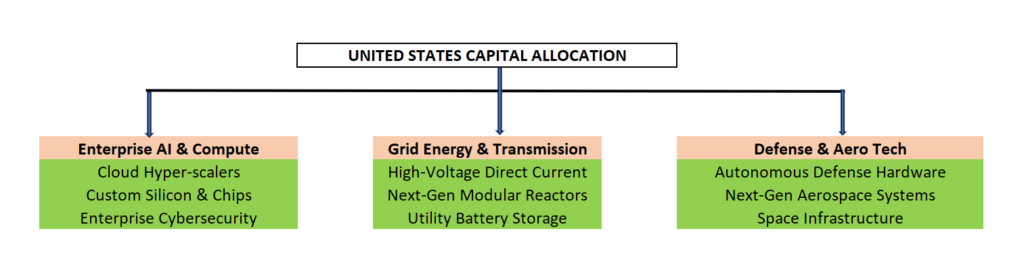
- Enterprise AI, Cloud Compute, & Cybersecurity: Companies building enterprise-grade software, AI agents, cloud architectures, and specialized hardware protection layers.
- Next-Generation Energy & Grid Modernization: Power generation utilities, high-voltage electrical equipment makers, small modular nuclear reactor (SMR) developers, and energy storage systems catering to exponential data center energy demands.
- Advanced Defense Technology & Aerospace: Autonomous systems, satellite networks, hypersonic defense, and advanced materials supplying both domestic security needs and global allied demand.
Strategic Summary for Global Investors & Executives
The United States through 2030 remains the ultimate high-volume, high-yield destination for institutional capital. While fiscal debt risks require long-term monitoring, the immediate 5-year outlook is defined by strong technology-driven productivity, resilient private consumption, and unmatched market liquidity. For global corporations and institutional allocators, exposure to the US economy remains an indispensable pillar of long-term growth strategy.
Top 65 Largest Economies in the World for 2027
Top 10 Largest Economies by 2030: IMF & World Bank GDP Projections for Global Powerhouses

U.S.- Canada Trade Talks Collapse; Carney Says Retaliatory Tariffs Begin September 8

Flock Cameras and the Future of Public Security

AI Infrastructure Boom Hits Physical Limits: Power, Financing, and Supply Chain Strain

Armanino adds Strategic Accounting Outsourced Solutions

New 2023 K-1 instructions stir the CAMT pot for partnerships and corporations

Tax Strategy: Employee Retention Credit update
-

 Stock News1 week ago
Nvidia Earnings Preview: What Wall Street Expects From the AI Bellwether’s Q2 Report
-

 Accounting1 week ago
SEC’s Semiannual Reporting Proposal Faces Investor Pushback: What CFOs Need to Know
-

 Stock News1 week ago
Nvidia Q2 FY2027 Earnings beats Wall Street Expectation with Record $96.2 Billion Revenue
-

 Finance1 week ago
Treasury Bond Volatility Forces Bessent to Double Debt Buyback Size as Yields Swing
-
 Technology5 days ago
AI Infrastructure Boom Hits Physical Limits: Power, Financing, and Supply Chain Strain
-
 Technology2 days ago
Flock Cameras and the Future of Public Security
-
 Economics2 days ago
U.S.- Canada Trade Talks Collapse; Carney Says Retaliatory Tariffs Begin September 8