Connect with us

Accounting

IRS noncommittal on future expansion of Direct File free tax prep system

Published

on

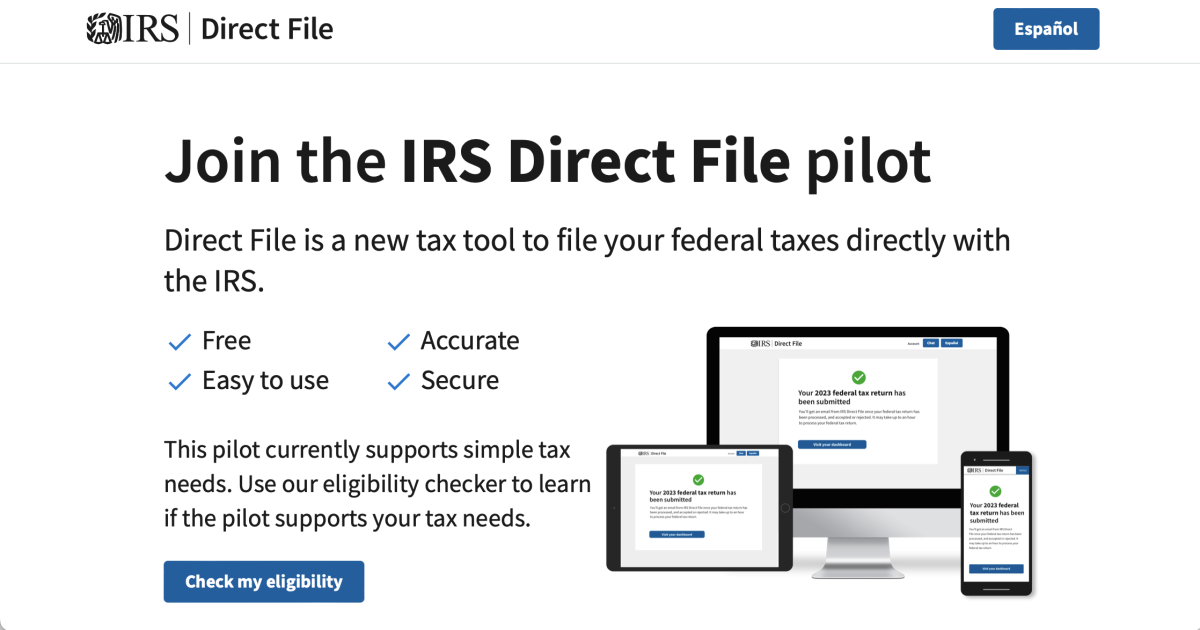
The Internal Revenue Service declined to commit to expanding its Direct File free tax preparation program nationwide in response to a report from the Government Accountability Office, as the program comes under threat from Republican lawmakers who want to shut it down.

The report, released Thursday by the GAO, found the IRS successfully pilot tested the Direct File program last tax season in a dozen states. The IRS said earlier this year that it would make Direct File a permanent option next tax season and double its reach from 12 to 24 states in 2025.

However, the program has attracted the opposition of Republican lawmakers and the commercial tax prep software industry. Last week, a group of 29 GOP members of Congress sent a letter to President-elect Donald Trump urging him to end the Direct File service. The IRS is already facing the likelihood of steep budget cuts next year. The continuing resolution that Congress will need to pass by this weekend to avoid a government shutdown includes a $20 billion cut in the IRS budget.

IRS commissioner Danny Werfel has been a major proponent of the Direct File effort, but Trump has already named a new IRS commissioner, Billy Long, three years before the end of Werfel’s term in November 2027. Werfel declined to comment on whether he plans to resign during a press conference last week. 

The GAO report found the IRS is already behind schedule with recruiting and training customer service agents to help taxpayers use it in the 24 states where Direct File is slated to be available next tax season, due in part to insufficient coordination among various IRS offices. 

The IRS limits participation in the Direct File program to taxpayers who live in certain states, facilitating coordination between federal and state tax filing. However, the GAO found the IRS could face challenges in reaching agreements with all 50 states, raising equity concerns for taxpayers who are unable to access Direct File due to where they live.

Last tax season, during pilot testing, the IRS accepted 140,803 Direct File returns in the 12 states where it was available, helping taxpayers with lower incomes fulfill their tax filing obligations. Taxpayers reported that Direct File was an easier tax preparation method than they had previously used, according to the report, and that factor contributed to the IRS’s decision to make Direct File a “permanent” option.

The IRS is planning to expand the scope of taxpayers who can use Direct File in 2025 by adding support for the premium tax credit for health insurance coverage under the Affordable Care Act, along with other tax provisions, and by allowing residents of the additional 12 states to use the federal Direct File system. 

The report also looked at the online tax filing systems used by some foreign tax authorities, including Australia, Belgium, Estonia, France, Ireland and New Zealand, as well as the U.S. territory of Puerto Rico, and found they prepopulate their taxpayers’ tax returns with information already on file, such as wages reported by employers. The IRS started offering limited prepopulation in April 2024 during the pilot phase of testing Direct File. IRS officials told the GAO they are considering additional prepopulation of taxpayer data but are still in the early stages of planning. Identifying additional data for prepopulation in Direct File and developing a plan for testing its accuracy could enable the IRS to reduce taxpayer burden, the GAO noted.

The GAO made four recommendations in the report to the IRS, including improving coordination among relevant offices to ensure the recruitment of customer support employees, opening Direct File to all eligible taxpayers in the future, and identifying additional data that could be prepopulated in Direct File and testing its accuracy. 

The IRS agreed with three of the GAO’s recommendations, but neither agreed nor disagreed with its recommendation to continue coordinating with state revenue agencies to expand access to Direct File and, as necessary, take steps to ensure the availability of the federal Direct File program to eligible taxpayers in all 50 states.

“We acknowledge GAO’s interest in seeing Direct File offered nationwide with expanded eligibility for taxpayers with more complex tax situations, and your recognition of the challenges we continue to explore in the expansion of Direct File,” wrote IRS deputy commissioner Douglas O’Donnell in response to the report. “The complex and nuanced nature of our nation’s tax laws require careful thought and consideration before support for any additional tax provisions can be added to Direct File to ensure nothing compromises its accuracy or usability for taxpayers.”


Continue Reading

Accounting

Mandatory ESG Reporting Standards Demand Standardized Non-Financial Audit Trails

Published

on

Mandatory ESG Reporting Standards Demand Standardized Non-Financial Audit Trails

Corporate accounting departments face an expanded regulatory mandate as mandatory sustainability and Environmental, Social, and Governance (ESG) reporting frameworks take full effect internationally. Governed by the European Union’s Corporate Sustainability Reporting Directive (CSRD) and the International Sustainability Standards Board (ISSB) IFRS S1 and S2 standards, enterprise financial controllers are now legally required to track, verify, and report non-financial data with the same internal controls and auditability as traditional financial statements.

The expansion shifts ESG compliance

This regulatory expansion shifts ESG compliance from marketing departments to corporate accounting offices. Financial managers are now responsible for gathering, consolidating, and verifying carbon emissions metrics, supply chain labor conditions, water usage, and climate risk exposures across multi-tiered corporate structures. These non-financial metrics must be integrated into standardized general ledgers to withstand rigorous third-party audit assurance processes.

To comply with these rigorous reporting mandates, accounting software providers have added dedicated ESG modules designed to aggregate data from IoT sensors, utility platforms, and vendor management systems. Controllers are implementing internal control frameworks—modeled after traditional COSO frameworks—to ensure the completeness, accuracy, and consistency of sustainability disclosures, protecting organizations against greenwashing penalties and litigation risks.

The transition requires significant cross-functional collaboration between accounting teams, legal counsel, and operational directors. Accounting professionals are expanding their technical expertise beyond financial ledgers to master carbon accounting methodologies, lifecycle assessment standards, and non-financial data governance protocols, fundamentally expanding the role of the modern corporate accountant.

Why This Information Matters
Mandatory ESG disclosures require companies to treat environmental and social metrics as audited financial records. Executives, accountants, and board members must institute formal tracking and assurance processes to satisfy legal mandates, maintain investor confidence, and mitigate regulatory non-compliance risks.

Continue Reading

Accounting

SEC’s Semiannual Reporting Proposal Faces Investor Pushback: What CFOs Need to Know

Published

on

U.S. Securities and Exchange Commission (SEC)

A proposal from the U.S. Securities and Exchange Commission to potentially shift some public companies away from quarterly financial reporting toward a semiannual model is drawing significant pushback from investors, even as it continues moving through the regulatory process. The debate has direct implications for corporate finance teams, auditors, and the broader transparency of U.S. capital markets.

What the SEC Proposed

According to a summary published by accounting advisory firm Cohen & Co., the SEC issued a proposed rule on May 19, 2026, aimed at simplifying financial reporting requirements for many U.S. public companies. The proposal would potentially reduce the frequency of certain mandatory disclosures from quarterly to semiannual, a structural change that has not been made to core U.S. reporting requirements in decades.

The proposal follows an extended debate within U.S. policy circles, with proponents arguing that reduced reporting frequency could lower compliance costs and free up management time for longer-term strategic planning rather than quarter-to-quarter results management.

Why Investors Are Pushing Back

Comment letters submitted in response to the proposal have been extensive, and according to Cohen & Co.’s review of the public record, investors “appear to be largely opposed” to the shift, viewing frequent interim reporting as a core benefit of U.S. capital markets relative to other jurisdictions.

Accounting and law firms have taken a more measured position, generally urging any changes to remain aligned with the Financial Accounting Standards Board (FASB), whose existing disclosure requirements and guidance are built around a quarterly reporting cadence. A shift to semiannual reporting without corresponding changes to FASB guidance could create friction between SEC filing requirements and GAAP-based disclosure expectations.

Lessons From the U.K. Experience

The debate is not without precedent. The United Kingdom moved away from mandatory quarterly reporting for listed companies in 2014, returning to a semiannual disclosure requirement. According to Cohen & Co.’s analysis, that experience offers a cautionary data point: there was no measurable increase in capital expenditure or R&D investment following the change, while analyst coverage of affected companies declined as reliable interim information became less available — a particular risk for smaller and newly public companies that rely on analyst coverage to maintain investor visibility.

Practical Implications for Finance Teams

Beyond the debate over disclosure philosophy, the proposal carries practical complications. Many companies have debt covenants and credit agreements structured around quarterly financial delivery; a shift to semiannual reporting could require renegotiating those terms. Reduced reporting frequency would also extend the “window of market silence” between disclosures, a factor that governance and investor-relations teams would need to manage carefully to avoid information asymmetry.

Separately, and unrelated to the reporting-frequency debate, the SEC and FASB have continued finalizing more routine updates this year. New Accounting Standards Updates are taking effect for December 31, 2026, fiscal year-ends covering income tax disclosures, credit loss measurement, induced debt conversions, and stock compensation, according to Eide Bailly’s review of 2026 ASU activity. Additional guidance on paid-in-kind dividends and environmental credits is also on the near-term horizon.

What to Watch Next

The semiannual reporting proposal remains in the comment and review phase, and no final rule has been adopted as of this writing. Finance leaders should monitor the SEC’s regulatory agenda for further movement, while treating the current quarterly reporting requirement as the operative standard until any final rule is issued and an effective date is set.

Given the extent of investor opposition documented in the comment file, a full shift to mandatory semiannual reporting appears more likely to result in either a scaled-back compromise or continued study rather than swift adoption — though the SEC’s ultimate direction remains uncertain.


Continue Reading

Accounting

AI-Driven Automation and Continuous Accounting Frameworks

Published

on

The accounting profession is undergoing a fundamental structural transition as enterprise finance departments shift from periodic month-end closes toward automated continuous accounting models. By integrating specialized machine learning algorithms directly into enterprise resource planning (ERP) platforms, chief accounting officers are transforming financial reporting from a retrospective exercise into a real-time operational asset.

The Shift from Periodic Close to Continuous Financial Reporting
Traditional accounting workflows heavily relied on manual data reconciliation, spreadsheet calculations, and multi-week closing cycles at the end of each fiscal period. In contrast, continuous accounting frameworks utilize automated software agents to process, validate, and post transactional data in real time as business activities occur.

Automated bank reconciliation tools cross-reference incoming bank feeds, invoice records, and purchase orders automatically. By resolving transactional variances instantly throughout the month, corporate accounting teams eliminate the traditional workload spikes associated with quarterly and annual closes.

Machine Learning in Audit Trails and Anomaly Detection
Advanced natural language processing (NLP) and machine learning tools are redefining internal audit and financial control environments. Automated systems analyze 100% of general ledger entries, identifying anomalous transactions, duplicate payments, and unauthorized journal entries in real time.

Rather than relying on random statistical sampling, corporate internal auditors can focus their attention on high-risk flags automatically surfaced by algorithmic monitoring platforms. This continuous risk assessment strengthens internal controls over financial reporting (ICFR) and significantly reduces fraud risk.

Evolving Roles for Accounting Professionals
As routine data entry and manual reconciliation tasks become fully automated, the skill set required for accounting professionals is shifting toward data analysis, system design, and strategic business advisory.
– Systems Governance: Accountants are increasingly responsible for monitoring algorithmic accuracy and managing data integration pipelines.
– Business Partnership: Finance professionals leverage real-time financial dashboards to advise operational leaders on margin management and working capital allocation.
– Regulatory Compliance Management: Accounting teams utilize automated platforms to ensure compliance with dynamic tax codes and international accounting standards.

Core Implementation Recommendations
1. Deploy Automated Reconciliation Tools: Integrate continuous transaction processing modules into existing enterprise ERP architectures.
2. Establish Algorithmic Governance Controls: Implement strict internal testing protocols to ensure automated accounting rules comply with GAAP/IFRS standards.
3. Reskill Accounting Teams: Invest in training finance staff on data analytics, workflow automation, and predictive financial modeling.

Continue Reading

Trending