
Accounting
Accounting in an era of disruption

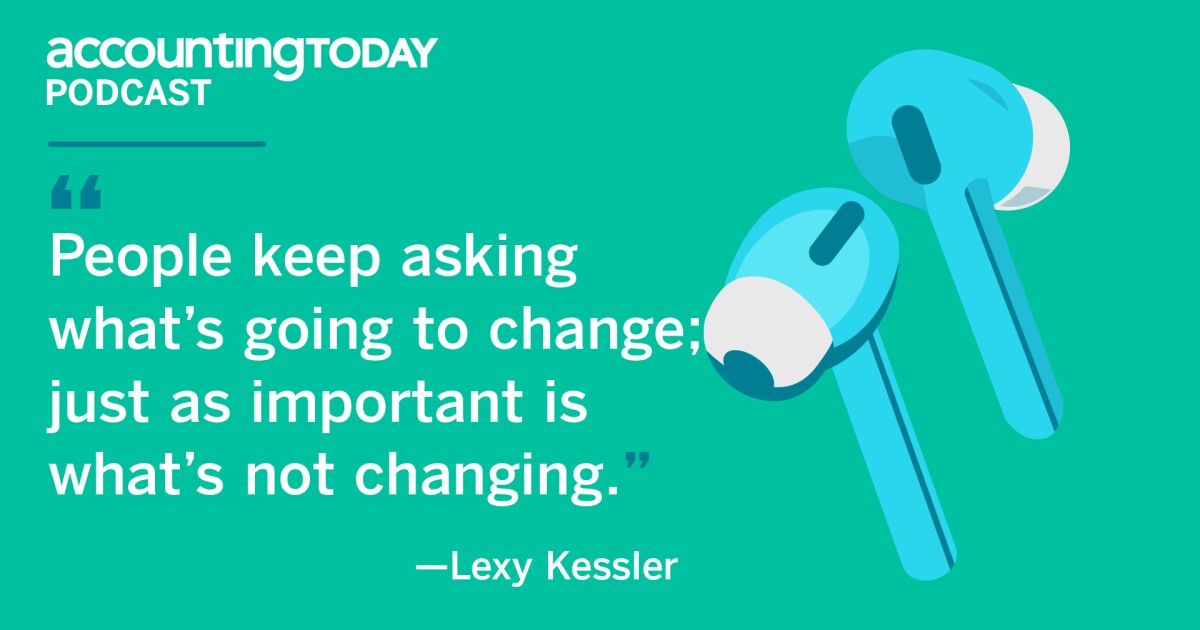

AICPA chair Lexy Kessler looks ahead at the challenges and opportunities —often one and the same — that are facing the profession, and what accountants need to do to be ready for them.
Transcription:
Transcripts are generated using a combination of speech recognition software and human transcribers, and may contain errors. Please check the corresponding audio for the authoritative record.
Dan Hood (00:03):
Welcome to On the Air with Accounting Today I’m editor-in-chief Dan Hood. With the accounting profession changing as rapidly as it does, it’s always good to have a chance to share the perspectives of those who are leading into the future and have a strong visibility into where it’s going here today to do exactly that as the new chair of the AICPA. Lexy Kessler, who’s also a partner at fast-growing Top 25 Firm Ario. Lexy, thanks for joining us.
Lexy Kessler (00:24):
Thanks for having me, Dan. It’s good to see you.
Dan Hood (00:26):
Yeah, it’s good to be talking to you. As I said, it’s always great to have this opportunity because I know from your position, both at Ayo but also at the AICPA, you have a lot of visibility to what’s going on, a lot of strong sense of where the profession is headed. So I want to start on an upbeat note. It’s always easy to say, well, what’s wrong? What’s the challenges? But I’m going to do a little differently for me. I’m going to start with the opportunities. What do you think are some of the biggest opportunities in accounting at the moment?
Lexy Kessler (00:51):
I think that there’s so many opportunities. Actually. I think that now keep in mind, I’m from the d and v, so I’ve got a little bit of slight of color towards it, just as far as disruption with change administration, which happens with any administration, but this one seems to be a little bit more so, and I think with disruption, I know it’s a cliche, it does come opportunity, and I think that this is just yet another example of how disruption is going to be a new way of life. I think the pandemic, I think really accelerated how often the disruptions are happening for us and when we see when periods of disruption happen, we see our clients and we see our businesses turn to us for guidance, for strategy, for thoughts, ideas, and most important, well actually there’s two points right now I think are most important really is that being able to put on the lens of stop listening to the noise that’s out there and filter through that noise to what is really the issue and what is it that we want to protect against?
(01:55):
Because right now, firms are struggling firms, businesses. You’re seeing in survey results that are being going on right now that the uncertainty is creating hesitation in the marketplace and rightly so. How do we help each other within the community help the business community, our ecosystem to get that noise out of our heads and to be able to focus? That’s number one. Number two is really change management. I think that I give this example when I started in public accounting and what I was doing as entry level staff person versus what people are doing today. Now, that’s obviously decades of difference, but that’s because there’s been change and that happened over time. It didn’t happen at the speed that it’s happening today. So I think that change management skill sets are a great opportunity for us, and I consider myself a change agent, by the way. I support it, I advocate for it, but it’s been really challenging for me. Also, I won’t lie, I think that those are two big just global umbrella areas of where I think that we can really within those fine opportunities to help the business community
Dan Hood (03:08):
As a change resistor, as an official opponent of change at all times and always at all kinds. Good to know who the enemy is, but what’s interesting about it is that when you talk about the opportunity and it is a tremendous opportunity, clarifying the landscape for your clients is enormous, but there’s also a degree, these are challenges that accounting firms face as well. Change management, the need to develop change management skills is huge for accounting firms. The need to see through just thinking about where we’re currently in the midst of trying to get a tax bill passed or watching a tax bill try to get passed and the uncertainty that comes along with that. What do you advise clients about? How do you prepare for next year? Are we going to have the extensions that we need, et cetera, et cetera, et cetera, and I’m always sort of fascinated by the way in which accountants in many cases seem to be like the teacher who’s one page ahead of the class in the book that they start to see what’s coming, not as well as they might want to, but better than their client does to be able to bring that back.
(04:05):
So it’s a fascinating opportunity, but also means they’ve got to be up to speed on
Lexy Kessler (04:10):
Agreed. And I think that because the nature of our profession is that we’re used to that we don’t realize that we really are a little bit further ahead and that we really can bring value to the table in the conversations and don’t take that for granted that they’ll just know that’s a very easy way to be like, oh, the clients, they know that, or our teams within our organization, they know that they don’t necessarily, or they may hear it from a different lens, from the lens that they’re looking at as a CEO or as a project manager, contracts person, whatever it may be. So it’s a different perspective to the issue.
Dan Hood (04:42):
Well, I think it’s fair to say that every accountant who might be listening to this, every accountant than the profession probably has an experience of a client who thinks they know what’s going on,
Lexy Kessler (04:54):
And then you just do the best you can with what’s there. Right? Exactly. That’s all you can do is give the guidance advice and it’s up to the person to take it or not.
Dan Hood (05:02):
Right. I think my next question is going to be about the big challenges the profession faces, and I think in some ways sort the flip side of the opportunities you’ve talked about may fit as potential challenges. The pace of change is enormous and some other things. When you look at challenges for the profession, what are you thinking firms should be paying attention to?
Lexy Kessler (05:22):
I think firms should be paying attention to what is ahead and to understand that and helping clients or the organizations with a strategy that you need to really build in a pivot. If it doesn’t have a pivot and it doesn’t have flexibility, it may not be viable. Then in addition to that, we have an obligation to be very current on what is happening out there, whether it be, now if you’re a small business, it’s a bit more difficult to do. You pick your lane where you’re good at and be up to date on it. We were listening during regional councils for an update on the tax law. You mentioned that earlier. The potential tax law changes, and I leaned over to a person next to me and I said, I can’t imagine trying to stay current on this if I wasn’t at meetings like this.
(06:04):
Being able to stay at the forefront and being educated about the changes because the more clients, the more that you can take something that you’re hearing in the news and relate it to their business, that really engages and brings value to a relationship and to an organization. So it’s taking what we know and pivoting to it. The other thing is that I would say is in thinking forward, people keep asking what’s going to change? What’s going to change? And I was at something recently where they played a clip from Jeff Bezos and Jeff said, people keep asking Jeff like I know him, Jeff, that they ask him What’s going to be changing? Is it the question that people aren’t asking me is what’s not going to be changing? It’s just as important. What’s not going to be changing? What’s the fundamental that’s out there or fundamentals that we can be pulling our organizations and clients to focus on to help weather some of this more disruptive territory? So I think that that’s another probably answering the two questions together a little bit that you’ve asked me overlapping there, but
Dan Hood (07:05):
Well, I mean this is one of those things where the challenges and the opportunities in accounting in a way that is different from a lot of other industries, they are very much different sides of the same coin. We talked about the need for clients to have help with change management. The flip side of that is the need for accountants to get help with change management. As we said, as long as they’re one step ahead
Lexy Kessler (07:25):
And if we don’t as a profession, individuals will get left behind and organizations will get left behind. If you’re not adapting technology at almost a disruptive pace in the right way, which is the other thing with the guardrails that need to be in place to use it correctly and have the quality standards around it, then you will get left behind. There are just too many, I mean the news now granted there’s very few other than the big four that have the resources that they do, that they’re investing in completely changing their methodologies and their audit methodologies and putting a billion each of them into revamping those technologies and ways to do it, which in theory we have that pipeline challenge, then that should help to free up people to be able to do the services that our clients really want to be paying for and the organizations want from their accounting and finance teams.
Dan Hood (08:18):
I want to dive here. You mentioned the pipeline. This is obviously one of the biggest issues going on in the profession. I want to dive into that because you played a major role in the National Pipeline Advisory Group and its report and the advice that put out for the profession. But before we do that, I want to talk a little bit brief. I love the, I’ve heard that quote, I didn’t realize it was Jeff Bezos talking about the question is what’s not changing? One of the things that Barry Milot used to always talk about was the trust position of the accounting profession and the need for trust. And you’ve alluded to right, with the need for certainty for understanding of what’s coming ahead, and that accountants, even though they sometimes don’t realize it can provide that in a way that fills a huge need and that demand will, I think is only going to grow the demand for that certainty. I mean, most accountants say, well, we’re not promising certainty, but you’ve got a lot more certainty than everybody else who’s out there and offer a lot more security and trust and assurance, and it seems like even though the need is the same, there may be a lot more of it. Is that a safe assumption?
Lexy Kessler (09:24):
Absolutely. I think that when you look back on history, there are cycles of disruption and we just have been fortunate for several decades to have relatively smooth sailing, so to speak. People there was certainty. Organizations could do their strategic plans, they could execute on them, but when you look back on in history, you have things like, we had two world wars, we had a depression, we had industrial revolution in some say, we’re going through another revolution, which I would tend to agree with when you’re in right now, we know we’re going through a period of change. We’re just not sure what it means yet, but there’s no question we are going through change right now, significant change, and we’ll look back in history and say, yes, I was there. But we’ve just been fortunate I think for the past few decades that we haven’t had to address that. So I do think there’s a little bit of a new norm that’s happening here because it seems like every time we turn around there is something new that is disrupting and that takes a toll too. So we kind of have to take care of ourselves in this process as well.
Dan Hood (10:24):
Yep. We all have sort lulled into a sense of security by the nineties who were relatively mild period of time. We were
Lexy Kessler (10:33):
Concerned about, remember Y 2K and then all of a sudden at midnight, oh, lights are still on. Everything’s okay.
Dan Hood (10:39):
I guess we
Lexy Kessler (10:40):
Were people off here old enough to remember that. But
Dan Hood (10:42):
Yeah, trust us. It seemed like a big, big idea at the time. A big problem at the time. That is interesting. It does seem like there’s a lot going on and the problem is no one’s given it a name or description that we’ll have in 20 years going to make it seem like a normal thing when really it’s just one pain after the other it seems. I’m sorry, we could dive into that. I think you’ve identified something there with that notion of errors of disruption and that we were coming out of a period, well, we’re well into a period of new disruption, but coming out of a period of unusually undisruptive tugs, that’s a terrible way to put it, and it’s getting used to that is going to take a while. One of the things that’s particularly related to the accounting profession where we’re seeing, I call disruption maybe not the right word, but troubling times right, is in the shortage of staff and future CPAs and future accountants coming in, and I said a great deal about that. You were on the NPAG, which worked on it for I’m you, the team there was working on it for at least a year, was it,
Lexy Kessler (11:47):
Did work on it for a year. Yes. Our first meeting to when we actually issued the final report, it was a
Dan Hood (11:53):
Year, and that report was comprehensive. I mean insanely covered the waterfront and took a lot of, really looked broadly at the problem and the issues behind it and the possible solutions and was held nothing back, I think is a good way to put it, and I think gave a lot of great advice for the profession to move forward. We have seen some inklings of things. There’s some reports about signups for accounting programs and accounting master’s programs and stuff, but there’s only a few, and I’m curious, sorry, I’m not saying what they are. The reports are saying that the signups are up, registrations in those programs are up, which is a positive sign, but it’s still pretty early days. It’s only been a couple of quarters. What’s your prognosis? I mean, are we beginning to grapple with the problem and what we need to do to solve it?
Lexy Kessler (12:50):
I think that the prognosis is going in the right direction. It’s hard to tell if this is a cycle or if this is in effect change. I think it’s too soon for me to get a feel for that, but I’m very excited. But there’s been three semesters in a row of double digit increases in accounting. Recent data has shown that really with some of the, that now I think there’s a combination of things, irons in the fire that have led to this. Okay. So what I’m saying is one of many, but I do think that the economic conditions have turned people to understand that accounting has job security, accounting can be very lucrative and starting salaries are starting to go up, which is a good thing in business and industry as well as in public accounting. And I think that with the impacts we report and the conversations really focusing on this, people are beginning to listen and understanding we need to do something different.
(13:55):
So I think there’s a whole ecosystem that is starting to respond to this, whether it’s academia and changing the introduction to accounting classes to make them more simulated case studies and more engaging to students and intermediate accounting, pulling them through, not weeding them out, which was a mindset from 40 years ago and then some to changing the conversation, how we talk about what we do and celebrating it, getting out into classrooms and talking to students about the profession. I think all of these things are beginning to put steps there and I know I’ve heard from a demographic perspective that there is a cliff that is coming. So I think that we’re going in this direction there will help us to mitigate that cliff at least some, but what I don’t know is what impact will back clip help combined with technology and the investments in ai.
(14:52):
But the reality is is that’s entry level. We really need it at that middle level though. We need the analytical skills, we need the ability to think analytically. And CGMA has just recently updated their curriculum that’s identifying three different sets of skill sets of thinking like critical strategic and the third one’s escaping me. But that type of curriculum built in to the education to get that certification is something that I know that Sue Coffey and her team are beginning to look at for how can we re-skill and change what the need is for individuals at entry level and then certainly once that three year, and I’m speaking management, I’m public accounting for the moment, how do we get them to where we need them to be, which is that critical thinking piece and being able to do that through schools or in some type of training immediately after that
Dan Hood (15:48):
For a long time. How they got that critical thinking, those skills are developed the more was by doing 10,000 tax returns and keeping their head down for 80 hours a week for five years and over the course of the time they were trained in it and sort of seated in. But as you say, with technology coming in and hopefully getting rid of a lot of that entry level grunt work, like you said somewhere, you’ve got to find a way to teach it to them at some point in the process. Otherwise they won’t be much use to you when they get to three to five years.
Lexy Kessler (16:17):
And I use an example that, I mean it’s not like this is something that hasn’t happened before, but I vividly remember not to date myself, but I’m going to, when our family household got our first handheld calculator, that was a big deal, but it was able to help you to do math well, you still need to understand that one plus one should be two or round two, not eight. There’s some core, and this is a very simple example, but you have to know if the output makes sense, which is why I really believe that we still need CPAs. It’s not like this is going away because of technology. I mean, what we do has evolved so much. I’ve seen the transformation in my career and it’s just going to continue to transform because what we bring to the table is so unique and we are the most trusted profession and people continue to turn to us in times of disruption.
Dan Hood (17:07):
Yeah, we’ve had tax prep software for 30 years and they’re still well north of a million tax repairers out there more than there’ve ever been in the past. So it’s not going to get rid of the profession. It may change it significantly, but
Lexy Kessler (17:19):
I agree that completely changed. You’re absolutely right. Absolutely right.
Dan Hood (17:23):
I am now having a flashback to the first calculator in my house because my mom was a tag prepare and we went to, she was very angry. We would go through reams and reams of those tiny little rolls of thermal paper. It was one of the first thermal printers for calculators. And me and my brothers and sisters just wasted that with reckless a abandon. I don’t know how we managed to afford to go to college given my mother spent most of her money on replacing those rolls of paper. But it was exciting stuff and now we know how old we are. I did want to just briefly touch on this. You mentioned some of the ways in which individuals can help bring more people into account, and that was one of my sort of favorite parts about the impact report was that it’s very easy to say, oh, the profession needs to do this and the profession needs to do that and firms need to do this and academia needs to do this, but there’s a role for the individual accountant, the individual CPA, to go out and bring to help get more people under profession.
(18:22):
If we just talk for a minute or two about that, I thought that was a really excellent part of the report that just pointed out the responsibility everybody has.
Lexy Kessler (18:31):
Thank you for that. And I want to give a shout out to Michelle Randall who was on impact. She’s an educator from, I believe it’s Michigan, and she, during the times when we’re going through this, there was certainly some moments that were more challenging than others where we were in the thick of it and trying to figure out, because of real understanding, learning the complexity and what are we going to do with this beast. And she said that she went back and she said that there was moments where she was starting to become overwhelmed that this thing is so big, what do we do? And she says, then I took a step back and I said, you know what? I’m going to do what I can in my piece of the world, in my role as an educator, and she is doing outstanding things where she teaches.
(19:21):
And I think that’s a great example of don’t become overwhelmed with the big picture. If we all do something, if we get just 10% of our members to do something that’s 60,000 people doing something and it’d be great to be more because that means we’re united more in what we’re doing. It’s not just somebody else’s problem and it’s not. And when I speak to a different state societies, different events, I really challenge people like, you need to own this. This isn’t something that anybody can just fix. It’s got to be how we behave. That needs to change. And I do think that’s starting to happen. You can get that sense of it when you talk to people. Now there is a sense of there’s an acknowledgement, first of all, acknowledging we have the problem with step one. Step two was trying to figure out, I think that we’ve gotten, we’re in process as far as the licensure issues. That’s kind of taken a path now and it’s building the conversation is happening now, which is what is needed for us to move forward. And I think that we’re seeing the results of all of that, but it is people owning what their real piece of the world. That’s all we’re asking people to do your piece of the world.
Dan Hood (20:40):
And it can be as simple, I always like to throw this out. It can be as simple as not telling horror stories about tax season. Stop telling people how you worked.
Lexy Kessler (20:48):
What are the great things that you’ve done? And if anybody has little children, there used to be, and I think there still is this cartoon on PBS called Arthur, and my children were very excited when I came home one day jumping up and down saying, mommy, mommy, Arthur’s, mommy has tax season two. And I became really cool. So there are some good things out there that all of a sudden it was Mommy’s like her.
Dan Hood (21:12):
That’s awesome. I didn’t realize that. That is spectacular. Obviously Arthur was sponsored by the big four, but that’s fantastic. Well, this is because we’re constantly looking for examples of accounts
(21:25):
In the real world who aren’t portrayed as never seeing their families for three months, a year, stuff like that. But very cool. Excellent. Alright, well we’re going to take a quick break, but we’ll be back in just a second. Alright. And we’re back with Lexy Kessler of the chair of the AICPA, talking about all things where the profession is, where it’s headed, what’s exciting, what’s less exciting, and most of it’s exciting. There’s a lot of exciting stuff, there’s a lot of challenges that go along with that excitement, but still a lot of positives out there. I want to talk because with the institute from the AICPA very recently managed an extraordinarily smooth transition from Barry Melanson who was CEO for 30, just around 30 years to a new president, mark pos. And it went as near as we can tell, extremely well. There were no cos, no fires, nothing exploded.
(22:24):
Everyone was sorry to see Barry go, but delighted to see Mark come in. That transition I understand went very well. We know a lot of firms are struggling with succession plans in many cases because they don’t have one at all, but in other cases just because a difficult thing to get. And I was wondering if, as someone who was on the ground for a lot of this stuff and around, do you have any lessons you think there are any lessons in how the A ICP handled its succession? Any advice or any advice you’d just give them from your own experiences?
Lexy Kessler (22:53):
Yeah, I think that first of all, I have to give credit to Carla McCall and Simon Biddlestones. They chair really the search committee piece of this end of it. I wasn’t on that committee, but I can share my thoughts and observations through that process though, is that I think that organizations need to look outside their organization as far as potential skill sets that may be needed. I think we’re very fortunate enough fact that Mark did have a history with A-I-C-P-A, many went to millennial and got that global experience, so made him really the natural fit. He knew the organization, he had a relationship with Barry already. Now firms that are struggling from a transition is that, honestly, I saw it myself that there just is no accountability to create a successor. Now, in fairness, nobody’s coaching the senior person on how to do that succession either.
(23:46):
So somebody’s never done something. It’s really hard sometimes to be able to figure out what’s the right way to do it and to take the time to figure it out, especially in today’s world. So I think it’s important that you use resources that are available to help guide. I think there’s organization, other support, CPA firms and succession planning do that because also, honestly, you just never know what life will throw at you. And it could be a life event that all of a sudden you have a hole in the organization for a period of time that maybe an illness or something that somebody is going through and they’ll be back. But what do you do in the meantime? And if you don’t have succession in there, it’s difficult. And I realize that’s a challenge if you’re sole proprietor. So I need to carve that out a little bit. But within firms that are a little bit bigger, or at least they have double digits of people, there is a process that it’s paying attention to it like anything else, if you just wait it out and wait it out and then you’re bringing on somebody just because you need to as opposed to they’re not the right person, it’s not the right skillset. You’re not setting yourself up for success with that. Right,
Dan Hood (24:59):
Right. Yeah, no, that’s the thing is simply we mentioned the big problem with succession planning that no one has succession plans or a lot of firms, and you’re certainly, I mean, it makes sense to carve out sole proprieties a different thing, but there are things they could do to prepare for a life event or something that may happen or absolutely.
Lexy Kessler (25:17):
Partnerships that people have with other organizations. Right.
Dan Hood (25:21):
See, we’re hearing of
Lexy Kessler (25:22):
That are out there. There’s a lot of relationships that can be made to help with things like that,
Dan Hood (25:27):
Right? Yeah. Every small sole provider knows another accountant in town who at least you can say, listen, if I get hit by a bus, my client, I’m telling all my clients to talk to you, talk to. But just to be thinking about it in some way, to be preparing for all the different things that might happen. Make perfect sense. Yeah. Excellent. This is a huge issue that I’m going to talk about next that we can talk about for days and days and days and days, which is why I’m saving it for the very last minutes of the podcast. But happy recently took on some outside investment. A lot of other firms are doing that private equity, but also other players are coming in and finding the accounting professions very attractive and firms who are finding that access to capital, that access to resources and advice, many of them are finding that very attractive. And I wanted to just see how you see the current wave of private equity firms and other people coming into the profession. How do you think it’s going to impact the profession?
Lexy Kessler (26:26):
So long-term? Hard to say how it’s going to impact certainly. I mean, there’s certainly the potential, but some things could go sideways. I don’t think the entire profession will. I really honestly don’t believe that there’s just too many guardrails in place and there’s too many different types of investors as well. You really to make sure you’re bringing on the right partner and the reasons why. Speaking from a R’S perspective, I can say the reason that we chose Charles bank was because they want us to keep doing what we’re doing. And they may have certain things that they just want to understand. They kind of want us to keep doing what we’re doing. That’s why they invested in us. I personally, and I know there’s different schools of thought, so I’m going to talk about my school of thought here for the moment. The reason I supported it and was actually an advocate for it was because I felt that our business model needed to change.
(27:13):
And I view it really as a recapitalization. We needed to get to where we could incentivize the younger partners, but it couldn’t be at the expense of the senior partners. They weren’t going to let that happen. So you had this rock in a hard place that you had to work through. I also think that from a firm business model perspective, if you’ve got 200 partners that all think that they have an opinion and deserve a seat at the table for that opinion, you can’t run a business. Not that they don’t have good opinions, but it’s really difficult to run a business like that. So your governance model needs to change and there needs to be accountability. So those were the three main factors for me. Why I really felt it was a change in business model, and I view it as a recapitalization, the organization now, the younger partners have financial incentive that they don’t have to wait 40 years to get. And honestly, that’s what our clients do. That’s what my clients do. Why should we be any different now? It’s going to be interesting to see. I think that, I was just reading something recently where it seems like what’s going to happen in this next phase, and some of these investments are very large. So I’m going to use a recent one, and I don’t know the numbers off the top of my head, but like a Baker Tilly, MOS Adams now, right?
(28:34):
EisnerAmper getting large grant forton that just did it. What’s that next step? Is it going to be conglomerate of investors together? Is it going to be going public? Otherwise? I’ve done that in the past. I’m not sure where direction it’s going to go in. So it’ll be very interesting to see the next few years, probably five years, seven years, what direction it goes in. And then there’s firms that are like, we can manage it, or they’re earlier in their life cycle where they can head off some of those things and maybe they don’t need to do that route, but they’re going to be very able and they’re going to be able to have the funds to invest in technology. So that’s another big one is investment in technology because that’s a key piece for you to be able to do what you do. So I’m curious to see how it plays out just like everybody else, but just to share my thoughts behind why I thought it was good for our organization and supported it. But it will be interesting if it’s an investor that is looking for a revenue stream as opposed to a flip, that type of investor would come in and that would work well.
Dan Hood (29:42):
And it’s interesting when you talk about younger firms are firms that are earlier in their life cycle. That’s a really fascinating point to think about. I don’t want to present to the reasons current firms were taking on PS because they had problems, but they had challenges they needed to meet. Younger firms may be able to set themselves up, as you say, in a way that allows them to solve those challenges in other ways. We talked about need to create a different corporate structure that doesn’t have 200 partners saying no, and no one can say yes.
Lexy Kessler (30:13):
Yeah. Or it’s where an organization that’s able to adapt that has been around for a long time. That’s not an easy thing to do. And I know for example, Carla, her firm has been able to do that and she do it pretty successfully. So the beautiful thing is this, we can make choices and we can all move forward
Dan Hood (30:32):
And one of the nice things, but the clear things you talked about because a little bit is that in part because PE has come in, all kinds of other people are going to start coming in. So there will be other options for finding ways to invest in technology. There’ll be ways to get capital from other sources from a retirement fund that is looking really more for a steady income stream as opposed to a big jump in five years, that kind of
Lexy Kessler (30:54):
Thing. I think that some of that was, I think investors are going to want stability as well. The uncertainty and A SCP as well has draft language out for modifying some of the independent standards relative to these alternative firm structures. So we’re on it and staying out of it and ensuring that the public trust remains where it needs to be.
Dan Hood (31:16):
Excellent. Very cool. We could talk on all these subjects. We could talk a lot more, but we’re probably going to have to stop shortly. But before we do, I want to just sort of get, this is a last question. I think you’re in a good position to give some solid advice to people who are looking to make a career in accounting. What advice would you give someone who’s assuming you’re going to say, yes, you should become an accountant. What advice would you give ’em about building a career here?
Lexy Kessler (31:43):
The advice that I wish I had done that I didn’t do was I did not get outside of the walls of my firm earlier on. It took me a long time and I say about getting outside the walls or virtual walls, whatever you want to call it, get out and volunteer for something. Now, it can be a charitable thing, but what I’m talking about really is like an industry trade association where you’re getting around other business leaders or the profession, state society, CPAs, AICPA, to be around other like-minded, I should say, should like-minded, to be around other people that are in the same segment or industry as you. We are one of the most, it blows me away how giving and sharing our profession is with each other. It’s quite humbling, and I give that trait. So much credit gotten me to where I am today, so I really wish I had done that sooner.
(32:43):
And for students in college say, look to the kid next to you. Sorry. Look to the person to your left. Look to the person, to your right. They’re going to be the business leaders across the conference table with you one day. So make a relationship with them. I think that that’s lost opportunity. That in hindsight, I wish I had done those things, but other than that, it’s the best profession in the world. It’s so diverse. You get to do so many different things, and it’s lucrative, it’s dynamic. You make a difference. Make a difference in the organizations you work for. You make a difference in the business community. Make a difference with the clients that you work with as well.
Dan Hood (33:25):
I feel like we should end with a URL. They can all go and sign up at
Lexy Kessler (33:28):
We are unstoppable. That’s what we are as a profession. We are unstoppable.
Dan Hood (33:34):
Now you make an excellent and excellent case, and I think you’re a hundred percent right on the givingness of the profession, the willingness of accountants to share ideas and strategies and tactics and templates and stuff that in any other profession would be considered highly guarded intellectual property. And they just hand it out, conferences, events, or when you call up. So it’s fantastic. Excellent. Well, Lexie Kessler of the A-I-C-P-A, thank you so much for joining us.
Lexy Kessler (33:59):
Thank you, Dan. It’s great to see you again.
Dan Hood (34:01):
Thank you all for listening. This podcast was produced by Accounting Today with audio production by Adnan k. Ready to review us on your favorite podcast platform and see the rest of our content on accounting today.com. Thanks again to our guest, and thank you for listening list.





Nvidia Q2 FY2027 Earnings beats Wall Street Expectation with Record $96.2 Billion Revenue

Treasury Bond Volatility Forces Bessent to Double Debt Buyback Size as Yields Swing

Nvidia Earnings Preview: What Wall Street Expects From the AI Bellwether’s Q2 Report

Armanino adds Strategic Accounting Outsourced Solutions

New 2023 K-1 instructions stir the CAMT pot for partnerships and corporations

Tax Strategy: Employee Retention Credit update
-

 Economics1 week ago
Nvidia’s Potential $3 Billion SB Energy Investment Could Reshape AI Infrastructure
-

 Economics4 days ago
Top 10 Largest Economies by 2030: IMF & World Bank GDP Projections for Global Powerhouses
-

 Stock News4 days ago
How to understand Intel $15B Stock Offering
-
 Technology1 week ago
U.S.-China AI Competition Intensifies as Washington Pushes Allies to Choose Sides
-
 Stock News1 day ago
Nvidia Earnings Preview: What Wall Street Expects From the AI Bellwether’s Q2 Report
-

 Economics4 days ago
Economic Profile of the United States of America (2026–2030 Horizon)
-
 Leaders3 days ago
Jackson Hole 2026: What the First Symposium Under Fed Chair Kevin Warsh Means for Markets
-

 Economics3 days ago
U.S. National Debt Surpasses $40 Trillion for the First Time: What It Means for the Economy