Andrea Stitt and her son Dante Reynolds fill up their camper with water at the Southern Oregon RV Park in Central Point, Ore. They moved into an RV after being evicted from their home at the end of May.
Minh Connors for NBC News
MEDFORD, Ore. — Days before his 12th birthday, Dante Reynolds zipped past rows of tightly packed RVs on his kick scooter until he arrived at the 22-foot travel trailer his family calls home. It was parked that week in a southern Oregon campground off a highway.
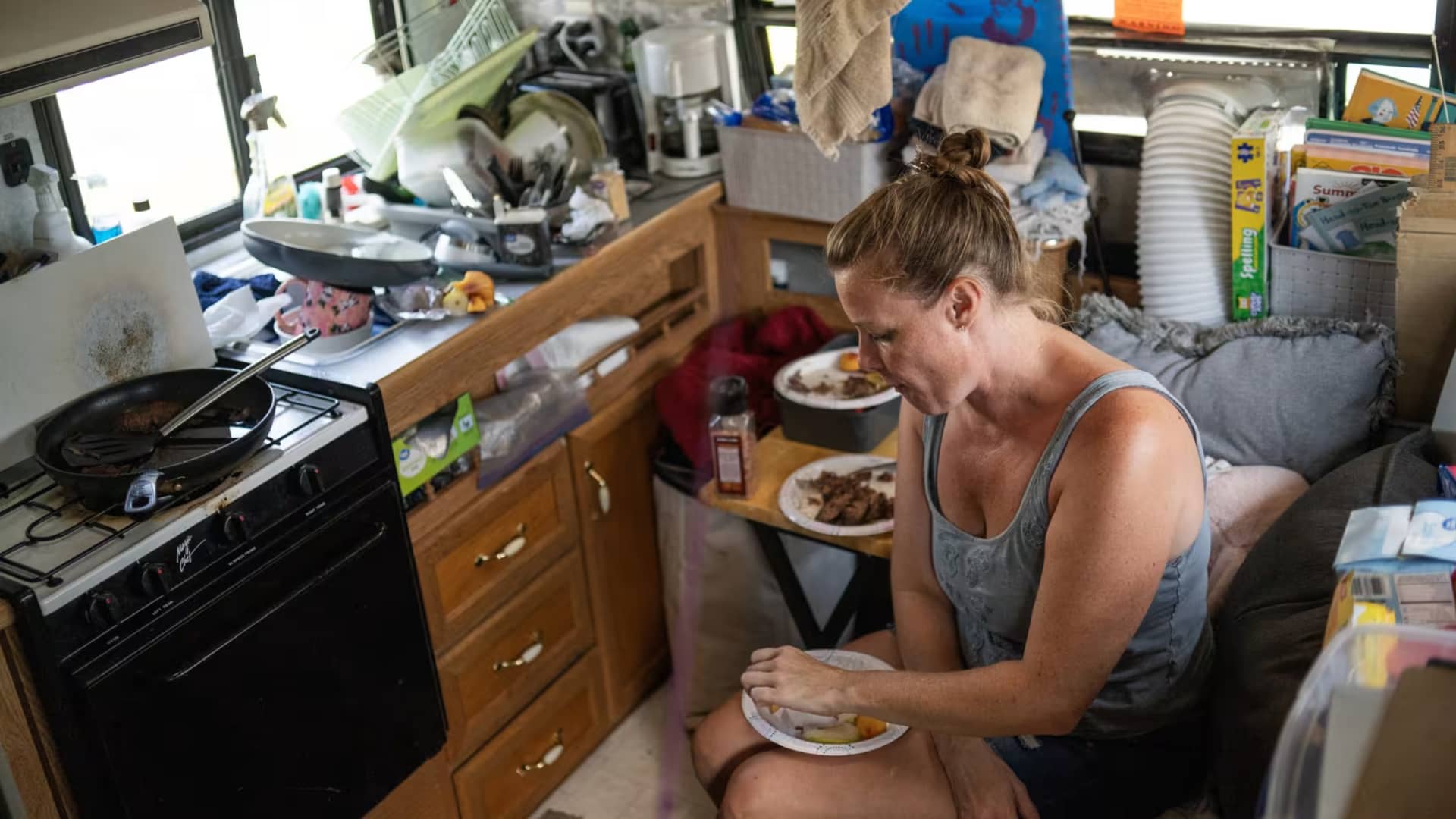
Inside, his mom was quickly washing a pile of dishes before the water in their RV’s tank ran out. He leaned his scooter next to his sister’s “Frozen”-themed tricycle and came inside to help make lunch. The RV doesn’t have any tables or chairs, so he sat on a makeshift bed covered by a SpongeBob blanket with a cutting board on his lap, chopping peaches, apples and kiwis while his mom cooked hamburger patties on the RV’s small gas range.
“This lifestyle doesn’t accommodate things like sitting at a table,” said his mom, Andrea Stitt.
Childhood looks a lot different for Dante than it did four months ago, before his mom lost the day care business she was running and the family was evicted from their four-bedroom home about three hours away. Now, living out of a roughly 175-square-foot RV with his mom and 6-year-old sister, Dante’s space is limited to a twin bed wedged under a loft, cordoned off with privacy curtains. Without regular Wi-Fi, he rarely plays video games anymore. Most of his belongings are confined to a couple of small bins, and his friends are hours away.
When the family is unable to afford a spot at a campground, which can cost $25 to $45 a night, they park on remote federal lands, which are free for two weeks. But those sites don’t come with water or electricity and have spotty cell service. At times, the family has bathed and washed their clothes in a river and gone to the bathroom in the woods to conserve the water in their RV’s tank.
“I’ve adapted to this lifestyle because we have to adapt,” said Dante, who now spends most of his free time outdoors exploring and started an online school program this fall. “If we don’t adapt, we won’t change, and if we don’t change, we’ll be mad, and if we’re mad, that just sucks. You don’t want to be mad.”
It’s a lifestyle adjustment that data indicates a growing number of Americans are making. As housing costs rise beyond what many families can afford, more people are looking for shelter outside the traditional housing market. About 486,000 people live full-time in an RV, which appears to be more than twice as many as in 2021, according to survey data from the RV Industry Association. About a third have children, and a vast majority earn less than $75,0000 a year. A separate survey by the Census Bureau found a similar trend: In 2023, the most recent data available, it estimated 342,000 people were living in an RV, boat or van, an increase of 41% from 2019.
Stitt tries to make the most of the space outside her RV, setting up a pen for her dog along with extra storage and seating.
Minh Connors for NBC News
For many, this is not the lifestyle of nomadic young professionals working remotely as they travel the country, chronicling their van life on social media. Nor is it the more traditional image of the retiree crossing national parks off their bucket list in a $100,000 motorcoach with the freedom of healthy retirement savings.
Rather, it’s the experience of lower-income Americans, making hourly wages as child care workers or home health aides or living off Social Security checks, with no place else to go in a housing market increasingly catering to the wealthiest slices of society.
Housing costs that soared during the pandemic have shown little sign of coming down, with the gap between the median household income and how much income is necessary to afford payments on a median-priced home reaching a near 10-year high last year, according to an NBC News analysis of housing data.
“There’s just a huge housing affordability challenge in this country, and that’s part of a larger cost-of-living challenge I think we’re generally having,” said Dan Emmanuel, director of federal research for the nonprofit National Low Income Housing Coalition. “It’s structural, particularly for the lowest income group. In virtually every housing market, it’s there.”
Stitt finishes her lunch inside her camper.
Minh Connors for NBC News
A slowdown in the labor market has made it increasingly difficult for many families to make ends meet. Applications for unemployment benefits jumped this month to the highest level in almost four years. At the same time, prices continue to tick up, driven by increases in household expenses such as groceries, gasoline and electricity.
Some say living full time out of an RV has freed them up financially to build their savings or pay down debt. Others say it has come with unanticipated benefits, like a sense of community among fellow RVers and the ability to spend more time with their children, with everyone living in a smaller shared space.
But while an RV might seem like an economical choice, it can come with unexpected costs and challenges. RVs aren’t built for full-time living, so the added wear and tear can lead to costly repairs, like broken air conditioning in the middle of summer or leaking pipes that leave owners taking a shower out of a bucket. The perpetual moving among campsites can make it hard to hold a job or find reliable child care. RVs also don’t compare to a traditional home when it comes to withstanding extreme weather. Flash flooding in Kerrville, Texas, earlier this year washed away an entire RV park of 28 trailers.
“RVs are recreational vehicles; they are a vehicle, they are built for temporary recreational use. That is how they are built and intended to be used,” said Monika Geraci, a spokesperson for the RV Industry Association.
“I’ve adapted to this lifestyle because we have to adapt,” Dante said.
Minh Connors for NBC News
They also come with different financial challenges: Unlike a traditional home, RVs often depreciate quickly. Loan terms can be spread out over long periods to lower monthly payments, but that can quickly leave borrowers underwater — owing more on their loan than their RV is worth.
Kat Tucker found that out firsthand. As a disabled veteran unable to work full-time, she moved into an RV in 2017 as a way to cut down on her housing costs. But after two years, she’d had to replace six tires, the refrigerator and toilet had broken, and the generator stopped working. Then the engine started acting up, which would have cost up to $10,000 to fix. Without money for the repair, she had to move out of the RV even as she continued paying the $500-a-month loan for several more years.
“It can be a great lifestyle, but it can also be yet another trap for poor people who just keep getting poorer,” Tucker, 64, said.
She house sat for a family member to get her finances back in order, but she found it difficult to afford a rental apartment on the $58,000 a year she gets in disability and Social Security payments. So last year she took out another loan on a used RV. The $22,500 loan is spread out over seven years to bring her monthly payments down to about $350, but she worries the camper will only last for five years, given its age.
She’s been living at a campground in Georgia, where she stays for free because she does volunteer work, cleaning up damage from Hurricane Helene last year.
“I’m never going to be able to afford decent housing even though I have a steady income,” Tucker said. “That’s what’s really frustrating.”
The journey to an RV
For Stitt’s family, a medical emergency set off the rapid financial spiral that led them to an RV. At the start of the year, Stitt was renting an 1,800-square-foot home about a half hour from Salem, Oregon, with horses in the backyard.
Debbie Williams moved to Shadowlands RV Park after struggling to find an affordable place to rent.
Stacy Kranitz for NBC News
After years of struggling financially and overcoming the odds of being a teen mom, with three kids by her early 20s, Stitt said she felt that she’d finally made her way into the middle class by her late 30s and could provide a better life for Dante and his sister. The mother of five opened her own day care a few years ago and was on track to make $100,000 this year, with plans to open a second location.
But in February, Stitt had to temporarily shut down her day care when one of her older children was hospitalized and needed around-the-clock care. Much of her savings went to pay the salaries of her child care workers, leaving her with little cushion for rent.
She tried finding side jobs, considered taking in roommates, even started a GoFundMe page, but none of it was enough to catch up. She applied for rental assistance from the state, but wasn’t approved in time. After three months of missing her $2,000 rent payment, she was evicted at the end of May. She used her last $3,000 to purchase a 28-year-old RV that an elderly woman had been living in.
The family consolidated years of keepsakes, toys and household essentials, selling most of their belongings at a yard sale and giving others away. She gave her 6-year-old daughter seven small plastic bins to pack up a bedroom layered with toys and stuffed animals.
“We all went into her room a couple different times over that week and had conversations with her about what’s important to you, like, ‘I know you really want to keep all your baby dolls, but you have 10, and we can only have two, and which two are your favorite, and which ones are we going to give to another child to enjoy?'” Stitt recalled.
Tom Seest and his son Charlie, with one of the dozens of stray cats that live on the Shadowlands RV Park property.
Stacy Kranitz for NBC News
Despite the downsizing, the family’s RV is a Tetris puzzle of bins and sleeping areas. The walls are lined with storage units, and nearly every flat surface is stacked with belongings. Stitt has been debating whether to get rid of a single bin of holiday decorations.
Finding a place to park the RV has been a perpetual challenge. Public campgrounds limit stays to 14 days. Longer-term RV parks can cost as much as $800 a month. The family has often lived off the grid, parked on remote federal land.
‘I make it work’
Debbie Williams, 66, doesn’t imagine she will ever live in traditional housing again. At the start of 2022, she owned a five-bedroom, three-bathroom home in a small Kentucky town, but decided to sell it to be closer to her children and grandchildren near Chattanooga, Tennessee.
Initially, Williams planned to use $100,000 from the sale of her house to buy another home. But as she looked, prices began to soar. Since July 2020, home prices in the Chattanooga metro area have increased by nearly 50%, to an average of $325,000, while rents are up 40%, to an average of $1,534, according to Zillow.
Williams worried those prices would be too much of a strain. Her current job, working overnight caring for two adults with special needs, pays $15.50 an hour, leaving her with about $2,000 a month after taxes to supplement the $1,000 in Social Security and annuity payments she receives. At the same time, she’s trying to save as much as she can for when she’s unable to work.
“At my age, do I want to do a 30-year loan on a house and then struggle because I would have to pay the mortgage, and then I would have to pay utility bills and insurance and somebody to mow my grass if I can’t do it myself?” Williams said. “I looked at the future, and I’m thinking, my gosh, could I even enjoy my life? I’d have to work a couple jobs.”
Instead, she bought an RV for $29,000 and pays $550 a month in rent to an RV park, which includes her electric, water and Wi-Fi.
Williams has done her best to make the space feel like home. Outside, she’s put down an outdoor rug, patio furniture and a fire pit. She’s adopted the RV park’s stray cats, putting out tiny pet tents for them in the nearby woods and plates of food. On a recent day off, she was peddling her outdoor exercise bike while smoking meat in her meat cooker. A neighborhood rooster had come by and was pecking at leftover cat food.
Shadowlands RV Park, where Williams lives, can fit up to eight RVs at a time. Tom Seest, who opened the park during the pandemic, has hosted a rolling cast of residents, some staying for a few months, others for years. He sees a lot of contract workers in town temporarily, people who need a place to stay while they look to buy a home, and those going through other transitions. One man moved in after getting divorced, his kids visiting on weekends.
Dante peeks at his mother as she washes dishes in their camper’s small sink.
Minh Connors for NBC News
About a 10-second walk from Williams’s RV is her neighbor, Gus Francis. His RV is a fraction of the size and nearly two decades older — the only available seating is the bed, and to get into the small fridge, he has to close the bathroom door. Francis’ RV has a stove, but he doesn’t use it because he’s afraid of gas leaks, given the RV’s age. Instead, he prepares his meals in the microwave.
He also can’t use his RV’s shower because of a leak. Instead, he fills a 5-gallon bucket with water, warms it with a small water heater, then uses a camping shower that pumps water through a hose and out of a small sprayer nozzle. His showers can last about seven minutes before he runs out of water in the bucket.
“My motto, I think it’s a military term, is improvise, adapt and overcome,” Francis, 66, said. “Don’t freak out because you don’t have everything that most people think are necessities. I have them, but they’re a bit more of a problem to utilize than you would in a conventional home or even like Debbie’s size trailer, but I make it work.”
Living out of an RV in retirement wasn’t his Plan A. He moved to the Chattanooga area in 2022 to be closer to his mother. He previously lived in San Antonio, where he worked as a professional diver doing maintenance at SeaWorld and paying $750 a month in rent. He was hoping to find comparable rent in Chattanooga, where he took a new job doing underwater maintenance for the cooling towers at nuclear power plants. But he struggled to find anything for less than $1,200.
He took $5,000 out of savings to buy his RV and pays $400 a month in rent. After retiring last year, Francis gets $3,000 a month in Social Security payments and has struggled to find a part-time job to supplement that income — he was recently turned down for a position as a pizza delivery driver.
“I was just very blessed I found this place,” Francis said.
Seeking middle class
Stitt doesn’t see an end to RV living anytime soon. She recently started working 25 hours a week as a teacher at a day care in Grants Pass, Oregon, but she isn’t making enough to afford decent housing in an area where the average rent is $1,650 a month. She hopes to eventually afford a longer-term RV spot so she doesn’t have to keep moving between campsites.
“I’m either going to have to be a rich person or a poor person because middle class isn’t possible anymore,” she said.
Dante, who celebrated his 12th birthday in the RV, is in no rush to leave.
“Before we moved, I hate to say it, but I was just a shut-in. I was inside all the time playing in my room, playing video games, doing whatever just inside,” he said. “But now I’m a lot healthier. I’ve been outside. I’ve been running around, getting some sun.”
Over the past few months, he said he’s learned how to fish and cook and gotten to spend more time with his mom and sister.
“I think it’s actually better than having a big house because I’ve learned a lot of stuff this summer,” he said. “I’ve learned more in three months than I have in my whole entire 11 years of being alive.”







 Stock News1 week ago
 Accounting1 week ago
 Stock News1 week ago
 Finance1 week ago

