
Personal Finance
Schools use financial literacy to teach risks



Ulysses Fitzgerald, a high school senior in Smyrna, Tennessee, said he thought sports betting would be an easy way to make money. He said he’d seen ads and influencers promoting big wins.
“This guy won like $5,000 because he predicted that this player wouldn’t get this many points,” Fitzgerald said of one influencer’s post. “I was like, that seems like free money.”
After watching that “winner” on YouTube, Fitzgerald took $25 he received for his 18th birthday to place his first bet. That led to more bets with progressively larger sums, but big winnings never materialized. “I was losing way more than I was making,” he said.
Fitzgerald soon quit, and said he had worried he could become addicted.
As the NCAA men’s and women’s tournament Final Four semifinals get underway this weekend, experts say many teenagers are playing another high-stakes game off the court: gambling.
U.S. gambling laws vary by state and activity, but minors are not legally allowed to participate. Most casinos and sports betting platforms require users to be at least 21.
Yet 36% of surveyed teenage boys between the ages of 11 and 17 say they gambled at some point in the prior year, according to a January report by Common Sense Media. For those who are 17 or older, the number rises to 49%.
The nonprofit, which provides media and technology ratings for families, polled 1,017 boys in July.
About 83% of teachers said they had recently observed or heard of their students participating in online gambling or sports betting, according to a new survey by Next Gen Personal Finance, a nonprofit focused on providing financial education to middle and high school students. NGPF surveyed 1,004 educators in November.
Wally Luckeydoo teaches personal finance at Smyrna High School in Tennessee.
Courtesy: Sandra Sisavath
“You’re seeing the advertising all the time at all the sporting events, but they’re not really seeing all the losses that occur,” said Wally Luckeydoo, who teaches personal finance at Smyrna High School outside of Nashville, Tennessee. Fitzgerald, who is one of Luckeydoo’s students, said he better understood the risks after learning about betting in class.
To skirt age restrictions on online gambling, students may be borrowing credentials of older family members, betting on offshore platforms or using fake IDs, teachers CNBC spoke with said.
“The legal sports betting industry is unequivocal in its zero tolerance for underage illegal betting,” Joe Maloney, president of the Sports Betting Alliance, said in an email. The advocacy group’s members include BetMGM, DraftKings and FanDuel, among others. Maloney said legal operators use age-verification technology and prohibit underage users from accessing another person’s account.
“We are very supportive of efforts to raise awareness around responsible gaming, including for those who are too young to access our platforms,” he said.
Betting platforms typically outline age restrictions in their terms and help pages, along with tools for reporting underage use.
Sportsbook platform FanDuel, for example, notes that it “verifies all accounts for age and eligibility.” According to a page on its site about parental controls, “If a minor is found playing on FanDuel, then that account will be closed.”
App PrizePicks’ responsible gaming page says the company is “committed to protecting minors and promoting responsible play.”
Lessons on sports betting focus on risk
Teacher Brian Suhovsky demonstrates the odds of winning roulette to a student.
CNBC
Chatter among students about parlays, point spreads and predictions has prompted some teachers to make gambling lessons a critical component of their personal finance courses.
Brian Suhovsky, who teaches math and personal finance at New York’s AECI 1 Charter School in the Bronx, said listening to students talk mostly about their bets inspired him to teach about the risks.
“Every single student is telling you about their latest win,” said Suhovsky, but that is “missing the point.”
“What about all the stuff we just lost?” he said.
Some teachers use lesson plans from Next Gen Personal Finance or the Federal Reserve, along with resources like simulator tools and their own creativity, to demonstrate the risks of sports betting. “We’re actually teaching you in the classroom about what could potentially happen to you if you were to get addicted to this,” Luckeydoo said.

Suhovsky brought in a roulette wheel to show his students firsthand what it feels like to win — or, more likely, to lose. He said he used math to break down the probability of picking a winning color and number, and to illustrate the house edge, showing how the odds are designed to favor the casino over time.
Comparing short-term outcomes of betting to long-term outcomes of investing is also a key lesson — one that Suhovsky said seems to sink in with his students.
“When it comes to stocks, you accumulate your money over the years,” said senior Jeanine Loko. “It’s not as risky.”
Sophomore Joseph Mayo said some teens see gambling as “a way to make money a little bit. But it’s also a way for them to lose money, and it could also build bad habits growing up.”
“I don’t think it should be something that’s your main income,” Mayo said. “That’s just a way to ruin your life.”
Schools play catch-up on personal finance education
Sports betting has grown rapidly since 2018, when the Supreme Court struck down a federal law that barred sports betting in most states. Now, 39 states and the District of Columbia have legalized sports betting, according to the National Council of State Legislatures.
The number of states requiring personal finance coursework before high school graduation has also increased, but very few have academic standards that address the consequences and risks of gambling.
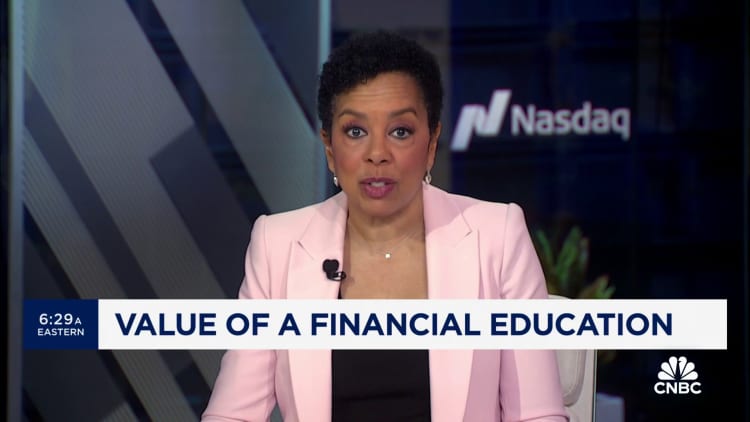
After Utah led the way in 2008, 30 states now require students to take a semester-long personal finance course to graduate. Utah is one of the few states that makes it standard to teach the differences between saving, investing, speculation and gambling.
Oklahoma and Wisconsin have also included understanding gambling in their academic standards. Last year, Massachusetts launched the country’s first youth sports betting prevention curriculum, but it’s not part of a personal finance course.
In New York, where Suhovsky teaches, the state Board of Regents recently approved a requirement that students in kindergarten through 12th grade receive personal finance education. That requirement, which will be phased in starting this fall, mandates that high school students receive instruction before graduation on topics including budgeting, credit, debt management and investing.
Though the measure does not specifically include gambling, the curriculum does call for educators to cover risk management — understanding the potential downsides of financial decisions and how to limit losses.
Suhovsky said he thinks the financial and psychological consequences of sports betting and gambling should be taught in every high school: “If we’re not teaching about this to our students, our most vulnerable students, when are you going to teach it to them?”


Personal Finance
Next-Generation Retirement Planning: Managing Longevity Risk and Variable Income Streams


U.S.- Canada Trade Talks Collapse; Carney Says Retaliatory Tariffs Begin September 8

Flock Cameras and the Future of Public Security

AI Infrastructure Boom Hits Physical Limits: Power, Financing, and Supply Chain Strain

Armanino adds Strategic Accounting Outsourced Solutions

New 2023 K-1 instructions stir the CAMT pot for partnerships and corporations

Tax Strategy: Employee Retention Credit update
-

 Stock News1 week ago
Nvidia Earnings Preview: What Wall Street Expects From the AI Bellwether’s Q2 Report
-

 Accounting1 week ago
SEC’s Semiannual Reporting Proposal Faces Investor Pushback: What CFOs Need to Know
-

 Stock News1 week ago
Nvidia Q2 FY2027 Earnings beats Wall Street Expectation with Record $96.2 Billion Revenue
-

 Finance1 week ago
Treasury Bond Volatility Forces Bessent to Double Debt Buyback Size as Yields Swing
-
 Technology4 days ago
AI Infrastructure Boom Hits Physical Limits: Power, Financing, and Supply Chain Strain
-
 Economics2 days ago
U.S.- Canada Trade Talks Collapse; Carney Says Retaliatory Tariffs Begin September 8
-
 Technology2 days ago
Flock Cameras and the Future of Public Security