
Personal Finance
How a trade war could impact the price of clothing

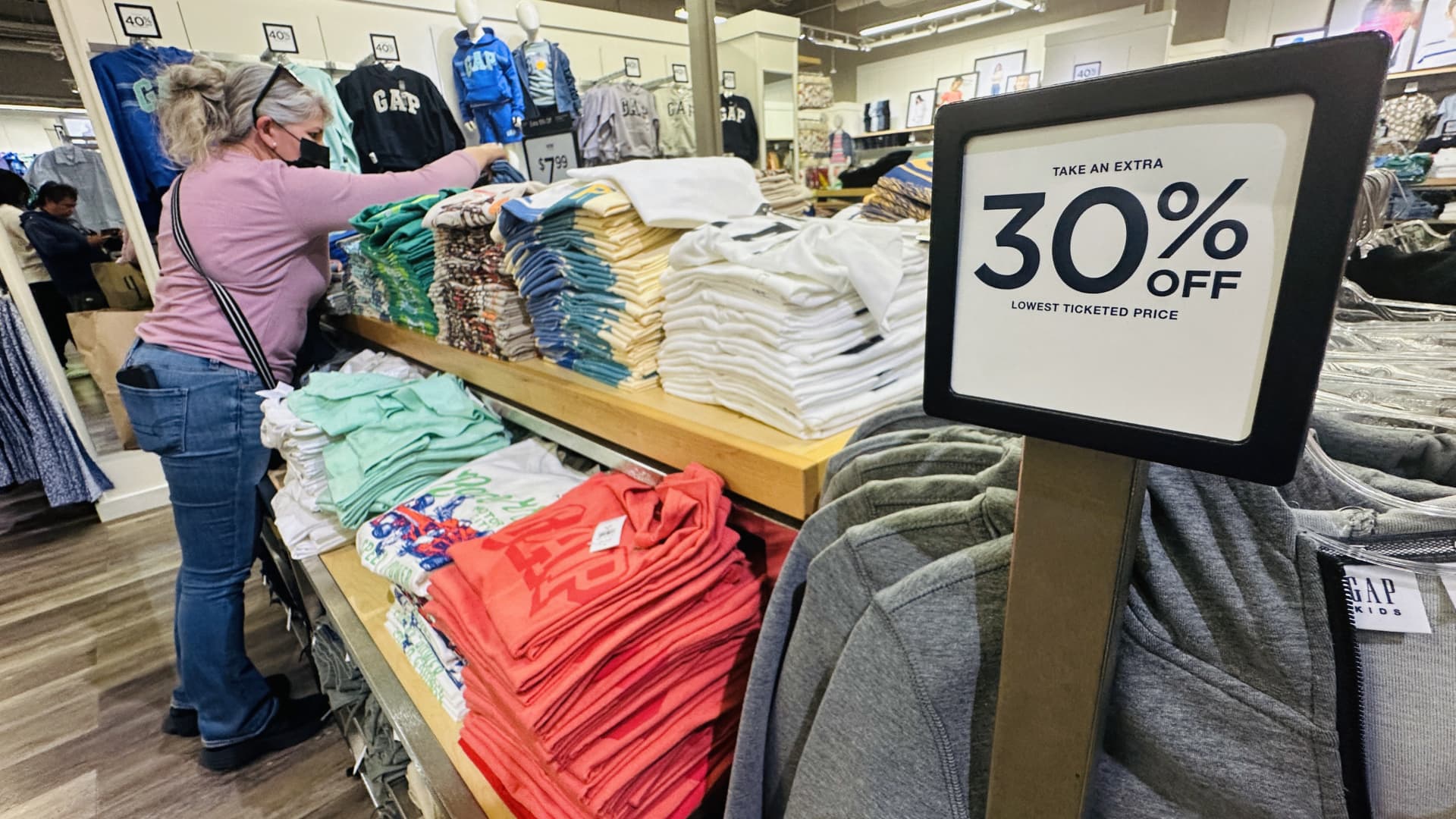
Women shop for clothing from a Gap outlet store in Los Angeles, California on April 10, 2025.
Frederic J. Brown | Afp | Getty Images
Few consumer products are immune from the impact of new tariffs on goods imported into the United States, but apparel may be among the hardest hit.
A trade war could significantly raise the price of clothing for consumers. Since a large portion of U.S. clothing and shoes are imported, tariffs on those goods would increase the cost for both the importers and, ultimately, the consumer, experts say.
“The 2025 tariffs disproportionately affect clothing and textiles, with consumers facing 64% higher apparel prices in the short-run,” according to forecasts by the Yale University Budget Lab. “Apparel prices will stay 27% higher in the long-run.”
For now, the Trump Administration has opted for a universal tariff rate of 10%. Earlier this month, the White House imposed 145% tariffs on products from China. President Donald Trump recently granted exclusions from steep tariffs on smartphones, computers and some other electronics imported largely from China.
“We are concerned about the escalating trade war with China. Ultimately no one wins,” said Julia Hughes president of the United States Fashion Industry Association.
More from Personal Finance:
Is now a good time to buy gold? What you need to know
Majority of Americans financially stressed from tariff turmoil
Why the stock market hates tariffs and trade wars
“This policy continues to subject U.S. imports of our industry’s largest trading partner to an unsustainable tax,” Steve Lamar, the American Apparel & Footwear Association’s president and CEO, said in a prepared statement.
Tariffs, particularly on clothing and materials, which are not made at scale in the U.S., will lead to higher prices for consumers and will only fuel inflation, according to the American Apparel & Footwear Association.
The U.S. receives 97% percent of clothing and shoes from other countries, but primarily China and Vietnam, a 2024 report by the American Apparel & Footwear Association found.
Tariffs ‘will be passed along to the consumer’
“Tariffs are a tax paid by the U.S. importer that will be passed along to the end consumer. Tariffs will not be paid by foreign countries or suppliers,” the National Retail Federation’s executive vice president of government relations David French said in a statement.
As part of the new high tariffs on China, Trump also revoked a popular tax loophole known as de minimis. The exemption allowed many e-commerce companies to send goods worth less than $800 into the U.S. duty-free. The loophole also allowed American shoppers to buy low-cost goods directly from retailers in China and Hong Kong.
Some popular clothing brands, like Shein and Temu imported from China, could face an immediate impact and will likely funnel those extra costs to customers in the way of higher prices, which would hit low- and middle-class Americans particularly hard.
How consumers plan to cushion the blow
Three-quarters of consumers said they’re already engaging in “trade-down” behavior when purchasing clothing and footwear, according to recent research by Empower.
In the years since high inflation made clothing more expensive, a shift was already starting.
Shoppers downgraded to more affordable second-hand merchandise and embraced buying “dupes” — short for duplicates.
“If you can’t afford Louis Vuitton, you are going to buy Coach. If you can’t afford Coach, you are going to buy the knock off,” said Shawn Grain Carter, an associate professor at the Fashion Institute of Technology, part of the State University of New York.
Historically, trade restrictions drive up the cost of authentic goods, creating the perfect conditions for counterfeiters to flood the market with cheaper, harder-to-detect fakes, according to Vidyuth Srinivasan, co-founder and CEO of Entrupy, an authentication service.
With Trump’s recent executive order eliminating duty-free de minimis treatment for low-value imports, the flow of counterfeit goods will also be more expensive and logistically challenging, Srinivasan explained.
However, “counterfeiters are incredibly agile,” he said. “When one route is blocked, they’ll adapt, seeking alternative distribution channels to continue flooding the market with fakes.”
Alternatively, “there might be a little more of a lean into the second-hand market because it just seems more affordable,” Srinivasan said.

Faced with higher costs, 67% of consumers plan to change their shopping habits, according to another recent report by Bid-on-Equipment. Among the top strategies, 46% say they will shop at thrift or second-hand stores. Other ways to save include comparison shopping or buying fewer imported goods. The survey polled more than 1,000 adults in January.
In another survey by shopping app Smarty, 50% of respondents said they’re more likely to consider secondhand goods or local alternatives because of tariff-induced price hikes.
“Tariffs are already prompting my customers to even more actively seek alternatives when it comes to luxury designer goods,” said Christos Garkinos, the CEO and founder of online reseller Covet By Christos.
“On the one hand, customers who are looking to make some extra money in this volatile economy are considering selling off parts of their designer collections,” Garkinos said.
“On the flip side, so many of my existing customers are doubling down on resale,” he said, “because they know that there is no tariff to pay and they can still get their hands on luxury goods without paying that extra premium right now.”
The U.S. resale market is experiencing significant growth, with projections indicating it will continue to expand rapidly over the next few years. This growth is being driven by factors like rising consumer preference for second-hand options, especially among younger generations, and the increasing adoption of online resale platforms, experts say.
Re-commerce — which encompasses the buying and selling of pre-owned, refurbished or secondhand goods — is projected to increase 55%, reaching $291.6 billion by 2029. That would outpace the overall retail market, with resale potentially accounting for 8% of total retail by 2029, according to a 2024 report by OfferUp, an online marketplace for buying and selling new and used items.
Still, there aren’t enough second-hand products to satisfy consumer demand, Hughes said. “The quantities aren’t there.”
For now, the apparel industry must wait and see what will happen with potential trade agreements going forward, just as back-to-school inventory — one of the most important shopping seasons of the year — is set to start shipping, Hughes said.
“The chaos is still rippling through,” she added. “This is a real time of uncertainty.”


Personal Finance
Next-Generation Retirement Planning: Managing Longevity Risk and Variable Income Streams


U.S.- Canada Trade Talks Collapse; Carney Says Retaliatory Tariffs Begin September 8

Flock Cameras and the Future of Public Security

AI Infrastructure Boom Hits Physical Limits: Power, Financing, and Supply Chain Strain

Armanino adds Strategic Accounting Outsourced Solutions

New 2023 K-1 instructions stir the CAMT pot for partnerships and corporations

Tax Strategy: Employee Retention Credit update
-

 Stock News1 week ago
Nvidia Earnings Preview: What Wall Street Expects From the AI Bellwether’s Q2 Report
-

 Accounting1 week ago
SEC’s Semiannual Reporting Proposal Faces Investor Pushback: What CFOs Need to Know
-

 Stock News1 week ago
Nvidia Q2 FY2027 Earnings beats Wall Street Expectation with Record $96.2 Billion Revenue
-

 Finance1 week ago
Treasury Bond Volatility Forces Bessent to Double Debt Buyback Size as Yields Swing
-
 Technology5 days ago
AI Infrastructure Boom Hits Physical Limits: Power, Financing, and Supply Chain Strain
-
 Technology3 days ago
Flock Cameras and the Future of Public Security
-
 Economics3 days ago
U.S.- Canada Trade Talks Collapse; Carney Says Retaliatory Tariffs Begin September 8