
Accounting
Managing stress at your firm

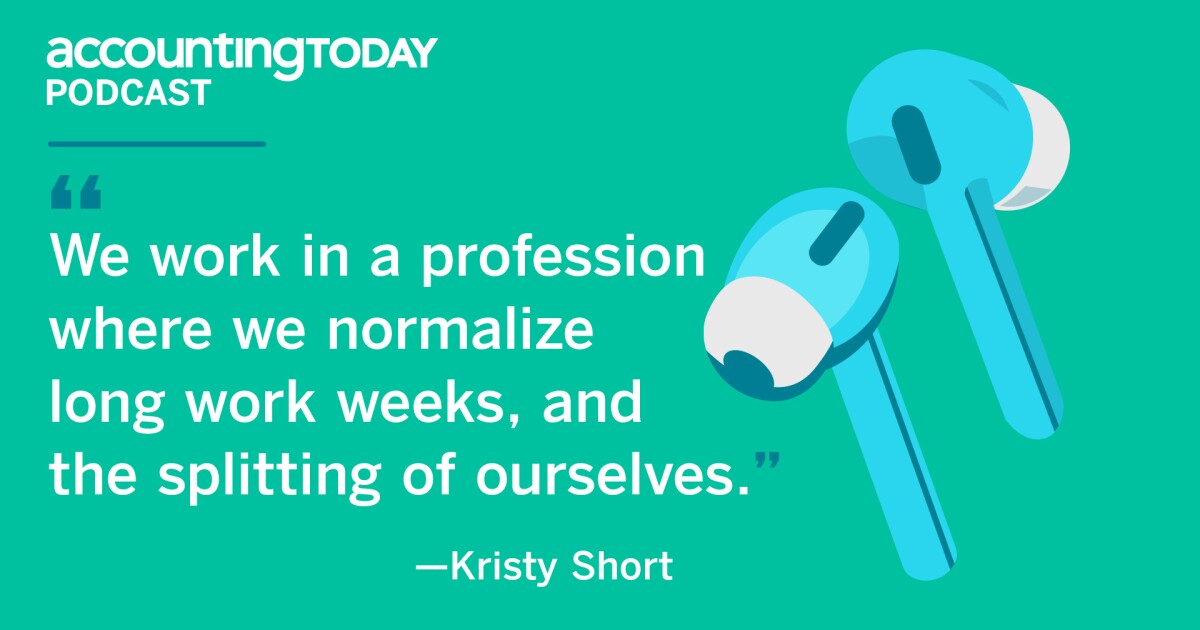

Long-time industry observer and author of the new book “Civil Warrior” Kristy Short shares best practices for keeping your staff — and yourself — from burning out.
Transcription:
Transcripts are generated using a combination of speech recognition software and human transcribers, and may contain errors. Please check the corresponding audio for the authoritative record.
Dan Hood (00:03):
Welcome to On the Air with Accounting. Today, I’m editor-in-chief Dan Hood. Everybody talks about burnout in the accounting profession, but in the end, the work has to go out so everyone just sort of puts up with it, or worse, they give up and leave the profession entirely here to talk about all that. As Kristy Short, she’s a long-term expert on accounting and the author of the new “
Kristy Short (00:35):
Thanks for having me, Dan. I’m super excited about this podcast, excited
Dan Hood (00:39):
Podcast. This is a great topic, particularly timely and particularly important for I think as we said for everybody. Maybe let’s level set a little bit. How bad would you say the problems of burnout, anxiety, these mental health issues, how bad are they in accounting?
Kristy Short (00:53):
I think they’re very bad. I’ve seen it as a leader. I’ve seen it as a team member really over the last, at least 10 years of my professional career, and I think there’s a solution to it, and I think that solution is to talk about it more, to provide some professional development to leaders, to be able to talk about it themselves, but to be able to talk about it with their teams, so you’re creating that open dialogue. I think the movement has started in accounting, but I think it has a ways to go.
Dan Hood (01:24):
As he said, we said people are talking about a lot. I’m not sure how much progress we’re making, but talking is maybe the first start. Why does it seem, are we really more burnt out, more anxious, more depressed? Are accountants really worse off, or are we just more aware of it these days, or is it genuinely getting worse?
Kristy Short (01:41):
I think that it’s always been there. I think that being more aware of it is bringing light to the issue, and when you bring light to an issue, more people talk about it, and when more people talk about it, then the solutions can come in. But I mean, let’s be real. We work in a profession of long work weeks. We work in a profession where we’ve normalized those long work weeks, and we’ve also normalized what I call the splitting of ourselves. So if I can be frank too, I mean the demographic, the majority demographic are baby boomer error white males who do not talk about their feelings. I know because my dad was one and he had trouble with it. I’ve worked with several CEOs and leaders of accounting firms who also have a problem with it. So when you don’t talk about it, then the issue persists, right? It’s like the old youngie insane. If you resist, it still persists. So the problem is there, we’re talking about it more, but we’ve got, like I said, a lot more work to do,
Dan Hood (02:42):
And I would say it remains up for grabs. No’s quite sure if baby boomers actually have feelings, we’re told they do, but that has not been scientifically proven yet. But for the long time, the profession didn’t and nobody did. It just said baby boomers, not just over leaders, but just sort of no one acknowledged these issues in part because the profession continued to function, right? Yes. They would continue to bring in new people, continue to a new draft, continue to make money. Now there’s questions. I mean, I think that’s some of the things that’s driving people’s interest in this isn’t purely concern over the health of their employees, but the concern about having employees at all. There are other things that are making this more of a, like I said, people are the pipeline problem, the capacity issues the firms are facing, obviously, so they’re paying more attention to their employee’s health and so on. Are there other things driving the amount of talk we’re seeing around this issue?
Kristy Short (03:32):
If we back up a bit, I think you nailed it. We are and have been for a long time, facing a pipeline shortage. So we already don’t have enough people, and when there’s an issue with burnout, anxiety, depression, people leave. So it’s difficult for some firms, some businesses to be able to keep people on board if they’re burned out, if they have anxiety, if they don’t feel like they’re being heard. There are certainly other factors in this, and again, I think it’s that lack of professional development. We’re not teaching people how to be emotionally intelligent driven leaders. We’re not teaching them how to speak to our team members. We’re not teaching leaders to be themselves, to be humans themselves. I go back to what I said earlier as well. We have normalized splitting ourselves in this profession. So the personal is separate from the professional, which means as a leader, you don’t talk about your personal feelings, which means that doesn’t cascade down to your team members, so they’re not going to come to you with their issues. That creates a lack of trust that can create turmoil, and it can ultimately come to a place of burnout where people just leave. People have to know you care about them. I mean, that’s just the bottom line.
Dan Hood (04:41):
Right, right. Curious, do you have a sense of, can leaders see this coming in the distance, like, oh wow, that person’s really having burnout or anxiety, or how often do you think it is for firm leaders that it turned out to be a surprise? They’re like, well, I didn’t know Bob was unhappy, or I didn’t know that If this is the same amount of work we’ve always done, we’ve always done crazy hours. Why is it this year that’s such a big deal? Can you see these things coming in advance?
Kristy Short (05:05):
You can see these things coming in advance if your team members are comfortable enough to make them known for one. So again, if you’re not talking about this very important topic of mental health in your business, team members aren’t going to feel comfortable coming forth, and I can talk about this from a personal perspective. So at the end of last year, at the end of 2024, culmination of things happened. I went into a spiral in November, but I was still showing up to work, and I really wasn’t communicating my mental health with my boss. So I would come to meetings with a deathlike. I would escape to my closet several times a day to have a panic attack, some so extreme that I would throw up, and it got to the point where I wasn’t eating, I wasn’t sleeping, I wasn’t showing up obviously as my full self because I was doing what everybody, what most other people do.
(05:58):
I was splitting my personal and my professional. When I finally did come to my boss, she came, she met me in the middle and she’s like, I’ve noticed these things. I think this is how we need to proceed. So there has to be that level of trust in order for us to get ahold of the issues with burnout in our businesses, just period. So there’s accountability on both sides. I don’t want to say that this is all about leaders need more professional development. Team members also have to feel like they can come to their leaders, but they also have to get to a place where they actually do that. So until that happens, and how does that happen? It happens by talking about it. So let’s continue this movement about talking about mental health in as many channels as we possibly can so that people can gain some perspective. If she’s talking about having to sign a suicide contract and she’s had a high powered career, then it must be okay that she has mental health struggles. It must be okay that she deals with anxiety. Now I can talk about that. I’m dealing with it as well. It needs to happen. We need to talk more.
Dan Hood (07:06):
Yep, yep. Well, from your own personal scary story, I know there were some firm leaders, particularly during the pandemic, particularly in the first year or so of the pandemic, were making a big point of sharing their own personal issues with the feelings of isolation and all the stuff that went along with the pandemic in an attempt to get their staff more comfortable with talking about these issues. They’re still obviously a long way to go on that, but because you brought up your personal issues, I want to talk a little about civil warrior. I’m imagining, I could be totally wrong on this, but I’m imagining that is some of your own personal experiences, some of what drove you to write the book. Is that fair?
Kristy Short (07:42):
Oh, absolutely. So the pinnacle was end of 2024 when I went through my fifties spiral. I’ve been through three major spirals in my life, my twenties, my thirties, and then my fifties, and it was so bad in my fifties, and I had moved so far away from what I call my program. So this thing that I have to do, this routine, this structure to maintain good solid mental health, I’d moved away from a lot of that. I wasn’t exercising as often as I should. My nutrition wasn’t great. The pandemic brought about some really bad habits, like watching too much tv, sleeping in a little bit more, or not getting good sleep. Just a lot of things were happening. So that spiral really opened my eyes to, I know other people are going through this, and it started out as journaling because journaling is very therapeutic for me, and then it just stoked a fire in my belly, and I just came out swinging.
(08:39):
I said, I’m going to write a book. I’m going to, it’s going to be therapeutic, but more importantly, it’s going to put my personal journal out for public consumption so other people can hopefully read this and say, holy shit, I go through this stuff too. And then they gain that perspective and then that opens the door for them to be more honest as well. I mean, it sounds a little trite, but it’s true. If it helps one person open up and get on a better mental health path, then I’ve done my job. Then Civil Warrior has done its job.
Dan Hood (09:11):
There you go. Very cool. Well, I mean, there is still to this day a fair amount of stigma around mental health issues. People are afraid to share with them, and as you say, the more people talk about it, the more people go, oh, wait a minute, everybody has, this is no more shameful or embarrassing than a cold. I mean, it’s worse for your health than a cold, but we shouldn’t be treating it as anymore problematic or shameful or embarrassing than a cold. But the more people talk about it, the better. The more people write books about it, the more people get it out there, bring it out into the light so we can see, oh yeah, this happens to everybody to varying degrees. And like I said, I’m not comparing it to cold to make it seem unimportant, but it should be just something we can deal with. I’m curious. I want to know what was going right in the forties. If it’s the twenties and the thirties and the fifties were your spirals, the forties were great, we need obviously to write down everything you did in the forties.
Kristy Short (10:02):
My forties were brilliant. I had to go back to my forties in a heartbeat. I’ll be honest, I actually had almost 20 years of what I call an emotional plateau, and that’s what I always strive for. That’s what I learned during my twenties spiral when I was in really intense therapy for a couple of years, is that I went into therapy saying, I just want to be happy. I think a lot of people say that, and what I learned from that is that I learned the definition of happy happiness is effusive and lots of exclamation points, and we all can’t feel happy all the time. What we need to strive for is general satisfaction, that feeling of even keel of calm, beautiful, those emotional plateaus. And I had that for a good 20 years. So my thirties spiral was early in my thirties. It was fairly short-lived 20 years of this even keel feeling, and then my fifties hit because I’d slacked off on my program and a lot of things happened, don’t get me wrong, death, divorce, personal protection orders, I mean, just a lot of stuff went down and it all sort of culminated, I think.
(11:08):
I thought I was handling those situations individually pretty good, but I was not, and then hit the spiral. So yes, most of my thirties and forties, I enjoyed an emotional plateau and I don’t regret going through my spirals in my 50 because it reminded me that I need to be dedicated to my program and I needed to refine it and quite frankly, just get my shit together.
Dan Hood (11:32):
Well, I mean, this is the thing. It’s work, right? There’s work you can do to improve your state and as you say it, it’s not going to always be smiling and happy and bouncing up and down with a bunch of exclamation points, but that even keel, keel requires regular work, and those are things that everyone could do. I want to talk a lot more about sort of things people can do on an individual basis, but we’re going to take a quick break.
Alright, and we’re back. We’re talking with Kristy Short. She’s among not many other things. The author of “Civil warrior,” which is, I should ask this specific, is it forthcoming or is it out already?
Kristy Short (12:11):
It’s out for pre-order, so you can find it on Barnes and Noble, on Amazon on a number of other online channels, and it’s due to be delivered on July 10th.
Dan Hood (12:22):
There you go. Excellent. We’ve been talking a lot about some of the details from your life and the issues that went on there and some of the tactics you’ve been using or that you used to maintain that we’ve been calling that even keel, which I think is a good way to describe that sort of ideal state, particularly for accountants. There’s the whole, the seasonality of the accountants year is going to naturally lead to highs and lows. Highs in terms of enormous amounts of work and burnout and stress and so on, and being able to manage that or mitigate that any way you can. You mentioned exercise, diet, all those things are important things to not, for instance, give up on during tax season, say, yeah, I can eat donuts and sleep two hours a night for three months because everything will be fine in the summer, but it won’t if you get away from those good habits. But I want to just keep talking more about that. What are things that accountants can do to help themselves to get themselves to that even keel and then to stick with it?
Kristy Short (13:16):
So yes, we definitely live in a profession that’s seasonal and it has its far more stressful times, but I think it’s important to mention it makes this even more important to follow your program all year round, whether you’re in high stress season or whether you are in the summer. Because let’s face it, if you are not taking care of yourself during busy season, during tax season, even when you go into summer, you’re bringing that workplace burnout with you, right? You’re already depleted. So some of the things that I talk about in the book are part of my own program, and I state very specifically, these aren’t for everybody. You’ve got to do what works for you. Exercise is a huge one. I know people roll their eyes at that. I did two in my twenties when I was 75 pounds overweight and just sick and tired all the time.
(14:02):
But exercise has immense benefits. It ups your production of serotonin, of dopamine, of endorphins, all of these natural drugs in your brain that really do mimic recreational drugs. I think it was Buddha that said, if you exercise every day of your life, you’ll never be depressed. And I find that, I find that to be true. So exercise, diet, I’m vegan. That just works for me. I am not a huge meat eater. Cancer also runs in my family. I’ve read the reports on links to cancer, so mentally it helps me to stay away from meat and I’m getting all my protein from plants, which is wonderful. But other things that some of us has to, we have to push ourselves to do. So being social is huge. I’m not talking about going to a rave or a big concert, but I fall in line with a lot of accountants.
(14:50):
I’m an introvert and I have to really push myself to go out and be social. And for me, sometimes that means just getting out of this office and going out to a coffee shop and working, even if I don’t talk to people, just having that interaction around me and feeling the vibe of other humans will lift my spirits and other things like good nighttime hygiene, turn off your phone by nine o’clock, don’t scroll through emails and get your brain over work so that you lose sleep. Focus on your sleep, get your apps in order. I moved one little simple thing. I moved all of my work apps to a separate screen on my phone, so I have to scroll all the way to page four to get to them and see those push notifications because before I was looking at them and if there was a push notification, I had to go in and look and then forget about sleep because the blue light got me and I started thinking about what I had to do the next day. So lots and lots of things that you can do. Practicing gratitudes. Another one, people think that sounds hokey, but when I feel overwhelmed, it’s almost like meditation. I will stop and I literally will close my eyes and think about what I’m grateful for. My seven-year-old nephew, duke, who says he loves his aunt Kiki more than anybody in the world, the time I have with my dad, the moments I have playing my guitar, these are things that we sometimes just need to stop and be in the moment.
Dan Hood (16:08):
And as you say, what’s fascinating about that is, as you say, so much of that’s personal. What really works for you, and you’ve got to try different things. I’ve got a friend who his entire regime is, he has a chair by his bed and before he goes to bed, he turns out the lights and he sits in the chair for 15 minutes in the dark and just sort of relaxes. And then he said, it’s changed his sleep patterns entirely. It’s reduced his tension through all of the next day. Everybody else would say, well, you’re just sitting in the dark. What’s that about? But it’s just that’s his way of breaking things up and being mindful or being in the moment or recentering himself. I’m not sure how he would describe it, but it seems to be working for him and everybody has different things like that.
(16:45):
But I should say certainly good hygiene, not good hygiene, good exercise regime, good eating, healthy eating has got to be helpful, positive relations with people around you. And I think probably the most important thing out of all that for accountants is to clearly differentiate work time, went from non-work time, as you say, put all your apps away, put all your work away, clearly delineate those so that you’re not carrying it with you everywhere you go to bed, to family events, that sort of stuff. I want to maybe flip it a little bit and talk about, we’ve talked about how important this is for accounting firms to have their staff in good mental health, which you would think would be obvious but is not as obvious or is not as widely accepted maybe as it should be. What can firms do if they look around and they say, Hey, yeah, I want to make sure my people are in good shape. What can they do to help out? They obviously can’t make people eat well or exercise, but what can they do?
Kristy Short (17:45):
I think this just goes back to being open. So people talk about during tax season we ordered pizza in, we have this little getaway to the ice cream store. That stuff’s great, but I don’t think it really has a huge impact on people’s mental health. Why not take 10 minutes while you’re eating that pizza and say, Hey, let’s have an open dialogue about how everybody’s feeling. I mean, why not have an emotional circle at work? I mean, you got people who are probably keeping it in who are ready to explode, give them the chance to talk about how they’re feeling, and maybe if they’re on the edge, that’s going to open the door to other people who are feeling that. And again, then you’re gaining common perspective among a group of people that you really care about. And then from that information, not only are your team members gaining perspective, but they’re also probably feeling that a little bit of the pressure is off that they were able to verbalize this in a safe space. But it also gives that firm owner and other leaders perspective too, maybe they can walk away and say, okay, we need to do more than pizza. Let’s give these people, let’s send them home and tell ’em they don’t have to come in on Saturday. Whether that’s plausible or not, figure out different ways to really ease that pressure. But it starts with opening up a dialogue.
Dan Hood (19:07):
Obviously as you do, you want to have fire hoses nearby in case they start a riot or some kind of revolution. But I say that as a joke, let me be clear, but also they’re probably too tired and burnt out to start a revolution anyway, so the more you can open up that conversation, the better. Certainly. And I said, you can’t make people do it. You certainly can’t. But I mean, we do know lots of good firms and even outside of tax season have that promote healthy lifestyles through walking clubs and gym memberships and all that sort of stuff. You can certainly make that available to your employees and those are good things. Looking at your workload at all points obviously has to be one thing, figuring out, we know firms are bringing in technologies of all kinds to increase capacity, but you can also bring in what do you do with the time you’ve saved with all the technologies you’re bringing?
(19:54):
Are you giving it back to people? Are you’re allowing them to use it in the way that’s healthiest and best for them as opposed to just allowing them to shovel through more work? This is such a big topic and there’s so many small things in many cases apart from, I think as you’ve said, the big one of talking about it, getting people comfortable with talking about it. Most of it is small things. There’s small ways to work yourself and your staff and your firm to a better health. Any other ideas you want to throw out there? Other things people can try? No idea is too small. No idea is too personal, I think.
Kristy Short (20:25):
Yeah, you’ve said more than once. You can’t make people talk. And that is true, and I think that’s why it’s so important for this to start with the leaders. So if people don’t want to talk, it’s probably a trust issue. So as a leader, you start that conversation, be vulnerable, open up to what you are feeling, and that’s what’s really going to lay the groundwork. So a good example of this is when I was a partner, rootworks, the year I lost my dad, I was crippling. I was dealing with crippling grief and I could have gone into work every day very closed about that and splitting my personal with my professional. But instead, because I was showered with compassion and support for my partners, I felt like that opened the door for me to be that way with my team members. And so I gave them visibility, full transparency, into my pain. They walked with me through the toughest time in my life and it changed our relationship. They started opening up more. I saw the bond solidifying. It wasn’t just glue, it was super glue, and we just continued to develop a culture that was healthy in many ways, but especially where mental health is concerned.
Dan Hood (21:41):
I’m so glad you brought up the culture word, right? This is probably something we should have been highlighting all through. This is a crucial part of a healthy culture at an accounting firm, is the ability to talk amongst yourselves about, and not just mental health, really sort of any issue that might come up, but you got to have open communication for a million other things, but it’s going to be an important part of a culture, of a healthy culture at any firm. So I’m glad you brought that up. I’m
Kristy Short (22:07):
Glad. Sometimes it’s just a matter of asking a simple question. One simple question can change the trajectory of your relationship with somebody. So if I’m a leader and I’m in a one-on-one and I notice that person is struggling, I could continue to talk about work and capacity and deadlines, but instead I’m going to stop and say there’s something going on. Do you want to talk about that one simple sentence? One simple gesture can change a relationship between a leader and a team member,
Dan Hood (22:34):
Right? Right. Now, I know to be fair, to be fair, we want to be to leaders everywhere, managers everywhere, but also particularly in the accounting firm, that one simple question can be terrifying for them. I don’t know what they’ll say. I dunno what they’ll answer, but really it’s a pretty simple question. You’re very rarely going to get anything, a terrifying answer. What you’re just going to get is people will share with you.
Kristy Short (22:52):
I think it’s more terrifying not to know. I think it’s more terrifying not to know what’s going on in the heads of your employees because their mental health is so important,
Dan Hood (23:00):
Right? You’ll only find out when they leave you, and then That’s
Kristy Short (23:02):
Right. Can’t open that
Dan Hood (23:03):
Door. That’s the worst of it. This is all fascinating, except for we said it’s a very important issue for not just the profession, but for the workforce as a whole. The book is Civil Warrior. It’s coming out, we said July 10th, right? July 10th, is that right?
Kristy Short (23:17):
It’s available for pre-order now, Amazon, but it’ll be delivered on July 10th. Yes,
Dan Hood (23:22):
There. Very exciting. Kristy Short, thank you so much for joining us.
Kristy Short (23:25):
Thanks for having me, Dan. I appreciate you giving me the platform to talk about this very important topic.
Dan Hood (23:30):
It’s a big deal, and I’m glad you’re here to share it with.
Kristy Short (23:33):
Thank you.
Dan Hood (23:33):
This episode of On the Air was produced by Accounting Today with audio production by Adnan Khan Greater. Review us on your favorite podcast platform and see the rest of our content on accounting today.com. Thanks again to our guest, and thank you for listening.
Accounting
Embedded AI and Automated Anomaly Detection Reshape Modern Corporate Accounting Frameworks





Dario Amodei’s Call to Pace the AI Frontier and Its Market Ripple Effects

Rising Oil Prices And Persistent Inflation Complicate Fed Decision

Bridging the AI Skills Gap: How Gen Z Youth Demographics Are Transforming the Workforce

Armanino adds Strategic Accounting Outsourced Solutions

New 2023 K-1 instructions stir the CAMT pot for partnerships and corporations

Tax Strategy: Employee Retention Credit update
-

 Stock News1 week ago
S&P 500 September Outlook: Tech Rally Holds Index at 7,600
-

 Finance1 week ago
S&P 500 Outperforms Amid Strong Corporate Earnings as Treasury Yields Cap Equity Multiples
-
 Accounting1 week ago
Mandatory ESG Reporting Standards Demand Standardized Non-Financial Audit Trails
-

 Insights1 week ago
Climate Resilience and Offshore Wind and Land Restoration Milestones
-
 Leaders1 week ago
India Unveils ‘Saptadhara’ Reform Agenda Targeting Technology, Youth Skilling, and Growth
-
 Economics1 week ago
U.S. Inflation Outlook for 2027
-

 Economics4 days ago
Economic Profile of the superpower of western Europe
-

 Economics4 days ago
Sovereign Bond Yield Volatility and Inflationary Shocks Challenge Global Central Banks