
Personal Finance
Wage growth now favors job stayers over job switchers

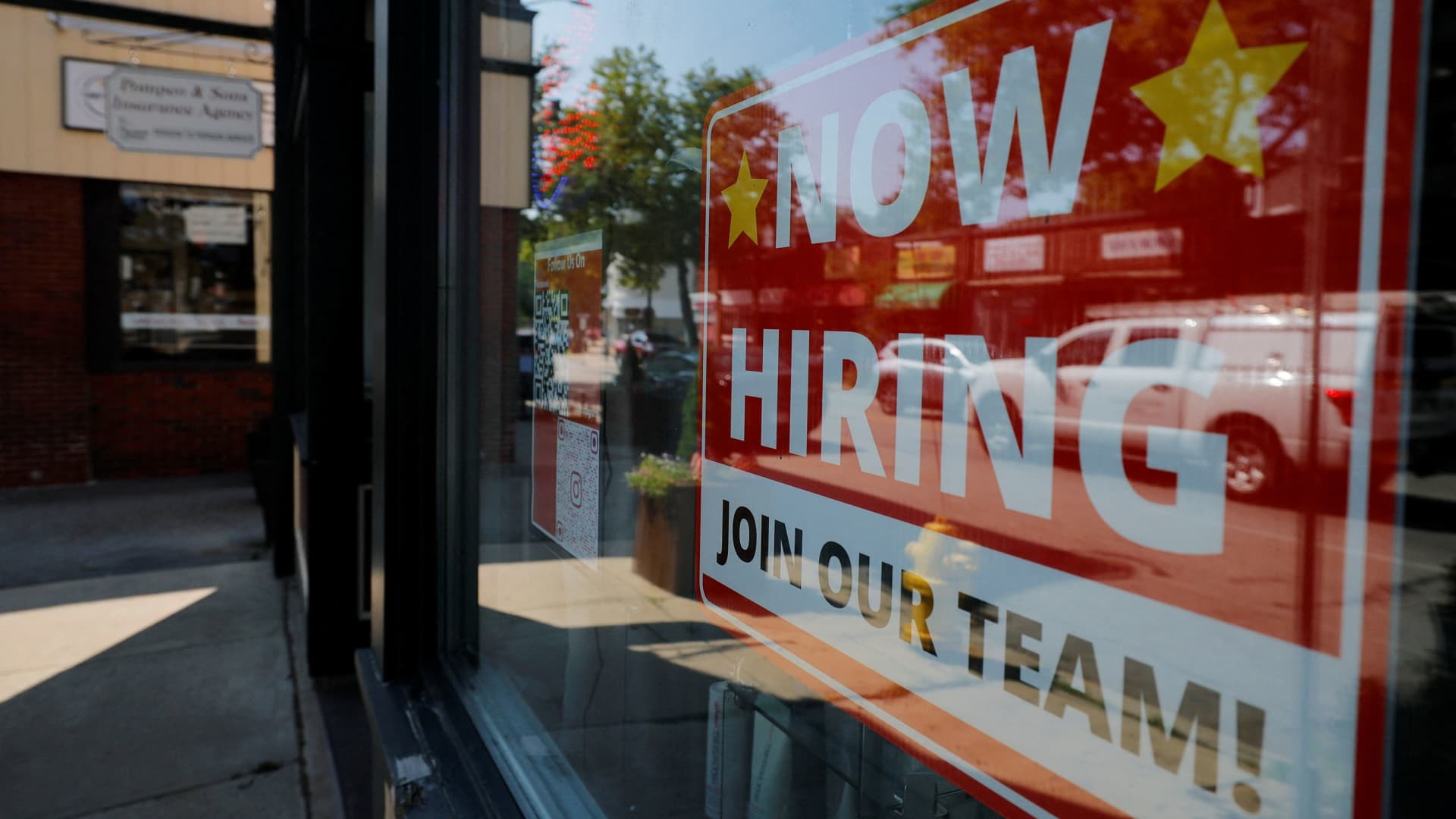
A “Now Hiring” sign hangs in the window of a hair salon in the Greater Boston town of Medford, Massachusetts, August 12, 2025.
Brian Snyder | Reuters
Wage growth is doing something odd these days.
Typically, wages grow at a faster clip each year for workers who switch jobs, compared to those who stay in their current role.
That makes sense: Workers generally leave a job when they find something better for them, which often includes a higher salary, according to labor economists.
But in 2025, the roles have reversed as workers, faced with a souring job market, shift from job-hopping to “job hugging” — that is, clinging to their current roles.
Annual wage growth for so-called “job stayers” has eclipsed that of “job switchers” for the past six months, since February, according to data tracked by the Federal Reserve Bank of Atlanta.
The margins aren’t huge: For example, in July, job stayers saw wages grow at a 4.1% annual pace, versus 4% for workers who switched jobs, according to the Atlanta Fed data.
However, that sustained reversal points to an underlying weakness in the labor market, economists said.
Since the late 1990s, a prolonged reversal in wage growth trends for job “switchers” versus “stayers” has only happened in periods around the Great Recession and the dot-com bust in the early 2000s, the Atlanta Fed data shows.
The last time a drawn-out reversal occurred was in and immediately following the Great Recession, during an 18-month period from February 2009 to July 2010, according to the data.
“We only tend to see it around other times when the labor market has been weak,” said Erica Groshen, a senior economics advisor at the Cornell University School of Industrial and Labor Relations and former commissioner of the U.S. Bureau of Labor Statistics from 2013 to 2017.
The Atlanta Fed computes a three-month moving average of median hourly wages using data from the Current Population Survey, reported by the U.S. Census Bureau and Bureau of Labor Statistics.
That said, aggregate data on the labor market suggests it’s still in “pretty strong” shape, Groshen said.
‘Workers have lost some bargaining power’
But it has gradually cooled from a torrid pace in recent years.
Job openings had ballooned to historic highs in 2021 and 2022 as the U.S. economy awoke from its pandemic-era hibernation. Ample opportunity led workers to quit their jobs in record numbers for new employment, commanding big payouts from companies eager to attract talent.
Now, amid high interest rates and economic uncertainty, job openings have fallen and employers are hiring at their slowest pace in more than a decade.

“Maybe employers are not feeling that they need to offer their new workers higher wages in order to get them, and workers have lost some bargaining power in the labor market,” Groshen said.
The quits rate — the rate at which workers are voluntarily leaving their jobs — has also declined sharply. It has hovered around 2% since the start of the year, according to data from the U.S. Labor Department’s Job Openings and Labor Turnover Survey. Outside of the initial days of the Covid-19 pandemic, levels haven’t been that consistently low since early 2016.
This is the primary reason why wage growth for job stayers has eclipsed that for job switchers, said Allison Shrivastava, an economist at the job site Indeed.
A depressed quits rate suggests workers aren’t voluntarily leaving their jobs to find better ones because they don’t have confidence in doing so, Shrivastava said.
More from Personal Finance:
Trump immigration policy may be shrinking labor force
Working longer to afford retirement is a risky plan
‘Job hugging’ has replaced job-hopping
In this “frozen” labor market, in which there’s not a lot of voluntary job-hopping, workers who are forced to leave a job involuntarily are more likely to accept a new job that doesn’t pay as well, she said.
“They’re more in a situation of taking what they can get,” Shrivastava said.
Long-term unemployment is increasing
This is especially true for workers who are considered long-term unemployed, economists said. Long-term unemployment is a period of joblessness lasting at least six months.
About 25% of all jobless individuals in July were long-term unemployed, the highest share since February 2022, according to U.S. Bureau of Labor Statistics data.
Such people are generally no longer eligible for unemployment benefits, economists said.
“They may be willing to take a job for a lower wage than they were at the beginning,” Groshen said.
Overall, the best way for workers to improve their wages in aggregate is still probably by switching jobs, Shrivastava.
“But the opportunity to switch your job right now is not really there,” she said.
There are ways for jobseekers to set themselves up for success in a tough hiring market, career experts said.
Among them: Find creative networking opportunities — conferences, seminars, lectures or book signings where other attendees are likely to be in your profession. Jobseekers can look internally for a new job placement, which may be easier than seeking out something external. They can focus on upskilling and reskilling to land a new job more easily when the market rebounds.


Personal Finance
Next-Generation Retirement Planning: Managing Longevity Risk and Variable Income Streams


U.S.- Canada Trade Talks Collapse; Carney Says Retaliatory Tariffs Begin September 8

Flock Cameras and the Future of Public Security

AI Infrastructure Boom Hits Physical Limits: Power, Financing, and Supply Chain Strain

Armanino adds Strategic Accounting Outsourced Solutions

New 2023 K-1 instructions stir the CAMT pot for partnerships and corporations

Tax Strategy: Employee Retention Credit update
-

 Stock News1 week ago
Nvidia Earnings Preview: What Wall Street Expects From the AI Bellwether’s Q2 Report
-

 Accounting1 week ago
SEC’s Semiannual Reporting Proposal Faces Investor Pushback: What CFOs Need to Know
-

 Stock News1 week ago
Nvidia Q2 FY2027 Earnings beats Wall Street Expectation with Record $96.2 Billion Revenue
-

 Finance1 week ago
Treasury Bond Volatility Forces Bessent to Double Debt Buyback Size as Yields Swing
-
 Technology5 days ago
AI Infrastructure Boom Hits Physical Limits: Power, Financing, and Supply Chain Strain
-
 Technology3 days ago
Flock Cameras and the Future of Public Security
-
 Economics3 days ago
U.S.- Canada Trade Talks Collapse; Carney Says Retaliatory Tariffs Begin September 8