
Economics
Will Joe Biden benefit from falling murder rates across America?


Your browser does not support the <audio> element.
Few politicians talk about violence as much as Donald Trump. In early April, when the former president held his first rally since wrapping up the Republican nomination in Grand Rapids, Michigan, he came onto the stage flanked by uniformed sheriffs. America, he argued, is being overwhelmed by murderous foreigners deliberately sent by hostile governments seeking to empty their prisons at home. Gang members, Mr Trump claimed, are “hiding in bushes, actually, they say”. Overall, he argued, crime rates are “only going in one direction and it’s going to be very bad”.
Unfortunately for Mr Trump, but happily for most Americans, what data there are suggest that most crime is indeed only going in one direction—down. In March the fbi released (partial) national data showing that violent crime of all sorts dropped in cities, suburbs and rural areas alike in the final quarter of 2023. That confirmed what city-level data were already indicating by the middle of last year: that the wave of violence that started almost everywhere across America in the summer of 2020 (when Mr Trump was still president) had crested in most places in 2022. Murder, both the most damaging and the most reliably counted of all crimes, is now heading back towards pre-pandemic levels.
Last year, according to data published by the Major Cities Chiefs Association, which represents police chiefs in the United States and Canada, in the 69 American police departments covered, the total number of murders declined by roughly 10%. More recent data gathered from police departments by ah Datalytics, a private analysis firm, suggest that the total has continued to drop so far this year (see chart 1). In some big cities, such as Boston, Philadelphia and Baltimore, the size of the falls has been especially striking. The firm’s figures also suggest that even the flood of car theft that swelled last year may have begun to ebb slightly.

Explaining why crime falls or rises is tricky. The best explanation for this fall, says Jeff Asher, of ah Datalytics, is simply the end of the pandemic. Most murders in America are the result of arguments that escalate to gunfights, typically between young men. When the virus was spreading, schools and other public services closed, and so more youngsters were pushed onto the streets. Higher levels of stress may have led to more arguments. Now things are somewhat back to normal. Added to that are a few policy changes. For example, many cities have invested plentiful federal money in “violence interrupters” who try to identify and de-escalate fights before they turn into shootings.
Will lower crime help Joe Biden win re-election? Certainly, it is better than the opposite. But the gains are likely to be limited. Polling suggests much of the public thinks crime is still rising. One of the bigger problems Mr Biden has is that police officers are generally conservative, and many are backing Mr Trump, who they think will let them continue to do their job the way they always have.
In the past few years, Republicans in general have enthusiastically hugged cops. For example, earlier this month Florida’s governor, Ron DeSantis, signed a law that criminalises “harassment” of police officers and bans civilians from “carrying out extra-judicial investigations against law enforcement”. Mr Biden, by contrast, is at least rhetorically committed to police reform. “It is a bit of a danger zone” for the president, says Neil Gross, a professor at Colby College in Maine.

The irony is that Mr Trump’s approach seems more likely to generate crime. Under Mr Biden trust in the police has risen among Democrats (see chart 2). When police are trusted, crimes are solved, and crime rates tend to fall. When trust is destroyed—by, say, a police killing—crime rises.
Among the places that saw a rise in the murder rate last year was Memphis, Tennessee. That city was shaken up last January when a young, unarmed and innocent man, Tyre Nichols, was brutally beaten to death by plainclothes officers from a “tactical squad” who had stopped his car. Murders in Memphis have edged down this year. But last month Republicans in the state overturned a city-level ordinance intended to end such unwarranted stops. If Mr Trump wins the election, he may get more violence to talk about. ■
Stay on top of American politics with The US in brief, our daily newsletter with fast analysis of the most important electoral stories, and Checks and Balance, a weekly note from our Lexington columnist that examines the state of American democracy and the issues that matter to voters.













Economics
U.S. National Debt Surpasses $40 Trillion for the First Time: What It Means for the Economy



Executive Summary & Core Macro Outlook
The United States enters the 2026–2030 macroeconomic window as the unquestioned heavyweight of nominal economic output, retaining its status as the primary engine of global financial liquidity, private enterprise innovation, and high-margin technological deployment. According to multi-year projections from the International Monetary Fund (IMF) World Economic Outlook and complementary datasets from the World Bank, the US nominal Gross Domestic Product (GDP) is projected to reach $32.38 trillion by 2026, accounting for approximately 25% of global nominal output and roughly 14.5% of world GDP measured at Purchasing Power Parity (PPP).
Unlike many of its advanced-economy peers across Western Europe and East Asia—which are grappling with acute demographic contraction and structural energy shocks—the United States demonstrates remarkable macroeconomic resilience. The IMF projects a real GDP Compound Annual Growth Rate (CAGR) of 2.1% to 2.3% through 2030. This expansion is sustained by three structural anchors: unmatched capital depth driving massive private-sector investment in Artificial Intelligence (AI) infrastructure, complete energy independence as a net exporter of hydrocarbons and liquefied natural gas (LNG), and high labor productivity gains that cushion the economy against rising debt-servicing costs.
Macroeconomic Data Matrix (2026–2030 Projections)
| Economic Metric | IMF / World Bank Baseline (2026–2030) | Global Benchmark & Context |
| Nominal GDP (2026 Projection) | ~$32.38 Trillion | Rank #1 Globally |
| GDP at Purchasing Power Parity (PPP) | ~$32.40 Trillion | Rank #2 Globally (Behind China’s ~$38.5T PPP) |
| Projected Real GDP CAGR (2026–2030) | 2.1% – 2.3% | Top decile among G7 advanced economies |
| Gross Public Debt (% of GDP) | ~122.5% – 128.0% | Structural fiscal deficit trajectory |
| Core Inflation Rate (PCE Target) | Stabilizing at 2.0% – 2.2% | Federal Reserve inflation target alignment |
| Current Account Balance (% of GDP) | -2.8% to -3.2% | Persistent capital import & reserve currency demand |
Deep Structural Growth Drivers
1. The AI Infrastructure Hyper-Cycle & TFP Expansion
The defining growth catalyst for the US economy over the 2026–2030 horizon is the unprecedented scale of private capital expenditure (Capex) poured into artificial intelligence infrastructure, enterprise software integration, and advanced computing hardware.
Major technology mega-caps and private equity funds are directing hundreds of billions of dollars annually into hyper-scale data centers, domestic semiconductor fabrication, high-voltage electrical grid upgrades, and AI-driven workflow platforms. According to World Bank economic research, technological adoption across American service and manufacturing sectors is driving a notable uptick in Total Factor Productivity (TFP). This productivity surge allows US companies to expand profit margins and output even in an environment characterized by higher structural real interest rates and tight skilled-labor markets.
2. Deep Capital Markets and Private Sector Liquidity
The structural backbone of US economic outperformance remains its financial system. US capital markets represent over 40% of global equity market capitalization and a vast majority of global venture capital and private credit assets.
This liquidity creates an efficient mechanism for capital allocation: high-potential emerging industries (such as quantum computing, synthetic biology, and advanced defense technology) receive early-stage funding at a scale that no other national market can match. When global monetary conditions tighten, global capital flees toward safety and yield, reinforcing US capital depth and lowering the relative cost of equity capital for American corporations.
3. Net Energy Independence & Industrial Cost Advantages
Unlike industrial hubs in Germany, Japan, or South Korea—which remain highly vulnerable to volatile sea-lane logistics and imported fuel price spikes—the United States operates as a major net exporter of petroleum, natural gas, and refined chemical products.
Access to abundant, cheap domestic natural gas provides US heavy industry, advanced manufacturing, and electricity-hungry data centers with a persistent structural cost advantage. Furthermore, federal policy frameworks (including the CHIPS and Science Act and clean energy tax provisions) continue to catalyze domestic private manufacturing investment, re-shoring high-value supply chains from East Asia back to the American Sunbelt and Midwest.
Macroeconomic Vulnerabilities & Downside Risks
1. Structural Sovereign Debt Trajectory
The most significant medium-term threat to US macroeconomic stability is the path of federal public debt. With gross national debt exceeding 120% of GDP and annual federal deficits running between 5% and 7% of GDP, the US fiscal baseline faces increasing structural pressure.
As older legacy low-yield Treasury bonds mature, they are refinanced at higher prevailing interest rates. According to IMF fiscal monitor assessments, federal net interest payments are absorbing an expanding share of total fiscal revenue, crowding out discretionary spending and narrowing the government’s capacity to deploy counter-cyclical fiscal stimulus during future downturns.
2. Commercial Real Estate (CRE) & Banking Sector Realignment
The structural transformation toward hybrid work models has permanently altered office space utilization across major US metropolitan areas. Regional and community banks, which hold a disproportionate share of commercial real estate debt, face ongoing balance-sheet pressure as legacy office loans mature and require refinancing at lower property valuations and higher interest rates. While systemic money-center banks remain well-capitalized, localized credit tightening from regional lenders presents a headwind for small-and-medium enterprise (SME) borrowing.
High-Outperformance Sector Matrix (2026–2030)
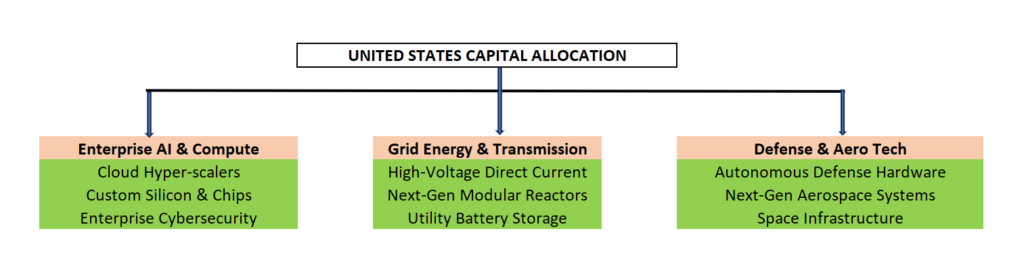
- Enterprise AI, Cloud Compute, & Cybersecurity: Companies building enterprise-grade software, AI agents, cloud architectures, and specialized hardware protection layers.
- Next-Generation Energy & Grid Modernization: Power generation utilities, high-voltage electrical equipment makers, small modular nuclear reactor (SMR) developers, and energy storage systems catering to exponential data center energy demands.
- Advanced Defense Technology & Aerospace: Autonomous systems, satellite networks, hypersonic defense, and advanced materials supplying both domestic security needs and global allied demand.
Strategic Summary for Global Investors & Executives
The United States through 2030 remains the ultimate high-volume, high-yield destination for institutional capital. While fiscal debt risks require long-term monitoring, the immediate 5-year outlook is defined by strong technology-driven productivity, resilient private consumption, and unmatched market liquidity. For global corporations and institutional allocators, exposure to the US economy remains an indispensable pillar of long-term growth strategy.
Top 65 Largest Economies in the World for 2027
Top 10 Largest Economies by 2030: IMF & World Bank GDP Projections for Global Powerhouses

U.S.- Canada Trade Talks Collapse; Carney Says Retaliatory Tariffs Begin September 8

Flock Cameras and the Future of Public Security

AI Infrastructure Boom Hits Physical Limits: Power, Financing, and Supply Chain Strain

Armanino adds Strategic Accounting Outsourced Solutions

New 2023 K-1 instructions stir the CAMT pot for partnerships and corporations

Tax Strategy: Employee Retention Credit update
-

 Stock News1 week ago
Nvidia Earnings Preview: What Wall Street Expects From the AI Bellwether’s Q2 Report
-

 Accounting1 week ago
SEC’s Semiannual Reporting Proposal Faces Investor Pushback: What CFOs Need to Know
-

 Finance1 week ago
Treasury Bond Volatility Forces Bessent to Double Debt Buyback Size as Yields Swing
-

 Stock News1 week ago
Nvidia Q2 FY2027 Earnings beats Wall Street Expectation with Record $96.2 Billion Revenue
-
 Technology4 days ago
AI Infrastructure Boom Hits Physical Limits: Power, Financing, and Supply Chain Strain
-
 Technology2 days ago
Flock Cameras and the Future of Public Security
-
 Economics2 days ago
U.S.- Canada Trade Talks Collapse; Carney Says Retaliatory Tariffs Begin September 8